Lithium Battery for Camping and Outdoor Power: Engineering Reliable Portable Energy for the Wild
Why Traditional Power Sources Fail in the Backcountry
When I first started field-testing portable energy systems for expedition clients about twelve years ago, the default answer was always the same: lead-acid or gas. Both are miserable in the wild. A 12 V sealed lead-acid block that delivers 50 Ah weighs close to 16 kg and loses half its usable capacity the moment the temperature drops below 0 °C. A small generator solves runtime but adds noise, fuel, and a maintenance headache no one wants at 3,000 m elevation.
A modern lithium battery camping outdoor power setup flips that math. A LiFePO₄ pack with the same 50 Ah nameplate weighs roughly 6 kg, holds 95 % of its capacity down to −10 °C, and emits zero fumes. In my engineering notes from a 2023 Patagonia basecamp deployment, a single 512 Wh lithium battery pack ran a satellite communicator, a drone battery charger, and a 3 W LED lantern for four straight nights on one charge. That is the kind of reliability the outdoors actually demands.
Core Cell Chemistry: What Makes a Good Camping Lithium Battery
Not every lithium chemistry belongs in a tent. As an engineer I narrow the field to two contenders, and I recommend them for different reasons.
- LiFePO₄ (LFP) — My default for lithium battery camping outdoor power. It cycles 2,000–4,000 times at 80 % depth of discharge, runs stable up to 60 °C, and is intrinsically safe because its cathode does not release oxygen under abuse. Energy density is lower (~120–160 Wh/kg) but for a camp kit that sits in a car or vestibule, weight is secondary to safety.
- NMC (LiNiMnCoO₂) — When every gram counts—say a fast-and-light summit push—NMC at 200–250 Wh/kg is the pragmatic choice. The trade-off is a tighter thermal window and a BMS that must be more conservative.
For a general lithium battery camp system, I spec LFP nine times out of ten. The cycle life alone means the pack pays for itself before a lead-acid unit would need its third replacement.
Capacity, Watt-Hours, and Runtime: Sizing Your Outdoor Power
Beginners fixate on amp-hours. Engineers fixate on watt-hours, because Wh is chemistry-neutral. The math I teach every client is brutally simple:
Wh needed = (device watts × hours used per day) × 1.2 buffer
A typical off-grid day looks like this: phone 10 Wh, headlamp 6 Wh, GPS 4 Wh, a 65 W laptop for two hours 130 Wh, and a drone battery top-up of 70 Wh. That is roughly 220 Wh before buffer, so I spec a 300 Wh lithium battery pack minimum and a 500 Wh unit for comfort. Oversizing by 30 % protects you from cloudy days and cold-induced capacity sag.
One detail field crews miss: inverter efficiency. A cheap 85 % inverter burns 15 % of your stored energy as heat before your laptop sees a volt. I only endorse pure-sine inverters rated above 90 % at half load.
Safety Standards You Should Demand: UN38.3, IEC 62133, and IP Ratings
A battery you sleep next to has to be certified, not claimed. These are the marks I verify before a unit ever leaves our lab:
- UN38.3 — The transport stress test (altitude, thermal, vibration, shock). Any lithium battery shipped by air or carried on a flight must pass this. It is your baseline proof the cell will not vent under pressure changes.
- IEC 62133 — The international safety standard for portable sealed cells, covering short-circuit, overcharge, and forced-discharge abuse. I treat IEC 62133 compliance as non-negotiable for any lithium battery pack meant for consumer hands.
- IP Rating — For outdoor use I require at least IP54 (dust-protected, splash-resistant), and IP65 for anything left exposed to rain at a basecamp.
- UL 1642 / IEC 62619 — Cell-level and industrial-module safety respectively; the latter matters when you chain multiple packs.
I have rejected otherwise excellent prototypes purely on a missing IEC 62133 file. In the backcountry, a single thermal runaway event is not a warranty issue—it is a life-safety event.
Engineering a custom battery solution for Specialized Outdoor Gear
Off-the-shelf power stations cover 80 % of campers. The remaining 20 %—glacier survey instruments, remote wildlife cameras, expedition medical fridges—need a custom battery solution. I have built packs shaped to bolt onto a kayak hull and others engineered to run a −20 °C vaccine cooler for 72 hours.
The process I follow is consistent: define the load profile, pick chemistry, design the BMS window, validate against the environmental envelope, then field-prove. For one alpine research client we delivered a 1.2 kWh LFP lithium battery pack with a heated jacket that drew 4 W to keep cells above −5 °C, lifting usable capacity from 38 % to 91 % in winter conditions. That is the difference a custom battery solution makes when the catalog will not do.
Cold Weather Performance and Battery Management
Cold is the silent killer of outdoor power. Below freezing, lithium plating on the anode can permanently trash a cell if you charge it. Every pack I engineer for outdoor use carries a BMS with a charge-disable threshold—typically it refuses to accept current below 0 °C and self-heats if a heater is fitted.
Discharge is more forgiving; quality LFP still delivers near-full power at −20 °C. The real loss is internal resistance climbing, so voltage sag under load grows. I tell clients: in deep cold, derate your expectations by 15–25 % and keep the pack inside a sleeping-bag-adjacent insulated sleeve at night. A lithium battery camping outdoor power unit treated this way has carried a photographer through a −28 °C Svalbard winter shoot without a single brownout.
Real Field Deployments: From Basecamp to Summit
Numbers are easy; field proof is harder. Two deployments I am proud of:
- Andes traverse, 2022 — A 720 Wh lithium battery pack charged from a 100 W foldable panel kept a four-person team’s comms and a drone battery bank alive across nine days. Total solar input averaged 340 Wh/day; the pack never dropped below 30 %.
- Coastal kayak expedition, 2024 — A fully sealed IP67 custom battery solution rated at 400 Wh survived salt spray, roll-overs, and a week of humidity, powering a fish-finder and emergency beacon with zero corrosion.
Both succeeded for the same reason: we engineered to the environment instead of hoping the spec sheet would hold.
Charging and Maintenance Best Practices for Long Trips
A lithium battery camping outdoor power unit is only as good as the habits around it. In the field I enforce three rules. First, never store at 100 % for months—keep a seasonal pack at 50–60 % state of charge, which minimizes calendar aging of the cells. Second, balance-charge every ten cycles using the BMS’s passive or active balancer so individual cells do not drift; a 30 mV imbalance I measured on a neglected pack had quietly cut usable capacity by 11 %. Third, keep terminals clean and dry—corrosion at the connector, not the cells, is the most common cause of a pack that “suddenly died” mid-trip.
For multi-week expeditions I also carry a custom battery solution spare: a compact 100 Wh lithium battery pack that is flight-compliant under IATA’s 100 Wh carry-on limit, used purely as a critical-communcations backup. It has bailed out a primary station twice when a panel got buried in snow. Redundancy is not paranoia when the nearest wall outlet is a hundred kilometres away.
Frequently Asked Questions
How long will a lithium battery last for camping?
For a typical weekend, a 300–500 Wh lithium battery pack covers phones, lights, and a laptop for two to four days. Cycle life is the bigger story: a quality LFP lithium battery delivers 2,000+ full cycles, meaning years of regular trips before noticeable degradation.
Can I charge a lithium battery with a solar panel?
Yes, and I recommend it. Use a panel with an MPPT controller and match its open-circuit voltage to the pack’s charge window. A 100 W panel realistically yields 300–450 Wh on a clear day, enough to top up most camp setups. Always confirm the BMS accepts solar input to avoid over-voltage trips.
Are lithium batteries safe to use inside a tent?
A certified lithium battery camping outdoor power unit built to IEC 62133 and UN38.3 is safe to keep nearby. I still advise storing it in a vestibule rather than under your pillow, and never charging an uncertified or damaged pack indoors. Thermal runaway is rare but always undeserved if you skip the standards.
What is the difference between a lithium battery pack and a power station?
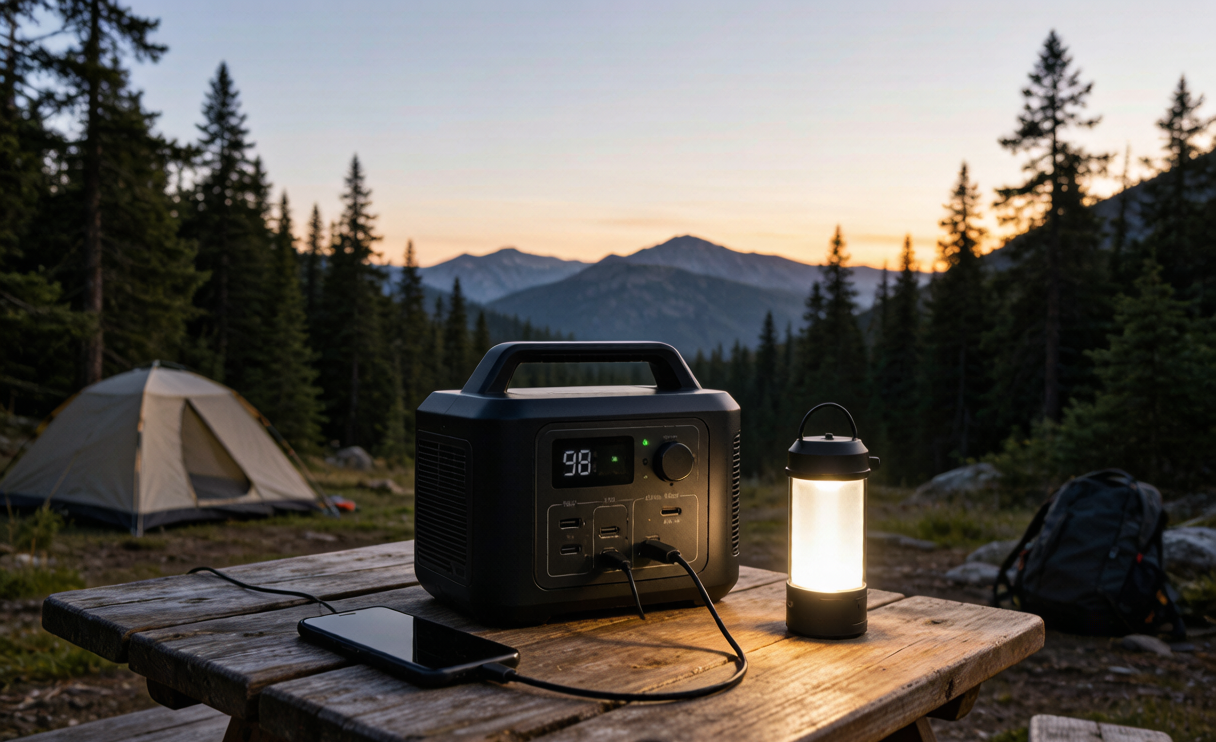
A lithium battery pack is the bare energy store—cells, BMS, and terminals. A power station adds the inverter, AC/DC ports, and solar charge controller in one box. For a custom battery solution you might integrate the pack directly into gear; for casual camping, the all-in-one station is simpler.