Lithium Battery Manufacturing for Power Tools
I have spent the better part of a decade on the production floor, and if there is one lesson that survives every product cycle it is this: a lithium battery is only as good as the line that builds it. Specifications on a datasheet are promises; manufacturing is where those promises are either kept or quietly broken. When the application is cordless power tools, the margin for error is narrower than most buyers realize. A drill or impact driver does not treat its cells gently — it demands 30–60 A pulses in under 100 ms, tolerates jobsite heat and freezes, and gets dropped onto concrete more often than anyone will admit. Building a lithium battery pack that survives that life, batch after batch, is a discipline in its own right.
Why Power-Tool Manufacturing Is Its Own Discipline
Most engineering teams approach a lithium ion battery project by starting at the cell and working outward. For power tools that order is backwards. You start with the duty cycle. A typical 18 V–21 V platform pulls a 5–15 A average draw during continuous work and spikes to 30–60 A during a stall or hard fastening. Duty is short and brutal — often 5–15% active time, with the pack sitting at high state-of-charge between hits. That profile punishes internal resistance and weld integrity far more than, say, an e-bike pack that sees a steady 10 A.
In my line we therefore design the manufacturing process around three threats: pulsed internal-resistance growth, interconnect fatigue, and thermal shock from a stalled motor. A pack that passes a benign capacity check can still fail in the field if its busbars were welded at the edge of the process window. Manufacturing for power tools means controlling that window on every single unit, not just on a qualification sample.
Incoming Cell Grading: The Quality Floor
Nothing downstream can fix a bad cell population, so grading is where a serious lithium battery manufacturing line earns its reputation. We receive cylindrical cells — usually 18650 or 21700 — in lots of tens of thousands, and we sort before anything is welded.
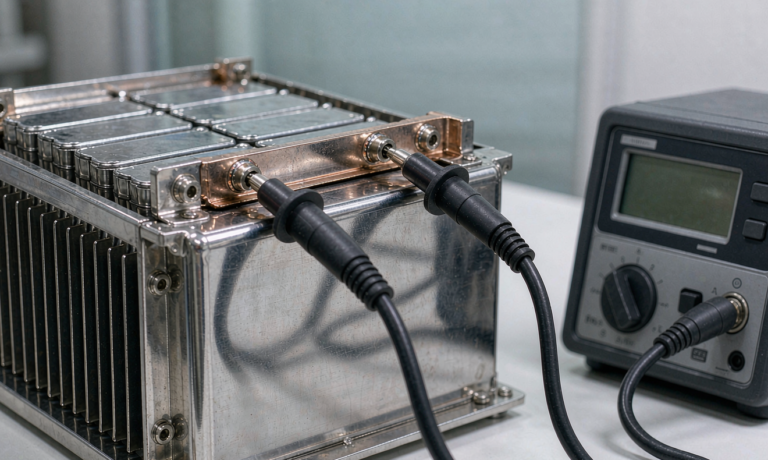
- Capacity grading. Every cell is discharged on a 4-wire fixture and binned to a coefficient of variation (CoV) below 6%. Within a single pack we hold capacity spread under 1% so that no cell reaches end-of-discharge voltage early.
- DCIR measurement. Direct-current internal resistance is measured with a 4-wire Kelvin method at a defined pulse, and we reject any lot whose DCIR CoV exceeds 10%. A matched pack keeps its voltage sag uniform across cells.
- ACIR and self-discharge. Alternating-current internal resistance catches porous welds at the cell tab, and a 24-hour open-circuit self-discharge screen flags micro-shorts before they enter the line.
- Cold-corner screening. A sample from each lot is pulsed at −10 °C to confirm the chemistry handles winter jobsites without a collapsed voltage floor.
This incoming gate is unglamorous, but it is the single biggest driver of fleet reliability. I have torn down competitor packs that skipped it, and the cell-to-cell spread was the first thing you could see with a multimeter.
Welding and Interconnect: Holding the Pack Together
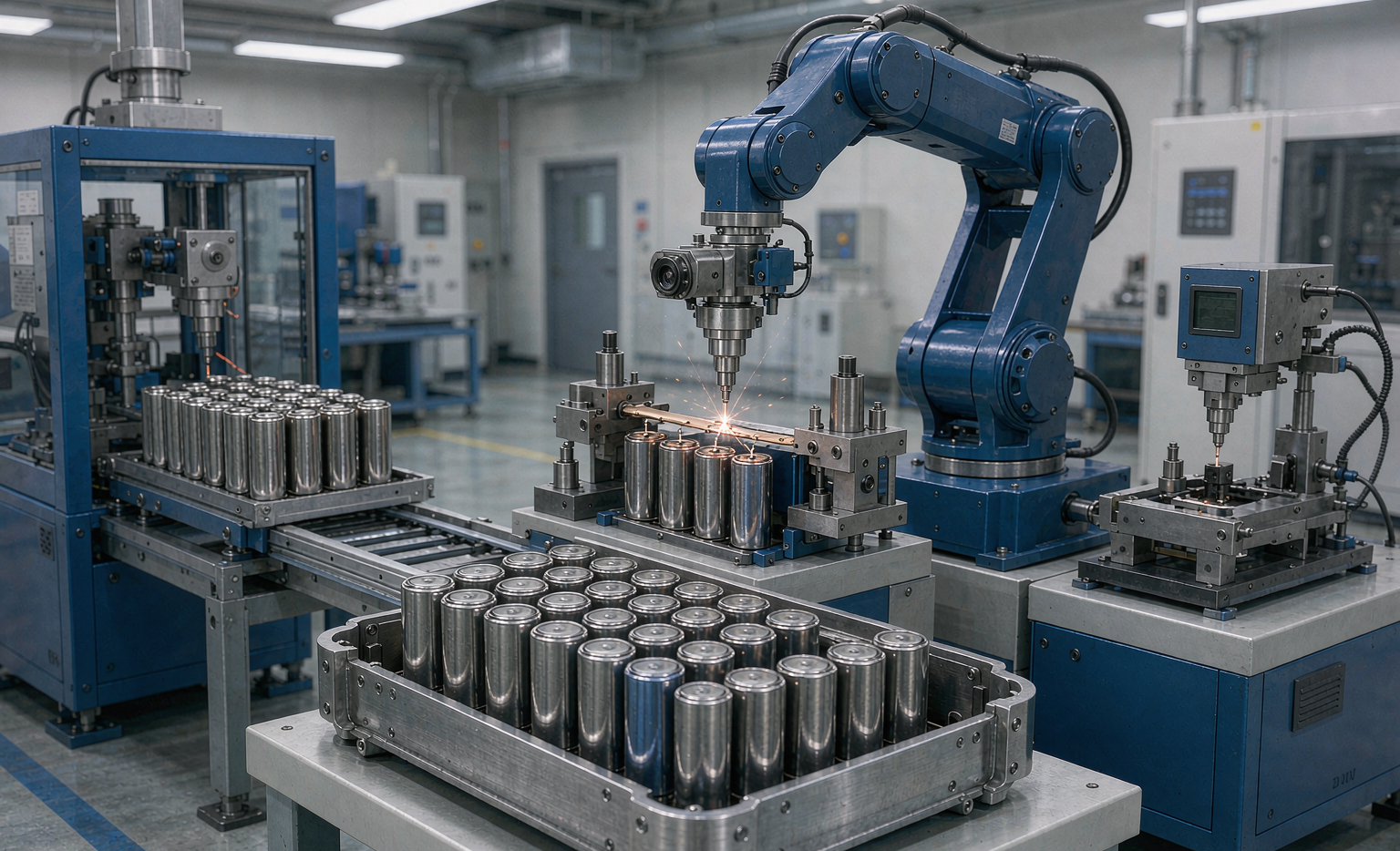
The interconnect is the most failure-prone part of any lithium battery pack, and it is where manufacturing discipline shows. We use pure-nickel strip, not nickel-plated steel, because plated steel work-hardens and fractures under vibration. Each weld is a laser spot tuned to a sub-0.15 mΩ resistance per joint at a peel strength above 25 N.
Process capability is the metric that matters here. We hold weld resistance to a Cpk of at least 1.67, which means the process is centered and the tails are controlled — not simply that the average weld is good. Every weld head is monitored for energy and displacement, and a statistical out-of-control signal stops the line rather than letting a marginal joint ship. For power tools, which live through drops and constant thermal cycling, a 0.3–0.7 MPa compression preload on the cell stack keeps the tabs from fretting against the busbar over thousands of cycles.
Formation, Burn-In and Functional Test
Raw cells leave the cell maker in a stabilized but not yet “formed” state, and a pack is not finished the moment it is welded. Formation is the controlled first charge that stabilizes the solid-electrolyte interphase on the anode. We run a multi-stage formation and burn-in on every finished pack:
- A gentle formation charge to seat the SEI layer.
- A capacity verification gate at ≥98% of rated nameplate.
- A pulsed functional test that replays a representative tool current trace and confirms pack voltage never sags below our 15 V gate during a 40 A pulse.
- A rest-and-measure step that records DCIR growth (we accept no more than +10% versus incoming) and a terminal-voltage spread of ≤30 mV across cells.
- An environmental stress screen spanning −10 °C to 60 °C, with a drop and vibration pass aligned to MIL-STD-810H 516.8 and 514.8.
Any pack that fails a gate is quarantined, not reworked blindly. Reworking a safety-critical lithium ion battery without understanding the root cause is how recalls start.
BMS Integration and Commissioning
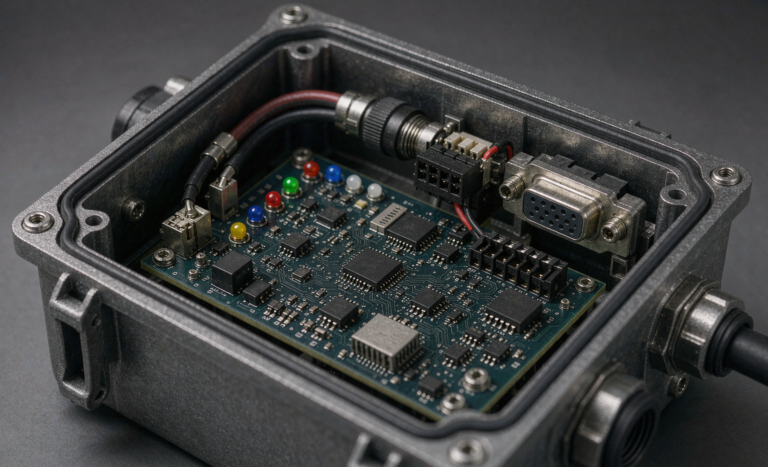
The battery management system is the pack’s immune system, and it is commissioned on the line, not just designed on paper. Our power-tool BMS carries layered protection: over-current at the 60 A tool ceiling, short-circuit protection that trips in under 200 ms, a pre-charge stage so the inverter capacitor does not arc the contactor, and a fuel gauge that actually tracks coulomb count rather than guessing from voltage.
We validate passive balancing during commissioning and confirm the fault log records cleanly. Before a pack is sealed, a final communication handshake checks that the BMS reports cell voltages, temperatures, and a status word the tool can read. A custom battery solution for an OEM often means tailoring this handshake to their proprietary tool protocol, which is why we keep the commissioning fixture firmware-updatable rather than hardcoded.
Traceability, Standards and the Shipping Floor
The last station is where manufacturing meets compliance. Every pack gets a DataMatrix code that ties it back to cell lot, weld parameters, and burn-in results — full manufacturing genealogy for any field return. That genealogy is what lets us answer a warranty claim in minutes instead of weeks.
On the standards floor, a power-tool lithium battery we build is qualified to UN38.3 T.1–T.8 (the transport abuse series), IEC 62133-2 for portable cells and packs, IEC 62619 for the industrial duty the tool sees, and UL 2580 where the pack is reviewed as part of a larger apparatus. For air and courier shipping we ship at the IATA Section II 30% state-of-charge allowance, because a fully charged pack is a different hazard class entirely. None of these standards are ceilings — they are the floor a B2B buyer should refuse to drop below.
From Line to Field: What Buyers Should Verify
If you are sourcing a power-tool pack, the questions that matter are not “what is the capacity” but “how do you prove every unit matches the sample.” Ask for the Cpk on weld resistance, the CoV on incoming cell grading, and the burn-in pass rate. A manufacturer who can show you the genealogy system and the formation data is one who controls their process. A custom battery solution built on that foundation will outlast three generations of the tool it powers.
Frequently Asked Questions
What certifications does a power-tool lithium battery pack need?
At minimum, UN38.3 T.1–T.8 for transport, IEC 62133-2 for the cell and pack safety, and IEC 62619 for industrial-duty use; UL 2580 applies when the pack is reviewed as part of a larger apparatus. For air or courier shipment we prepare packs at the IATA Section II 30% state-of-charge limit. These define the compliance floor, not a performance target.
How do you keep cell-to-cell variance low in mass production?
We grade every incoming cell on a 4-wire fixture: capacity CoV under 6%, DCIR CoV under 10%, with a 1% capacity spread enforced within each pack. ACIR screening and a 24-hour self-discharge check catch micro-defects before welding. Controlled variance at incoming is what keeps end-of-discharge voltage uniform across the pack in the field.
Why is formation important before a pack ships?
Formation stabilizes the solid-electrolyte interphase on the anode during the first controlled charge. Skipping it leaves the pack electrically unstable and shortens life. We run multi-stage formation plus burn-in and only release packs that hit ≥98% of rated capacity with DCIR growth under +10% and a terminal spread of ≤30 mV.
Can a power-tool pack be reused as a custom battery solution for other devices?
Often yes, with engineering care. The same high-rate cylindrical cells and welded topology that suit a drill also suit robotics, portable medical gear, or even certain drone battery form factors where pulse current dominates. The BMS handshake and mechanical envelope usually need retuning, which is exactly what a custom battery solution engagement delivers.
How does manufacturing for power tools differ from drone battery production?
Both need matched cells and clean welds, but a drone battery is optimized for energy density and weight at a lower sustained current, while a power-tool pack is optimized for repeated high-rate pulses, shock, and jobsite temperature swings. The manufacturing emphasis shifts: power tools demand tighter weld Cpk and harder environmental stress screening, whereas drones push harder on gravimetric density and balance tolerance.