Lithium Battery Reliability for Power Tools: Engineering a
Why Power-Tool Duty Cycles Break Packs Differently
As a senior lithium battery engineer at Horizon Power, I have spent the better part of a decade qualifying cells and packs for cordless tools that see some of the most abusive duty cycles in the entire consumer and professional space. People assume a drone battery or an e-bike pack is the toughest application. In the workshop, the truth is the opposite. A cordless impact driver can pull 30–50 A out of a 4–5 Ah pack in sub-second bursts, sit fully charged on a shelf for two weeks, then get dropped into a −10°C jobsite the next morning. That combination of high pulse rate, long idle at high state-of-charge, and mechanical shock is exactly what ages a lithium battery fastest.
When we scope a power-tool program, I start from the load profile, not the cell datasheet. A typical 18 V brushless drill draws 15–22 A under continuous load and spikes to 40–60 A during a stall or fastening event. Across a working day that is thousands of partial-discharge micro-cycles rather than a few deep ones. The degradation chemistry that dominates is not the classic calendar fade you see in stationary storage — it is weld-fatigue, lithium plating during cold charging, and BMS drift from vibration. If you design only for rated capacity, the pack will pass the bench and fail in the field within a season.
The Reliability Metrics I Specify for Every Cordless Tool Pack
Before a pack earns a place in our catalog, it has to clear a quantified reliability contract. These are the numbers I personally sign off on for any lithium battery intended for professional tools:
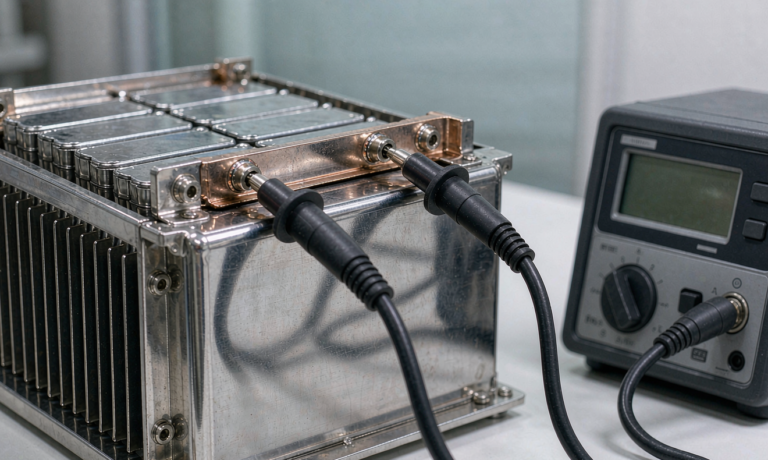
- Internal resistance match: cell-to-cell DCIR spread under 3 mΩ at 1 kHz / 50% SoC, measured with a four-wire Kelvin method. A 5 mΩ spread is the early-warning gate for field infant mortality.
- Cycle life at realistic depth: 400–600 full-equivalent cycles to 80% capacity at 2–3C discharge and 25°C. Tool users rarely deep-cycle, so we also report “micro-cycle life” — typically 1,500–2,500 partial cycles.
- Pulse capability: sustained 20–30 C for 2–5 s without the pack voltage sagging below the tool’s cutoff. Voltage sag, not capacity, is what makes a drill feel weak.
- Self-discharge: under 3% per month at 25°C and under 8% at 45°C storage, verified over 90 days.
- End-of-discharge voltage stability: cell voltage spread under 30 mV at end of discharge, so the weakest cell is never reverse-charged by stronger siblings.
These metrics map directly onto a custom battery solution spec sheet. When a client tells me “make it last longer,” the first thing I do is re-measure these five numbers on their returned packs, because the failure is almost always visible in DCIR spread long before capacity drops.
Cell Chemistry: NMC vs LFP in the Workshop
The two chemistries we ship most for tools are nickel-manganese-cobalt (NMC) and lithium-iron-phosphate (LFP). Each wins a different jobsite.
NMC 18650 and 21700 cells still dominate high-end 18–36 V tools because of energy density: 200–260 Wh/kg at the cell, roughly 150–200 Wh/kg at the pack. That lets a 5 Ah pack weigh under 600 g. The trade is a thermal-runaway onset around 150–180°C and a tighter charge window — I cap charge at 4.10–4.15 V/cell and never let a tool pack sit at 4.20 V for more than a day.
LFP is the chemistry I now recommend for fleet and rental use. Its thermal-runaway onset sits near 270°C, it tolerates 100% SoC storage far better, and it delivers 2,000–4,000 cycles. The penalty is ~20–30% lower energy density, so the pack is heavier for the same runtime. For a cordless tool that sits on a truck all week, that weight penalty buys a year or two of extra life and a dramatically safer failure mode.
Interestingly, the high-rate NMC cells we qualify for drills share a lineage with the high-discharge cells used in a drone battery. Both need low DCIR and tight weld resistance; the difference is the drone pack is optimized for a single continuous high-C discharge, while the tool pack must survive millions of interrupted micro-bursts.
Mechanical Shock, Vibration, and Thermal Load
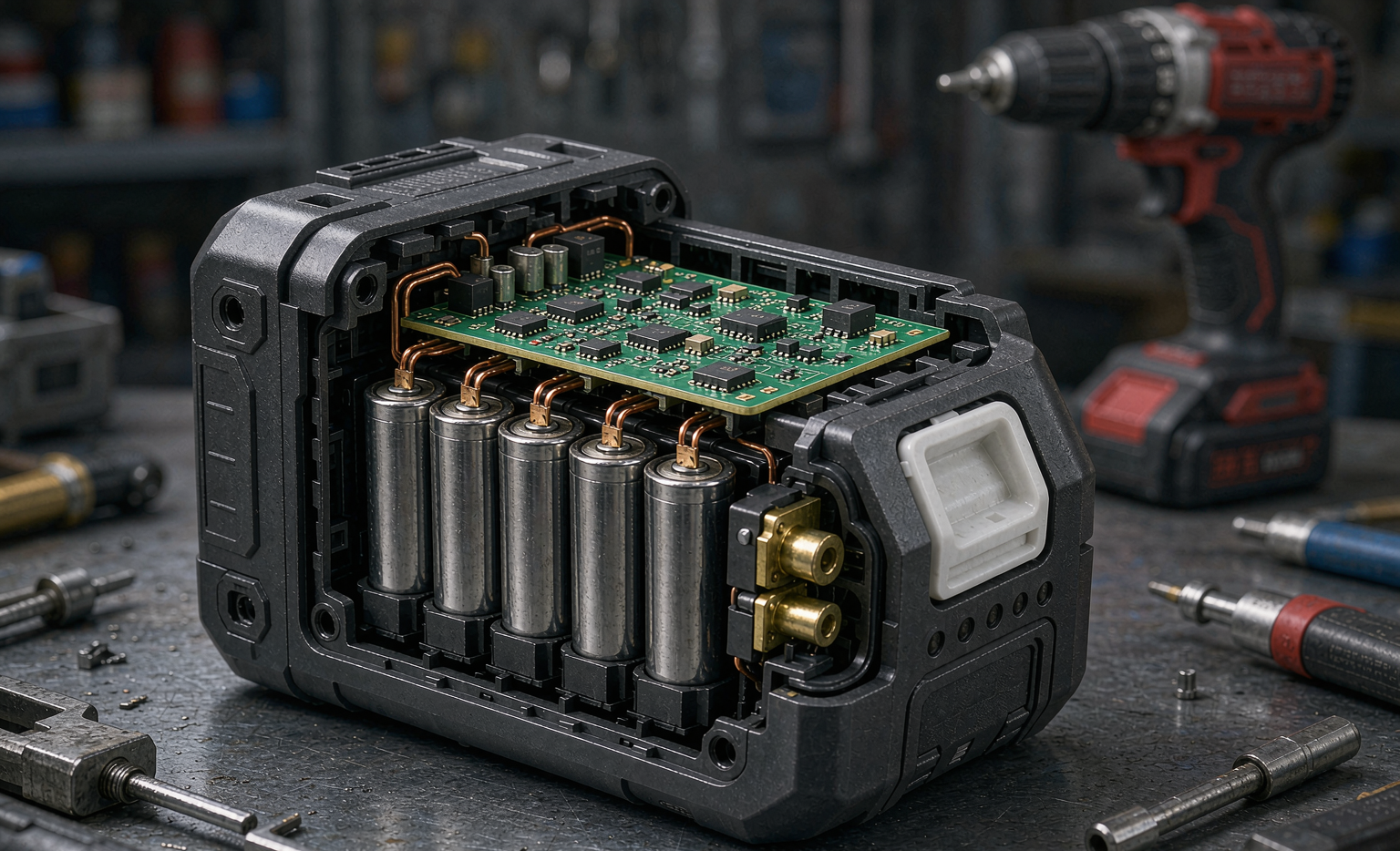
A lithium battery in a power tool is a structural component, not a loose cell taped together. The pack lives inside a housing that gets dropped, kicked, and spun at 30,000 rpm of reaction torque. My mechanical rules are non-negotiable:
- Spot or laser welds to pure-nickel strips must hold a 25 N peel and under 0.15 mΩ resistance. I require X-ray or AI vision on 100% of welds, not a sample.
- Potting and strain relief: sense wires and busbars get silicone or epoxy potting so a 1.2 grms vibration sweep (per MIL-STD-810H Method 514.8) does not fatigue them.
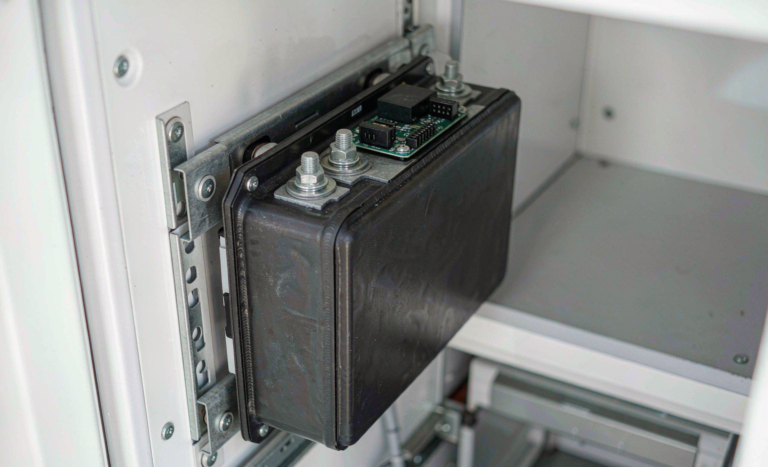
- Compression preload: cells are held at 0.3–0.7 MPa so they cannot walk under shock; a loose cell is a cell that eventually shorts.
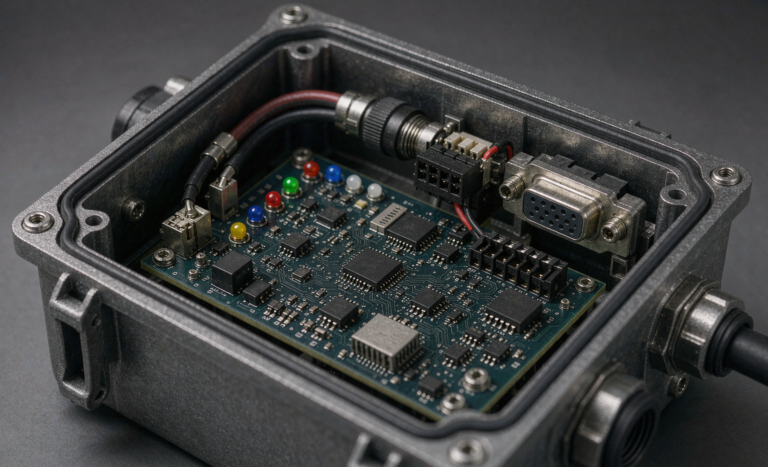
- Thermal envelope: we design for a 60°C surface limit and a 55°C core limit, with a two-stage BMS derate — trim current at 45°C, hard cutoff at 55°C.
The single biggest field killer I see is charging a cold pack. Below 10°C, lithium plating on the anode is irreversible and permanently shrinks cycle life. Every Horizon Power tool pack I specify carries a charge-temperature lockout at 0–5°C with a pre-warm hint, and a derate to 0.3 C below 10°C.
The Standards Floor: UN38.3, IEC 62133-2, and Transport
Reliability engineering does not replace compliance — it builds on top of it. The regulatory floor for any lithium battery we ship is fixed, and I treat it as the minimum, never the target:
- UN38.3 (Tests T.1–T.8): altitude simulation, thermal test, vibration, shock, external short, impact, overcharge, and forced discharge. This is the transport qualification that lets a pack move by air, sea, or road.
- IEC 62133-2: the international safety standard for portable lithium cells and batteries, covering internal-short, temperature, and over-current limits.
- IEC 62619 / UL 2580: referenced where the same cells feed industrial or vehicular packs.
- FAA / EASA carriage rules: for the loose cells and prototype packs that cross borders in our qualification lab, the 100 Wh and 160 Wh thresholds and the 30% SoC transport rule apply. A drone battery prototype we send to a flight-test partner follows the identical UN3480 / UN3481 carriage path.
My standing line to junior engineers: certification proves the pack will not explode in a shipping container. It does not prove the pack will still deliver rated torque after 800 jobsite drops. The second claim is the reliability job.
Building a Reliability Program for Tool Fleets
For fleet and OEM customers I wrap the above into a closed-loop program, because reliability is only proven by returned-field data. The workflow looks like this:
- Cell grading at incoming: capacity within ±1%, DCIR coefficient of variation under 6%, self-discharge under 1.0 mV/day. A pack built from ungraded cells inherits the worst cell’s fate.
- Formation and burn-in: every pack gets a formation cycle plus a 48-hour aging gate; we reject anything under 98% rated capacity or above 10% DCIR rise.
- DataMatrix genealogy: each pack carries a laser-etched 2D code linking cell lot, weld parameters, and test results. When one fails, we trace the other 4,000 from the same lot in hours, not weeks.
- Predictive retirement: retire at 80% capacity, or earlier at DCIR +30%, or cell spread over 40 mV — whichever comes first. This is cheaper than a callout for a swollen pack on a client site.
When a customer needs a pack that does not exist in our catalog, we turn it into a custom battery solution: we profile their tool’s duty cycle, pick the chemistry, and requalify only the deltas. The reliability contract above travels with it unchanged.
Frequently Asked Questions
How long should a lithium battery for power tools actually last?
Professionally, I budget 400–600 full-equivalent cycles or roughly 18–36 months for an NMC tool pack used daily, and 2,000–4,000 cycles for an LFP pack. Real life depends far more on charge habits and storage temperature than on the cell label. A pack kept at 30–70% SoC and charged at room temperature routinely outlasts one left fully charged on a cold truck.
Why does my drill lose power before the battery is “empty”?
Because voltage sag, not capacity, ends the job. Under a 50 A stall, pack internal resistance drops the terminal voltage; when any cell hits the cutoff, the tool cuts out even though average capacity remains. Tight DCIR matching and a low-resistance weld are what keep a drill feeling strong to the last screw. This is the same physics we manage in a high-rate drone battery.
Is LFP worth the extra weight in cordless tools?
For owner-operators chasing runtime, NMC wins on weight. For fleets, rentals, and anyone who leaves packs charged for weeks, LFP’s 270°C runaway onset, 100% SoC tolerance, and 2,000+ cycles usually pay back inside a year. I spec LFP wherever safety margin and calendar life beat gram-counting.
Can I charge my tool battery in a cold garage?
Not above 0.5–1 C, and not below 0°C at all on most packs. Charging lithium below 10°C plates metallic lithium on the anode — it is permanent capacity loss you cannot see until spring. A charge-temperature lockout is the single highest-return safety feature I add to any custom battery solution.
What certifications must a power-tool lithium battery meet?
At minimum UN38.3 (T.1–T.8) for transport and IEC 62133-2 for portable-cell safety, with IEC 62619 / UL 2580 referenced for industrial variants. FAA and EASA carriage rules govern how loose cells and prototypes move. These are the floor; my reliability contract sits one layer above them.