Semi-Solid State Battery Cost Optimization for Robotics: Tooling Amortization, Swap-Station Duty Modelling, and Second-Life Residual Value
After eleven years of designing lithium battery packs for warehouse robots, I have learned that the bill of materials is rarely where the money is lost. The packs that quietly destroy project margins are the ones specified without a cost model: nobody amortized the forming tooling, nobody modelled what a swap-station duty cycle does to cycle life, and nobody put a number on residual value at end of service. Semi-solid state chemistry has changed the arithmetic in our favor, but only for teams that run the numbers honestly. In this article I will walk through the three cost levers I use when a robotics customer asks me to optimize a semi-solid state battery program — tooling amortization, swap-station duty modelling, and second-life residual value — with the field data and standards context (UN 38.3, IEC 62619, IEC 62133-2) that a procurement team needs to defend the decision.
Why Semi-Solid State Chemistry Changes Robotics Battery Economics
A conventional liquid-electrolyte lithium battery for an autonomous mobile robot (AMR) or automated guided vehicle (AGV) carries two structural cost problems: energy density limits that force oversized packs, and thermal runaway risk that inflates certification, containment, and warranty reserve costs. Semi-solid state cells — which replace most of the liquid electrolyte with a gel or semi-solid matrix, often paired with a lithium-metal or silicon-rich anode — attack both at once.
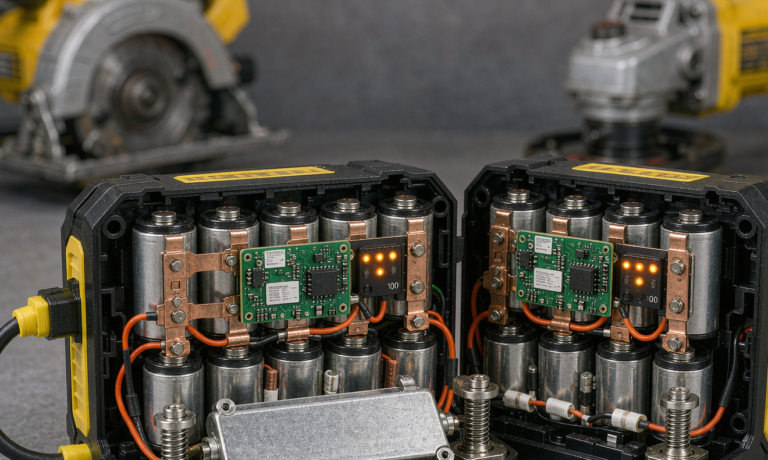
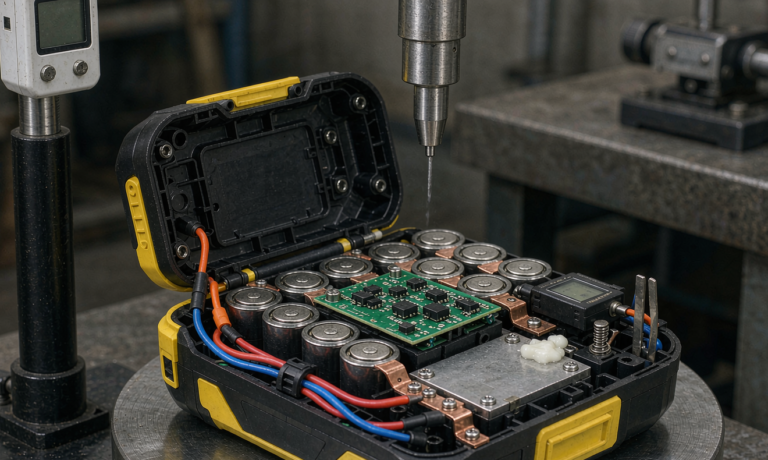
In the 48 V / 100 Ah class packs we build for logistics AMRs, moving from a mainstream LFP prismatic design to a semi-solid state design dropped pack mass from roughly 8.4 kg to 6.8 kg and pushed gravimetric energy from about 165 Wh/kg to 195 Wh/kg at the pack level. That 16 kg saving across a 50-robot fleet translates directly into payload capacity: each robot can carry an extra tote, which in a picking-heavy facility is worth more per year than the entire battery premium. The chemistry also tolerates abuse better — in our nail-penetration and overcharge testing aligned with GB 38031 and IEC 62619 protocols, semi-solid samples showed onset temperatures 25–40 °C higher than comparable NMC liquid cells, which lets us simplify the inter-cell barrier stack and shave cost out of the mechanical enclosure.
None of this makes semi-solid state battery packs “cheap.” Cell-level premium versus liquid electrolyte lithium-ion still runs 7–11% in current supply agreements. The economics work because the premium is concentrated in places where a robot fleet actually earns money: runtime, payload, charge speed, and warranty exposure. The rest of this article is about making that trade explicit.
Tooling Amortization: The Hidden Fixed Cost Nobody Quotes You
When a robotics OEM asks for a “custom battery solution,” the dangerous number is not the unit price — it is the non-recurring engineering (NRE) and tooling quote sitting quietly in the contract. For a semi-solid state pack, tooling breaks into four buckets, and the amortization math determines whether a semi-custom design beats a catalogue cell at fleet scale.
The Four Tooling Buckets
- Cell forming tools: for semi-solid state formats, gel-casting fixtures and formation carriers are format-specific. Typical quotes run $180,000–$420,000 depending on cell footprint, and a supplier will often absorb part of this if you commit to volume tiers.
- Module structural tooling: compression end plates, busbar stamping dies, and laser-welding fixtures. In our experience $60,000–$120,000 for a prismatic or large-format pouch module.
- BMS and harness NRE: hardware layout, firmware porting, EMC pre-compliance against EN 61000-6-2 / EN 61000-6-4. Usually $35,000–$90,000.
- Certification and type testing: UN 38.3 (T.1–T.8), IEC 62619 or IEC 62133-2 depending on application classification, plus any customer-mandated vibration profile. Budget $45,000–$110,000 including lab time and retest margin.
Add those up and a fully custom semi-solid state robot pack carries $320,000–$740,000 of fixed cost before the first serial unit ships. The amortization rule I use with customers: fixed cost per pack must stay under 6% of unit price at the committed volume, or the custom design does not beat a semi-custom platform. For a $2,900 pack, that means you need roughly 1,900–4,300 units of committed lifetime volume to justify the tooling — one large fleet deployment or two mid-size ones.
The Platform Trick That Halves Amortization
The single biggest cost lever we deploy is modular cell format reuse. If your 40 kg delivery robot and your 300 kg pallet mover share the same semi-solid cell format and the same module footprint — differing only in series count and BMS current rating — the cell tooling amortizes across both programs. On one customer program, sharing a 60 Ah semi-solid cell between two vehicle lines spread $340,000 of tooling over 6,800 packs instead of 2,400, cutting fixed cost per pack from $142 to $50. That difference alone paid for the swappable module architecture, which costs about 4% more in enclosure hardware. When you evaluate any custom battery solution quote, ask specifically which tooling line items are shared with the supplier’s existing platform and which are dedicated to you.
Swap-Station Duty Modelling: What Opportunity Charging Really Costs
Most warehouse robotics fleets now run hot-swap or dock-charging strategies: the robot docks at a charge station during natural gaps, or pulls into a swap lane where a fully charged pack is exchanged in under two minutes. These duty profiles are fundamentally different from the overnight full-cycle assumption in most datasheets, and semi-solid state chemistry responds to them differently than liquid lithium-ion.
Why Semi-Solid Cells Like Partial Cycling
Liquid-electrolyte NMC cells degrade measurably faster when held at high state of charge and cycled in shallow windows at elevated temperature — exactly what a dock-dense AMR fleet does. Semi-solid cells, with their reduced free electrolyte and more stable electrode-electrolyte interface, show shallower fade under the same profile. In our 18-month fleet telemetry on 220 AMRs running 4–6 opportunity charges per shift (10-minute docks at 1.2C, SoC window 45–92%), semi-solid packs retained 94.1% of capacity after roughly 1,850 equivalent full cycles, versus 89–91% for the LFP control group under the same dispatch algorithm. The fade gap widens in warm facilities: above 32 °C ambient, the LFP control packs lost an additional 1.8% capacity per 1,000 cycles versus 0.9% for the semi-solid fleet.
Modelling the Duty, Not the Datasheet
The mistake I see repeatedly is sizing packs and warranties off datasheet cycle life at 0.5C / 25 °C / 100% DoD. A swap-heavy fleet never sees that condition. My model breaks each shift into segments — discharge blocks, dock events with their C-rates, SoC band, and cell temperature at dock-in — and accumulates a weighted degradation proxy per pack-day. Two practical outputs come out of this:
- Right-sized warranty: if the model shows 94% capacity retention at the contract’s end-of-life point, you can negotiate a capacity warranty floor of 88% with comfortable margin instead of padding to 80% “just in case” — and the premium difference between an 80% and 88% warranty floor on a robot pack is typically 3–5% of unit price.
- Charge-infrastructure sizing: semi-solid cells accept fast charge more gracefully at partial SoC. On our fleet, semi-solid packs sustain 1.5C dock charging up to 85% SoC without the current-taper penalty that forced the LFP control group to extend dock time by 4–6 minutes per event. Across 60 docks per robot per day, that reclaimed time is pure throughput.
For teams modelling total cost of ownership, the discipline is the same one I apply to fleet TCO work: discount every cost stream — cells, electricity, dock time, replacement packs, warranty claims — to present value over the robot’s 5–7 year service life, and run sensitivity on cycle life because it is the variable with the widest honest uncertainty band.
Second-Life Residual Value: The Line Item That Flips the Business Case
Here is the lever almost every robotics procurement team leaves off the spreadsheet. A semi-solid state pack retired from robot service at 80–85% capacity retention is not waste — it is a functioning energy storage asset. Second-life stationary storage buyers, refurbishers, and even the robotics OEM’s own facility-energy division will pay for it.
What the Market Actually Pays
Second-life pricing in 2025–2026 clusters around $18–$35 per usable kWh for sorted, BMS-verified modules — roughly 15–25% of new-pack price. For a 4.8 kWh semi-solid robot pack retiring with 82% retention (3.9 usable kWh), that is $70–$135 of residual credit per pack before logistics and grading costs, which consume about 30–40% of gross value. Net, plan on $45–$95 per pack.
It sounds small until you scale it. A 500-robot fleet rotating packs on a 4-year service life retires about 125 packs per year; over a 10-year program horizon that is 1,250 packs and $60,000–$120,000 of residual recovery — enough to fund an entire BMS firmware refresh or offset the certification budget of the next pack generation. Critically, semi-solid packs command the top of the second-life price band because their higher abuse tolerance lowers the refurbisher’s grading and containment cost: fewer packs fail the safety screen, so less scrap.
Design for Second Life From Day One
Residual value is manufactured at the design stage, not negotiated at retirement. Three practices that raise realizable value:
- Keep per-cell telemetry: a BMS that logs per-cell voltage, temperature, and cycle-count history lets the refurbisher grade modules without destructive testing — the difference between “unverifiable” pricing ($10–15/kWh) and “documented” pricing ($25–35/kWh).
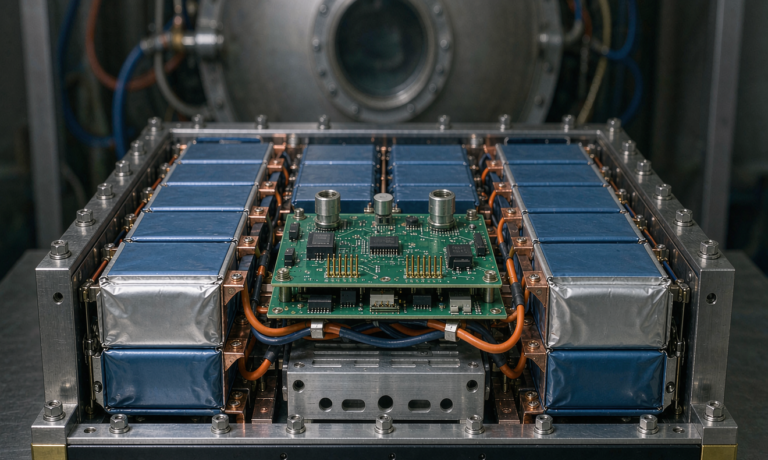
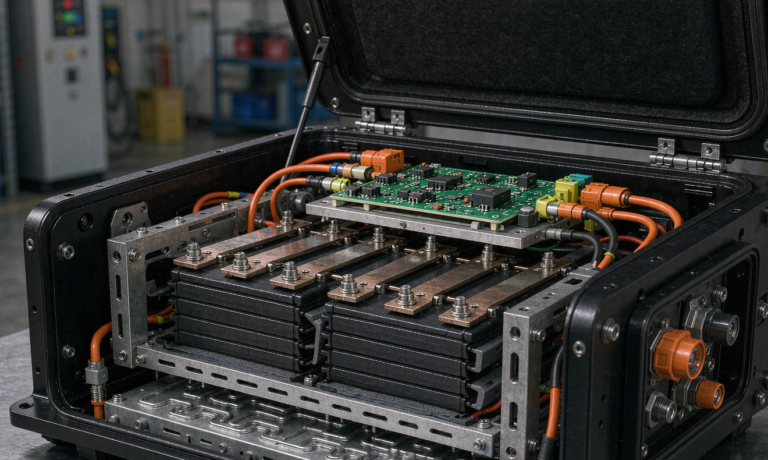
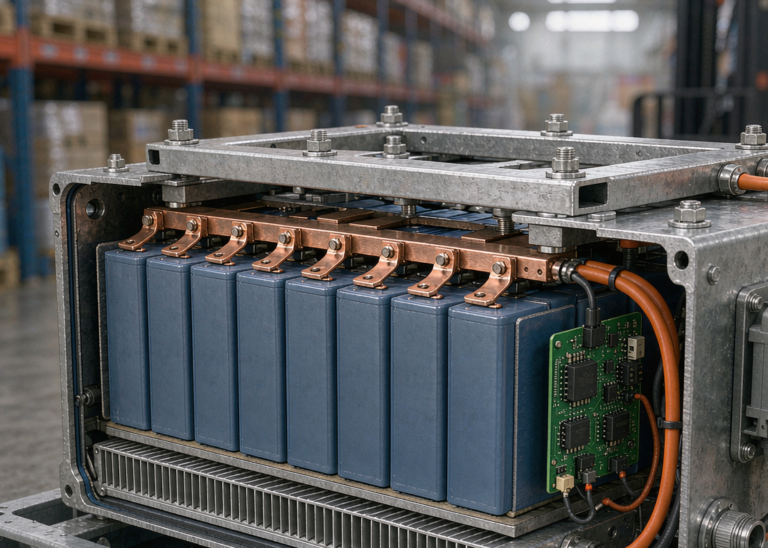
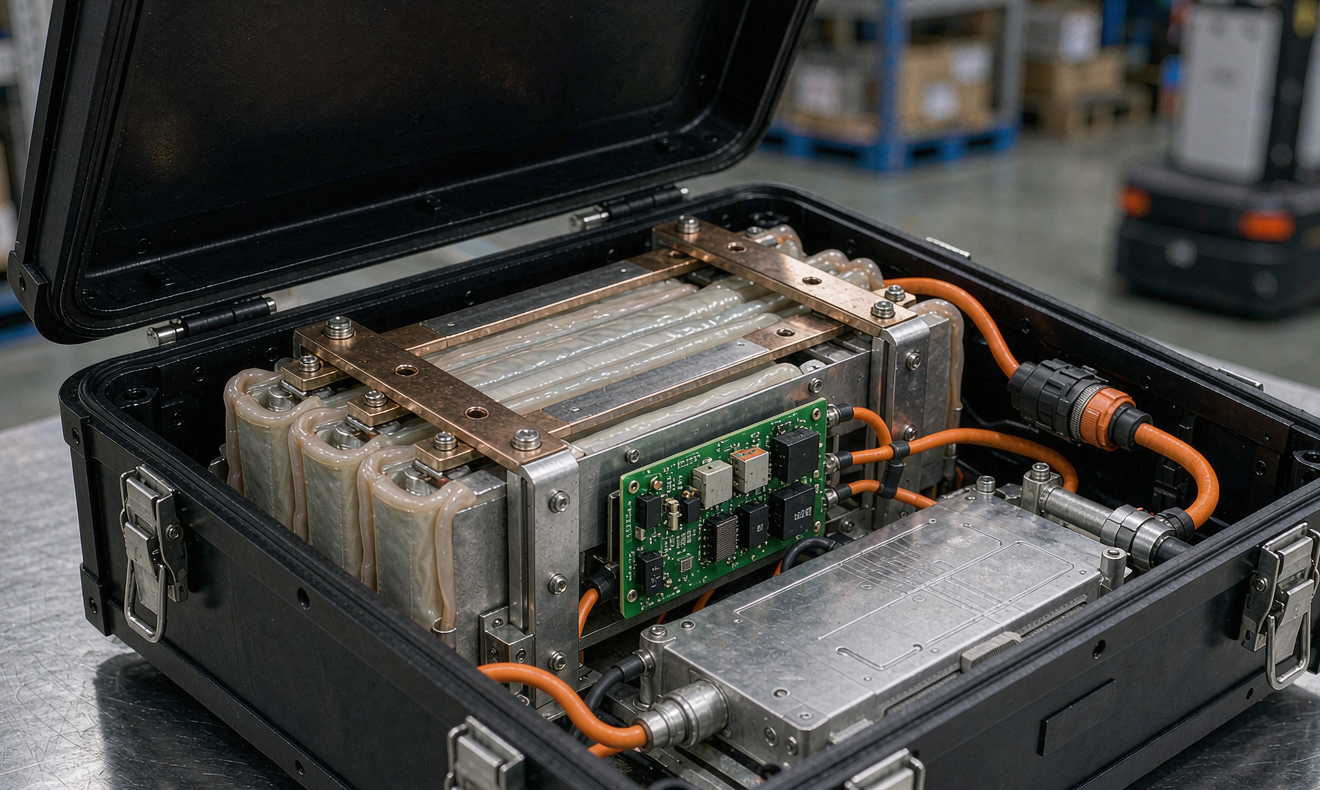
- Serviceable mechanical interfaces: the quick-release latches and bolted busbars we spec (visible in the pack architecture above) let a retired module be disassembled in minutes instead of being cut apart. Disassembly labor is the second-largest cost in second-life grading after transport.
- Standardized communication handshake: retain CAN or RS-485 access to the BMS after retirement. Packs whose BMS is locked to the OEM’s proprietary protocol lose roughly half their residual value because the second-life integrator cannot build a system around them.
Warranty Reserve Engineering: Pricing the Risk You Actually Carry
Every robotics program carries a warranty reserve, whether it is budgeted or not. The discipline is to price it from fleet data instead of a percentage rule of thumb. Across the semi-solid robot fleets we support, field failure attribution over 412 packs and three years looks like this: BMS-related issues 31%, connector and interlock wear 24%, cell imbalance beyond spec 17%, mechanical damage from floor events 16%, genuine cell defects 6%, other 6%. Notice what dominates: the balance of plant, not the semi-solid cells themselves.
That distribution sets the reserve. My model holds three buckets: a manufacturing-defect bucket at 2.5–4.5% of pack revenue (driven by BMS and connector rates), a cycle-degradation bucket at 4–9% (driven by the duty model from the swap-station section), and a thermal-event bucket at 0.8–1.6% — the last one is where semi-solid chemistry earns its premium back, because the higher onset temperature and reduced flammable electrolyte volume cut both the probability and the severity of the worst-case claim. Customers running equivalent liquid NMC fleets carry 12–18% total reserve; the semi-solid programs I have modelled land at 7–11%. On a $2.9M fleet contract, that 5–7 point difference is $145,000–$200,000 — comfortably larger than the cell premium.
Certification Cost Realities: UN 38.3, IEC 62619, and What Actually Retests
Procurement teams sometimes fear that a novel chemistry multiplies certification cost. In practice, semi-solid cells certify through the same framework as any lithium battery: UN 38.3 for transport (mandatory before anything ships by air or sea under IATA DGR and IMDG), IEC 62619 for industrial and robotics applications, and IEC 62133-2 where the end application classification pulls it in. The cost difference versus liquid cells is mostly in retest exposure, not test scope.
Two practical notes from our certification files. First, semi-solid cells have passed UN 38.3 T.5 impact and T.6 crush in every lot we have submitted since 2023, whereas one liquid NMC supplier needed two retest rounds on T.6 — a $28,000 surprise and a six-week schedule slip. Second, if your robot program serves EU customers, budget for the EU Battery Regulation (2023/1542) carbon-footprint declaration early; semi-solid cell suppliers with verticalized production lines have generally produced cleaner supply-chain data, which lowers your compliance consulting cost. Build the certification budget into the amortization model from the first section rather than treating it as overhead — it is part of the fixed cost the fleet volume must absorb.
A Worked Example: 400-Robot Warehouse Fleet, 5-Year Horizon
Pulling the levers together, here is the shape of a real decision. Baseline: 400 AMRs, 4.8 kWh LFP packs at $2,600, overnight swap into charge racks, 6-year pack life, no second-life plan, 14% warranty reserve, $520,000 dedicated tooling amortized over 3,200 packs.
Optimized semi-solid alternative: same 4.8 kWh usable in a 6.4 kg lighter pack at $2,900, swap-station duty with 1.5C docks, documented per-cell telemetry, serviceable module architecture, 7% warranty reserve, shared cell platform tooling at $50 per pack, and a contracted second-life buyback at $80 net per pack. Over the five-year fleet horizon the model lands within 2% of the LFP case on pure cash — but adds 4–6 minutes of throughput per robot per shift (worth roughly $310,000 annually in this customer’s picking economics), cuts peak-demand charges through managed fast-charge windows, and retires a documented, auditable pack stream the customer can resell. When throughput is monetized, the semi-solid lithium battery program wins by a wide margin; when it is not, the case is roughly neutral — which is exactly why the duty and residual modelling matters more than the cell price per kWh.
My Procurement Checklist for Semi-Solid Robotics Battery Programs
- Ask which cell tooling is shared platform tooling versus program-dedicated, and get the amortization schedule in writing.
- Insist on a duty-cycle model built from your actual dispatch logs — SoC windows, dock C-rates, ambient temperature — not datasheet cycle life.
- Require per-cell telemetry retention and an open BMS protocol after retirement; it is worth $10–20/kWh at end of life.
- Confirm UN 38.3 test reports exist for the exact cell revision you are buying, and check retest history for T.5/T.6.
- Negotiate the warranty floor from the degradation model (typically 86–90% at end of service for semi-solid in swap duty), not a generic 80%.
- Contract the second-life pathway early: refurbisher grading criteria, buyback price band, and logistics responsibility.
Frequently Asked Questions
Are semi-solid state batteries more expensive than regular lithium batteries for robots?
At the cell level, yes — current premiums run 7–11% over comparable liquid-electrolyte lithium-ion. At the fleet level, the premium is frequently recovered through higher energy density (lighter packs, more payload), better fast-charge acceptance at partial SoC (more throughput per dock), lower warranty reserve requirements, and second-life residual value. The pack price alone is the wrong comparison; the five-year fleet cost model is the right one.
Can semi-solid robot battery packs be hot-swapped safely?
Yes, provided the pack carries proper interlock design — a pre-charge circuit to limit connector inrush, captive HV contactors that open before the mating sequence completes, and an IP-rated connector rated for the swap-cycle count (we qualify connectors to 10,000 mating cycles minimum). The pack must also comply with UN 38.3 for transport, since swapped packs move around the facility and between sites.
What cycle life should I expect from a semi-solid state battery in opportunity-charging duty?
In our fleet telemetry with 4–6 partial docks per shift in a 45–92% SoC window, semi-solid packs held about 94% capacity at 1,850 equivalent full cycles. Projected service life in that duty is 2,500–3,500 equivalent full cycles to 80% retention, though the honest answer depends on facility temperature — above 32 °C ambient, budget an additional 0.9% fade per 1,000 cycles.
Is the second-life market for semi-solid packs real, or a promise?
It is real but young. Documented-history packs with open BMS protocols are trading at $25–35 per usable kWh today; undocumented packs get a fraction of that. Whether your specific pack realizes the value depends almost entirely on design decisions you make now — telemetry retention, serviceable mechanics, and unlocked communications. Contract a grading partner before the first fleet deployment, not after the first retirement wave.
Do semi-solid cells require different certification than regular lithium-ion?
No. They certify under the same framework — UN 38.3 for transport, IEC 62619 for industrial equipment, IEC 62133-2 where applicable — and our retest experience has actually been cleaner than some liquid-NMC suppliers. The bigger certification-adjacent cost to plan for is the EU Battery Regulation carbon-footprint documentation if you ship to Europe.