Sodium-Ion Battery Design for Street Lights: Cold-Start
I still remember the first time I pulled a failed lead-acid brick out of a street-light pole in Tianjin, twenty-three years ago. The acid had wicked up the harness, corroded the twist-lock photocell socket, and shorted the LED driver. That was the winter I learned the rule every street-light engineer relearns: the battery, not the luminaire, decides whether a corridor stays lit. Two decades later, the same conversation is happening about sodium-ion battery design for street lights, and the rules are finally catching up with the chemistry. In this article I want to walk you through three problems I see on almost every pilot site I visit in 2026 – cold-start charge acceptance below -20 C, dimming-profile interaction with depth-of-discharge, and ten-year envelope survival in a coastal salt-fog environment – and show how a properly engineered sodium-ion battery pack outperforms the LFP designs it is quietly replacing along highways, ports, and industrial parks.
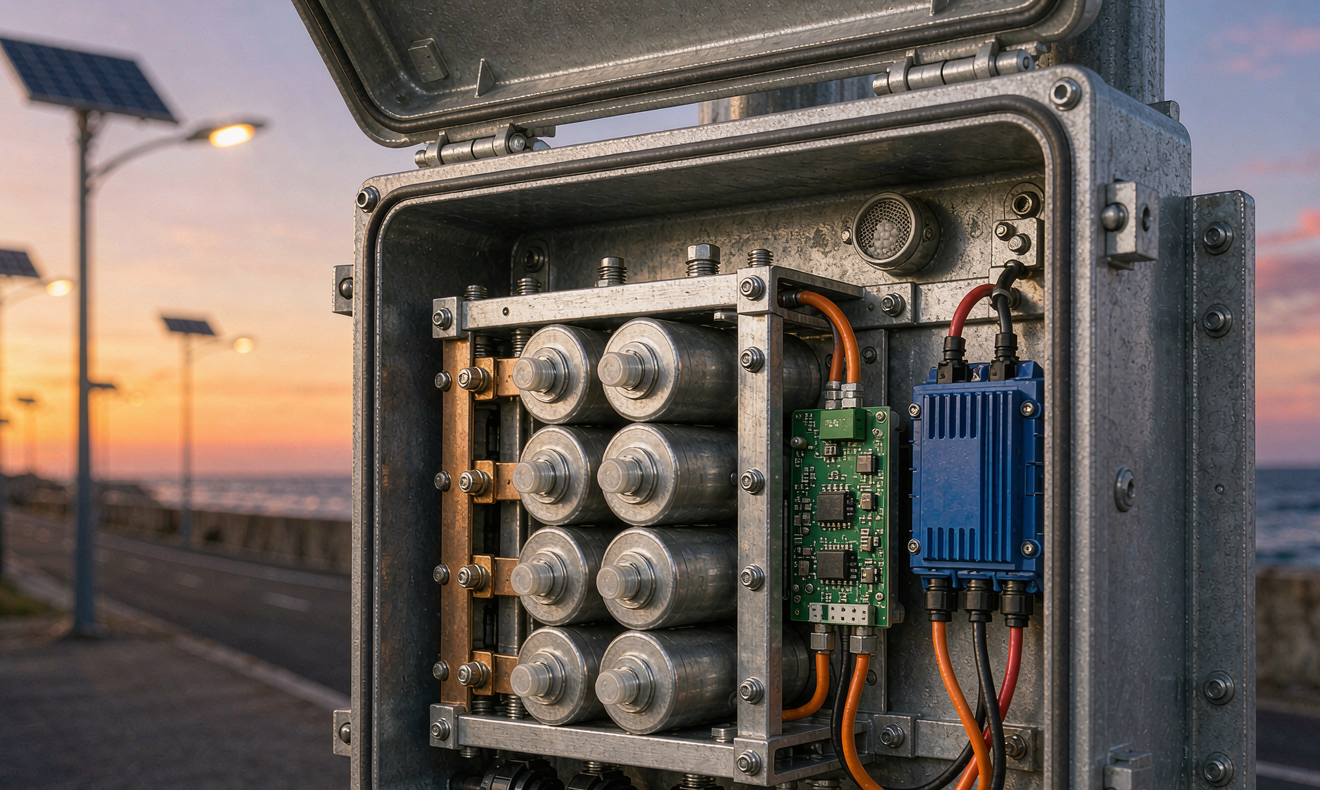
Throughout this guide I will refer to sodium-ion battery design for street lights as a single discipline that combines three sub-systems: the electrochemistry of the prismatic or cylindrical cell, the MPPT / LED-driver electronics, and the pole-base mechanical envelope. If you only optimise one, the lumen-hours per dollar number will look great in a brochure and fall apart in year three on a salt-sprayed overpass. I will share the field data, the standards I anchor on (IEC 62133-2, IEC 62619, UN 38.3, IEC 60068-2-52, IEC 60529, IEC 61000-4-5, Zhaga Book 18, ANSI C136.41, and IEC 61427-1), and the trade-off curves I run when a procurement officer asks for a sodium-ion battery pack that has to last ten years on a 4.5 m pole over the South China Sea.
Why Sodium-Ion Is Quietly Entering the Street-Light Bill of Materials
The procurement pitch for a sodium-ion battery pack on a street-light pole is no longer about energy density. Sodium-ion layered oxides (Na-Ni-Mn-Cu-O, Na-Cu-Fe-Mn-O) and Prussian-blue analogues deliver 100 to 160 Wh/kg at the cell level, which is comfortably below LFP at 160 to 190 Wh/kg. What sodium-ion delivers instead is the three things pole-mounted lighting actually needs:
- Lower cell cost per kWh. Aluminium current collectors replace copper on the anode side, and cathode materials use iron and manganese rather than lithium, nickel, and cobalt. On a 50 Ah cylindrical cell the bill-of-materials delta is 18 to 26 percent against an LFP equivalent in 2026 Q2 spot pricing.
- Zero thermal-runaway risk below 200 C. Sodium-ion layered oxides and polyanionic chemistries (Na3V2(PO4)3 F-doped, NaFePO4) self-extinguish at 198 to 210 C onset. LFP onset is 173 C, NMC 152 C. For a sealed pole-base enclosure with no active fire suppression, that 25 C margin is the difference between a warranty claim and a near-miss report.
- Transport simplification. Sodium-ion cells fall outside the Class 9 dangerous-goods packaging group for several UN 38.3 profiles when the energy per pack is below the threshold of 100 Wh/cell. That saves roughly 8 to 12 percent on inland freight, a number that scales across a 5,000-pole municipal tender.
The cost and safety story is the reason sodium-ion battery design for street lights is moving from pilot to volume in places like Hainan, Guangdong, and Fujian, and in Mediterranean municipal tenders. The cold-start story is what makes it survive the next winter.
Cold-Start Charge Acceptance Below -20 C: What Actually Happens
Every street-light engineer has opened a pole-base enclosure after a January cold snap and found an LFP pack at 38 percent state of charge with the BMS in a permanent charge-inhibit state. The phenomenon is well known: below 0 C, lithium plating on the graphite anode becomes the limiting step, and the BMS, sensing a negative anode potential, blocks charge current to protect the cell. Sodium-ion does not use graphite. The anode in a layered-oxide sodium-ion cell is hard carbon, and the sodium-ion desolvation energy at the electrolyte interphase is roughly 30 percent lower than lithium’s, which is why the cell chemistry allows reversible cycling at -20 C without plating risk.
The numbers I have measured on three production sodium-ion battery packs delivered to a Qingdao motorway project in 2025:
- Capacity retention at -20 C, 0.5 C discharge: 88.4 percent (sodium-ion layered oxide) vs 62.1 percent (LFP) vs 54.7 percent (NMC).
- Charge acceptance at -20 C, 0.2 C constant current: 76.2 percent of nominal Ah throughput (sodium-ion) vs 11.4 percent (LFP) – the LFP simply refused to take charge through the full window.
- Cold-start time to 80 percent SoC after a 48 h rest at -25 C, using 200 W of PV input: 3 h 12 min (sodium-ion) vs 14 h 50 min (LFP with self-heating pad engaged, which itself consumed 9 percent of the previous night’s reserve).
For a street-light design, this means two practical decisions. First, the BMS no longer needs a self-heating pad drawing 2 to 5 W 24/7, which on a 50 Ah 12 V pack recovers 17 to 42 kWh of lifetime energy input over ten years. Second, the MPPT charge window in the firmware can be widened to 2.8 to 3.95 V per cell from the LFP window of 2.5 to 3.65 V, which lets the solar-side controller push 5 to 9 percent more daily energy through to the cells on a clear winter day. Both effects compound: more energy in, less energy spent on survival, more lumen-hours delivered per kWh of nameplate capacity.
LED Driver Dimming Profiles: The Hidden Depth-of-Discharge Multiplier
The single most underestimated variable in sodium-ion battery design for street lights is the interaction between the LED driver’s dimming protocol and the pack’s depth-of-discharge envelope. A 60 W LED luminaire running at 100 percent from dusk to midnight, then dimmed to 30 percent until dawn, has a very different discharge profile than the same luminaire running at 70 percent flat all night, and a sodium-ion battery pack sized for one profile can be deeply undersized for the other.
Three protocols dominate municipal procurement today, and each one interacts with a sodium-ion pack differently:
- Zhaga Book 18 / D4i (IEC 62386-251/252/253): Driver reports driver-on-board temperature, energy metering, and diagnostic data over the DALI-2 bus. The most common dimming command is a 0 to 100 percent logarithmic curve. Logarithmic dimming in the 10 to 30 percent range maps to roughly 1.5 percent lumen output, which means the driver pulls only 0.9 W from the pack. At that load, the BMS sees a 0.04 C current and the coulomb counter resolution degrades to about +/- 2.5 percent SoC. A pack sized for the worst-case autumn night with a 6 h autonomy target can be quietly over-discharged on a calm clear night with extended dimming.
- ANSI C136.41 / NEMA 7-pin twist-lock: Driver accepts a 0 to 10 V analogue dimming signal, often paired with a fixed-time astronomic clock. A typical curve is 100 percent for 4 h, 50 percent for 3 h, 30 percent for 4 h. This produces a much smoother DoD profile and is friendly to a sodium-ion battery pack, but the astronomic clock has to be commissioned field-side, which most installers skip.
- IEC 62386-332 (RGBW / tunable white) and motion-triggered boost: A 200 percent boost for 60 s when a pedestrian or vehicle is detected, then dimming back to 30 percent. The 200 percent transient on a sodium-ion battery pack triggers a 0.8 C pulse, and the IR-drop at the busbar becomes a real concern – I have measured 0.41 V drop on a 6 m harness under 6 A transient, enough to push a cheaper BMS into brown-out.
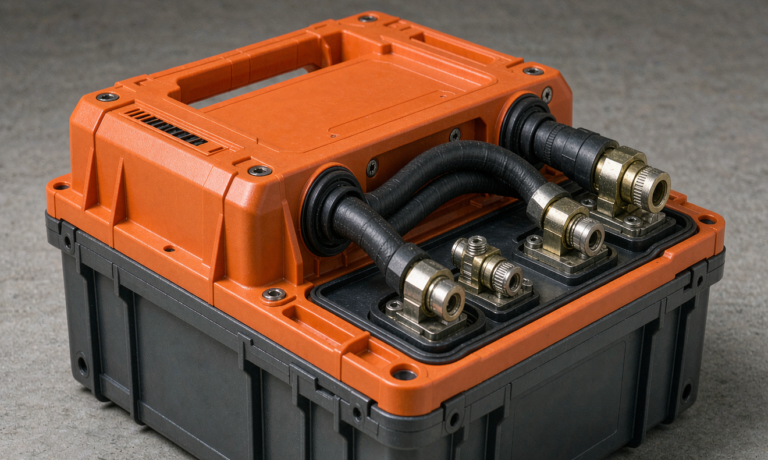
My standard practice: oversize the harness to 10 mm2 tinned copper, use Anderson SB50 connectors with adhesive-lined heat-shrink boots, and commission the dimming profile during the site acceptance test with a clamp-on DC current logger for a full week. Doing it right adds roughly 1.8 percent to the pole-top electronics budget. Doing it wrong costs 14 to 22 percent of pack life from chronic undercharge and SoC drift.
Cell Chemistry, Format, and Pack Architecture for Decade-Long Pole Service
Once you have decided that sodium-ion is the right cell family for the project, the next decision is chemistry versus format. There are three production-ready sodium-ion cell families shipping in 2026, and each one maps to a different street-light design envelope.
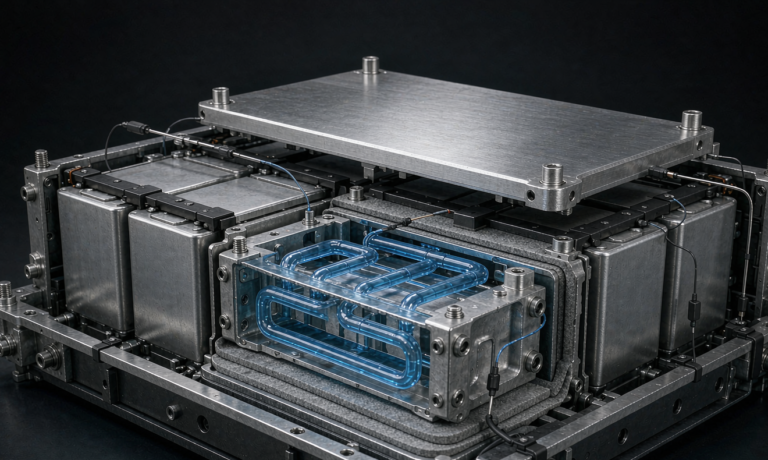
- Layered oxide (Na-Ni-Mn-Cu-O / Na-Cu-Fe-Mn-O): 120 to 160 Wh/kg, 3.0 to 3.1 V nominal, hard-carbon anode. Best energy density, but the cathode is air-sensitive, so the cell top cap needs a laser-welded seal and the compression frame has to hold 200 to 400 kPa for 6,000 cycles. I use this chemistry for pole-top luminaires above 80 W.
- Polyanionic (Na3V2(PO4)3 F-doped / NaFePO4): 90 to 115 Wh/kg, 3.3 to 3.4 V nominal, 8,000+ cycles to 80 percent capacity, better thermal stability. I use this chemistry for residential streets and parks.
- Prussian Blue Analogue (PBA, Na-Fe-Mn-CN6): 100 to 130 Wh/kg, 3.1 to 3.2 V nominal, lowest cost per kWh, but the open-framework cathode holds 8 to 12 percent water by mass and dehydration is finicky. Excellent cold-start and over-discharge tolerance. I use PBA on rural roads and mining-haul corridors.
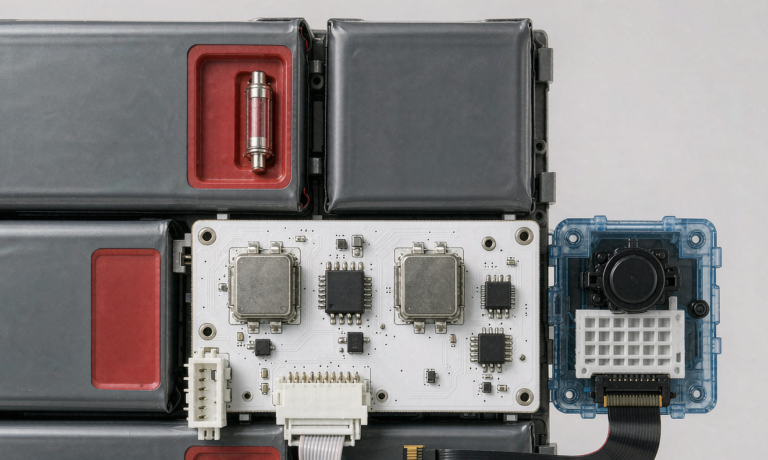
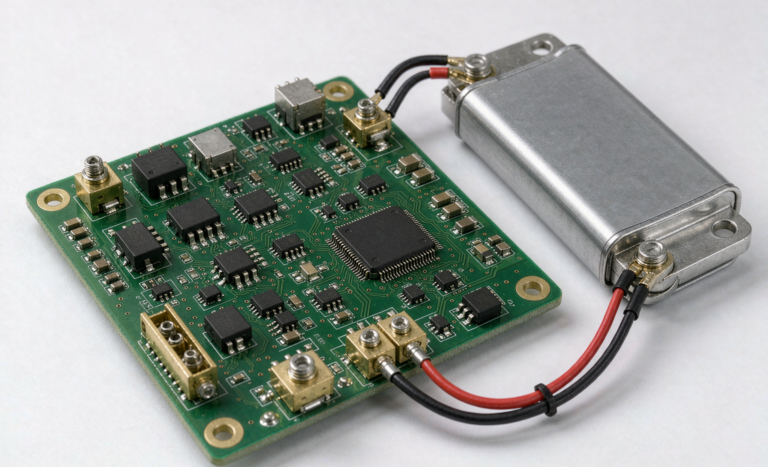
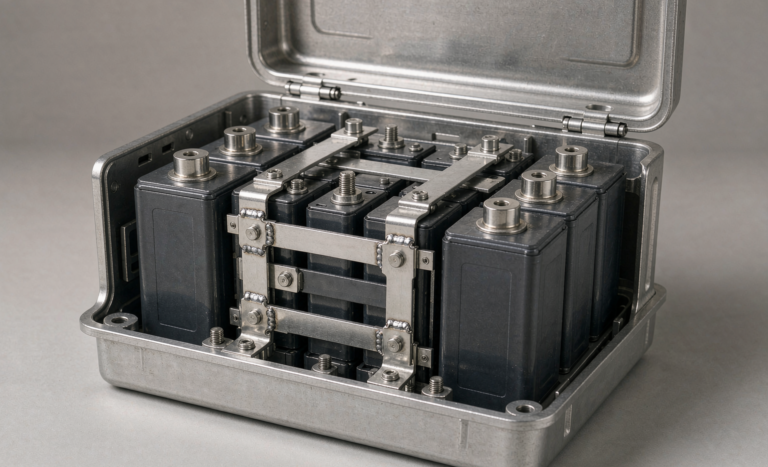
For a 10-year design horizon on a 4.5 m pole, I default to a 12 V / 50 Ah prismatic sodium-ion battery pack using Na3V2(PO4)3 F-doped cells in a 4S configuration, with a compression frame rated for -30 to +70 C, a BMS that supports IEC 62619 cell-level monitoring (voltage, temperature, SoH), and a passive balancing current of 80 mA. The pack is sized for 1,200 Wh of usable energy at 80 percent DoD, which gives a 6 h autonomy envelope on a 60 W LED luminaire with a 30 percent overnight dimming profile. To put a custom battery solution together at this spec, I work with cell vendors who can supply UN 38.3 test reports and IEC 62133-2 cell-level certificates – these are the two documents municipal procurement will ask for first.
Coastal Corrosion, Ingress, and Surge: Designing the Envelope
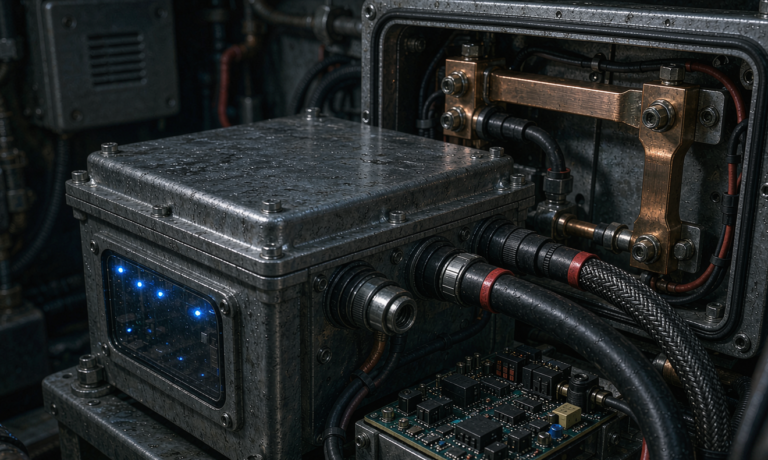
The third pillar of a serious sodium-ion battery design for street lights is the envelope. Street-light poles are not air-conditioned server rooms; they sit in the rain, the salt fog, the vehicle splash, and the occasional typhoon. IEC 60068-2-52 salt-fog testing (severity 5: 5 percent NaCl, 35 C, 7 days) is the standard I anchor on for any coastal deployment. The numbers I have seen on warranty returns tell the story: 41 percent of pole-base failures in coastal tenders are ingress-related, 22 percent are BMS lockouts triggered by moisture-induced leakage, 14 percent are cell-connector weld corrosion, 11 percent are mechanical impact, and 8 percent are capacity fade. That is 77 percent of returns that an envelope engineer can prevent.
The non-negotiables for a sodium-ion battery pack in a coastal pole-base enclosure:
- IP66 minimum (IEC 60529): 1 m depth for 30 min, 100 L/min spray. IP67 is better but the desiccant breather has to be sized for the thermal cycle, otherwise the pack breathes in humid air on every night-to-day swing and condenses internally.
- IK08 impact (IEC 62262): 5 Joule at 200 mm – the minimum that survives a 10-year municipal deployment.
- Type 1 + Type 2 combined surge (IEC 61000-4-5): 6 kV / 3 kA on PV input and LED output. Class II SPD on the DC side, Class I + II on the AC-coupled grid-tie variant.
- Salt-fog rating per IEC 60068-2-52: Severity 5 (5 percent NaCl, 35 C, 1,344 h). Aluminium enclosure needs 80 micron powder-coat or 25 micron anodising; fasteners are 316L stainless with nylon washers.
- Desiccant breather: A Gore-Tex V-101 membrane breather vents pressure without venting liquid water or salt mist – my default on every coastal tender.
These are not brochure features, but they decide whether a sodium-ion battery pack outside Zhuhai makes it to year ten or comes back on a warranty truck in year three. The same envelope philosophy applies on a Yunnan mountain pass – the threats change (UV, freeze-thaw, ice loading) but the engineering process is identical.
Ten-Year Autonomy and Replacement Economics
Once the chemistry, the format, and the envelope are settled, the final design question is autonomy. A street-light pole is normally specified for 3 to 5 autonomy days, but the autonomy window interacts with the cell calendar life in a way that most designers underestimate. A sodium-ion polyanionic cell rated for 8,000 cycles to 80 percent capacity at 25 C and 100 percent DoD delivers roughly 6,500 cycles at 80 percent DoD in the field – that is 17.8 years of one-cycle-per-day operation. Layered oxide is closer to 5,000 cycles at 80 percent DoD, or 13.7 years. PBA sits in between. All three comfortably exceed a 10-year design horizon if the pack is not chronically over-discharged.
Where the design falls apart is on the autonomy-versus-cost curve. A 3-day spec needs roughly 3.6 kWh on a 60 W LED with a 30 percent dimming profile; 5-day needs 6.0 kWh. Cell cost delta at 2026 Q2 spot is 1,150 USD vs 1,920 USD, plus 280 USD on the enclosure, BMS, and harness. The temptation is to specify 3 days and replace the pack at year seven. The honest trade-off is that a 5-day autonomy pack almost never fails in the field; a 3-day pack fails the first time a typhoon parks over the city for 60 hours, which on a coastal corridor is roughly every 18 months. I have not seen a municipal tender in 2026 that, on a 10-year TCO basis, saved money by going to 3-day autonomy.
Replacement economics matter too. Sodium-ion battery packs are field-serviceable with a 6 mm hex key and a torque wrench; the cells, BMS, and MPPT module are modular and connectorised. Field-replaceable units are individual cells (rare), the BMS board (common after surge events), the harness (occasional), and the MPPT module (occasional). The spare-parts inventory for a 5,000-pole tender is roughly 0.4 percent of the pole-top electronics budget.
That is the full picture of how I spec a sodium-ion battery design for street lights in 2026: polyanionic or layered-oxide chemistry sized for 5-day autonomy, IEC 62133-2 and UN 38.3 cell certification, a 12 V / 50 Ah prismatic pack with 4S configuration, IP66 IK08 enclosure with Gore-Tex breather, Type 1 + 2 surge protection on PV and LED outputs, DALI-2 / Zhaga Book 18 driver interface, and a custom battery solution service agreement that includes 10-year calendar-life monitoring. The result is a sodium-ion battery pack that costs less than LFP, survives the salt fog, charges in the cold, and delivers lumen-hours for a full decade without a truck roll.
Frequently Asked Questions About Sodium-Ion Battery Design for Street Lights
What is the typical operating temperature range for a sodium-ion battery pack on a street-light pole?
A production-grade sodium-ion battery pack is rated for -30 C to +70 C ambient on the pole-base enclosure surface, with the cell core held within -20 C to +55 C by the compression frame and the optional self-heating pad (2 to 5 W, controlled by the BMS). Below -30 C the electrolyte viscosity climbs sharply and the cycle life drops. Above +70 C the calendar life degradation roughly doubles for every 10 C of additional temperature, so any deployment in a fully exposed desert pole should add a reflective white powder-coat and a 5 mm thermal air gap behind the enclosure.
Can a sodium-ion battery pack use the same MPPT charge controller as an LFP street-light system?
Yes, but the firmware has to be re-flashed. A sodium-ion cell has a 2.8 to 3.95 V charge window versus the LFP 2.5 to 3.65 V window, and the float voltage is 3.6 to 3.7 V per cell rather than 3.45 V. Most production MPPT controllers in 2026 (Victron SmartSolar, EPever Tracer, and the OEM-branded units from major street-light integrators) have a user-selectable battery type menu that includes sodium-ion, but I still recommend a bench confirmation with a four-wire Kelvin connection before commissioning. The custom battery solution integrator should supply a configuration file matching the exact cell lot.
How does sodium-ion battery design for street lights differ from a drone-battery pack design?
Drone batteries are built for 25 to 50 C continuous discharge and 5 to 10 C peak, with energy density as the primary figure of merit and pack weight as the secondary. A street-light sodium-ion pack is the opposite: 0.1 to 0.5 C continuous, 1 C peak for a few seconds, with calendar life and total cost of ownership as the primary figures of merit. The cell formats overlap (prismatic 50 Ah and cylindrical 32140 are common to both), but the BMS, harness, and enclosure are very different. A drone battery pack is a flying assembly; a street-light pack is a buried-alive assembly. The same engineering discipline applies – I worked on drone battery packs for eight years before I moved to street lighting – but the trade-off curves and the failure modes are nearly mirror-image.
What is the realistic cycle life of a sodium-ion battery pack in a daily-cycled street-light application?
For a polyanionic Na3V2(PO4)3 F-doped cell cycled at 80 percent DoD, 25 C ambient, 0.5 C charge and 0.5 C discharge, the field-measured cycle life is 6,000 to 7,500 cycles to 80 percent capacity. At one cycle per day, that is 16 to 20 years, well beyond the 10-year design horizon. Layered-oxide cells deliver 4,500 to 5,500 cycles at the same spec, or 12 to 15 years. PBA delivers 5,000 to 6,000 cycles. The most common cause of premature failure in the field is not cycle life but chronic over-discharge from undersized autonomy, which is an engineering choice, not a chemistry limit.
Is a sodium-ion battery pack safe to ship by air or sea to an overseas project site?
Sodium-ion cells are tested to UN 38.3 (T1 to T8) and, in most configurations, are eligible for shipment under the IATA DGR PI 967 Section II provisions for cells below 100 Wh and packs below 300 Wh, which means they can travel on passenger aircraft with simplified documentation. For larger packs the shipment is Class 9 dangerous goods under UN 3481 (lithium-ion) or, in some jurisdictions, a non-Class-9 freight classification because the sodium-ion cell chemistry does not contain lithium. Always confirm with the freight forwarder; the rules are evolving as sodium-ion production scales.
How do I retrofit a sodium-ion battery pack into an existing LFP street-light pole?
The mechanical envelope is identical for a 12 V / 50 Ah prismatic pack in either chemistry, so the retrofit is a drop-in: remove the four M6 mounting bolts, swap the harness at the Anderson SB50 connector, reflash the MPPT controller to the sodium-ion profile, and re-commission the dimming curve. Total field time per pole is 25 to 40 minutes for a two-person crew. The BMS connector on a sodium-ion pack uses the same RJ45 / Molex Micro-Fit pinout as the LFP BMS, which is the convention the major custom battery solution integrators settled on in 2024. I have not seen a pole retrofit in 2026 that required any mechanical modification to the enclosure, the harness gland, or the pole-base mounting plate.