Commercial and Industrial Lithium Storage: Sizing and Safety
When a factory, warehouse, or telecom site asks me to size a stationary lithium battery system, the conversation is never about the headline capacity number. It is about load profile, duty cycle, and what happens on the worst day of the year. As a senior lithium battery engineer at Horizon Power, I have commissioned commercial storage from 50 kWh rack systems to multi-megawatt installations. In this guide I will cover how we size commercial and industrial lithium storage, why LFP has become the default chemistry, and the safety architecture that keeps large banks from becoming liabilities.
Start With the Load, Not the Battery
The first step in any industrial sizing exercise is the load profile. A lithium battery pack sized only on average load will either be wildly oversized or fail on its first peak. We collect at least 30 days of interval data — typically 15-minute resolution — and identify three numbers:
- Peak demand (kW) — the highest sustained draw, which sets the inverter and cell discharge C-rate.
- Daily energy throughput (kWh) — the energy moved per day, which sets capacity.
- Autonomy requirement (hours) — how long the system must hold up during an outage, which sets usable capacity and depth of discharge.
For a typical light-industrial site doing peak shaving, we might see 120 kW peaks and 400 kWh daily throughput with a two-hour autonomy target. That math points to roughly 250 kW power and 500 kWh usable — and because we cycle to only 90% depth of discharge on LFP, the nameplate lands near 560 kWh.
Why LFP Dominates Stationary Storage
For stationary commercial storage, lithium iron phosphate (LFP) is now the default chemistry, and the reasons are practical rather than theoretical. An LFP battery runs a flat 3.2 V nominal, tolerates 90% to 95% depth of discharge without the rapid wear that NMC would show, and is intrinsically more thermally stable.
By contrast, an NCM battery offers higher energy density, which matters in weight- or space-critical mobile applications, but in a fixed cabinet the density advantage is outweighed by LFP’s longer cycle life and lower fire risk. For most C&I projects I specify LFP with a 6000-cycle rating at 80% depth of discharge, versus the 2000 to 3000 cycles typical of NCM in the same duty.
Sizing the Power Conversion System
The battery is only half the system. The power conversion system (PCS) — inverter and battery management — must be matched to the load’s power, not its energy. A common mistake I see is undersizing the PCS to save cost, which then clips peak demand and undermines the whole business case.
We size the PCS at 1.2x the measured peak load to absorb motor inrush and future expansion. For the 120 kW example above, that means a 150 kW PCS. The lithium ion battery cells themselves must support a 1C to 2C discharge for that window; stationary LFP easily does 1C continuous, so a 500 kWh bank delivers 500 kW peak — far more headroom than needed, which is fine and keeps cells cool.
Thermal and Safety Architecture
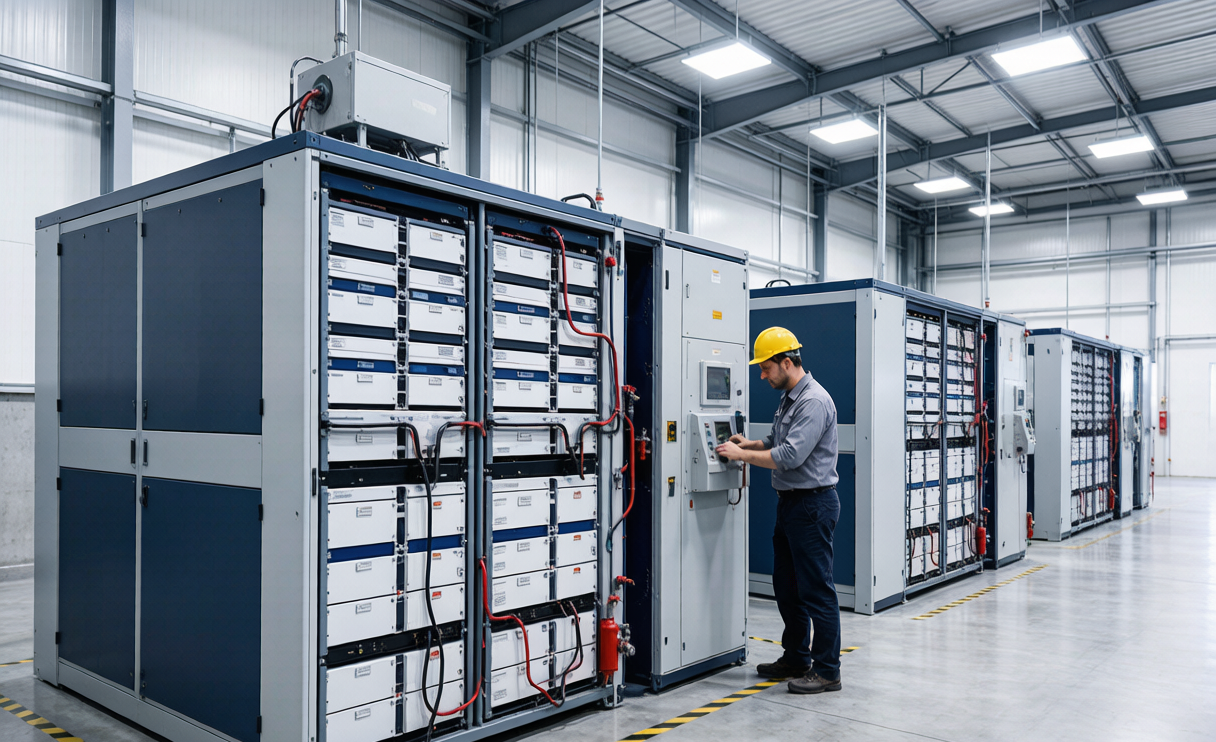
Safety is where commercial storage earns or loses its license to operate. A large bank is a concentrated energy source, so we build defense in depth:
- Cell-level fusing — every parallel string has a fuse so a single fault cannot drag the bank down.
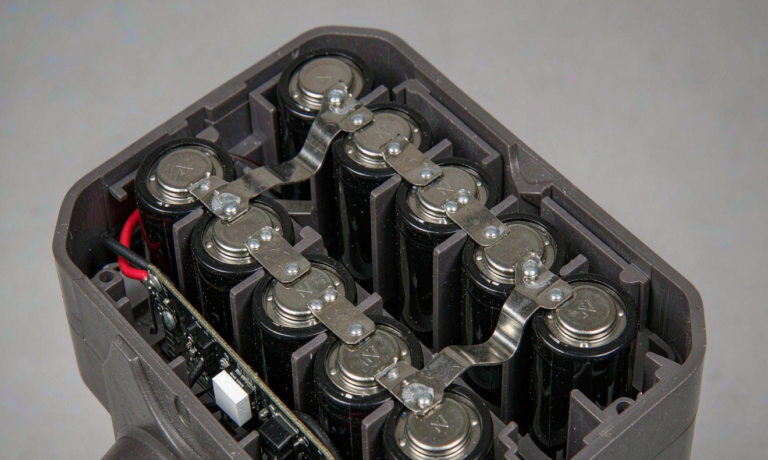
- Multi-stage BMS — cell voltage, temperature, and current are monitored at the module level and aggregated at the rack controller, with hard contactors that isolate on fault.
- Ventilation and separation — cabinets are spaced per local fire code, typically with at least 1 meter of clearance and dedicated exhaust.
- Fire suppression — we specify aerosol or water-mist suppression integrated with the building system, not as an afterthought.
Every pack we ship for industrial use is verified against IEC 62133 for cell safety and the relevant IEC 62619 standard for industrial battery systems. As a lithium battery manufacturer, we also run internal short-circuit and thermal propagation tests so a single cell failure does not cascade through the rack.
Transport and Compliance
Even stationary banks begin life as cells that must be transported to the site. That means UN38.3 compliance is non-negotiable — the cells and modules must pass altitude, thermal, vibration, shock, and short-circuit testing before they ever leave the factory. For sites in regulated industries, we also prepare the documentation for local electrical inspection and grid interconnection.
Operations and Maintenance Reality
The best-sized system fails if nobody maintains it. We brief every client on a simple monthly routine: check the BMS state-of-health readout, verify cabinet temperatures stay below 35°C ambient, and confirm the suppression system is armed. In our own monitored fleets, proactive cell-balancing at the BMS level has extended real-world life past the rated cycle count by keeping every series group within 20 mV.
If you are planning a custom battery solution for an industrial site, bring us the load profile first. The battery is the easy part; matching it to your actual duty cycle is where the savings and the safety both come from.
FAQ
How do I size a commercial lithium storage system?
Start from 30 days of load-interval data and extract peak demand (kW), daily throughput (kWh), and required autonomy (hours). Size the power conversion system at about 1.2x peak load and the battery at nameplate capacity equal to usable energy divided by your depth of discharge — typically 90% for LFP.
Why is LFP preferred over NCM for stationary storage?
LFP offers 6000+ cycles at 90% depth of discharge, superior thermal stability, and lower fire risk. NCM packs more energy per kilogram, which matters for mobility, but that advantage is irrelevant in a fixed cabinet where safety and cycle life dominate the lifetime cost.
What safety standards apply to industrial lithium banks?
Cell safety follows IEC 62133; industrial battery systems follow IEC 62619; transport follows UN38.3. On top of the standards, proper architecture — cell fusing, multi-stage BMS, ventilation, and fire suppression — is what actually prevents incidents.
How much maintenance does a C&I lithium system need?
Minimal but non-zero: a monthly check of BMS state-of-health, cabinet temperature, and suppression status. Modern BMS handles cell balancing automatically, which is the single biggest factor in hitting the rated cycle life.