Drone Battery Shipping Regulations
Every engineer who has ever packaged a drone battery for a customer overseas knows the sinking feeling of a shipment bounced back at the cargo gate. After fifteen years building drone lithium battery packs at Horizon Power, I can tell you that a compliant battery is only half the job—getting it from our factory floor in Shenzhen to a survey operator in Munich or a vineyard in Chile is governed by a stack of transport rules that are unforgiving if ignored. This guide walks through the drone battery shipping regulations I brief every B2B account manager on, covering air and ground transport, the test standards behind the labels, and the practical packing choices that keep a lithium battery shipment moving instead of sitting in a customs hold.
Why Drone Battery Shipping Regulations Exist in the First Place
Lithium cells are classified as dangerous goods because they can release energy violently when short-circuited, crushed, or overheated. A single 6S 22.2V drone battery can deliver a sustained 100A-plus discharge; in a confined cargo container, thermal runaway in one pack can cascade to the next. The transport framework exists to keep that energy contained. From my bench experience, the failure mode is almost never the cell chemistry itself—it is poor terminal protection, missing documentation, or a courier that does not accept Section II lithium freight. The drone battery shipping regulations are the operating manual that prevents those failures from becoming incidents.
The UN38.3 Test Suite: The Foundation of Every Compliant Shipment
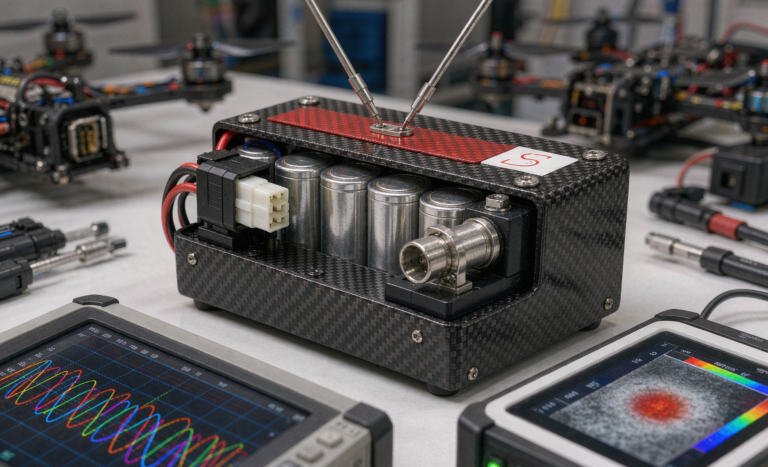
Before any lithium battery leaves our line for export, it must carry proof of UN Manual of Tests and Criteria, Part III, Section 38.3 compliance. UN38.3 is not a single test—it is eight:
- T.1 Altitude simulation – 11.6 kPa for at least six hours, simulating unpressurized cargo hold conditions.
- T.2 Thermal test – ten cycles between +75°C and −40°C with no mass loss or leakage.
- T.3 Vibration – swept-frequency profile, followed by T.4 Shock (150 G half-sine for large cells).
- T.5 External short circuit – 55°C ±2°C, with surface temperature capped at 170°C and no fire.
- T.6 Impact / crush – 13 kN applied to the cell.
- T.7 Overcharge and T.8 Forced discharge for battery-level assemblies.
A key threshold buyers should verify: cells and batteries below 20 Wh (cells) or 100 Wh (batteries) are still subject to UN38.3, but most consumer and industrial drone packs sit between 100 Wh and 300 Wh, which pushes them firmly into the documented, labeled, and often State-of-Destination approved category. At Horizon Power we keep the UN38.3 test summary on file for every custom battery solution we ship, because the carrier—not the manufacturer—decides at the ramp whether your paperwork is sufficient.
IATA DGR and Air Transport: Section II vs. Section IA/IB
For air freight, the IATA Dangerous Goods Regulations (DGR) is the rulebook couriers actually enforce. Lithium-ion batteries are assigned UN3480 (batteries alone) or UN3481 (packed with or contained in equipment). In my experience the most common confusion is the watt-hour band:
- Section II (UN3480, ≤100 Wh): Can often travel as non-dangerous goods if the package meets PI 965 packing instruction limits, but still requires the lithium battery handling mark and a declaration that the shipment meets the provisions.
- Section IB (>100 Wh up to 160 Wh): Limited to two cells or one battery per package when shipped alone; full hazard label and Shipper’s Declaration required.
- Section IA (>160 Wh): Fully regulated dangerous goods, full Class 9 label, UN specification packaging, and explicit airline approval.
Most professional drone batteries—think a 22.2V 10,000 mAh pack at roughly 222 Wh—fall into Section IA. That means your freight forwarder must file for operator acceptance, the outer box must be a UN-approved fiberboard or metal container, and gross mass per package is capped at 35 kg for passenger aircraft. I have watched a perfectly good drone lithium battery order miss a trade show because nobody requested the carrier’s written approval three working days ahead. Build that lead time into your plan.
FAA and EASA: Regional Enforcement You Cannot Ignore
IATA sets the global baseline, but civil aviation authorities add teeth. In the United States, the FAA enforces 49 CFR through its Hazardous Materials Regulations and routinely issues fines for misdeclared lithium freight; the FAA also bans bulk undeclared lithium-ion batteries as cargo on passenger aircraft. In the European Union, EASA aligns with ICAO but member-state bodies (such as the UK’s CAA or Germany’s LBA) can impose additional documentation checks at origin. For a B2B buyer importing into the EU, that means your supplier’s documentation must travel with the goods, and the Safety Data Sheet should reference both UN3480 and the applicable packing instruction. When we design a custom battery solution for a European OEM, we pre-stage the bilingual SDS and the test summary so the importer is never stuck explaining a gap at the border.
Ground Transport Compliance: ADR, DOT, and the Lithium Mark
Air gets the attention, but most drone batteries actually move by truck. On European roads that is ADR; in the United States it is 49 CFR / DOT HM-181; in China it is the JT/T and GB standards for road dangerous goods. Ground rules are generally more permissive than air—higher state-of-charge is allowed and UN specification packaging is sometimes relaxed for smaller quantities under the limited-quantity provisions—but the lithium battery handling mark is still mandatory, and the hazard placard (Class 9) is required above the limited-quantity threshold. In my shipping audits I always confirm three things for ground: terminals insulated, packs separated so they cannot contact, and the package marked with the correct UN number and lithium mark facing outward. A lithium battery packed loose in a tote without terminal caps is a failed audit waiting to happen.
Practical Packing I Specify for Every Export Order
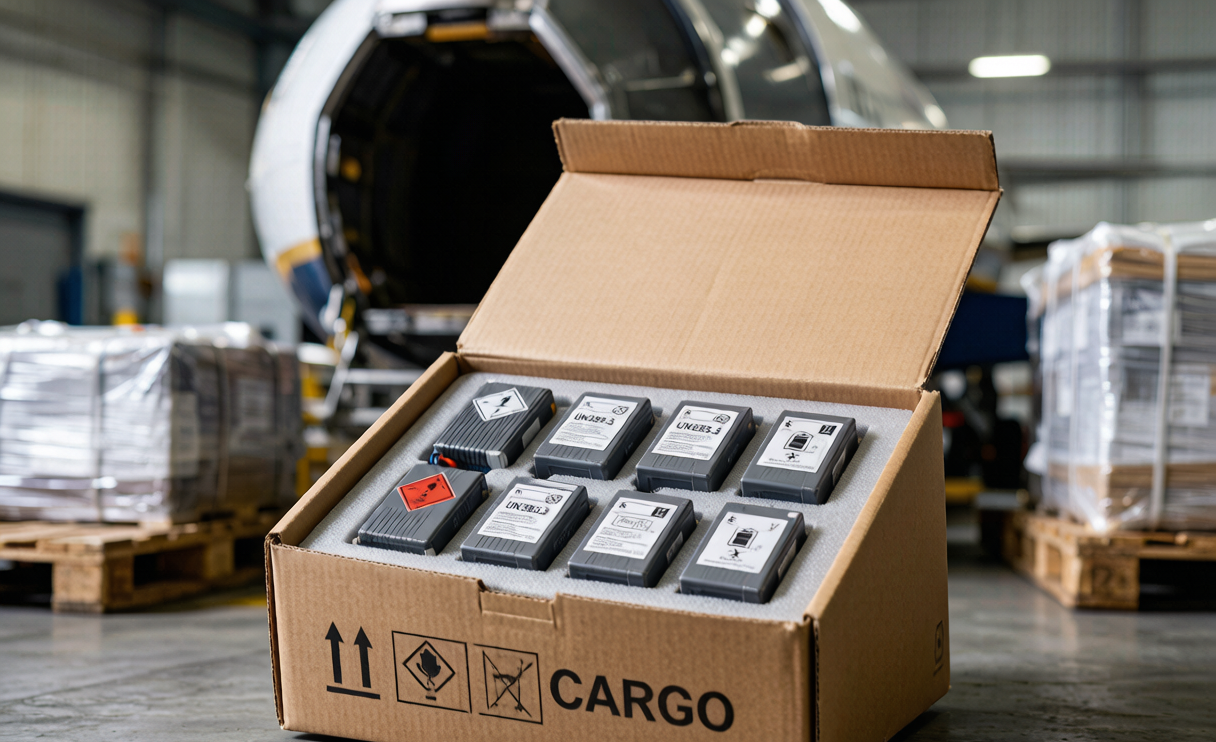
Beyond the legal text, here is the packing recipe we use at Horizon Power for outbound drone batteries:
- Terminal protection: Each pack gets insulating caps or tape over the XT60/EC5 connectors—non-negotiable.
- Inner cushioning: Die-cut EPE foam so cells cannot shift; we keep pack-to-pack spacing so a puncture in one does not reach the next.
- State of charge: For air, I cap shipped SOC at 30% unless the customer needs fly-ready packs and accepts the fully-regulated route.
- Outer carton: UN-rated fiberboard with the Class 9 lithium battery label, UN number, and a Shipper’s Declaration of Dangerous Goods completed by a certified person.
- Documentation pack: UN38.3 summary, SDS, and the IATA DGR declaration travel in a waterproof sleeve taped to the box.
Following this consistently is what lets a drone battery clear both the freight terminal and the receiving warehouse without a hold. If your volumes are high or your packs exceed 160 Wh, talk to us about a custom battery solution with integrated shipping compliance built into the BOM, not bolted on at the dock.
FAQ: Drone Battery Shipping Regulations
Can I ship a drone battery in passenger luggage?
For most commercial drone packs above 100 Wh, the answer is no as cargo and only under strict carry-on rules (typically ≤100 Wh with airline approval, limited count) as accompanied baggage. Spare batteries are banned from checked baggage by IATA. Always check the carrier’s currentwh limit before booking.
What is the difference between UN3480 and UN3481?
UN3480 covers lithium-ion batteries shipped alone; UN3481 covers batteries packed with equipment or contained in equipment. A standalone replacement drone battery is UN3480 and faces the strictest air rules, while a drone shipped with its installed battery is UN3481 and is treated more leniently.
Do I need UN38.3 testing for every battery order?
UN38.3 is a model/design qualification, not a per-shipment test, but you must keep the test summary available and repeat testing when the cell design, protection circuit, or capacity changes materially. For a custom battery solution with a new form factor, budget for a fresh UN38.3 run.
Is IEC 62133 required for shipping?
IEC 62133 is a safety standard for portable cells and batteries (covering short circuit, overcharge, and temperature abuse) rather than a transport rule, but carriers and buyers increasingly require it as evidence of cell quality. At Horizon Power we qualify cells to IEC 62133 alongside UN38.3 so a single battery satisfies both the safety and the drone battery shipping regulations expectations of our B2B customers.
What happens if I misdeclare a lithium battery shipment?
Misdeclaration can lead to shipment seizure, carrier bans, and fines that run into tens of thousands of dollars under FAA or EASA enforcement. More importantly, it puts handlers at risk. Accurate classification and a signed Shipper’s Declaration are the cheapest insurance you can buy.