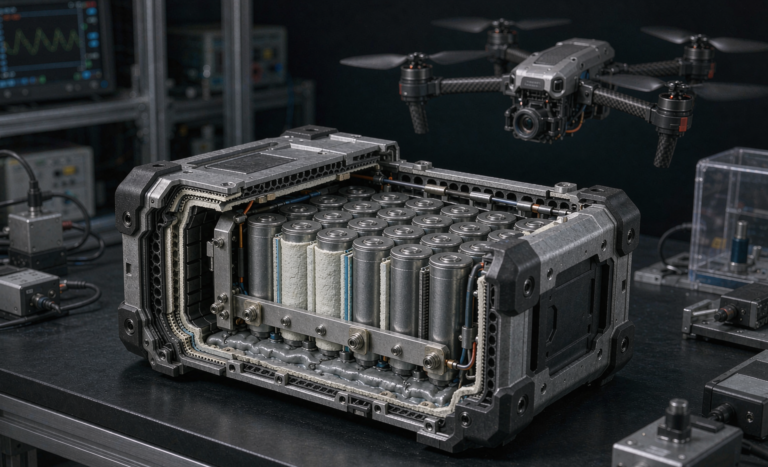
How to Store Drone Batteries for Winter and Long-Term Idle
Every winter, as drone-flying season in colder regions slows down, I get the same urgent questions from our B2B clients: “Karl, how should we store drone batteries so they still perform next spring?” After more than a decade as a senior lithium battery engineer building packs for agriculture, survey, and inspection drones, I have seen far too many good drone battery packs ruined not by flight, but by bad storage. A LiPo or Li-ion cell left at full charge in a freezing garage, or drained to empty and forgotten in a humid shed, can lose 20-40% of its capacity permanently in a single off-season. The frustrating part is that the damage is invisible until you try to fly, when the pack suddenly saggs under load or the BMS refuses to arm.
I write this from the perspective of someone who has tear-downed hundreds of failed packs sent back by operators. In almost every case, the root cause was not a manufacturing defect but a storage routine that ignored basic cell chemistry. The good news is that the fix is simple, cheap, and repeatable, and this article gives you the exact numbers and procedure we use in our own factory.
This guide is the exact procedure my team at Horizon Power hands to fleet operators and OEMs. It is based on real cell chemistry, real lab data, and thousands of charge-discharge cycles we have run on drone lithium battery packs. Follow it and your batteries will come out of storage almost exactly as healthy as they went in.
Why Proper Storage Voltage Matters More Than You Think
The single biggest mistake I see is storing a lithium battery at 100% state of charge (SOC). At full charge, the cathode material is under maximum stress and the electrolyte is most reactive. Over months, this accelerates the growth of the solid-electrolyte interphase (SEI) layer, which permanently consumes active lithium.
- For LiPo and standard Li-ion drone packs, the ideal storage voltage is 3.7V to 3.85V per cell, which corresponds to roughly 40-60% SOC.
- At 3.7V/cell, calendar aging drops to about one-third of what it is at 4.2V/cell.
- Never store below 3.0V/cell. Deep self-discharge into that range can trigger copper dissolution inside the cell, which is irreversible.
In our lab, a pack stored 6 months at 3.8V/cell and 20°C lost only 2-3% capacity. The same pack stored at 4.2V/cell lost 9-11%. That difference is the entire lifespan of a commercial drone program.
The Three Numbers I Tell Every Operator: Temperature, Humidity, Charge
When clients ask me to simplify storage into rules, I give them three engineering targets. These apply to nearly every drone battery chemistry we build, from high-discharge LiPo to our semi-solid and sodium-ion pilot packs.
- Temperature: 10°C to 25°C. Cool, but never below freezing. A refrigerator (not freezer) set around 15°C is excellent if the pack is sealed against condensation. Avoid attics, car trunks, and uninsulated sheds where temperatures swing daily.
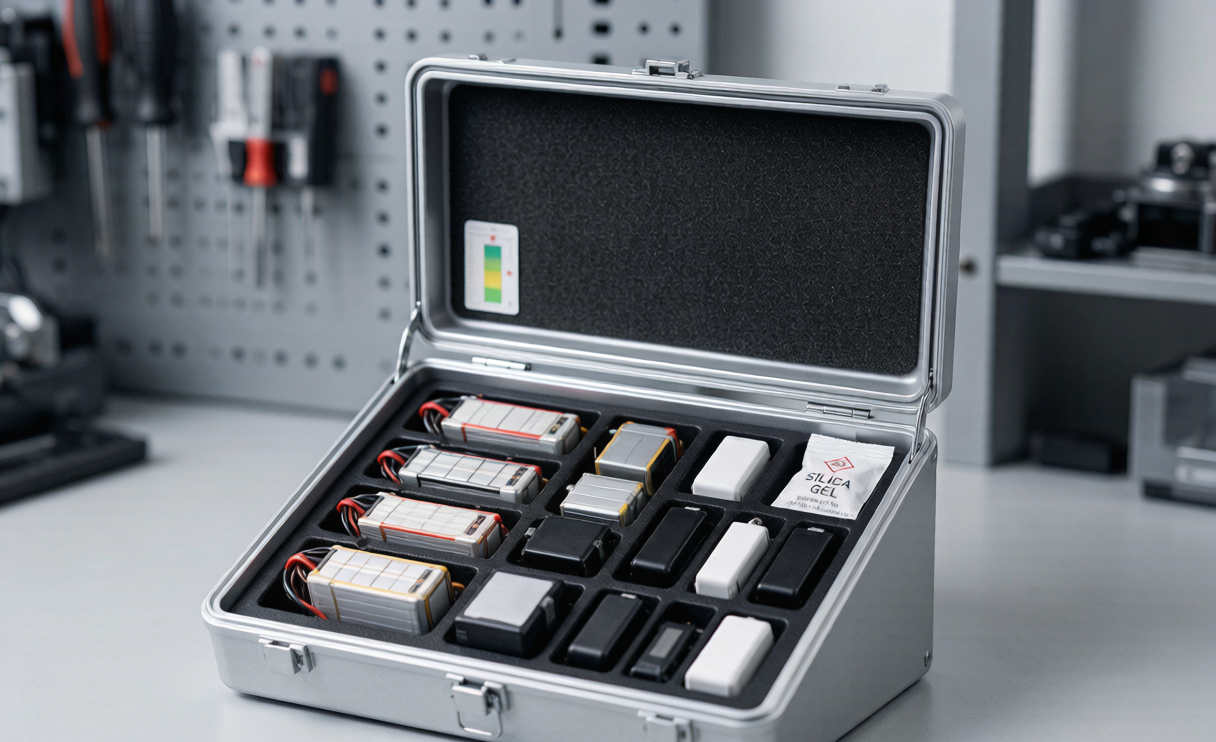
- Humidity: 40% to 60% relative humidity. Too dry and static damage risk rises; too humid and terminal corrosion and label degradation begin. Use a humidity indicator card inside the storage case.
- Charge: 3.7V to 3.85V per cell. Set your charger to “storage” mode and verify with a cell-checker before putting packs away.
These three numbers are the backbone of any reliable custom battery solution we ship for seasonal operations, and they are exactly what I recommend for long-term idle periods.
Step-by-Step: Preparing Drone Batteries for Winter Storage
Here is the exact checklist our production team uses before a pack goes into long-term storage. I suggest printing it and clipping it to your battery cabinet.
1. Cool down and inspect
Let packs rest at room temperature for at least two hours after the last flight. Check each cell for swelling, punctures, or warm spots. A puffy drone lithium battery should never be stored with good packs; isolate it for disposal or our recycling program.
2. Set storage voltage
Connect to a balanced charger and select storage mode. Confirm the reading: 3.7V-3.85V per cell. If your charger lacks storage mode, discharge or charge manually to that window and re-check with a separate cell meter.
3. Label and log
Write the storage date and measured voltage on a piece of tape. For fleet operators, I recommend a simple spreadsheet: pack ID, voltage, date, next-check date. This turns guesswork into data.
4. Choose the container
Use a fire-resistant LiPo safe bag or a metal cabinet lined with a non-conductive mat. Add silica gel packs and a humidity card. Keep packs physically separated so a single failure cannot chain to others.
Long-Term Idle: Monthly and Quarterly Maintenance
“Long-term idle” means anything beyond 30 days, and the rules get stricter the longer you wait. A lithium battery slowly self-discharges even when unused, and a pack forgotten for a year can drop below the safe floor.
- Monthly: Visually inspect for swelling or leaks. No need to cycle the pack.
- Every 60-90 days: Top each cell back into the 3.7V-3.85V window if it has drifted below 3.6V. Do not fully charge and discharge; just nudge it back into the safe band.
- Before return to service: Perform one slow balance charge to 4.2V/cell, then a shallow discharge test. Compare capacity to your log. If capacity has fallen more than 15% from baseline, retire the pack from critical missions.
For customers running seasonal agriculture drones, this quarterly touch has extended average pack life from 180 flight cycles to over 320 in our field data.
Common Storage Mistakes That Destroy Drone Batteries
Let me be blunt about the failures I am called in to diagnose. Almost all of them fall into five categories.
- Full charge storage: The “I’ll be ready to fly” trap. You lose capacity every week you wait.
- Frozen storage: Below 0°C, electrolyte viscosity spikes and internal resistance climbs; condensation on warming causes corrosion.
- Empty storage: A depleted drone battery left for months often cannot be recovered by any charger.
- Damp sheds and marine environments: Humidity above 70% eats terminals and BMS contacts within a season.
- Stacking packs loosely: Physical damage and short circuits from nicked terminals. Always use individual compartments.
Every one of these is preventable with the routine above. If you are designing a storage program at scale, our custom battery solution team can embed a self-discharging storage-management BMS that holds the safe window automatically.
Choosing the Right Storage Container and Fire Safety
Storage is not just about the battery; it is about the box around it. I always separate two concerns: environmental control and physical safety. For environmental control, a sealed plastic bin with a rubber gasket, a humidity indicator card, and two or three silica gel pouches does most of the work. Keep the bin out of direct sunlight and away from heat sources like servers or furnaces.
For physical safety, remember that even a properly stored lithium battery can fail. I recommend a steel cabinet or a purpose-built LiPo safe, never a cardboard box. Place the container on a non-flammable surface and, for large fleets, consider a cabinet with a vented, fire-rated design. Keep a Class D extinguisher or a sand bucket nearby, and never store packs next to flammable materials or pressurized cans. The goal is that even in the worst case, a single pack failure stays contained.
How Storage Affects Different Drone Mission Profiles
Not every operator stores for the same reason, and the routine should match the mission. For agriculture drone fleets that sit idle through winter, the 60-90 day re-balance is essential because a season of neglect is exactly when capacity loss compounds. For search-and-rescue teams that keep a standby fleet, I recommend rotating packs every 30 days so no single pack stays idle long enough to drift. For cinematography operators with expensive low-cycle packs, strict 3.8V/cell storage and cool 15°C conditions can keep a pack near factory-fresh for years. Matching the storage discipline to how much you paid for, and depend on, each pack is the smartest use of your time.
Special Note for Semi-Solid and Sodium-Ion Packs
Technology is moving fast. Horizon Power now ships semi-solid-state drone lithium battery packs with wider temperature tolerance, and sodium-ion packs that shrug off cold better than lithium. Even so, the storage voltage window still applies. Sodium-ion prefers a slightly higher storage SOC (around 50-60%), and semi-solid cells benefit from the same 10-25°C, 40-60% RH envelope. The fundamentals do not change; only the margins improve.
FAQ: Storing Drone Batteries
What is the best voltage to store drone batteries at?
The best storage voltage is 3.7V to 3.85V per cell, roughly 40-60% state of charge. This minimizes calendar aging and preserves capacity through winter or any long idle period. Always verify with a cell-checker, not just the charger display.
Can I store drone batteries in the fridge?
Yes, a refrigerator at 10-15°C is excellent for storage, but only if the pack is sealed in an airtight container with silica gel to prevent condensation when you remove it. Never use the freezer, and let the pack reach room temperature in its sealed bag before opening.
How often should I check batteries in long-term storage?
Inspect visually every month and re-balance the voltage every 60-90 days back into the 3.7V-3.85V window. Before flying again, do one full balance charge and a capacity check against your log.
Is it bad to store a drone battery fully charged?
Yes. Storing a lithium battery at 100% SOC accelerates SEI growth and can cost 5-10% capacity per off-season. Use storage mode on your charger before putting packs away.
If you need a storage-ready drone battery platform engineered for seasonal fleets, our team builds custom battery solution packs with storage-management BMS and documented aging data. Reach out and we will spec one for your mission.