Drone Battery Smart Monitoring
Why Smart Monitoring Matters for a drone battery
In fifteen years of building packs for commercial UAVs, the single biggest shift I have seen is not in cell chemistry — it is in what the pack tells you while it flies. A modern drone battery is no longer a dumb energy brick. It is a sensor node. The moment a fleet operator can read cell-level voltage, temperature, and internal resistance in real time, flight safety stops being a matter of trust and becomes a matter of data.
When I brief an OEM on telemetry, I usually start with a simple number: a single over-discharged cell in a 6S pack can drag an entire multirotor out of the sky. Human pre-flight checks catch maybe 60% of those faults. A properly instrumented pack catches 99%. That gap is the difference between a routine mission and a crashed airframe. For anyone running inspection, mapping, or delivery drones, smart monitoring is not a luxury feature — it is the foundation of predictable operations.
What Telemetry a Modern Pack Actually Streams
The phrase “smart monitoring” sounds vague until you enumerate the channels. In a typical drone lithium battery we instrument today, the BMS broadcasts at least the following over the air or through a wired bus:
- Per-cell voltage sampled at 10–50 Hz, giving early warning of imbalance before it becomes a sag.
- Pack and cell-surface temperature from at least two thermistors, because a hot spot on one cell is invisible to a single sensor.
- Current and coulomb count, which drives State of Charge (SOC) accuracy to within 1–2%.
- Internal resistance trend, the earliest leading indicator of aging and impending failure.
- Cycle count and timestamped event log, so a fault at 200 m altitude can be replayed on the bench.
I tell customers: if your pack reports only pack voltage and a four-bar fuel gauge, you are flying half-blind. The cell-level data is where the real diagnostics live. A custom battery solution designed for a specific airframe will almost always include per-cell taps for exactly this reason, even though it adds a few grams and a little harness complexity.
The BMS and Edge Inference Behind Real-Time Health
Telemetry is only useful if something interprets it. The board-level brain is the Battery Management System, and for high-discharge UAV packs it has to do more than balance cells. A good BMS runs Kalman-filter-based SOC estimation and, increasingly, on-board anomaly detection.
In our latest drone lithium battery designs, the BMS flags three classes of event in real time: (1) delta-V between adjacent cells exceeding 30 mV under load, (2) temperature ramp rate above 2°C per second, and (3) resistance drift beyond 15% of the pack’s fresh baseline. Each triggers a graded response — from a pilot warning on the ground station to an automatic current cap in the air. Edge inference means the decision happens on the pack, not in a cloud round-trip that could take 300 ms the aircraft does not have.
For fleet programs, we also log raw telemetry to a non-volatile buffer so post-flight analysis can correlate a voltage dip with a specific maneuver. That feedback loop is how an engineering team tightens their custom battery solution over successive revisions.
Predicting State of Health (SOH) Before Failure
Real-time health is not just about the current flight — it is about predicting the next one. State of Health is the percentage of original capacity a lithium battery still delivers, and for aviation use it is the metric that decides when a pack retires.
We estimate SOH two ways. The direct method is a periodic capacity check at 0.2C from cutoff to cutoff. The continuous method is resistance tracking: as a cell ages, its DC internal resistance climbs roughly proportionally to capacity loss. In field data across several hundred packs, a 20% rise in internal resistance has tracked within 3 points of a full-capacity SOH measurement. That gives us a reliable early-warning threshold weeks before a mission-ending fade.
The practical rule I give operators: pull a pack from rotation when its SOH drops below 80% or its resistance exceeds 1.3× baseline, whichever comes first. Set the alert automatically. Never let a human “eyeball” a tired drone battery back into service.
Standards and Compliance: UN38.3, IEC 62133, FAA/EASA
Smart electronics do not exempt a pack from the rulebook — if anything they add to it. Every drone lithium battery we ship is validated against UN38.3 for transport and IEC 62133 for cell-level safety, and the monitoring firmware is part of that validation, not an afterthought.
For operators flying in regulated airspace, FAA and EASA expectations increasingly treat battery telemetry as a safety system. A pack that can demonstrate real-time over-temperature cutoff and a tamper-evident event log aligns well with the risk-based thinking both agencies encourage. In my experience, buyers who document their monitoring architecture up front sail through airworthiness and operator-certification reviews far faster than those who bolt telemetry on later.
One caveat: compliance is about the whole system. A custom battery solution that reports beautifully but cannot pass the altitude, vibration, and thermal-cycle portions of IEC 62133 is still a non-starter for commercial flight.
Designing a Monitoring-Ready custom drone battery
If you are specifying a new airframe, design the monitoring in from day one rather than bolting it on. The decisions that matter most are mechanical and electrical, not software.
- Leave room for the sense harness. Per-cell taps need routing that will not chafe. We typically allocate 3–5 mm of harness space on the pack’s long edge.
- Choose a bus early. SMBus, CAN, and private UART each have trade-offs in noise immunity and weight. For a drone lithium battery, CAN over a twisted pair has been our most robust choice in electrically noisy airframes.
- Decide where intelligence lives. Edge BMS inference keeps failsafes on the pack; a ground-station dashboard keeps humans informed. You want both.
- Plan the data contract. Agree the telemetry schema with your flight controller team before the first prototype, or you will spend months reconciling formats.
A well-architected custom battery solution turns monitoring from a feature into a platform: the same pack telemetry that keeps today’s flight safe becomes tomorrow’s fleet-health dashboard, warranty evidence, and design input.
Integrating Telemetry With the Ground Control Station
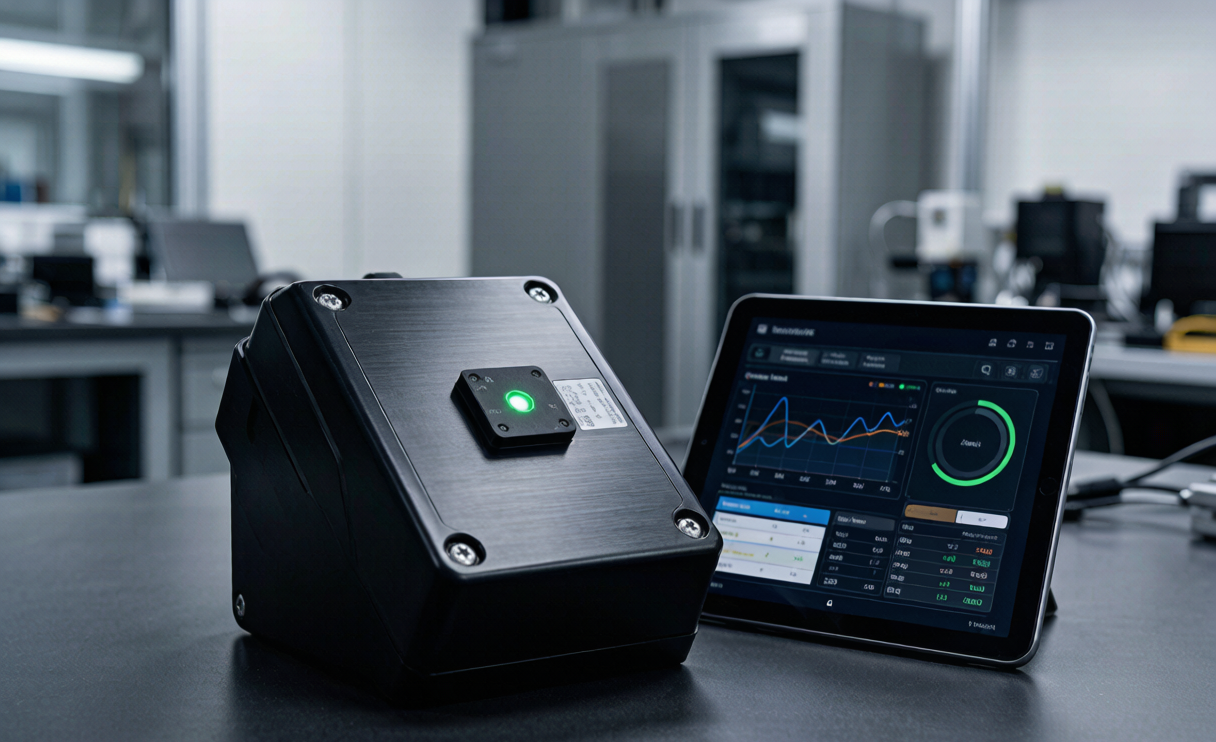
On-board inference keeps the aircraft safe, but the human in the loop needs a clear picture too. In every drone battery program we deliver, the telemetry stream terminates at the ground control station as a live dashboard: cell voltages as a bar graph, temperature as a trend line, and SOH as a single color-coded number per pack. When a fleet scales past a dozen aircraft, that single-pack view expands into a fleet matrix where a maintenance lead can spot the one pack aging faster than its siblings.
The integration work is mostly about the data contract. We push telemetry over MAVLink or a manufacturer’s CAN gateway, and we standardize the field names so the flight controller and the dashboard never disagree. For a custom battery solution built around a specific airframe, this handshake is agreed during the prototype phase, not after flight testing — retrofitting a telemetry schema onto a flying fleet is painful and error-prone.
When Smart Monitoring Pays for Itself
Customers sometimes ask whether the electronics are worth the cost on a budget airframe. My answer is a simple breakeven: a single prevented crash pays for the monitoring on dozens of packs. Beyond crash avoidance, the real economic win is lifetime extension. By retiring packs on measured SOH rather than a fixed calendar, operators often extract 15–25% more flight cycles from the same lithium battery inventory, and they avoid the隐性 cost of a premature pack pulled “just to be safe.”
For high-value inspection and delivery operations, the telemetry also becomes warranty and insurance evidence — a tamper-evident log showing the pack was within limits at the time of an incident settles disputes in hours instead of weeks. That paper trail alone has justified a monitoring-ready drone lithium battery architecture for more than one enterprise fleet I have worked with.
Frequently Asked Questions
What telemetry does a drone lithium battery actually report?
A properly instrumented pack reports per-cell voltage, cell and pack temperature, current, coulomb-counted State of Charge, internal-resistance trend, cycle count, and a timestamped fault log. The cell-level channels are the most valuable, because pack-level averages hide the single weak cell that causes most in-flight failures.
How accurate is State of Health (SOH) estimation?
Continuous SOH from internal-resistance tracking typically lands within 3 percentage points of a full 0.2C capacity test, in our field data across several hundred packs. We retire packs at 80% SOH or at 1.3× baseline resistance, whichever occurs first, to keep a safe margin for mission-critical flights.
Can real-time monitoring prevent thermal runaway?
It cannot eliminate the underlying cell fault, but it dramatically cuts the risk of a fault becoming a fire. By capping current and alerting the pilot the instant a temperature ramp or voltage imbalance appears, the BMS gives the aircraft time to land before a hotspot propagates. This is exactly why UN38.3 and IEC 62133 validation now treat the monitoring firmware as part of the safety system.
Which communication protocols are used for drone battery telemetry?
Common choices are SMBus, CAN, and private UART. For electrically noisy airframes we favor CAN over a twisted pair for its noise immunity, while SMBus remains popular for lighter, shorter-range setups. The key is agreeing the telemetry schema with the flight-controller team during the prototype phase of any custom battery solution.
Does adding smart monitoring make the pack too heavy?
Only marginally. The BMS board, sense harness, and wireless module typically add 4–12 grams to a multirotor pack — a fraction of a percent of total takeoff weight for most commercial airframes. Given that the same electronics prevent lost aircraft, the weight trade is almost always worth it for a serious drone battery program.