Drone Battery Maintenance Between Flights: A Field Checklist
Why Between-Flight Care Decides Pack Life
When I walk a flight line as a senior lithium battery engineer, the single habit that separates a 300-cycle pack from an 800-cycle pack is almost never the cell chemistry. It is what the operator does in the 20 minutes between landing and the next takeoff. A drone battery is a high-energy-density system that gets shaken, heated, cooled, discharged hard, and recharged fast — often in dust, heat, or salt air. Between flights is exactly when small problems (a loose connector, a warm cell, a slightly swollen pouch) are still cheap to catch. Leave them alone and they compound into a thermal event or a dropped airframe.
In this field guide I will walk through the same between-flight checklist my team hands to commercial operators running survey, spraying, and inspection drones. It is built on real failure data, the UN38.3 and IEC 62133 test frameworks, and the practical limits imposed by FAA and EASA transport and operation rules. None of it requires a lab — just discipline and a few cheap tools.
The Pre-Flight Visual and Tactile Inspection
Before any battery touches the aircraft, I run a 60-second look-and-feel check. It catches more field failures than any diagnostic tool.
- Shell and label integrity. Cracks, dents, or melted shrink wrap mean the internal structure has been stressed. I retire any pack that has taken a hard impact even if it still holds voltage.
- Swelling. Press the pack gently against a flat surface. A healthy drone lithium battery stays rigid. Even 1–2 mm of bulge in a pouch cell is a warning that the anode is gassing — pull it from service.
- Connector and lead condition. Look for blackened pins, melted housings, or frayed silicone wire. A high-C discharge pushes 60–150 A through an XT60 or EC5; a resistive contact there turns into heat and voltage sag at the worst moment.
- Smell. A faintly sweet or acrid odor is electrolyte off-gassing. Do not fly it.
I tell new operators: if you would not hand the pack to your own team lead, it does not fly. This single rule has prevented more incidents than every dashboard alarm combined.
Temperature Management: The 20–40°C Sweet Spot
Lithium cells like to be warm, not hot. The usable, healthy window for a lithium battery on a flight line is roughly 20–40°C surface temperature at takeoff. Below about 10°C, internal resistance climbs and usable capacity drops; push a cold pack to full C-rating and you risk lithium plating, which permanently kills capacity. Above 50°C surface, you are in accelerated-aging territory and approaching the onset of thermal runaway for damaged cells.
My between-flight routine:
- After landing: let the pack rest 10–15 minutes. Surface temp often reads 45–55°C right after a heavy lift; forcing a charge now bakes the cells.
- Before charging: confirm pack is under 40°C. Many smart chargers will refuse anyway, but the operator discipline matters more than the limiter.
- In cold climates: keep packs in an insulated case against your body or a warmed container until seconds before install. I have measured 18% capacity recovery just by warming a pack from −5°C to 20°C before flight.
- In desert heat: shade the batteries. A pack left on a 60°C truck bed for 30 minutes enters a self-reinforcing heating cycle you cannot reverse in the field.
Voltage, Internal Resistance and Capacity Checks
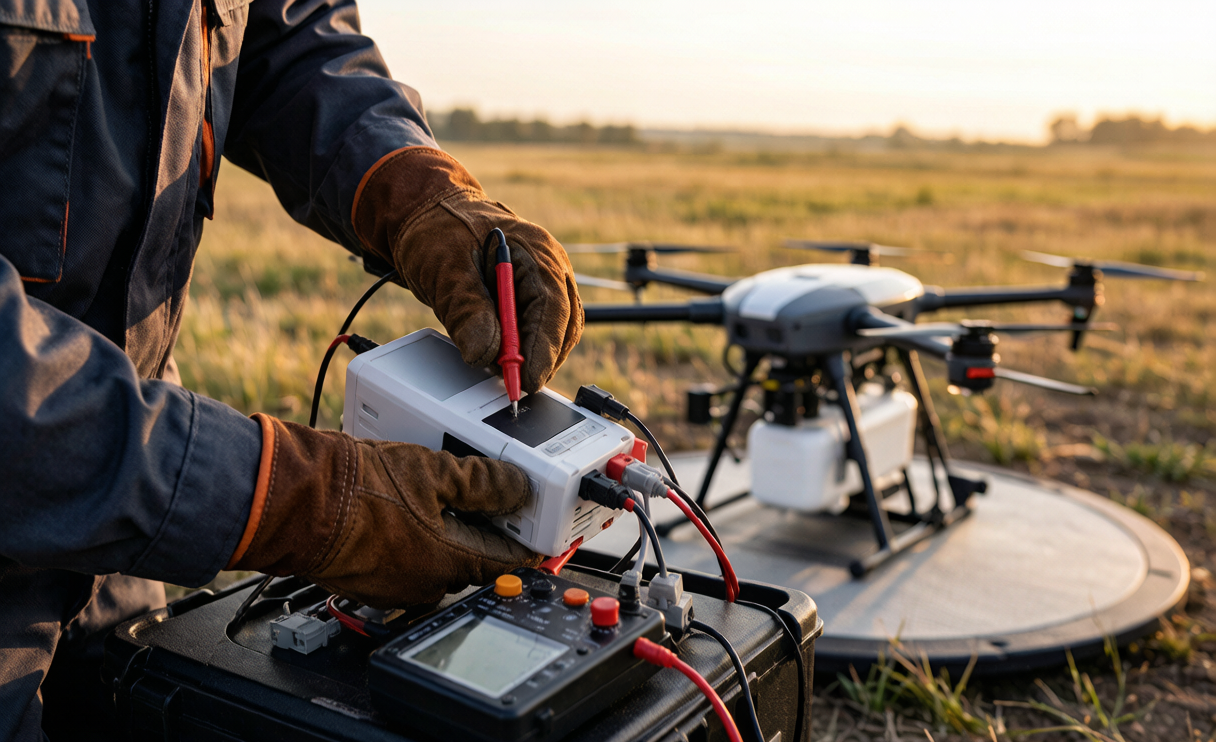
The numbers tell the story a visual check cannot. Between sorties I log three values per pack:
- Resting cell voltage. With a 6S pack, every cell should sit within 0.02–0.03 V of its siblings after a balanced rest. A single cell drifting 0.05 V low is the earliest reliable sign of a weak cell.
- Internal resistance (IR). A handheld battery analyzer gives this in milliohms. Track the trend, not the absolute. A pack that creeps from 8 mΩ to 14 mΩ across a season is aging; the one that jumps overnight is failing.
- Real delivered capacity. Once a week, do a controlled discharge and confirm the pack still delivers within 90% of its rated mAh. This is the only test that directly answers “will it make the mission.”
I standardize every fleet on the same logging sheet so a weak pack is obvious the moment its curve diverges. It is the same discipline we apply when designing a custom battery solution for an OEM — you cannot improve what you do not measure.
Connector and BMS Hygiene
The battery management system is your last line of defense, but only if it is healthy and the physical interface is clean. Between flights I do two things:
- Clean the contacts. A dab of isopropyl alcohol on a lint-free swab removes the conductive dust and oxidation that cause intermittent voltage drops. Never use petroleum greases on HV connectors — they attract grit.
- Verify BMS telemetry. If the pack reports cell-level data over SMBus or a proprietary protocol, confirm the BMS is awake and reading. A BMS that has dropped a cell channel is silent until it is too late. I pair every smart pack with a field reader so the pilot sees per-cell voltage on the ground, not just in the air.
For operators standardizing fleets, this is where working with a manufacturer on a custom battery solution pays off: consistent connectors, a known BMS protocol, and spare boards on the shelf turn a 3-day downtime into a 20-minute swap.
Storage, Transport and Compliance Between Missions
Between flights is also between the rules that keep you legal. Three frameworks shape what I do:
- UN38.3. Every pack we ship or carry has passed the UN38.3 series — altitude simulation, thermal test, vibration, shock, external short, impact, overcharge, and forced discharge. If a pack has been in a hard crash, its UN38.3 validity is effectively void for transport. I re-test or retire.
- IEC 62133. This is the safety baseline for portable secondary cells. When I audit a fleet, I want proof the cells meet IEC 62133; it is the difference between a pack designed for consumer gadgets and one built for repeated high-C abuse.
- FAA / EASA. Spare drone lithium battery packs must travel as carry-on, terminals protected, typically at or below 100 Wh without special approval (larger packs need operator permission). On the flight line, that means battery cases with cell dividers, not loose packs rattling in a pelican case.
For multi-day deployments, store packs at roughly 30–60% state of charge in a cool, dry place. A fully charged pack sitting at 40°C for a week loses more life than one flown daily. This single storage habit is the cheapest cycle-life multiplier I know.
Building the Habit Into Your Operation
A checklist only works if it is fast and written for the field. I use a laminated one-page card per aircraft type with checkboxes for: visual, swelling, connector, temp, resting voltage, IR trend, BMS read. The pilot initials it; the lead reviews the log weekly. If you run mixed fleets or prototype airframes, a custom battery solution with unified connectors and a shared BMS protocol makes the same card work across every airframe — which is the real reason many operators move to standardized packs.
Frequently Asked Questions
How long should a drone battery cool between flights?
I recommend a 10–15 minute rest after landing, then confirm surface temperature is below 40°C before charging or reinstalling. In hot weather this may stretch to 20–30 minutes. Charging a pack that is still above 50°C is the fastest way to permanently shrink its capacity.
What is the earliest sign a drone lithium battery is failing?
The earliest reliable signs are a single cell drifting more than 0.05 V from its siblings at rest, a steady climb in internal resistance across flights, and any visible swelling. Catching any of these between flights lets you retire the pack before it becomes a safety event.
Can I charge a cold drone battery right before flight?
Not at full rate. Below about 10°C, charging or high-C discharge risks lithium plating on the anode, which permanently reduces capacity and can create internal shorts. Warm the pack to at least 15–20°C first; in deep cold, keep it insulated until seconds before install.
Should I store drone batteries fully charged between missions?
No. Store at 30–60% state of charge in a cool, dry place. A pack held at 100% charge and elevated temperature ages far faster than one flown regularly. Most smart chargers have a “storage charge” mode that lands the pack in exactly this window.
Do I need UN38.3 and IEC 62133 documentation for field packs?
You need UN38.3 for any transport of lithium cells and IEC 62133 as the safety baseline for the cells themselves. After a hard crash the transport certification is effectively void, so I re-test or retire the pack rather than risk carrying a damaged high-energy pack.
How often should I run a full capacity test?
Once a week per pack under active service is enough for most fleets. The goal is not a perfect number but an early warning: when a pack delivers below 90% of its rated capacity, or its trend diverges from the fleet, it is time to rotate it to less critical duty or retire it.