Drone Battery Voltage Selection
Every drone program I have worked on—from a 250 mm racing quad to a 30 kg agricultural sprayer—has hit the same fork in the road before a single cell was spot-welded: what nominal pack voltage should we build around? As a senior lithium battery engineer at Horizon Power, I have seen teams burn three months and a five-figure tooling budget because they picked 6S when the motor actually wanted 12S, or vice versa. Voltage is not a detail you tune at the end. It is the first architectural decision that cascades into motor KV, ESC rating, wire gauge, thermal design, and even how the pack ships under UN38.3. In this field guide I will walk you through how we select drone battery voltage in real programs, what the 6S and 12S options actually buy you, and where the common mistakes hide.
Why Voltage Is the First Decision, Not the Last
A lithium battery pack rated at 6S has a nominal voltage of 22.2 V (6 × 3.7 V) and a fully charged voltage of 25.2 V. A 12S pack doubles that to 44.4 V nominal and 50.4 V at full charge. That factor-of-two jump changes almost everything downstream. Higher voltage lets you push the same power through with lower current, which reduces I²R copper losses and keeps connectors cooler. Lower voltage keeps the system simpler, lighter on insulation, and friendlier to off-the-shelf ESCs. When a buyer asks us for a custom battery solution, the very first question we ask is not capacity—it is “what voltage does your powertrain expect?”
The trap is that voltage feels interchangeable early on. A prototype flies on 6S, looks fine, and then the production version needs 40% more thrust. At that point the motor KV is locked, so the only levers left are ugly: parallel packs, oversized ESCs, or a full redesign. Getting the drone battery voltage right up front is the cheapest insurance you will ever buy.
Reading the Motor Curve: KV, RPM and Voltage
Brushless outrunner motors are governed by a simple relationship: no-load RPM ≈ KV × applied voltage. A 6S pack at 25.2 V driving a 900 KV motor spins near 22,680 RPM unloaded. The same motor on 12S at 50.4 V wants 45,360 RPM—roughly double. That is rarely what you want, because prop tip speed goes supersonic, efficiency collapses, and noise spikes. In practice, when we move from 6S to 12S we drop the motor KV by about half so the prop sees the same target RPM.
Here is the part engineers underestimate: prop load is not linear. Thrust scales steeply with RPM, so a small voltage change moves your operating point on the motor curve a long way. In our lab we always pull the real motor curve at 25 °C and at -10 °C, because a drone lithium battery that looks perfectly matched on the bench can fall off the efficiency cliff in cold air. We log throttle-position-versus-RPM at three voltages before we commit a pack design.
6S vs 12S: A Side-by-Side Engineering Comparison
Neither 6S nor 12S is “better.” They trade off current, weight, and complexity. The cheat sheet below is what I hand to new clients.
- 6S (22.2 V nominal): Lower current for a given power means thinner wires and simpler BMS balancing. Great for sub-2 kg quads, cinematic platforms, and most hobby-grade airframes. ESC choices are abundant and cheap.
- 12S (44.4 V nominal): Half the current for the same watts. This is the sweet spot for heavy-lift, long-endurance, and industrial airframes above ~5 kg where copper mass and connector heating dominate. You pay for it in insulation, higher-rated ESCs, and a more careful BMS.
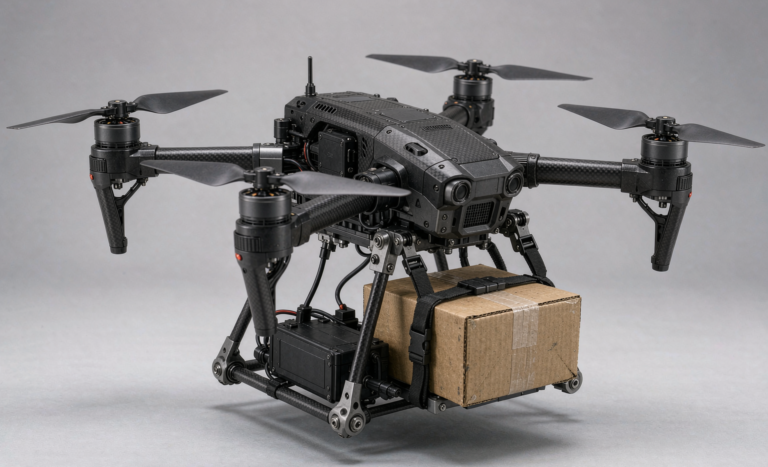
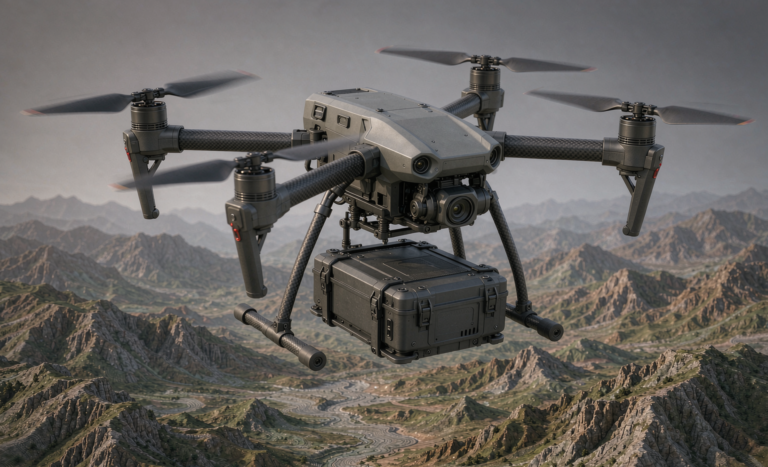
In one agricultural spraying program, moving from 6S to 12S cut pack-to-motor current from 90 A to 48 A at peak thrust. That single change let us drop the main harness from 10 AWG to 14 AWG and removed a kilogram of copper. For a drone battery, a kilogram is an eternity of flight time.
ESC and BMS: What Changes When You Go to 12S
The ESC is the component that feels 12S first. A 6S ESC is typically rated to ~30 V; a 12S pack at 50.4 V will destroy it instantly. You need an ESC with a voltage ceiling comfortably above 50.4 V and MOSFETs rated for the higher bus. We also spec the BMS differently: at 12S the balancing current and cell-voltage accuracy matter more because a single weak cell shifts the pack midpoint and the flight controller sees sag.
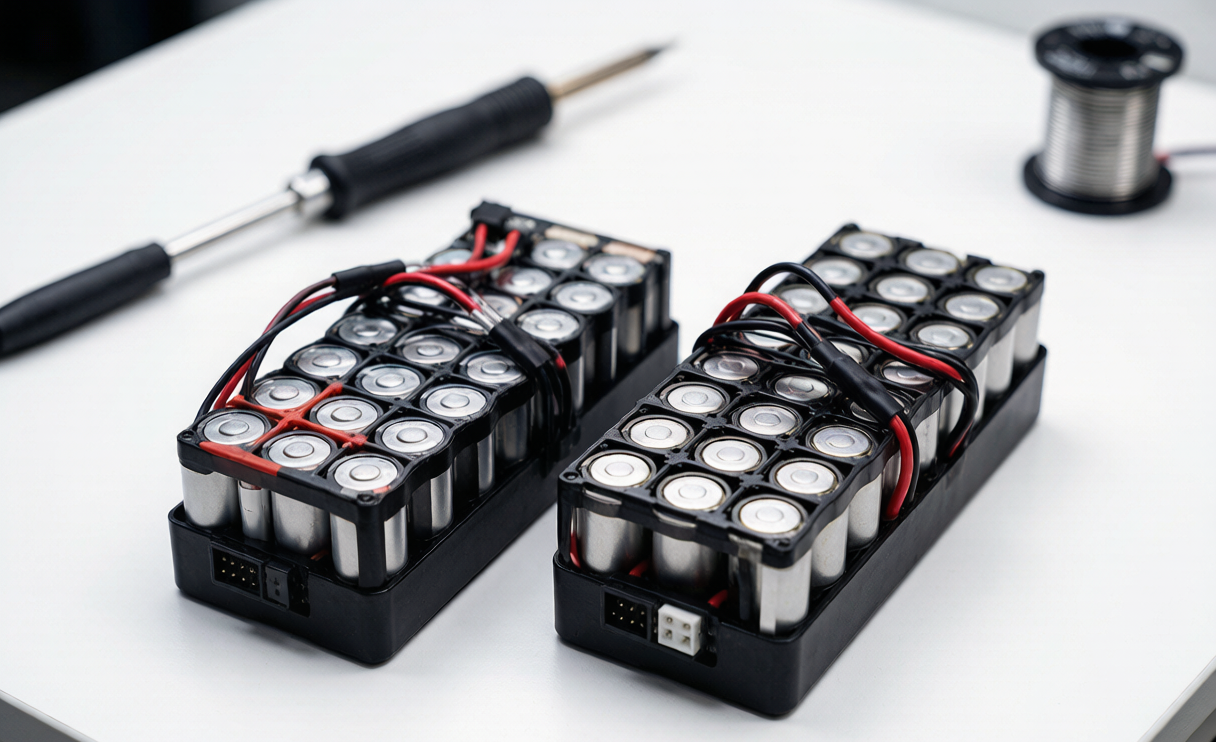
At Horizon Power we build the BMS into the custom battery solution rather than bolting it on. For 12S we use a stacked protector with individual cell tap monitoring, over-voltage set at 4.25 V per cell, and under-voltage at 3.0 V. The telemetry—per-cell voltage, pack temperature, and state-of-charge—is streamed to the flight controller over a digital bus so the pilot gets a low-voltage warning while there is still margin to land. That is the difference between a precaution and an emergency.
Wiring, Connectors and IR at Higher Voltage
Higher voltage is forgiving on current, but it is unforgiving on isolation. At 50 V a nicked wire or a sloppy solder joint can arc, and the energy in a lithium battery pack is more than enough to start a fire. We mandate silicone-insulated wire with a 600 V rating even though the pack only reaches 50.4 V, and we torque-check every XT90 or Anderson connector. Internal resistance (IR) still matters: a 12S pack built from mismatched cells develops a hot spot at the weakest series group, and that hot spot is exactly what UN38.3 abuse tests are designed to expose.
Connectors deserve a paragraph of their own. A 6S sport quad often runs an XT60 rated to ~60 A; a 12S industrial drone needs an XT90 or an Anderson SB120 because the contact resistance at high current is what quietly cooks the plug. We have torn down competitor packs where the connector was the single point of failure. Do not let the cheapest part on the airframe decide its safety.
Certification and Shipping Reality: UN38.3, IEC 62133, FAA/EASA
Voltage also shapes your compliance path. A drone lithium battery must pass UN38.3, the international transport test that covers altitude simulation, thermal, vibration, shock, external short, impact, overcharge, and forced discharge. Above certain watt-hour thresholds the rules tighten, and a 12S pack almost always crosses limits that change how you label and document it. IEC 62133 covers cell-level safety—short circuit, overcharge, forced internal short—and we require Grade-A cells with valid IEC 62133 reports before they enter a pack.
For shipping, the FAA and EASA rules hinge on watt-hours rather than voltage directly, but the two are linked: a higher-voltage pack at the same capacity carries the same Wh, yet the higher bus voltage changes how you manage in-transit state-of-charge and terminal protection. We ship every pack at 30% state-of-charge, terminals taped, in UN-certified boxes, because a single non-compliant shipment can ground an entire product launch. If your custom battery solution has to cross borders, build the certification file before you build the pack.
Frequently Asked Questions
Can I just run a 6S motor on 12S by changing the prop?
Not safely. Doubling voltage roughly doubles no-load RPM, and no prop change restores the original efficiency window. You would need a much lower KV motor. In practice, switching bus voltage means reselecting the motor, not just the prop.
Is 12S always better for long flight time?
No. 12S wins when current is high enough that copper and connector losses dominate. For a small, lightweight quad the extra BMS and insulation weight can erase the gain. The crossover is usually around the 5 kg takeoff-weight mark in our field data.
How do I know my ESC is 12S-capable?
Check the maximum input voltage on the spec sheet and confirm it exceeds 50.4 V with margin. A “6S” ESC rated to 25.2 V will fail on a 12S pack. When in doubt, buy the next voltage class up.
Does a higher-voltage drone battery charge faster?
For the same wattage, yes—higher voltage means lower charge current, which stresses cells and connectors less. But total charge time depends on capacity and the charger’s watt limit, not voltage alone. We routinely balance-charge 12S at 5 A without the heating issues a 6S pack at 10 A would show.
What fails first when voltage is mismatched?
Almost always the ESC or the connector, not the battery. The pack keeps delivering; the downstream electronics hit their ceiling. That is why we validate the whole powertrain—motor, ESC, wiring, and BMS—as one system.
How does cold weather change the voltage choice?
Cold air increases density (more thrust) but drops cell voltage under load. A pack that is marginal at 25 °C can sag below the ESC cutoff at -10 °C. We derate capacity by 15–20% in the voltage model for winter operations and prefer chemistries that hold voltage under load.
Choosing between 6S and 12S is rarely about which number is bigger. It is about matching the bus voltage to your motor’s KV, your ESC’s ceiling, and your airframe’s weight budget, then building a lithium battery pack and BMS that keep all of it safe under real flight loads. If you are at the early stage of a program and unsure which way to go, that is exactly the kind of question a custom battery solution engineer should be answering before tooling is cut—not after.