Drone Battery Connector Types
Most drone operators obsess over capacity, C-rating and energy density, then bolt the pack to the airframe with whatever connector was in the parts bin. In my fifteen years specifying drone battery systems at Horizon Power, I have seen more mission aborts, voltage sags and outright fires trace back to the connector than to the cells themselves. A connector is a single point of failure that sits between your expensive lithium cells and your motors, and it is also the most underspecified component in most RFQs I review.
This guide walks through the connector families you will actually encounter when building or sourcing a drone lithium battery: the XT series and EC family that dominate the hobby-to-industrial transition, and the Anderson, MC4 and circular industrial options you need once you leave the bench and enter inspection, agriculture or defense programs. I will cover current rating, contact resistance, the failure modes I see in the field, and how we specify connectors inside a custom battery solution so the pack survives real flight.
Why the Connector Is the Weakest Link in a Drone Battery
A lithium battery pack for a multirotor can deliver 100 A or more in a hard climb. That current has to cross four contact interfaces: cell-to-busbar, busbar-to-lead, lead-to-connector, and connector-to-ESC. The connector is the only one designed to be repeatedly mated and unmated, which means it is also the only one where surface oxidation, debris and mechanical wear accumulate over the life of the pack.
Contact resistance on a cheap connector can climb from 1 mΩ to 15 mΩ after a few hundred cycles. At 100 A that is 150 W of heat dissipated inside a plastic shell that is already warm from the pack. I have thermographed XT60 plugs hitting 90°C under sustained load on a heavy-lift airframe. The cells were fine; the connector was cooking. When you size a power system, treat the connector as a resistor in series with your pack, not as a free pass-through.
XT60 and XT90 — The Hobby Standard That Scaled to Industry
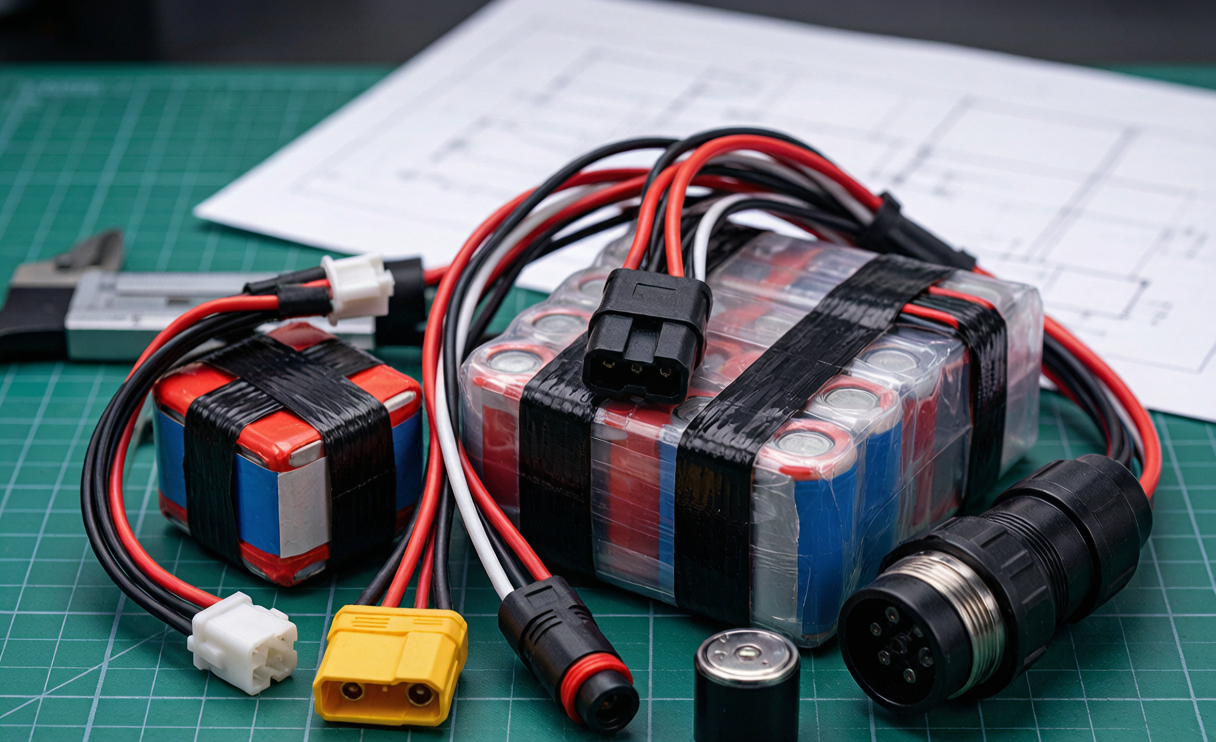
The XT60 is the default connector on the majority of consumer and prosumer drones, and for good reason. It is rated for a continuous 60 A, handles short peaks around 80–100 A, and its gold-plated copper leaves keep contact resistance low. The shape prevents reversed insertion, and the semi-enclosed housing resists accidental shorting when you drop a tool across the terminals. For most sub-10 kg multirotors running a 6S drone battery, an XT60 is perfectly adequate.
Step up to the XT90 and you get roughly 90 A continuous in a nearly identical footprint. I specify XT90 for heavy-lift platforms and for any airframe that pulls sustained current during a long climb or a loaded cinematic pull-up. The XT90-S variant adds a spark-suppression resistor on the negative lead, which I strongly recommend for packs above 10 Ah where the inrush arc when you plug in will eventually pit the contacts.
One caveat buyers should know: there are genuine and counterfeit XT60s on the market, and the fakes use thinner plating and softer plastic. We only buy from known distributors and verify a sample from each lot by pull-test and contact-resistance measurement before it goes near a production pack.
EC5, EC3 and the Deans (T-Plug) Family
The EC series — EC3, EC5, EC8 — uses a different contact geometry: a flat-blade style that seats with a satisfying click and resists vibration loosening. EC5 is rated around 120 A and is common on larger fixed-wing and VTOL platforms where the airframe sees sustained cruise current for twenty or thirty minutes at a time. EC8 pushes toward 150 A for big industrial airframes.
The Deans T-Plug is older and lower current, roughly 40–50 A, but it remains popular in the fixed-wing community because it is compact and has very low profile. I would not put it on a modern heavy-lift quad; it simply does not have the copper cross-section. Where I do still see it is on small sub-2 kg survey drones where every gram matters and peak draw stays modest.
For a custom drone battery built around a specific airframe, the choice between XT and EC usually comes down to what the ESC already ships with. Standardizing on the ESC connector saves an adapter, an adapter is one more point of failure, and in a custom battery solution we design the pack leads to mate natively rather than add a converter.
Industrial and Aerospace-Grade Options: Anderson, MC4 and Circular Connectors
Once a drone lithium battery leaves the hobby segment and enters inspection, mapping, agriculture or defense work, the connector requirements change. You now care about sealing, keying, tool-less field service and qualification to standards rather than just amps.
Anderson Powerpole connectors are modular, genderless and rated into the hundreds of amps depending on the housing and contact size. They are common on ground-support equipment and on tethered or docked drones where the battery is hot-swapped by technicians rather than pilots. The big advantage is serviceability: a burned contact gets replaced without scrapping the whole plug.
MC4 connectors are the solar-world standard and show up when a drone docks to a solar-charged base station. They are IP67 sealed and field-proven, though their current rating (typically 30 A per pair) means you parallel several for a high-draw pack. For genuine outdoor and marine-adjacent deployments, the sealing is worth the bulk.
For defense and industrial UAV programs we frequently move to circular connectors — M8, M12 or larger military-style styles with keyed inserts and full environmental sealing. These mate with a quarter turn, cannot be inserted backwards, and survive the dust, salt spray and repeated handling that kills a plastic XT in a season. They cost more and add weight, but on a program where a lost link means a lost airframe, that trade is easy.
Current Rating, Contact Resistance and Why They Matter
The single number printed on a connector box — “60 A” or “120 A” — is not the whole story. What matters for pack health is the voltage drop across the mated interface at your actual operating current, and how that drop changes as the contacts age.
- Contact resistance: a quality XT60 sits around 0.8–1.5 mΩ per pole. Multiply by two poles and by I² and you have your heater. At 80 A, 3 mΩ total is about 19 W of heat — manageable. At 120 A on a worn contact at 10 mΩ, that becomes 144 W, which will melt the housing.
- Derating with temperature: every connector is rated at a reference temperature, usually 25°C or 30°C. Inside a sealed pack bay at 50°C ambient, derate the current rating by 20–30%. I have seen spec sheets ignored here and connectors fail on the second flight of a hot-day operation.
- Cycle life of the contact: gold plating wears. After a few hundred mates the plating thins and resistance climbs. For frequently-swapped packs, budget for connector replacement as a consumable, not a lifetime part.
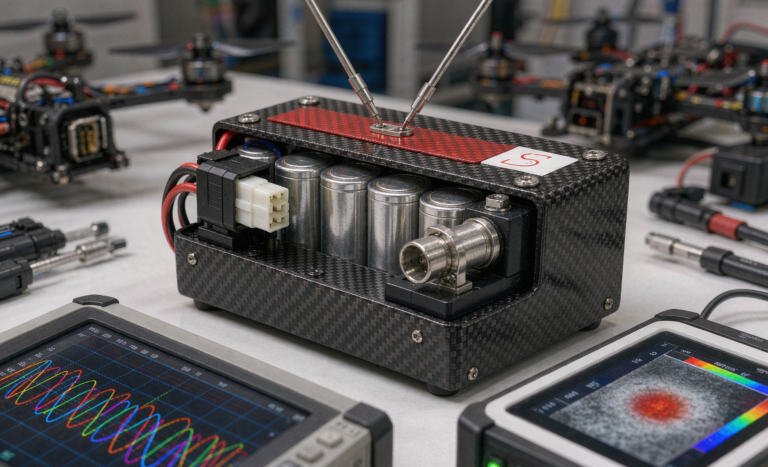
When we build a lithium battery pack for a customer, part of the deliverable is a derating table: rated amps at 25°C, 45°C and 60°C, plus the measured contact resistance of the production lot. That single document has prevented more field failures than any other line item in our test report.
How We Specify Connectors at Horizon Power
In our custom battery solution engineering process, connector selection happens at the same time as cell selection, not after. The steps I use:
- Calculate peak and continuous current from the motor/ESC specifications, not from marketing claims.
- Choose a connector rated at least 1.5× the continuous current, then re-check that rating at the pack’s expected operating temperature.
- Match the connector to the mating device to avoid adapters.
- Specify plating and housing material; for outdoor use we require UV-stable and, where relevant, IP-rated shells.
- Qualify a sample lot by pull-test, contact-resistance measurement and a thermal imaging run under load before release.
This is the difference between a pack that “probably works” and one we will put our name on. It is also where a good drone battery manufacturer earns the relationship: the connector is cheap, but getting it wrong is expensive.
Soldering, Crimping and Field Failure Modes
How the connector attaches to the lead matters as much as the connector itself. A cold solder joint on an XT60 lead will have higher resistance than the plug and will be the actual failure point. I prefer crimped terminals where the tooling is available, because a good crimp is more repeatable than a hand solder, and it survives vibration better.
The field failures I see most often:
- Partial insertion: the plug looks seated but one pole is not fully home. Resistance spikes, heat builds, the pack thermals out mid-flight. Keyed and quarter-turn connectors largely eliminate this.
- Cross-threaded or forced mating: a tech forces an EC into an XT and damages the contacts. Standardize one connector type per program.
- Corrosion: salt spray or humidity oxidizes the contact surface. Sealed circular connectors or dielectric grease on the interface solves most of it.
- Meltdown from undersizing: the classic — a 60 A connector on a 90 A draw. The math always wins.
If you are building your own packs, invest in a proper crimp tool and a contact-resistance meter. If you are buying, ask the supplier for their lot qualification data. A serious lithium ion battery vendor will hand it to you without hesitation.
FAQ
What connector should I use for a 6S drone battery on a 5 kg quad?
For a typical 6S pack pulling 40–70 A continuous, an XT60 is the right default. If your peak draws exceed 80 A in hard climbs or you run packs above 10 Ah, step up to the XT90-S for spark suppression and higher margin.
Are EC5 connectors better than XT60?
Neither is universally better. EC5 is rated higher (around 120 A) and its blade geometry resists vibration loosening, which suits larger fixed-wing and VTOL airframes. XT60 is lighter, smaller and ubiquitous on the ESC side. Match the connector to your current and to what your ESC already uses.
Can I adapt an XT60 pack to an EC5 drone?
Technically yes with an adapter, but I advise against it on production aircraft. An adapter is an extra mated interface, an extra point of resistance and heat, and one more thing to forget or install backwards. Have the pack built with the correct native connector.
Why does my connector get hot even though the battery is barely warm?
That is almost always contact resistance from an undersized, worn or poorly crimped connector. Check the actual draw, then measure the mated-interface resistance. If it is above a couple of milliohms at your current, the connector is the bottleneck, not the cells.
Do industrial drones need sealed connectors?
For inspection, agriculture, marine and defense work, yes. IP-rated circular or MC4-style connectors survive dust, moisture and repeated field handling that destroys plastic hobby plugs within a season. The weight and cost penalty is justified by reliability.
How often should drone battery connectors be replaced?
Treat them as consumables on frequently-swapped packs. Inspect for discoloration, pitting or looseness every few dozen cycles, and measure contact resistance periodically. In a fleet program we schedule connector replacement at a set cycle count rather than waiting for symptoms.