Drone Battery Capacity Testing: How to Verify Real mAh
Every drone operator has been burned at least once by a pack that promises 5,200 mAh on the label but delivers 4,100 mAh in the air. After fifteen years on the bench at Horizon Power building drone lithium battery packs for survey, cinematic, and inspection fleets, I can tell you that the printed capacity number is a marketing claim until you measure it yourself. drone battery capacity testing is the single most underrated quality step in the entire procurement chain, and it is also the cheapest insurance you can buy against mid-mission power loss. In this field guide I walk through how we verify real mAh, the equipment that actually matters, and the failure modes that fake capacity hides.
Why Rated mAh and Real mAh Diverge
A lithium battery cell is rated at a nominal capacity derived under a specific discharge protocol, usually a slow 0.2C drain to a fixed cut-off voltage at 25°C. Real-world drone loads are nothing like that. A multirotor pulling 30C during a punch-out and then coasting at 5C during cruise forces the pack through a far wider voltage and temperature envelope than the lab test. Internal resistance, cell imbalance, and aged separators all eat into usable capacity under those dynamic loads.
From my bench data, a healthy 6S pack fresh off a certified line typically delivers 96–99% of rated mAh at 1C. A pack built from mismatched or grade-B cells can read as low as 82% of label at the same rate. The gap widens at high C-rate. That is exactly why a custom battery solution built with sorted, matched cells behaves so differently from a cheap off-the-shelf pack that looks identical on the outside.
The Equipment You Actually Need
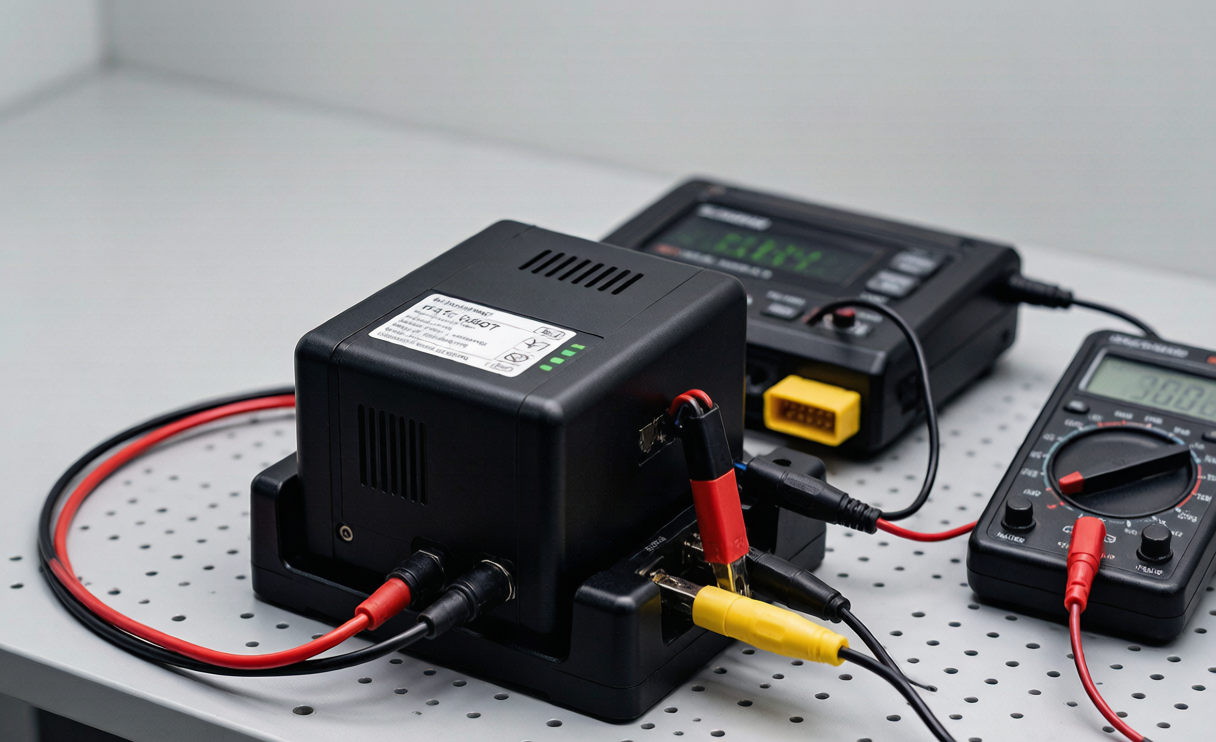
You do not need a six-figure lab to get trustworthy numbers. For field and small-factory verification, the core kit is simple:
- Electronic load (DC) – a programmable constant-current or constant-power sink rated at least 150% of your pack’s max discharge current. For a 30C 5,200 mAh pack that means a load sinking ~235 A; most bench units cap lower, so we test at 1C–5C and extrapolate.
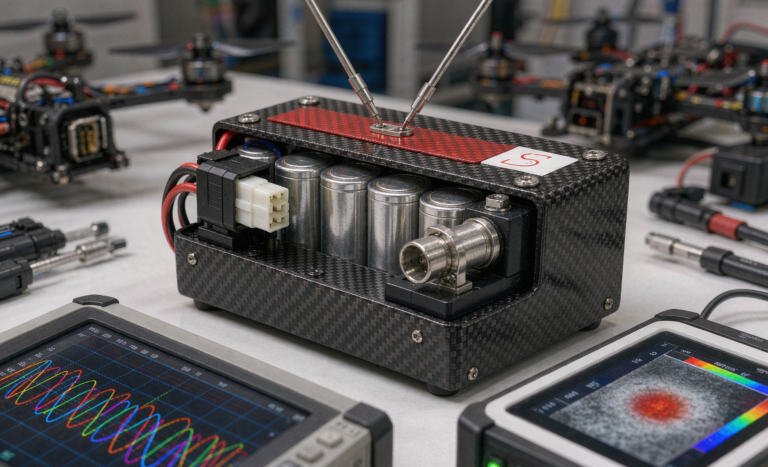
- Coulomb counter / battery analyzer – the instrument that integrates current over time to report true mAh and Wh. This is the heart of any drone battery capacity testing rig.
- Data-logging multimeter – to capture terminal voltage and cut-off events with a time stamp.
- Temperature probe – surface temp on the pack wrap, because capacity and internal resistance both move with heat.
- Balanced charging station – to set a known, full state of charge before every discharge run.
I keep a calibrated analyzer on the line for incoming inspection and a portable unit in the field service case. Both log to CSV so every reading is auditable against UN38.3 and IEC 62133 documentation we ship with the pack.
The Standard Capacity Test Procedure
Here is the method we run on every drone lithium battery before it leaves the building. It is deliberately repeatable so two technicians get the same answer.
- Charge to full under CC-CV at 0.5C, terminating at 4.20 V/cell ±0.02 V with a 50 mA tail, at 25°C ±2°C.
- Rest for 30 minutes to let surface charge settle.
- Discharge at 1C constant current down to 3.00 V/cell cut-off, logging mAh and Wh.
- Record discharge time, terminal capacity (mAh), energy (Wh), peak temperature, and end-of-discharge voltage per cell group.
- Repeat for three cycles; report the stabilized (third-cycle) value as the verified capacity.
The three-cycle rule matters. The first discharge often reads low because formation residue and soft shorts relax after a full cycle. A single run can mislead you by 4–6%. For procurement sign-off we only accept the third-cycle number, never the first.
Reading the Results: What Good Looks Like
A trustworthy pack meets a few simple thresholds. At 1C and 25°C, verified capacity should be within 3% of the rated label for new grade-A cells. Internal resistance measured at 1 kHz should sit inside the cell datasheet window, typically 8–15 mΩ per cell for a 5 Ah high-C pouch. Cell-to-cell voltage spread at end of discharge should stay under 0.05 V; wider spread signals a weak or mismatched cell that will drag the whole pack down over time.
When we build a custom battery solution, we also report the Wh figure, not just mAh, because Wh is what your flight controller’s power model actually cares about for endurance prediction. A pack can hit its mAh target yet lose Wh to a sloppy BMS or high-resistance busbar, and you would only see it in the air.
Capacity Under Real Flight Loads
Bench 1C numbers are the baseline, not the verdict. Drones rarely discharge at a steady rate, so we also run a representative mission profile on the load: a scripted current trace that mimics hover, climb, and descent. On a heavy-lift agriculture drone the same 16,000 mAh pack that read 15,700 mAh at 1C delivered only 13,900 mAh under the duty cycle because sustained 12C surges heated the cells and the BMS clipped peak current.
This is where drone battery capacity testing earns its keep. A pack that passes the slow test but fails the profile test is a returns disaster waiting to happen. We log profile capacity for every production batch and feed it back into the cell-sorting spec.
Common Capacity-Inflation Tricks to Watch
Buyers should know the usual ways capacity gets faked:
- Inflated label – the simplest fraud, a 4,200 mAh sticker on a 3,200 mAh cell.
- High cut-off voltage – ending the discharge at 3.4 V instead of 3.0 V leaves usable energy untapped and overstates "usable" capacity.
- Optimistic temperature – testing at 35°C instead of 25°C can add 5–8% to the reading.
- Selective cells – grading only the best samples from a bin and shipping the rest untested.
When we supply a lithium battery pack for aviation or industrial UAV programs, we attach the full test CSV and the IEC 62133 certificate so the buyer can reproduce our numbers. If a supplier refuses to share raw discharge curves, that is your red flag.
Capacity Testing in the Procurement RFQ
If you are sourcing packs at volume, write capacity verification into the purchase order. We routinely include an acceptance clause that lets the buyer independently re-test a random sample of, say, three packs per 500-unit lot, with a pass threshold of 95% of rated mAh at 1C. Any lot failing the sample is returned for sorting, not negotiated down. This single clause has saved our clients from entire bad shipments. It also forces suppliers to care about cell grading upstream, because a custom battery solution that cannot survive an independent check is not a solution at all. For fleets operating under FAA Part 107 or EASA U-space frameworks, keeping those verified-test records alongside the UN38.3 transport file also smooths your audits.
Keeping Capacity Honest Over the Pack’s Life
Capacity is not static. A pack at 300 cycles typically holds 85–90% of its original mAh if treated well, and 60–70% if abused with deep discharges and hot storage. We recommend a capacity re-verification every 50 flight cycles or quarterly for fleet operators. A simple 1C discharge on the portable analyzer takes under two hours and tells you exactly when a pack should be retired before it strands an aircraft.
For fleets flying under FAA Part 107 or EASA U-space rules, logging verified capacity per pack also supports your maintenance records. Inspectors increasingly ask for evidence that batteries are within declared performance windows, and a clean drone battery capacity testing history is the easiest way to show it.
FAQ
How accurate is a basic capacity test for a drone battery?
A properly calibrated analyzer reading at 1C is accurate to within about 1–2% of true mAh. The bigger source of error is the test protocol, not the instrument. Cut-off voltage, temperature, and rest time all shift the result more than the meter does.
What is the difference between mAh and Wh in battery capacity?
mAh measures charge; Wh measures energy and equals mAh times average voltage divided by 1,000. Two packs with the same mAh but different cell chemistry or voltage curves can have very different Wh, and Wh is what determines real flight time.
Can I test capacity with just a charger?
Some smart chargers report mAh put back in during recharge, which is a rough proxy but not a true discharge measurement. For procurement or retirement decisions you need a controlled discharge with a coulomb counter, because recharge accounting misses losses and BMS overhead.
Why does my pack read less capacity in cold weather?
Below about 10°C, lithium-ion internal resistance rises and usable capacity drops, often 15–25% at 0°C. This is chemistry, not a defect. Cold-rated packs and pre-flight warming mitigate it, but always test at the temperature you actually fly.
How often should a drone battery be capacity tested?
New packs: once on incoming inspection. In service: every 50 cycles or quarterly for active fleets. Before any critical or beyond-visual-line-of-sight mission, a fresh verification is cheap insurance.
What capacity loss means it is time to retire a pack?
We retire at 80% of original verified mAh, or sooner if a single cell shows more than 0.05 V spread at end of discharge. Flying past 80% risks sudden voltage collapse under load, which is how most in-flight battery failures actually happen.