Lithium Battery Formation Process
As a senior lithium battery engineer, I have commissioned formation lines that processed everything from 2,000 mAh pouch cells to 100 Ah prismatic modules. If there is one manufacturing step that quietly decides whether your pack lives 800 cycles or 3,000, it is formation. Buyers obsess over cathode chemistry and energy density, but the formation process — the controlled first charge, degassing, and aging of every single cell — is where latent defects are either burned out or baked in for good. In this guide I will walk through what formation actually does, how it shapes pack consistency, and why a serious custom battery solution provider treats it as a quality gate rather than a line item.

What the Formation Process Actually Is (and Why It Isn’t Optional)
The formation process is the first full charge-discharge cycle applied to a freshly assembled lithium cell. During this step, the electrolyte wets the electrodes and a solid electrolyte interphase (SEI) layer forms on the anode surface. That SEI layer is essentially permanent; its quality governs coulombic efficiency, self-discharge, and calendar life for the entire service life of the cell. Skip or rush formation and you get uneven SEI growth, trapped gas, and high initial capacity loss. For any lithium battery intended for industrial or commercial duty, formation is non-negotiable. It is not a cosmetic finishing touch — it is the moment the cell becomes a finished electrochemically stable product.
In my experience auditing supplier lines, the plants that ship the most reliable cells are the ones that treat formation as a discipline with its own yield target, not a step they try to compress to save time. A lithium-ion battery that leaves formation with a clean, uniform SEI will almost always outperform a cheaper cell that was formed too fast, even if both share the same datasheet headline numbers.
The Standard Formation Workflow
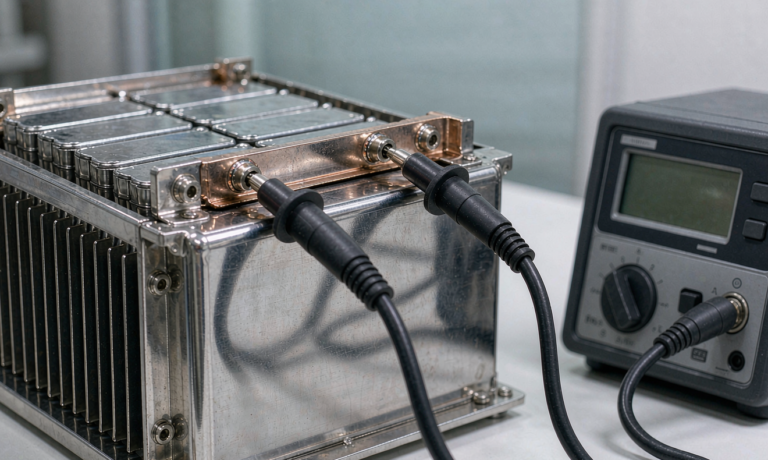
A typical formation process runs as a sequence rather than a single event. The exact recipe varies by format and chemistry, but the spine is consistent:
- CC-CV first charge: a constant-current, constant-voltage charge to the specified upper cutoff voltage, usually at 0.2C to 0.5C for the first cycle so the SEI forms gently.
- Rest and voltage stabilization: the cell sits open-circuit so the voltage settles and micro-shorts can reveal themselves as abnormal self-discharge.
- Partial discharge: a controlled discharge that resets the state of charge and confirms the cell can deliver rated current.
- Degassing (pouch formats): for pouch cells, a vacuum fixture removes gas generated during first formation before the pouch is heat-sealed.
- Aging: 7 to 14 days at ambient or slightly elevated temperature (25-45°C) so early capacity fade and leakage current surface.
- Capacity and IR binning: we measure real mAh and internal resistance, then grade cells so a lithium battery pack is built only from matched groups.
I always specify that the grading data follows the cell into the pack build records. That paper trail is what lets a custom battery solution partner defend a warranty claim months later when a field failure shows up.
How Formation Decides Pack Consistency
A lithium battery pack is only as strong as its weakest parallel group. If formation leaves one cell 4% lower in capacity or 30% higher in internal resistance, that cell becomes the bottleneck under load and ages fastest. Good formation plus tight binning keeps group-to-group variance under 2% in capacity and under 10% in internal resistance — the kind of consistency a custom battery solution needs for predictable, repeatable runtime across an entire production batch.
This matters enormously for pack-level balancing. A well-formed, well-binned pack arrives at the BMS already balanced, which means the balancer has almost nothing to do and the cells age together instead of drifting apart. The formation yield number, in other words, is the upstream cause of most downstream “balancing drift” complaints I get called in to diagnose.
Formation and Safety Certification
Formation is also where we screen for internal shorts, gas generation, and thermal anomalies before a cell ever ships. Cells that fail formation checkpoints never enter a pack. This maps directly to UN38.3 (transport safety) and IEC 62133 (portable cell safety) compliance: a well-formed cell holds a stable voltage under the required abuse and altitude simulation tests. I tell procurement teams that the formation yield percentage is a better quality signal than any marketing claim on a brochure.
A BMS solution still protects the pack in the field, but it cannot repair a cell that was never properly formed. The BMS assumes a sound cell; formation is what delivers that sound cell in the first place. When I review a new supplier, I ask for their UN38.3 test summary and their formation yield on the last three production lots before I look at price.
Where a Custom Battery Solution Provider Adds Value
Off-the-shelf cells are formed to a generic recipe. A reputable custom battery solution partner tunes the formation process to your specific chemistry and duty cycle — slower first formation for high-load NCM, controlled degassing for thin pouches, longer aging for LFP stationary cells. They also keep the formation data tied to each serial-numbered pack, which simplifies warranty claims and field failure analysis.
When I brief an OEM program, I ask for the formation recipe and the lot yield report before I ask for the quote. If a vendor cannot show me formation data per lot, I treat that as a red flag regardless of how attractive the unit price looks. A lithium-ion battery program that skips this visibility will eventually pay for it in returns.
Common Formation Defects and How to Catch Them
Most field failures I trace back to formation trace to one of four root causes:
- Insufficient wetting: high initial impedance and unstable voltage under load.
- Over-charge during first cycle: swollen or hot cells that fail later.
- Poor degassing: residual gas that puffs pouches within weeks.
- Short aging: hidden capacity fade that shows up in the first 50 cycles.
You catch these with capacity grading, IR mapping, and a short burn-in at the pack level before shipment. A BMS solution with telemetry makes field detection easier, but catching the defect at formation is always cheaper than catching it in a customer’s hands.
Cost, Throughput, and Quality Tradeoffs
Formation is slow and capital-intensive — it can consume 30% to 50% of total line cycle time. Rushing it to hit throughput targets is the classic false economy in this industry. The right move is to size formation capacity to your true production volume and accept that a disciplined custom battery solution with careful formation simply yields fewer warranty returns. For most lithium-ion battery programs, that tradeoff pays for itself within the first year of field deployment through lower RMA rates and steadier pack performance.
Process Control: Why Formation Equipment Matters
The quality of the formation process is capped by the equipment running it. Precision CC-CV channels with tight voltage accuracy (within a few millivolts) and stable temperature control are what let you repeat a recipe lot after lot. I have seen two lines run the same nominal recipe and produce 97% versus 88% formation yield purely because one used drift-prone low-cost cyclers. For any lithium battery program where consistency matters, the formation hardware tolerance is part of the spec, not an afterthought. A capable custom battery solution partner will disclose channel accuracy and environmental control as readily as they disclose cell grade.
Frequently Asked Questions
How long does the lithium battery formation process take?
For a typical cell, expect 1 to 3 weeks including aging. The active charge-discharge steps take a day or two; the 7 to 14 day aging window is what pushes the calendar time out. High-volume lines parallelize thousands of channels, but the aging clock cannot be shortcut without hurting quality.
Does formation apply to all lithium chemistries?
Yes. Whether it is NCM, LFP, or LCO, every lithium cell needs a first formation to build its SEI layer. The recipe differs — LFP tolerates faster formation, high-nickel NCM needs it slower — but the principle is universal across any lithium battery design.
Can formation fix a bad cell?
No. Formation reveals defects; it does not repair them. A cell with an internal short or contaminated electrolyte will fail formation screening. The value is in catching and rejecting it before it enters a lithium battery pack, not in hoping formation heals it.
What formation data should a buyer request?
Ask for lot yield percentage, capacity distribution histogram, internal resistance spread, and the formation recipe (rates, cutoffs, aging duration). A transparent custom battery solution provider will share these as standard documentation with every shipment.
How does formation affect cycle life?
A clean, uniform SEI from proper formation directly extends cycle life and reduces capacity fade. Poor formation accelerates early fade and raises self-discharge, which is why two cells with identical spec sheets can deliver very different real-world lifespans.
Is formation different for a lithium battery pack versus a single cell?
Cell-level formation happens before assembly. After the pack is built, a shorter pack-level conditioning and burn-in verifies the BMS solution and group matching, but the decisive formation quality is set at the individual cell stage.