Home Energy Storage for Tiny Homes and ADUs: How to Size a Compact Battery for Small-Space Living
I have spent the last fifteen years on the factory floor and in the field, and few applications test a battery engineer’s assumptions like tiny homes and accessory dwelling units (ADUs). When Karl Huang signs off on a home energy storage design, I am not thinking about a 13 kWh wall box on a suburban garage wall. I am thinking about 200 square feet, a wood stove, a composting toilet, and a homeowner who wants lights, a fridge, and a laptop without a single trip to the fuel station. The math is brutal and beautiful at the same time: you get a smaller load, but you also get almost no room for error on clearance, ventilation, or thermal runaway. This guide is the exact playbook I use when a client asks us to spec a home battery backup for a 400-square-foot ADU or a 28-foot tiny home on wheels.
Over the past three years, our team at Horizon Power has shipped compact home energy storage system units into everything from backyard cottages in Oregon to off-grid tiny cabins in the Rockies. The recurring lesson is simple: small spaces magnify every design decision. A battery that is “fine” in a climate-controlled basement can become a liability in a 90°F loft with two feet of clearance on three sides. Below, I walk through how we size, select, and certify residential battery storage for exactly these constraints, with the standards I actually verify before a unit ever leaves the building.
Why Tiny Homes and ADUs Change the Battery Math
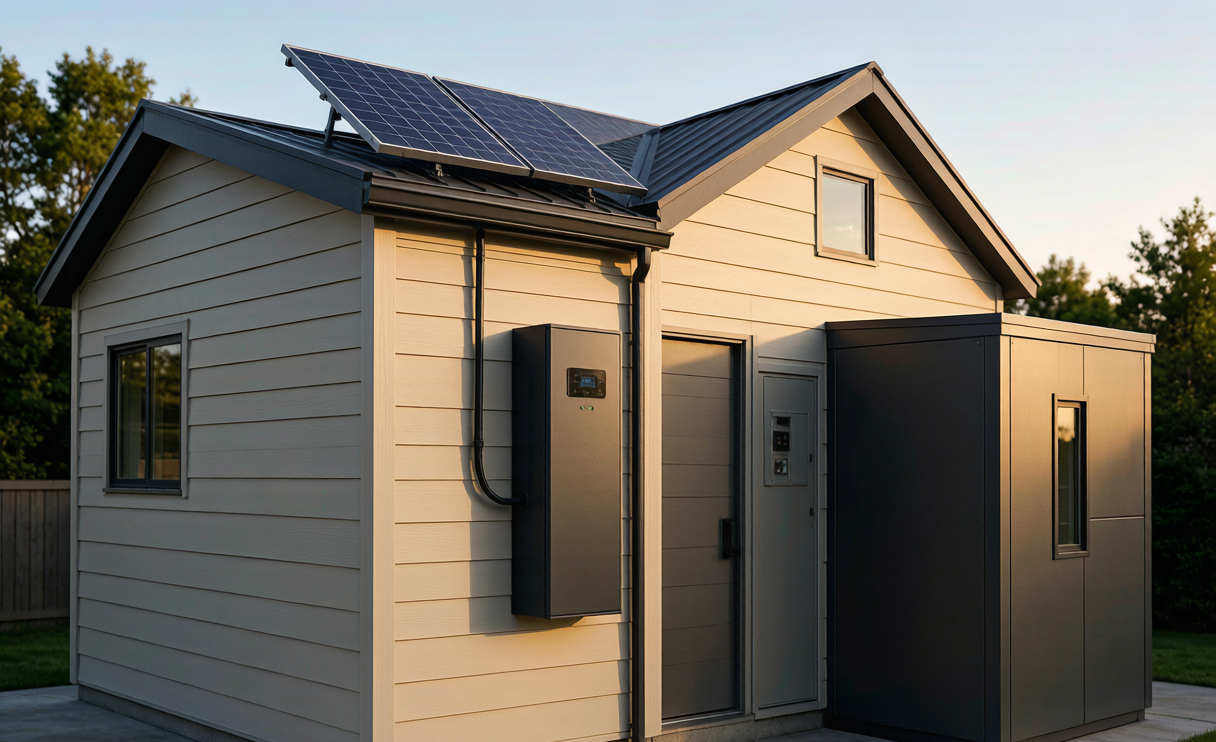
A conventional home might draw 30–50 kWh per day. A well-designed tiny home or ADU often lands between 4 and 12 kWh per day, depending on whether heating and cooling are electric. That lower consumption is good news: it means a smaller, cheaper home energy storage bank covers a larger fraction of the load. But the footprint is the catch. In a 300-square-foot ADU, every cubic foot is contested by a Murphy bed, a hot water tank, and a staircase. The battery cannot simply be “somewhere out of the way” because there is no “out of the way.”
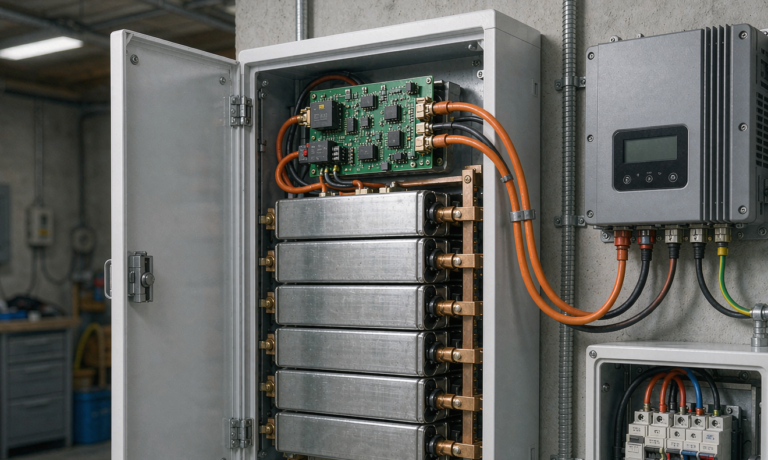
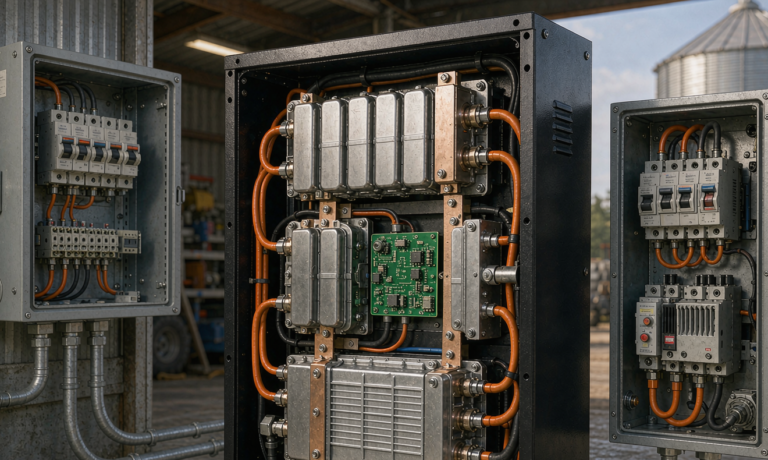
From an engineering standpoint, this pushes us toward two design philosophies. The first is densification: use high-quality LFP (LiFePO₄) cells with a flat discharge curve and a long cycle life so we can store more energy in less volume. The second is integration: treat the battery as a structural and aesthetic element, not a gray box bolted to the wall after the fact. When we design a home battery backup for an ADU, we frequently co-locate it with the inverter and the electrical panel in a single shallow cabinet, which also shortens conduit runs and reduces voltage drop.
Sizing the Home Energy Storage System for a Small Load Profile
Sizing starts with the load audit, not the brochure. I ask every tiny-home client for a 7-day log of actual consumption, ideally from a clamp meter or a smart plug dashboard. If they cannot provide one, we model from nameplate: LED lighting (30–80 W), a small DC or efficient AC fridge (80–150 W running, 400–900 W startup), a laptop (60–100 W), a water pump (400–900 W), and a possible mini-split (600–1,200 W). The peak matters more than the average in small systems because you have less headroom to absorb a simultaneous surge.
Once we have daily kWh, we apply a depth-of-discharge (DoD) rule. For LFP in a stationary home energy storage system, we design to 90% usable DoD because LFP tolerates deep cycling far better than NMC. A client who needs 8 kWh usable per day therefore gets roughly a 9 kWh nameplate pack. We then add one to two days of autonomy for cloudy or low-wind stretches, landing most tiny homes on a 10–14 kWh system. That is a fraction of a full-size home’s bank, and it is the single biggest reason compact residential battery storage pays back faster in small dwellings than in large ones.
Form Factors That Actually Fit: Cabinets, Wall-Mount, and Rack
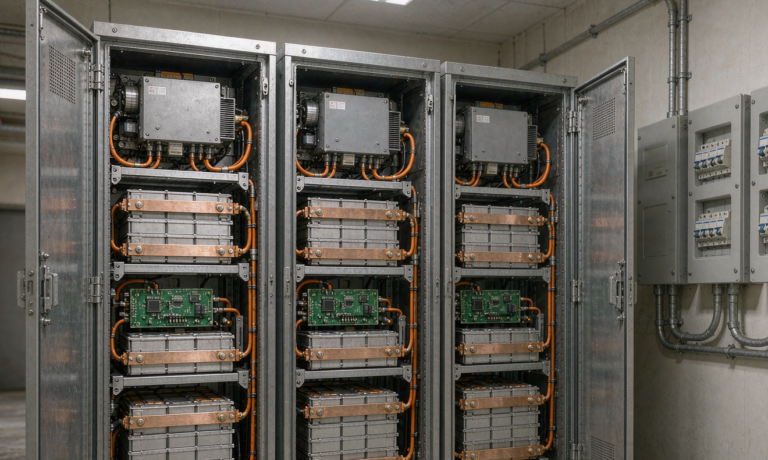
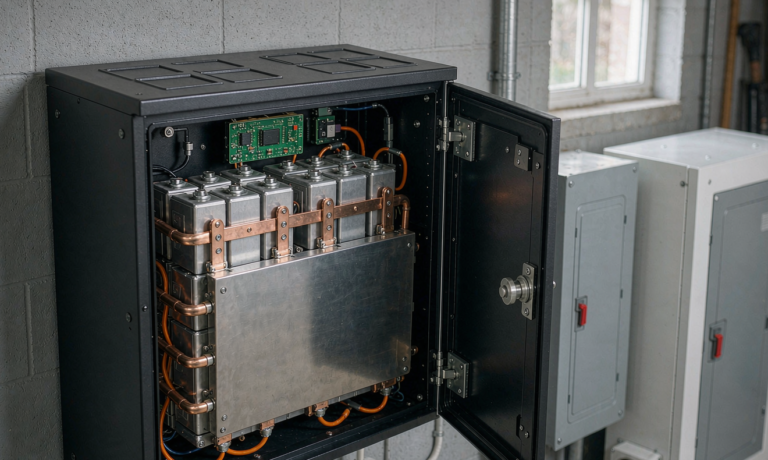
In a tiny home, the form factor is not a cosmetic choice; it is a spatial one. We typically offer three options. The wall-mount cabinet (depth 6–9 inches, 2–5 kWh per module) suits ADUs with a free interior wall and keeps the floor clear. The shallow floor cabinet (depth 12–16 inches) works when wall structure is weak or the unit must sit beside the panel. The rack-mount tray is reserved for tiny homes with a dedicated utility closet, because it demands vertical space and clear front access for service.
I steer most tiny-home clients toward a modular wall-mount approach so the home battery backup can grow from 5 kWh to 15 kWh by bolting on stacked modules rather than replacing the whole pack. Every module we ship is UN38.3 certified (the T.1–T.8 test suite: altitude, thermal, vibration, shock, external short, impact, overcharge, and forced discharge), and the cells carry IEC 62133-2 and IEC 62619 documentation. Those certificates are not paperwork for the drawer; they are what let the system pass inspection and what let an insurance adjuster sleep at night.
Safety Codes and Clearances in Tight Spaces
This is where small spaces get unforgiving. In the United States, stationary home energy storage falls under NFPA 855 (installation of stationary energy storage systems) and the dedicated battery articles of the National Electrical Code, NEC Article 706 (2020/2023 cycle) and Article 710 for dedicated outdoor backup. NFPA 855 sets maximum allowable energy per compartment and required separation distances based on the technology. For LFP under roughly 20 kWh in a dwelling unit, you are often inside the “small ESS” exemption, but the local authority having jurisdiction (AHJ) still wants to see listed equipment.
That is why we build to UL 9540 (the system safety standard) and UL 9540A (the thermal runaway propagation test) before we ever quote a price. In a tiny home, where the battery might share a wall with the bed, UL 9540A’s propagation resistance is the difference between a contained incident and a house fire. We also stamp our enclosures to IEC 62619 for the international market. None of this is optional in my book: a home energy storage system in a 300-square-foot box has to be safer, not cheaper, than one in a barn.
Thermal and Ventilation Realities in Small Footprints
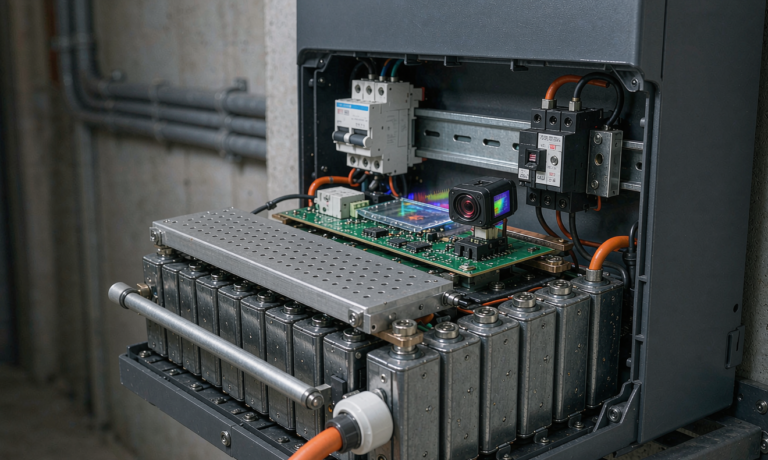
LFP does not like heat, and tiny homes generate it. A south-facing loft in July can sit at 40°C, and cell degradation climbs steeply above 35°C. We specify enclosures with passive vent paths and, in warm climates, a small thermostatically controlled fan that exhausts to the exterior, never into the living space. The rule I give installers: keep cell temperature under 45°C in operation and under 30°C for long-term storage. For an ADU used seasonally, we recommend a “storage mode” that floats the pack at 50–60% state of charge, which IEC 62619 and most cell datasheets agree is the sweet spot for calendar life.
Humidity is the silent killer in residential battery storage too. Coastal and humid-climate tiny homes get enclosures rated to at least IP54, with gasketed conduits and drip loops on every penetration. I have seen a perfectly good pack corrode at the busbar in eighteen months because someone skipped the drip loop. The extra thirty minutes of installation discipline is the cheapest insurance in the whole build.
Wiring, Metering, and IEEE 1547 / UL 1741 Compliance
A tiny home battery is rarely an island. Most ADUs tie to the main house panel or to the grid, which means the inverter must be listed to UL 1741 (including the SB edition for smart-inverter functions) and must ride through disturbances per IEEE 1547-2018. If the system is grid-interactive, anti-islanding protection is mandatory; if it is a true off-grid tiny cabin, we still keep the charge controller and inverter to UL 1741 and add a properly rated transfer switch so a generator can pick up the load without back-feeding.
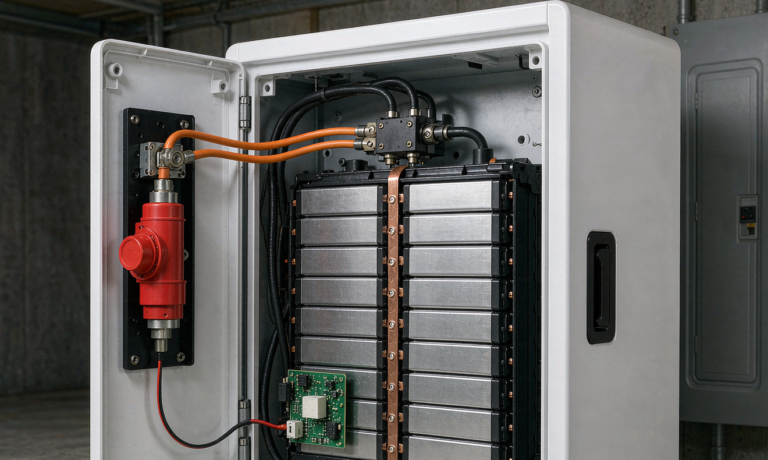
Wire sizing in small builds is where I see the most field errors. A 14 kWh pack at 48 V can source 300+ amps at the busbar, so the DC conductors must be sized for continuous current with the correct temperature derating, and the overcurrent protection has to be within reach but outside the living envelope. We label every home battery backup enclosure with the disconnect location in plain language, because in an emergency the firefighter does not have time to decode a wiring diagram.
Cost and Payback for a Compact Home Battery Backup
Compact systems are where the economics get friendly. A 10–14 kWh LFP home energy storage system for a tiny home typically lands in the installed range that, paired with a small rooftop or a portable solar array, offsets most of a low-consumption dwelling’s bill. Payback depends entirely on the local tariff. In a time-of-use market, shifting even 6 kWh of evening load to stored midday energy can shave a meaningful slice of the monthly cost, and for an off-grid ADU the comparison is not “vs the grid” but “vs the generator fuel and the silence you buy back.”
I tell clients to model two scenarios: grid-tied arbitrage and full backup. If the ADU is a rental, a home battery backup also becomes a selling point that raises occupancy and nightly rate. The payback clock starts the day the generator stops running, and for many tiny-home owners that is the number that actually matters.
Frequently Asked Questions
Can I install a home energy storage system inside the living space of a tiny home?
In most jurisdictions, listed LFP equipment under the NFPA 855 small-ESS threshold can be installed in the occupied volume, but I still advise a dedicated, vented enclosure with clear separation from sleeping areas. The battery should never share a sealed wall with the bed. A shallow cabinet in a utility nook, exhausted to the exterior, is the configuration I approve most often for tiny homes.
How much home battery backup do I need for a 400-square-foot ADU?
Most ADUs we equip land on 10–14 kWh of usable storage, which covers lighting, refrigeration, laptops, and a small heat pump for one to two days of autonomy. Run a 7-day load log first; if your only electric load is lighting and a fridge, you may get by on 5–8 kWh. The peak startup surge of the fridge and any pump drives the inverter size more than the daily kWh does.
Do tiny-home batteries need UN38.3 and IEC certification?
Yes. UN38.3 (T.1–T.8) is the transport and baseline safety suite we require on every cell, and IEC 62133-2 plus IEC 62619 document the cell and system safety for stationary use. In the U.S. market, UL 9540 and UL 9540A are what your inspector and insurer will ask for. Skipping these is how a cheap pack becomes an uninsurable liability in a 300-square-foot home.
What is the best residential battery storage chemistry for a small space?
For tiny homes and ADUs, LFP (LiFePO₄) is my default: it has a flat voltage curve, excellent thermal stability, and a long cycle life that suits daily shallow cycling. NMC offers more energy density but runs hotter and is less forgiving on thermal runaway, which matters more when the battery sits two feet from where you sleep. Sodium-ion is emerging for stationary use but is not yet our primary recommendation for compact dwellings.
How do I keep a tiny-home battery safe in hot or humid climates?
Keep cell temperature under 45°C in operation with passive vents plus a thermostatically controlled exterior exhaust fan, use an IP54-rated enclosure in humid or coastal sites, and always install drip loops on conduit penetrations. Float the pack at 50–60% state of charge if the ADU is seasonal. These four habits are what separate a pack that lasts a decade from one that corrodes in two years.