Home Energy Storage Battery Room Ventilation and Off-Gas
As a senior lithium battery engineer I have walked into more than a few residential installs where the homeowner asks the same question: do I really need to vent the room? The short answer is yes, and the longer answer is what this article covers. A home energy storage battery system is safe when it is engineered correctly, but lithium cells can release flammable and toxic gases during venting or thermal runaway. Proper ventilation and off-gas management are not optional finishing touches. They are the line between a compliant installation and a genuine hazard. In this guide I explain how the gas is generated, which codes apply, how to size airflow, and how to detect and exhaust off-gas before it reaches dangerous concentrations.
Why Off-Gas Forms in a Home Energy Storage Battery
Lithium-ion cells use an organic electrolyte built around lithium hexafluorophosphate dissolved in carbonate solvents. Under normal operation that chemistry stays sealed. The problem begins when a cell is pushed past its limits: overcharge, an internal short, crush damage, or simple overheating. At roughly 80 to 120 degrees Celsius the separator breaks down and the cell vents. The electrolyte decomposes and releases a mixture of carbon dioxide, carbon monoxide, hydrogen, light hydrocarbons such as methane and ethane, and hydrogen fluoride when the salt meets trace moisture.
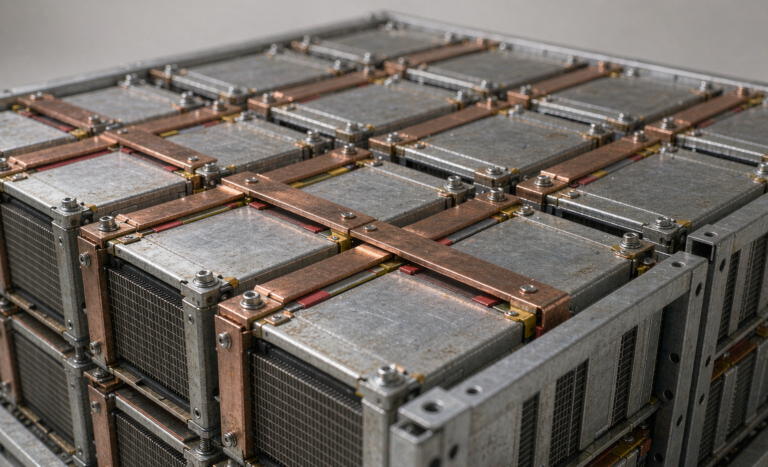
A single 100 Ah prismatic cell can release on the order of 10 to 50 liters of mixed gas during a venting event. A typical 10 kWh home energy storage battery pack contains dozens of cells, so the worst-case volume in a sealed room is substantial. Even short of full thermal runaway, one cell that vents during a fault releases enough hydrogen to matter. Hydrogen is the gas that keeps me awake at night because it is colorless, odorless, and explosive above 4 percent by volume in air. State of charge matters here: a pack sitting at 90 percent charge off-gasses far more violently than one stored near 30 percent, because there is more stored energy and more reactive lithium to release.
What worries engineers beyond the single cell is the cascade. Once one cell vents and heats its neighbors, the event can propagate cell to cell until the whole module contributes gas at once. That is why ventilation is planned against the full-pack worst case, not against a lone cell, and why spacing and module barriers are part of the same conversation as the fan.
Codes and Standards That Govern the Room
Several documents shape how a battery room must be built. NFPA 855, the standard for stationary energy storage systems, limits the stored energy per room and requires ventilation that is tied to gas detection. The IEC 62933 series covers stationary lithium energy storage systems and their safety. UL 9540A is the accepted test method for thermal runaway propagation and is cited by most inspectors before they will sign off a room. UL 9540 certifies the complete system. IEC 62619 governs the industrial cells themselves, and UN38.3 covers transport.
For off-gas specifically, the practical trigger is hydrogen. Its lower explosive limit is 4 percent by volume. The design rule I follow is to keep hydrogen below 25 percent of that limit, which works out to about 1 percent, and to activate exhaust through gas detection rather than a dumb timer. A timer cannot know that a cell just vented; a sensor can. On the electrical side, the US National Electrical Code Article 706 sets requirements for energy storage systems, and rooms that exceed the NFPA 855 energy threshold typically also require sprinkler protection and listed disconnects.
Sizing Ventilation Airflow for the Space
The industry unit for room ventilation is air changes per hour, or ACH. A passive louvre rarely moves enough air for a battery room, so I plan forced exhaust. Start with the room volume V in cubic meters. The required exhaust flow Q equals V multiplied by the target ACH divided by 60, giving cubic meters per minute. For battery rooms I typically design for 6 to 12 ACH depending on how tight the envelope is and how much pack energy sits inside.
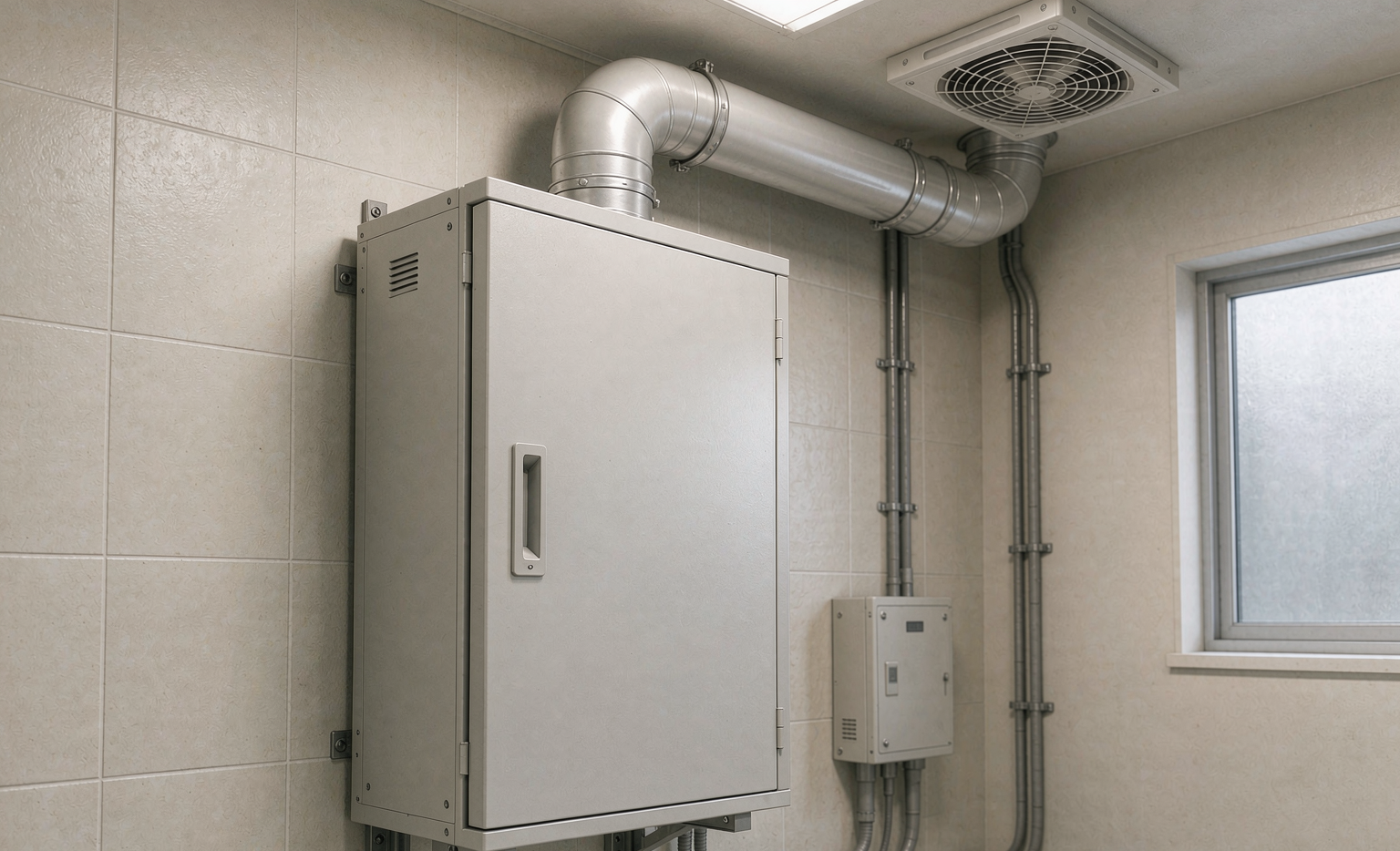
Worked example: a 12 cubic meter room at 8 ACH needs 12 times 8 divided by 60, or 1.6 cubic meters per minute, which is about 56 cubic feet per minute. I size the fan with margin on top of that. Hydrogen is lighter than air, so the exhaust pickup belongs near the ceiling and the make-up air enters near the floor. If gas detection is installed, the fan runs continuously at a low rate and steps up to full speed the moment an alarm trips. I also keep duct velocity below about 8 meters per second so the system stays quiet and the static pressure stays manageable, and I specify a gravity relief path so the room cannot go badly negative if the powered fan fails.
Gas Detection and Alarm Interlocks
A hydrogen sensor mounted at the ceiling, set to 1 percent (25 percent of LEL), should boost the exhaust and sound a local alarm. I also fit a carbon monoxide sensor because CO tracks incomplete combustion and cell off-gassing. Hydrogen fluoride detection exists but is specialist; for residential work the practical baseline is H2 plus CO coverage. The sensor must interlock the exhaust fan, and on a sustained alarm it should signal the battery management system to disconnect the pack. I document every set point and leave the values on a label inside the room.
Room Layout and Physical Separation
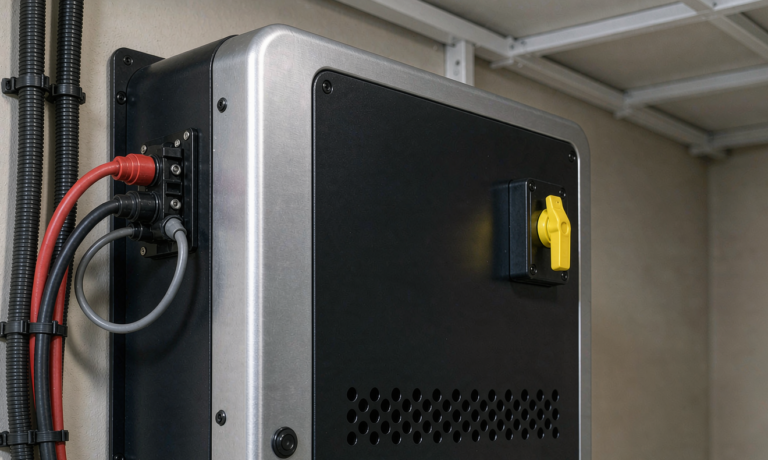
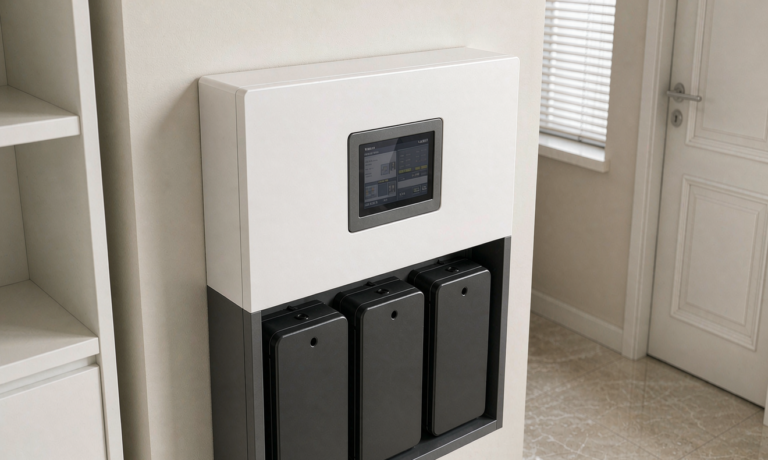
Put the battery in a dedicated, fire-rated room or enclosure, never inside a living space or a bedroom. Keep clearances from ignition sources, seal every wall and floor penetration, and provide a dedicated make-up air path. Do not place the pack above an escape route. For custom battery solution deployments I often specify an enclosure with its own internal forced exhaust and an external duct that discharges to the outdoors, at least 1.5 meters from any opening back into the building. The discharge point should be where occupants and intakes cannot be exposed, and the duct itself should be non-combustible and supported independently of the battery rack.
Common Battery Room Mistakes to Avoid
Most of the failures I am called to fix share the same roots. The first is using a cheap bathroom fan that is not rated for continuous duty or for potentially explosive atmospheres. The second is venting into the attic or a shared return instead of straight outdoors, which just moves the hazard. The third is mounting the gas sensor too low; hydrogen rises, so a low sensor sees nothing until the room is already full. The fourth is forgetting make-up air, which lets the room go negative and pull fumes back into the house through every gap. The fifth is treating the battery like a kitchen appliance instead of a sealed-energy hazard that needs its own engineered envelope.
Commissioning and Ongoing Maintenance
A room is not finished when the fan spins. At commissioning I verify airflow with a velometer, test the gas detector against calibration gas, and confirm the interlocks close the contactor. I label the room, the disconnect, and the exhaust. After that, the fan and sensor get an annual check, the calibration gas test repeats every twelve months, and any fault code from the BMS is investigated before the system is re-enabled. I keep a one-page record for each install with the design ACH, the fan model, the sensor set points, and the last test date, because a home energy storage battery that is vented, sensed, and documented is a system a homeowner can trust for a decade.
How much ventilation does a home energy storage battery room need?
Most residential battery rooms are designed for 6 to 12 air changes per hour of forced exhaust, scaled to room volume and pack energy. A 12 cubic meter room at 8 ACH needs roughly 56 cubic feet per minute of exhaust, with the pickup near the ceiling where hydrogen rises.
What gas does a lithium battery release during venting?
A venting cell releases carbon dioxide, carbon monoxide, hydrogen, light hydrocarbons, and hydrogen fluoride from electrolyte decomposition. Hydrogen is the main explosive risk because it ignites above 4 percent by volume in air, and a higher state of charge makes the event more violent.
Is a hydrogen sensor required for residential battery rooms?
Where NFPA 855 or a local adoption applies, ventilation must be tied to gas detection, and hydrogen is the gas to watch. I treat a ceiling H2 sensor set at 1 percent as the baseline for any indoor home energy storage battery room, paired with a carbon monoxide sensor.
Can I use passive vents instead of a powered fan?
Passive louvres rarely deliver the airflow or the reliable exchange a battery fault demands. Forced exhaust interlocked to gas detection is the safer design and the one inspectors expect for enclosed rooms, with a gravity relief path as backup if the fan fails.
What should I do if the gas alarm triggers?
On alarm the exhaust should step to full speed and the BMS should disconnect the pack. Evacuate the space, vent it fully, and do not re-enter until a technician confirms the gas level is clear and the fault is diagnosed.
Does NFPA 855 apply to small home systems?
NFPA 855 sets limits on stored energy per room and requires detection-linked ventilation, and many authorities adopt it regardless of system size. Even where a small pack is exempt, the same ventilation and off-gas principles keep the install safe.
Further Reading
References