Home Energy Storage State of Charge Best Practice: How to Set SOC Windows That Protect Your Battery
What State of Charge Actually Means in a Home Battery
When a homeowner asks me about getting the most life out of their home energy storage system, the conversation almost always starts with one number: state of charge, or SOC. In plain engineering terms, SOC is the available capacity of a battery pack expressed as a percentage of its nominal rated capacity. At 100% the cells are at their upper voltage limit; at 0% they have reached the manufacturer’s defined end-of-discharge voltage. It sounds simple, but the SOC window you actually allow the pack to cycle in is one of the single biggest levers you have over calendar life and cycle life.
I have spent more than a decade on the factory floor and in the field as a Senior lithium battery Engineer at Horizon Power, validating home energy storage system designs against UN38.3, IEC 62133-2, IEC 62619, and UL 9540. The one habit I see hurting residential batteries the most is treating SOC like a fuel gauge for a car — full when you can, empty when you must. A lithium cell is not a fuel tank. The closer you sit to the voltage extremes, the faster side reactions accumulate inside the electrode. Below I will walk through the SOC best practices we apply to the systems we ship, and the ones I recommend to any homeowner or installer specifying a residential battery storage install.
Why the 100% / 0% Habit Degrades Cells Faster
The instinct to charge to 100% and discharge to 0% comes from lead-acid thinking, where you wanted every usable amp-hour. For lithium iron phosphate (LFP) and NMC chemistries used in modern home battery backup systems, that full swing is the most stressful profile you can choose. At high SOC, the cathode operates near its upper potential, accelerating electrolyte oxidation and lithium plating risk during charging. At very low SOC, the anode potential rises and copper dissolution can begin, which permanently reduces capacity.
In our internal formation and aging data, an LFP pack cycled between 10% and 90% SOC routinely delivers two to three times the cycle count of an identical pack cycled 0% to 100%. This is not a marginal effect. It is the difference between a battery that is still at 80% capacity after 6,000 cycles and one that crosses that threshold closer to 2,000. For a stationary home energy storage application where the battery sits idle most of the day, the math is even more favorable to partial states of charge, because time-at-high-SOC stress is removed.
Recommended SOC Windows for LFP Home Energy Storage Systems
For the LFP packs we build for residential use, our default recommendation is a daily cycling window of roughly 15% to 90% SOC, with a long-term storage ceiling of 50% to 60% if the system will be idle for weeks. Here is the practical breakdown I give installers:
- Daily cycling ceiling: 90% SOC. Leaving the top 10% unused avoids the steep voltage knee where stress climbs fastest. Most homeowners never notice the missing 10% because real usable energy is limited by the inverter’s usable window anyway.
- Daily cycling floor: 10% to 15% SOC. Dropping below 10% risks deep discharge and, with weak cell balancing, can reverse the weakest parallel group.
- Backup reserve: For home battery backup against outages, set a hard reserve of 20% to 30% that the self-consumption logic is not allowed to touch. This guarantees overnight or multi-hour resilience without pushing the pack into the low-SOC danger zone.
- Storage / vacation mode: 50% to 60% SOC, with a top-up alarm if it drifts below 40% or above 70% during long idle periods.
These numbers are conservative by design. They keep the pack inside the region where IEC 62619 stationary stress limits and our own accelerated aging tests show the flattest capacity-fade curve.
Setting SOC Limits in the BMS and Inverter
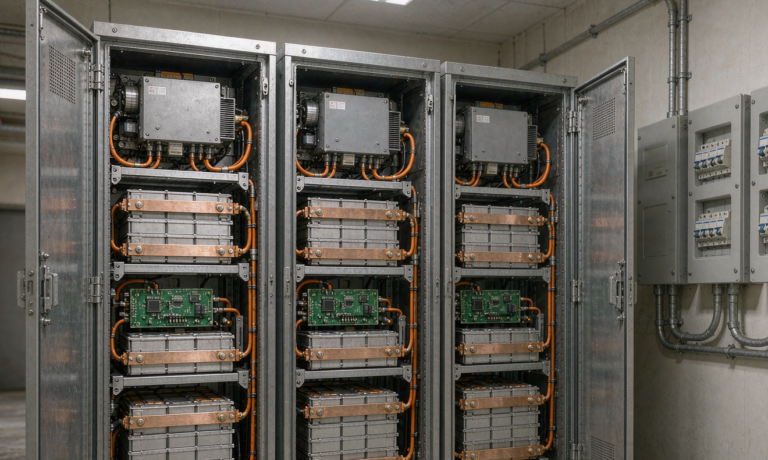
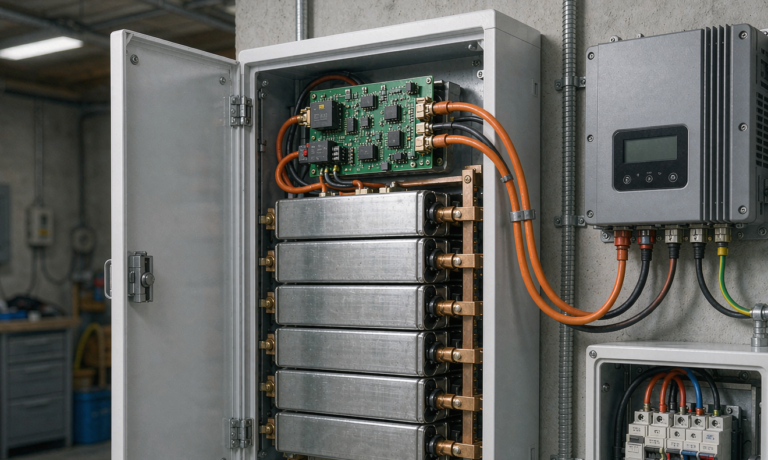
A best practice on paper means nothing if the hardware cannot enforce it. In a compliant home energy storage system, the battery management system (BMS) and the hybrid inverter both carry SOC limits, and they must agree. We configure the BMS as the ultimate safety authority: it holds the hard min/max voltage and SOC cutoffs, while the inverter’s energy management system (EMS) handles the softer economic windows like the backup reserve and the self-consumption target.
In the field, the most common misconfiguration I find is an inverter programmed to 100% charge cutoff while the BMS is set to 95%. The inverter keeps pushing current, the BMS trips on overvoltage, and the homeowner sees a nuisance fault. The fix is to set the inverter cutoff a few percent below the BMS cutoff so the EMS yields gracefully. For UL 9540 and IEEE 1547-2018 grid-interactive systems, the inverter SOC logic also has to respect export limits, so the reserve and the charge ceiling become part of the interconnection paperwork, not just a menu setting.
How Temperature Changes Your Safe SOC Range
SOC best practice is not temperature-independent. Below about 0°C, charging an LFP cell to a high SOC accelerates lithium plating because the intercalation kinetics slow down. That is why any residential battery storage installed in a garage, cabin, or unconditioned space needs a temperature-compensated charge limit. Our packs use the BMS to cap charge current and lower the charge cutoff SOC when cell temperature drops below 5°C, then re-enable full charging once the cells warm.
At the other extreme, heat is the silent killer of calendar life. A battery parked at 100% SOC in a 40°C enclosure ages dramatically faster than the same pack at 60% SOC in the same heat. If your install location runs hot, lower the storage ceiling to 50% and keep the cycling ceiling near 85%. This is one of the reasons we emphasize environmental sealing and ventilation in our IEC 62619 and UL 9540A commissioning checks. FAA and EASA rules do not apply to stationary storage, but the thermal discipline we borrow from aviation-grade cell handling absolutely does.
SOC Strategy for Self-Consumption vs Backup Reserve
How you use SOC depends entirely on why you bought the battery. For a pure self-consumption user who wants to shift solar into the evening, the strategy is to charge toward 90% during the day and bleed down through the evening, holding the backup reserve untouched. For a user whose primary goal is home battery backup during grid outages, the priority flips: keep the reserve charged and let only surplus solar fill the upper band.
I usually recommend a hybrid profile for most homes. Set a 25% locked reserve, allow the system to charge to 90% on sunny days, and let the EMS decide whether to export or hold based on the next day’s forecast. This gives you both bill savings and resilience without ever parking the pack at a stressful extreme. When a customer wants a fully custom battery solution tuned to a specific load profile — say a heat pump plus an EV charger — we model the daily SOC trajectory in simulation before we lock the parameters, because the optimum window is load-dependent, not universal.
Field Data: What We See Across Deployed Residential Battery Storage
Across the deployed fleet we monitor, systems that follow a 15% to 90% window with a temperature-compensated charge limit show capacity retention around 92% to 94% after 2,000 equivalent full cycles. Systems left to free-run 0% to 100% under the same loads land closer to 82% to 85% over the same period. The economic difference is real: at typical residential energy values, protecting those extra cycles delays a capacity-related service event by years.
The second pattern is that backup-reserve discipline matters more than people expect. Homes that treat the whole battery as usable frequently dip into the low-SOC region during multi-day cloudy stretches, and those deep excursions, not the daily shallow cycles, are what we see correlated with early warranty claims. A locked reserve is cheap insurance.
Frequently Asked Questions
What is a healthy SOC range for a home battery?
For LFP-based home energy storage, a healthy daily cycling window is about 15% to 90% SOC, with a locked backup reserve of 20% to 30% if you care about outage resilience. Long-term idle storage is best around 50% to 60% SOC.
Should I keep my home battery backup at 100% all the time?
No. Holding 100% SOC, especially in warmth, is one of the fastest ways to lose calendar life. For backup, a 90% ceiling with a 25% reserved floor gives you nearly the same resilience while sparing the cells the high-voltage stress that drives capacity fade.
How does cold weather change SOC best practice?
Below roughly 5°C, charging to a high SOC risks lithium plating. A properly configured BMS should reduce charge current and lower the charge cutoff as temperatures fall. If your residential battery storage sits in an unconditioned space, make sure temperature-compensated limits are enabled rather than relying on a fixed SOC target.
Can the BMS enforce SOC limits automatically?
Yes, and it should. In a compliant home energy storage system, the BMS holds the hard SOC and voltage cutoffs while the inverter’s EMS manages the softer economic windows. The two must be set so the inverter yields before the BMS trips, which prevents nuisance faults and keeps the pack inside its safe operating area.