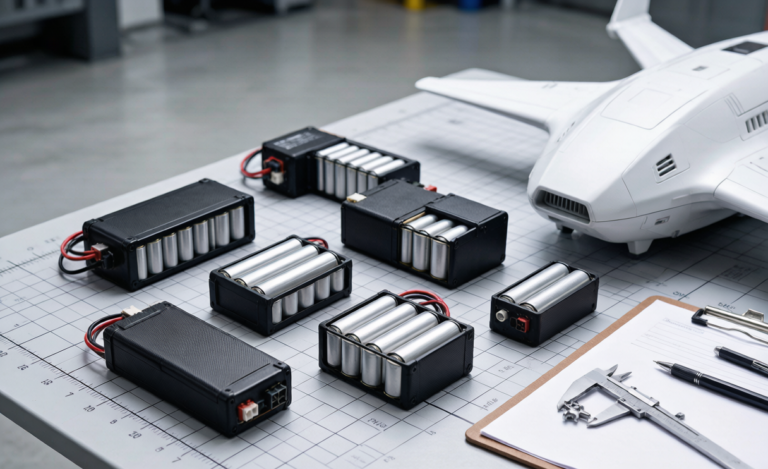
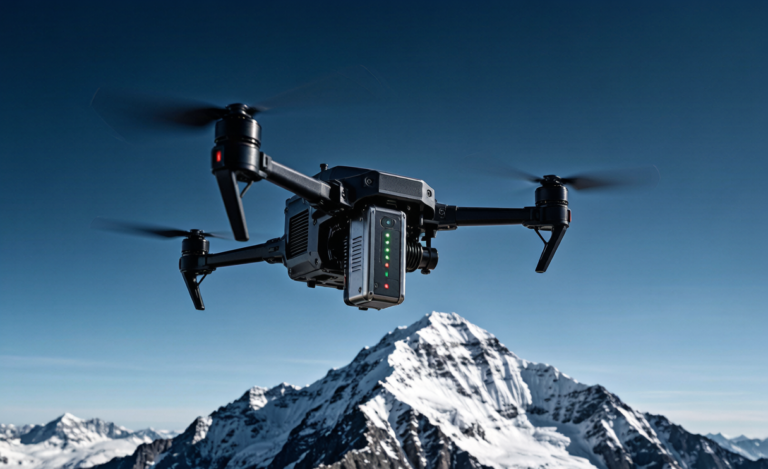
Drone Battery for Night Operations and Lighting Payloads: An Engineer’s Field Guide
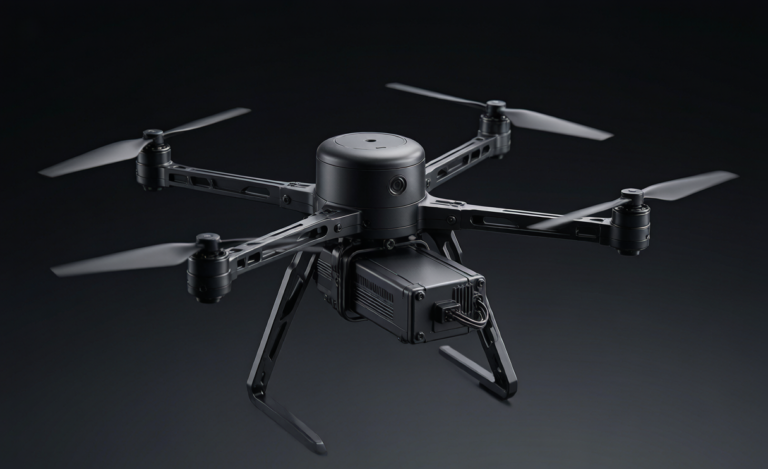
Night flying is a different sport entirely. The moment the sun drops, a professional drone battery has to do more than just spin rotors — it is now feeding a searchlight, an infrared illuminator, a gimbal camera, and sometimes a small onboard compute module, all at the same time. Over my years as a senior lithium battery engineer at Horizon Power, I have spec’d packs for search-and-rescue teams, firefighting units, and industrial inspection crews that only get useful work done after dark. The rules that apply to a daylight mapping mission do not apply here, and the battery is where most of the surprises show up.
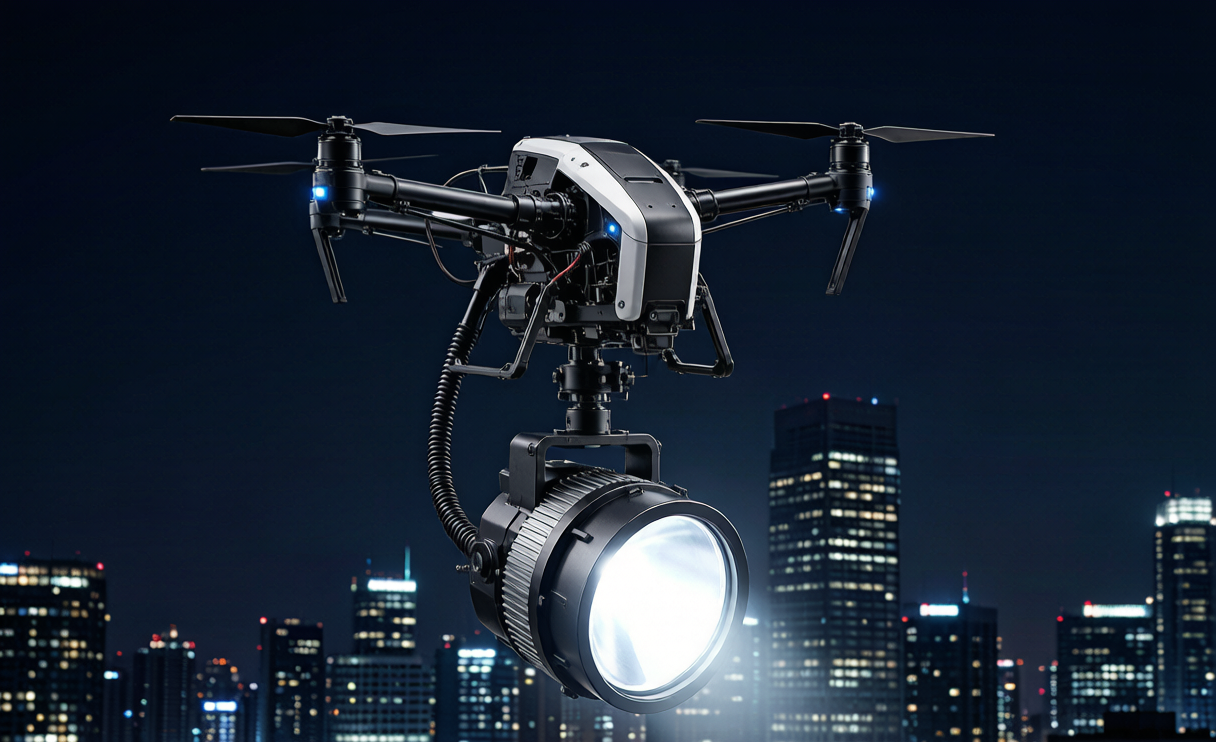
Why Night Operations Change the Battery Math
During the day, a typical multirotor draws almost everything from propulsion. At night, you bolt a lighting payload onto the airframe and the energy budget splits. A 50 W LED searchlight running for 20 minutes pulls about 16.7 Wh on its own — for a 6S drone lithium battery pack rated at 22.2 V, that is roughly 0.75 Ah that never goes to the motors. Add a gimbal, a thermal core, and a video transmitter at 8–12 W, and you are quietly asking the same pack to deliver 25–40% more total energy than the daylight equivalent mission.
In my test lab I treat the lighting load as a steady-state parasitic drain on top of the propulsion curve. The propulsion demand itself does not change much at night, but the usable flight time shrinks because the pack’s state of charge (SoC) is being eaten from two directions. The practical consequence: a pack that gives you 28 minutes of daylight mapping may only give you 19–21 minutes once a 60 W light bar is live. That is the single most common surprise new night operators report, and it is entirely predictable if you size for it up front.
Sizing Capacity for Lighting Payloads
The first question I ask a client is simple: what is the continuous watt draw of everything that is NOT the motors? Let us run a realistic example. A 6S 22000 mAh pack holds about 488 Wh (22.2 V x 22 Ah). If propulsion averages 600 W and the lighting payload plus avionics pulls a steady 70 W, total draw is 670 W. At 90% usable SoC, you get roughly 0.9 x 488 / 670 = 0.655 hours, or about 39 minutes of total flight. Pull the light off and you jump to roughly 44 minutes. The light costs you five minutes — but on a cold night with a heavier airframe, the same light can cost you eight to ten.
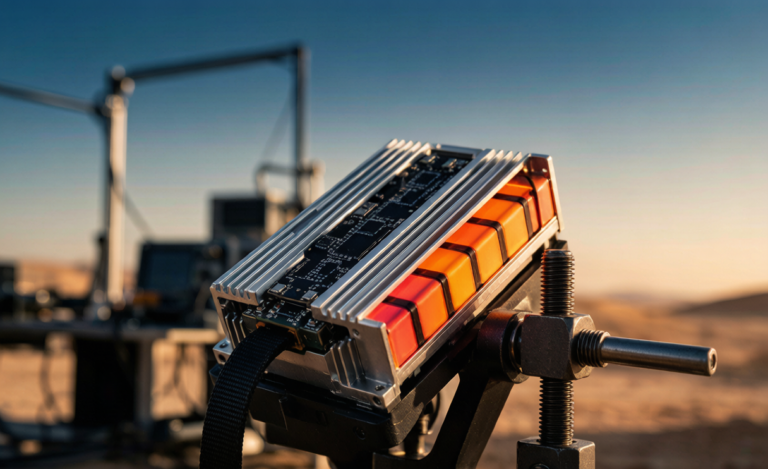
For high-lumen missions I usually recommend bumping capacity 20–30% over the daylight baseline rather than chasing a brighter light. A lithium battery pack built around grade-A cells with a low internal resistance (I look for under 25 mΩ per cell at 1C) keeps the voltage sag under heavy combined load manageable, so your 6S pack does not droop below the 21 V cutoff when the light and motors surge together on a climb-out.
- Continuous lighting load: measure it at the connector, not the spec sheet. LED bars often draw 10–15% more than rated at full white.
- Voltage sag margin: size so that worst-case combined surge stays above your low-voltage cutoff with at least 0.5 V headroom.
- Reserve rule: I never plan a night mission below 25% reserved SoC — darkness removes your visual cue of “getting home.”
Thermal Behavior in Cool Night Air
Night air is usually cooler, and cooler air is friendlier to lithium cells up to a point. Cell internal resistance drops, voltage holds better under load, and you can often extract slightly more usable energy than at 35°C afternoon heat. But there is a trap: if ambient drops below about 10°C, a cold drone battery loses both capacity and peak discharge capability. At -10°C a standard NMC pouch can lose 20–30% of its rated capacity and refuse high-C bursts.
My field fix is twofold. First, for sub-10°C operations I spec cells with a low-temperature electrolyte formulation and verify them against IEC 62133 abuse and thermal cycling tests before they ever ship. Second, I build in a pre-flight warm-up: keep the pack in an insulated case until launch, and on the ground run a 1C partial discharge for 60–90 seconds to bring cell temperature into the 15–25°C sweet spot. That single habit has saved more night missions than any other tweak I know.
BMS and Telemetry for Low-Visibility Missions
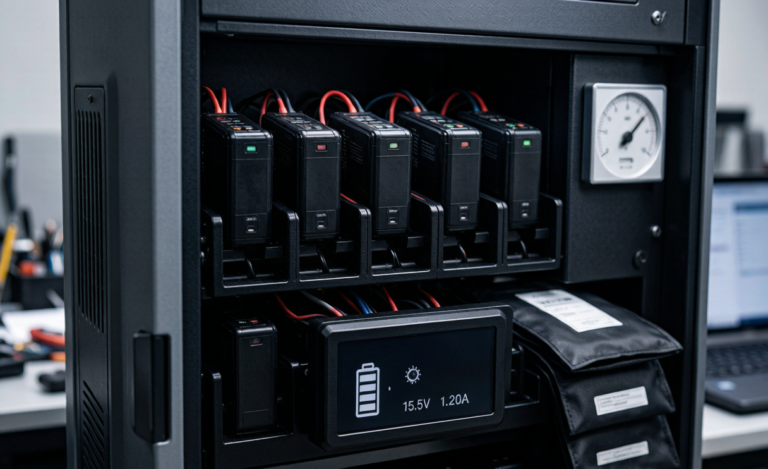
At night you cannot see a swollen pack or a smoking connector, so the battery management system (BMS) becomes your eyes. For night operations I insist on a BMS that reports per-cell voltage, pack temperature, and instantaneous current over a telemetry link the ground station can read in real time. A good BMS will trip on over-current within milliseconds if a lighting ballast shorts, and it will warn you at 30% SoC so you can plan a return while you still have margin.
I also recommend logging. A custom battery solution we deliver for a firefighting client records a full flight telemetry stream — voltage, current, temperature, and cycle count — so after a night operation the team can see exactly where the energy went. When a pack comes back warmer than expected, the log tells us whether it was the light, a wind gust, or a failing cell, which is far better than guessing.
Safety, Certification and Compliance
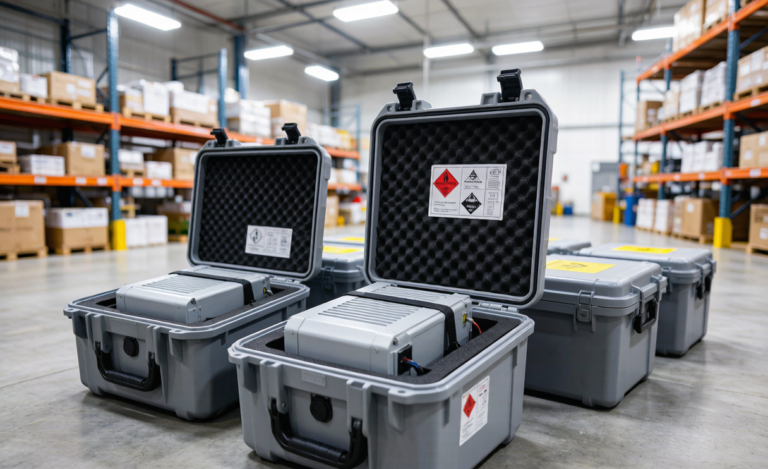
Night flying often means flying near people, near structures, or under official authorization, so compliance is not optional. Every pack we build for these programs is validated against UN38.3 for transport safety and IEC 62133 for portable cell safety, and we document the test reports so operators can show them to aviation authorities. In the field, the relevant flight rules come from the FAA in the United States and EASA in Europe — both require that the aircraft and its power system be airworthy and that any lighting used for navigation or illumination meets the applicable airspace rules.
From an engineering standpoint, the certification that matters most for night fleets is thermal runaway prevention. A lighting payload sitting inches above a pack means heat from the light can raise pack temperature during a long hover. I design the enclosure with thermal isolation between the light bar and the cells, and I keep the BMS temperature cutoff conservative — typically a hard disconnect at 60°C pack temperature. That is the kind of detail regulators and insurers both appreciate.
Specifying a Custom battery solution for Night Fleets
Off-the-shelf packs are fine for hobby night flying, but a professional night fleet almost always needs a custom battery solution. The brief I want from a client is specific: target flight time with light on, maximum continuous and peak lighting load, ambient temperature range, connector type, and any airspace or certification constraints. With those five inputs I can spec cell count, capacity, discharge rating, and the BMS feature set in an afternoon.
For a recent search-and-rescue program we built a 12S 30000 mAh pack with a 120 W lighting bus tapped directly off the pack through a protected regulator, plus a BMS with live telemetry. The operator gained seven minutes of lit flight time over their old 6S setup and, just as importantly, got per-cell visibility they never had before. That is the difference between a pack that “works” and a power system you can actually trust at 2 a.m. over water.
Frequently Asked Questions
Does adding a lighting payload really cut flight time that much?
Yes, and more than people expect. A 50–70 W light on a typical multirotor pack removes roughly 15–25% of usable flight time depending on airframe and ambient temperature. The fix is to size capacity up 20–30% rather than dim the light, because the whole point of the mission is the illumination.
What battery temperature is safe for night operations?
I target 15–25°C at launch. Below 10°C, capacity and peak discharge fall sharply, so I use low-temperature cells and a short pre-flight warm-up discharge. Above 50°C pack temperature during flight, a conservative BMS should warn, and at 60°C it should hard-disconnect to prevent thermal issues.
Which standards should a night-operations drone battery meet?
At minimum, UN38.3 for transport and IEC 62133 for cell safety, with full test documentation. Flight authorization follows FAA rules in the U.S. and EASA rules in Europe, and the lighting itself must comply with the airspace requirements those agencies set for night flight.
Can I just use my daylight battery pack at night?
You can, but plan for shorter endurance and keep a larger SoC reserve — I recommend 25% reserved. If you fly night missions regularly, a custom battery solution sized for the lighting load and tuned for cooler air will be safer, longer-lived, and far less surprising.