Lithium Battery for Electric Bicycles and Last-Mile Mobility: Engineering Insights from the Field
As a Senior lithium battery Engineer at Horizon Power, I have spent the last decade designing energy storage systems for everything from industrial drones to grid-tied home units. But few applications have evolved as rapidly — or as practically — as the lithium battery for electric bicycle last-mile fleets. When a logistics operator asks me to spec a pack for urban delivery, the conversation is never just about capacity. It is about duty cycle, safety certification, weight budget, and the brutal reality of daily charging in all weather. In this article I will walk through how we engineer a lithium battery electric bicycle last mile solution that actually survives commercial use, drawing on real standards such as UN38.3, IEC 62133, and the operational lessons our field teams have collected across three continents.
Why Last-Mile Mobility Needs a Purpose-Built Battery
The shift from vans to e-bikes and cargo trikes for the final leg of delivery is driven by congestion, emissions rules, and cost. But a consumer e-bike battery and a commercial last-mile pack are not the same animal. A retail commuter might pedal 15 km a day with rest days. A delivery rider in a dense city can log 60 to 90 km across six to eight hours, often with the motor doing most of the work and the battery deep-cycled twice per shift through a midday swap. That duty profile dictates everything downstream: cell selection, thermal margin, connector rating, and BMS aggressiveness. When we develop a custom battery solution for a fleet operator, the first thing we model is not peak range — it is the cumulative watt-hours per week and the temperature the pack will see inside a locked outdoor cabinet at 2 p.m. in July.
The economics reinforce the engineering. A delivery business pays per successful drop, not per kilometer ridden, so unplanned downtime is the enemy. A pack that loses 15 percent capacity in its first season silently erodes margin on every route. That is why commercial last-mile programs should never reuse consumer-grade battery architectures; the connector, the enclosure, and the firmware all need to be built for a machine that is earning money every hour it is on the road.
Cell Chemistry: NMC vs LFP for Electric Bicycle Packs
For a lithium battery electric bicycle last mile build, the two realistic chemistries are nickel-manganese-cobalt (NMC) and lithium-iron-phosphate (LFP). NMC trades at roughly 200 to 260 Wh/kg versus LFP’s 120 to 160 Wh/kg, which matters when every kilogram on a bike frame changes handling. But LFP wins on cycle life — 2,000 to 4,000 cycles versus 800 to 1,500 for NMC — and thermal stability; it simply does not enter thermal runaway as easily. For last-mile fleets that charge aggressively and want a pack to outlast the vehicle, we increasingly recommend LFP despite the weight penalty, especially for cargo trikes where payload matters more than grams. For lightweight pedal-assist bikes where range per charge is king, NMC still has a place. The choice is a system trade, not a spec-sheet checkbox.
There is also a supply-chain dimension. NMC depends on cobalt and nickel, both subject to price swings and sourcing scrutiny. LFP uses abundant iron and phosphate, which stabilizes cost across a multi-year fleet contract. For operators signing three-year service agreements, that predictability is often as valuable as the chemistry’s cycle life.
Safety Certification and the Standards That Actually Matter
You cannot ship or operate a commercial lithium battery without certification, and the burden is higher for fleet use. UN38.3 is the baseline for transport; it simulates altitude, thermal, vibration, shock, and short-circuit abuse. IEC 62133 covers the cell and pack safety requirements for portable sealed secondary cells, including overcharge, forced discharge, and temperature abuse. For any pack that rides on a public road, we also design to the relevant regional e-bike standards and ensure the pack passes external short-circuit and crush testing with margin. A lithium battery electric bicycle last mile product that skips these is a liability, not a cost saving. In our lab we routinely test to 1.5 times the standard’s pass threshold because real-world abuse — a dropped bike, a flooded curb — exceeds the textbook scenario.
Sizing the Pack: Range, Weight, and Duty Cycle
Sizing is where engineering meets the spreadsheet. Start with the rider’s average draw: a last-mile cargo e-bike under load draws 250 to 600 W continuous, spiking to 1,000 W on hills. At a nominal 48 V pack, that is roughly 5 to 12 A continuous. A 48 V 20 Ah (960 Wh) LFP pack gives a realistic 40 to 55 km in mixed urban conditions; a 48 V 30 Ah (1,440 Wh) pack stretches that toward 70 to 80 km. But range claims from marketing departments are usually optimistic by 20 to 30 percent. We size to the 10th-percentile day — headwind, cold battery, full cargo — because a rider stranded at kilometer 80 of a 90 km route costs the operator more than the extra cells. This is exactly why a custom battery solution, tuned to the operator’s actual route telemetry, beats an off-the-shelf pack every time.
We also model the pack’s own aging. A battery that delivers 70 km when new may deliver 55 km after 800 cycles. If the route requires a 60 km round trip, the pack becomes a liability well before it is formally “end of life.” Building in a 15 to 20 percent capacity reserve at day one is the cheapest insurance a fleet can buy.
Battery Management Systems for Fleet Reliability
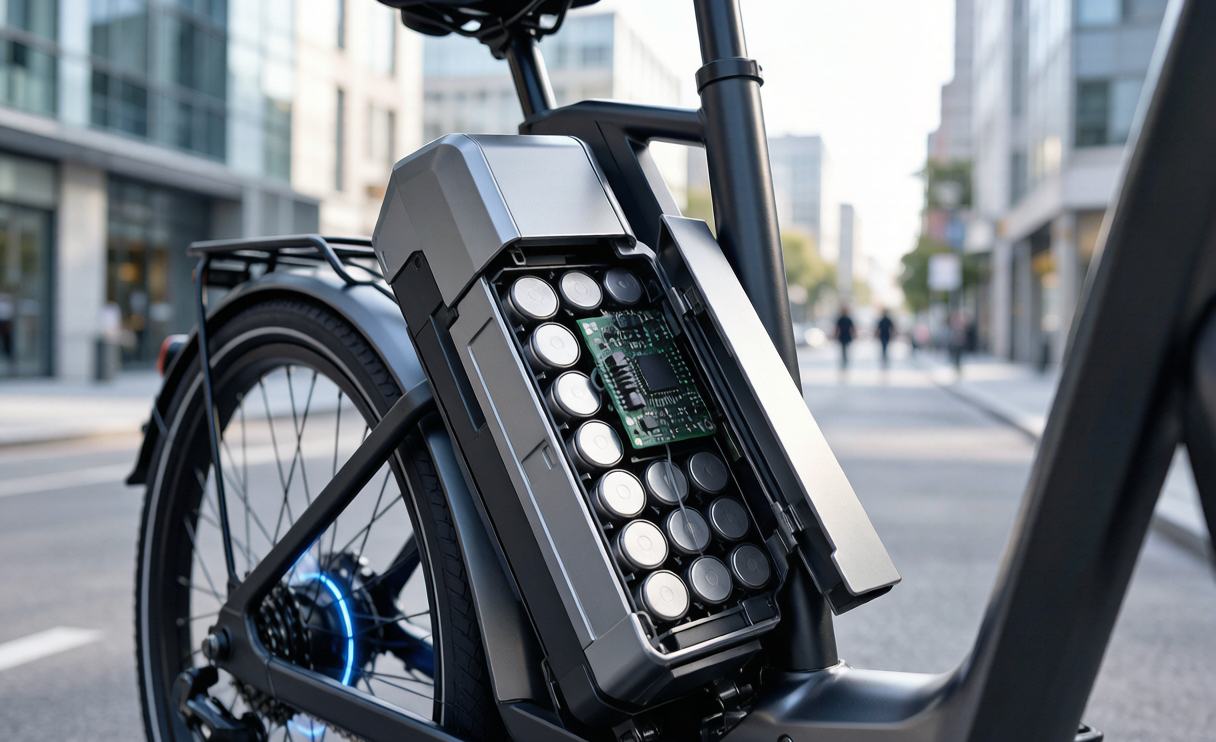
The BMS is the difference between a battery that lasts four years and one that fails in eight months. For a lithium battery electric bicycle last mile fleet, we specify a BMS with:
- Accurate cell-level voltage balancing, with active balancing preferred for LFP’s longer life
- Temperature sensors on at least two pack locations
- Controlled current limiting during cold-weather charging to prevent lithium plating
- CAN or UART telemetry so the operator’s dashboard knows state-of-health, not just state-of-charge
- A sealed enclosure rated IPX5 at minimum, since bikes live outdoors
I tell operators: if your BMS cannot tell you which cell is degrading, you are flying blind. The data we pull from fleet BMS logs is what lets us refine the next custom battery solution iteration — we have caught early imbalance trends weeks before they became road failures.
Cold-Weather Performance and Seasonal Reality
Lithium cells hate the cold, and last-mile riders work through it. Below about 10 degrees Celsius, usable capacity drops and internal resistance climbs, so a pack rated for 70 km in spring may deliver 50 km in January. More dangerous is cold charging: forcing current into a cold cell causes metallic lithium plating on the anode, which permanently damages the cell and raises fire risk. A proper BMS must gate charging until the pack warms above a safe threshold, or better, precondition it. We design our northern-climate custom battery solution variants with insulated enclosures and optional pad heating so the pack reaches a safe charge window faster at the depot.
Charging, Swapping, and Total Cost of Ownership
Last-mile operations live and die by charge turnaround. A fast-charge LFP pack at 0.5C reaches 80 percent in about 90 minutes; push to 1C and you trade cycle life for speed. Many fleets instead use battery swapping: riders exchange a depleted pack for a charged one at a hub, eliminating downtime. That model demands standardized mechanical and electrical interfaces — which is why we often deliver a custom battery solution as a family of interchangeable modules rather than a single glued pack. On total cost of ownership, the LFP pack’s longer cycle life usually wins despite higher upfront cost, especially when you factor in the labor saved by not replacing packs every season.
Frequently Asked Questions
How long does a lithium battery for an electric bicycle last?
A well-engineered LFP pack in commercial last-mile use typically delivers 1,500 to 2,500 full-equivalent cycles, which translates to roughly two to four years of daily multi-shift operation. NMC packs trend shorter, around 800 to 1,200 cycles. Lifespan depends heavily on depth of discharge, charging temperature, and BMS quality — shallow discharges and controlled charging extend life substantially.
What certifications does a last-mile delivery battery need?
At minimum, UN38.3 for transport and IEC 62133 for cell and pack safety. Depending on the market you will also need regional e-bike or vehicle compliance, and we recommend third-party testing to the applicable standard with margin beyond the pass threshold. Skipping certification is not worth the risk for a commercial lithium battery electric bicycle last mile deployment.
Can the same battery be used for e-bikes and cargo trikes?
Often yes, if the pack is designed as a scalable module family. The cargo trike draws more continuous current and benefits from LFP’s cycle life and thermal margin, while a lightweight e-bike may prioritize NMC’s energy density. We usually build a common cell format and vary the series-parallel count and enclosure for each vehicle — that is the essence of a flexible custom battery solution.
How do I choose between NMC and LFP?
Choose LFP for fleet duty, cargo loads, and longest life; choose NMC when every gram of weight and every Wh of range per charge is critical and you accept shorter cycle life. For most last-mile operators running multiple shifts, LFP is the safer long-term bet.
Conclusion
Engineering a lithium battery electric bicycle last mile system is less about chasing the highest number on a datasheet and more about matching chemistry, enclosure, BMS, and charging model to the brutal rhythm of daily delivery. At Horizon Power we have learned that the packs which survive are the ones designed around real telemetry, certified with margin, and built as part of a custom battery solution rather than a generic off-the-shelf box. If you are scaling a last-mile fleet, start the battery conversation early — it is cheaper to spec it right than to swap it later.