Sodium-Ion Battery for Cold-Climate Solar Storage
I am Karl Huang, a senior lithium battery engineer. In twelve years split between cell labs and commissioning sites, the most frustrating warranty call I handle is the winter one: a customer in a northern province, a well-built solar array, a properly wired inverter, and a battery bank that refuses to take the charge the panels are producing. The array is making power. The load is modest. The state of charge does not move. Nothing is broken in the way the customer expects broken to look.
That failure mode pushed our team into serious low-temperature work, and it is why I now specify a sodium-ion battery for cold climate solar storage on a growing share of off-grid and rural microgrid projects. What follows is what actually goes wrong below freezing, what sodium-ion chemistry does differently, the numbers we measured in our chamber and in the field, how to size and enclose the bank, and the three cases where I still recommend a conventional lithium battery.
Why Conventional Lithium Banks Stall in Deep Cold
Cold rarely destroys a lithium iron phosphate bank. It quietly makes it unusable, which is worse, because the customer keeps waiting for it to recover.
Three mechanisms stack up. First, charge acceptance collapses. Below roughly 5 °C, intercalation into graphite slows until plated metallic lithium becomes thermodynamically favoured over insertion — irreversible, electrolyte-consuming, and in the worst case dendrite-forming. Cell makers know this, so virtually every credible battery management system enforces a hard charge lockout at 0 °C and permits only a 0.02–0.05C trickle to 5 °C. That is not a defect; it is the BMS protecting the pack from the installer.
Second, internal resistance rises steeply. In our chamber a good 280 Ah LFP prismatic measuring 0.42 mΩ DCIR at 25 °C lands at 1.5–2.1 mΩ at −20 °C, a 3.5–5× rise. Usable capacity at 0.5C falls to 55–70% of rated, and voltage sag under a well pump or inverter surge trips low-voltage cutoff long before the cells are empty.
Third — the part that turns an inconvenience into a site failure — the heater that fixes problems one and two has to be powered by something. Grid-tied, you pull 300 W from the utility and forget it. Off grid in December, that heater eats the harvest. A 30 kWh cabinet with 50 mm polyurethane needs 250–450 W continuous to hold cells above 0 °C at −30 °C ambient, or 6–11 kWh per day. At 50° latitude in late December a 5 kWp array often yields only 0.8–1.6 kWh per installed kWp per day, so the heater can consume 25–40% of everything the panels make. When a storm drops yield to near zero for four days, the bank heats itself flat, then locks out charging because it is now both cold and empty.
What a Sodium-Ion Battery Does Differently Below Zero
Sodium-ion is not a magic chemistry, and I am tired of marketing that implies it is. It is a different set of trade-offs, and several of them happen to point the right way for winter.
The anode is hard carbon rather than graphite. Sodium stores in disordered carbon by surface adsorption and pore filling rather than tidy layer intercalation, and the sodium plating potential sits at a more comfortable margin above that anode’s working potential than lithium’s does above graphite. So a sodium-ion cell accepts meaningful current where a lithium cell must refuse it. The electrolyte helps too: our sodium salts hold higher low-temperature ionic conductivity than LiPF6 systems, and Na⁺ desolvation energy at the interface is lower — which is where most cold-temperature resistance in a lithium battery originates.
Two secondary properties matter more than customers expect. Both current collectors are aluminium, because sodium does not alloy with aluminium, so a cell can be discharged to 0 V without copper dissolution. That is why sodium-ion ships at zero state of charge under the UN 3551 and UN 3552 entries added to the UN Model Regulations and IATA DGR for 2025, and why a frozen, fully depleted sodium bank comes back undamaged. Nominal voltage is 3.0–3.1 V over a 1.5–4.0 V window, so a same-series-count pack sits lower than LFP and needs its own inverter voltage-window check — not a drop-in swap.
The Cold Numbers We Actually Measured
The data below comes from our 2 m³ climate chamber, comparing 25 Ah pouch sodium-ion cells against 100 Ah LFP prismatics from a tier-one supplier, both under 50 cycles. Discharge at 0.5C; charge at the highest rate permitted without violating plating or voltage limits. Every number is a range because cell-to-cell and vendor spread is real.
- 0 °C: sodium-ion 94–97% capacity, 0.5C charge accepted, DCIR 1.25–1.4×. LFP 82–88%, charge limited to 0.05–0.1C or blocked, DCIR 1.9–2.4×.
- −20 °C: sodium-ion 85–90% capacity, 0.25–0.4C accepted, DCIR 1.7–2.2×. LFP 55–70%, no charge permitted, DCIR 3.5–5×.
- −30 °C: sodium-ion 72–80% capacity, 0.1–0.2C accepted, DCIR 2.6–3.4×. LFP 30–45%, no charge permitted, DCIR 6–9×.
- −40 °C: sodium-ion 55–65% capacity, charge only after preheat, DCIR 4–6×. LFP effectively unusable.
Cycle life at 25 °C is where sodium-ion loses ground on paper and gains it back in winter service. Our gen-2 cells deliver 3,000–4,500 equivalent full cycles to 80% state of health in a 10–95% window — comparable to mid-grade LFP, below premium LFP’s 6,000-cycle claims. But in a realistic off-grid 25–85% SOC winter profile with daily incomplete recharge, we measured 91% retention after 1,500 cycles on sodium versus 84% on the LFP control, which accumulated plating damage during every marginal sub-5 °C charge its BMS did permit. The chemistry that is allowed to charge is the chemistry that survives.
Enclosure, Insulation and Heater Strategy
Choosing a chemistry buys margin. It does not excuse a bad box. Here is the specification I hold cold-climate cabinets to.
Insulation and thermal bridging
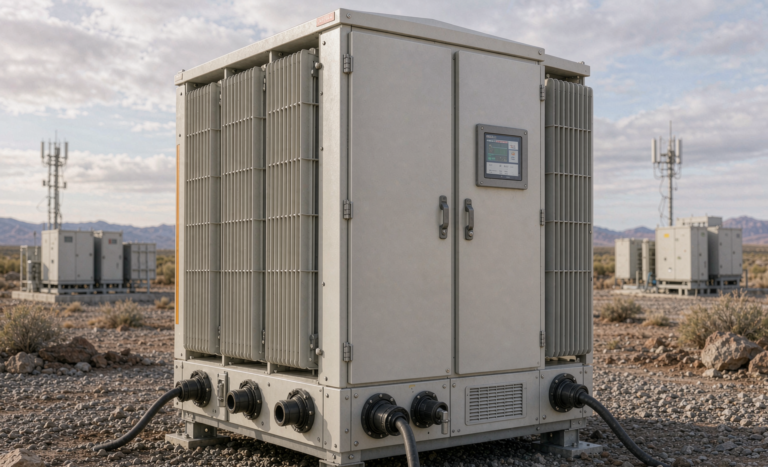
Minimum 50 mm closed-cell polyurethane on all six faces, 75 mm below a −30 °C design temperature. The failure I find most often is not thin insulation but thermal bridging through cable glands, mounting feet and hinges. On one audit I measured a 6–9 °C gradient across a cabinet because the DC busbar penetration had no thermal break: cells nearest the gland at 20 °C, the far end at 11 °C. Over 5 °C of spread inside a string drives divergent ageing, so specify thermal-break glands and fit at least three temperature sensors per string, one on the cell furthest from the heater.
Heater sizing and set point
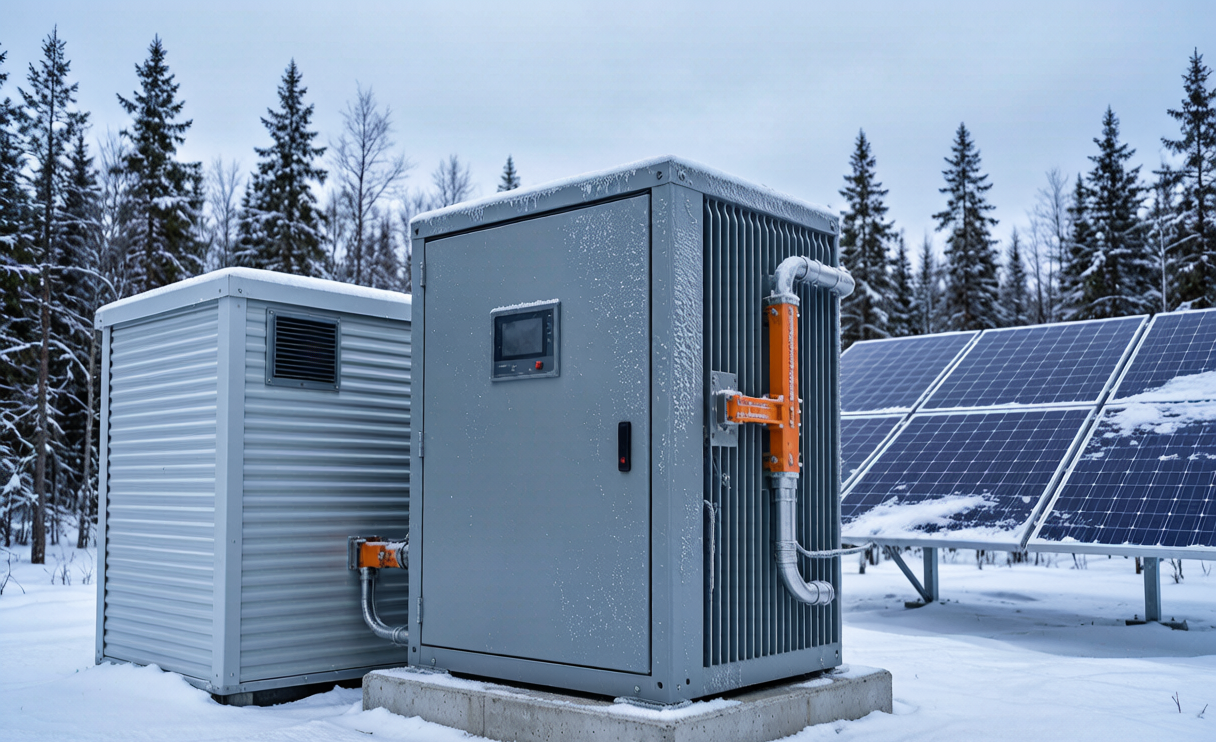
Because sodium-ion accepts charge at −20 °C, the heater no longer has to hold 5 °C. Its job shifts from enabling charging to protecting efficiency, so I set the enable point at −15 °C with a target of −5 °C rather than +15 °C. On a 30 kWh cabinet at −30 °C ambient that cuts continuous draw from 250–450 W to roughly 60–140 W, or 1.4–3.4 kWh per day.
Self-heating and charge current shaping
Do not fight physics with resistance heaters alone when the pack makes its own heat. At −20 °C and 0.3C our 30 kWh cabinet generates 90–160 W of I²R heating, lifting core temperature 4–7 °C over the first ninety minutes of a charge window. I ramp allowed current with measured cell temperature — 0.1C below −25 °C, 0.25C from −25 to −15 °C, 0.4C from −15 to 0 °C, 1C above 0 °C — and let the pack warm itself into a higher rate.
Sizing a Cold-Climate Bank: A Worked Example
A telemetry-and-cabin site we commissioned at 52° N: 4.8 kWh average winter daily load, 3 days autonomy, 6 kWp array, design ambient −34 °C.
December yield at that latitude runs 1.0–1.5 kWh per kWp per day, so call it 7.2 kWh on a fair day. Useful load plus a sodium-ion cabinet heater at the −5 °C target is 4.8 + 2.4 = 7.2 kWh — break-even on a fair day, a deficit when overcast, so the bank must ride the deficit out. Three days at 4.8 kWh is 14.4 kWh usable. Sodium-ion at −20 °C delivers 85–90% of rated, and I hold winter depth of discharge to 80% to keep low-SOC sag clear of inverter cutoff: 14.4 ÷ 0.85 ÷ 0.80 ≈ 21.2 kWh, so we installed a 24 kWh cabinet.
Run the same arithmetic with LFP and you do not get a bigger battery — you get a different system. At −20 °C it delivers 55–70% of rated and cannot recharge until a 350 W heater has held it above 0 °C for two to four hours, costing 1.5–2.5 kWh before a single amp-hour goes in. Nameplate climbs past 32 kWh, parasitic load roughly triples, and the array grows to about 9 kWp. Sodium-ion is not cheaper per kWh at the cell level today; it is cheaper per delivered winter kWh at the system level, and on remote sites the array and civil works are where the money sits.
Where I Still Recommend Lithium Instead
Three honest counter-cases, because a battery solution that ignores them will embarrass whoever specified it.
Mass or volume constrained installations. Commercial sodium-ion cells land at 140–160 Wh/kg against 160–180 for LFP and 250–280 for NMC. For a structurally limited rooftop, a mobile trailer, or anything airborne — our drone battery line, where FAA Part 107 and EASA rules make every gram a payload trade — sodium-ion is the wrong answer.
Mild climates optimising cost per cycle. If the design minimum is above 5 °C, the cold advantage never gets paid out. High-volume LFP at 6,000-plus cycles and lower installed cost per kWh remains rational for most temperate home energy storage. Do not buy winter margin you will never use.
Sustained high C-rate service. Above roughly 1C continuous, gen-2 sodium-ion heats and fades faster than good LFP. Welding shops, EV charging buffers and heavy motor-start duty belong to lithium, or to a hybrid where a small lithium battery takes the pulses while the sodium bank carries the energy.
Standards, Shipping and Commissioning
Cold-climate projects attract cold-climate scrutiny, and the paperwork must match the exact configuration you are shipping — not a similar model from the same supplier. On our sodium-ion cabinets we hold this file:
- UN 38.3 T.1–T.8 on the shipping configuration, altitude and thermal cycling run at cabinet level, not just bare cells.
- UN 3551 / UN 3552 transport classification, shipped at 0 V — no 30% SOC ceiling of the kind IATA PI 965 imposes on lithium air freight.
- IEC 62133-2:2017 and IEC 62619, the latter applied by analogy where sodium-specific clauses are still maturing.
- UL 1973 for stationary storage, plus UL 9540 / 9540A propagation data where the AHJ or NFPA 855 spacing requires it.
- IEC 62933-5-2 for grid-connected safety, and IEC 60068-2-1 / 2-14 cold testing to prove the enclosure, not just the cells.
- IEC 60529 IP54 or IP65 with the gasket tested at design low temperature — EPDM that seals at 20 °C can take a set and leak at −35 °C.
Before sign-off I insist on three measurements: cell temperature spread across the string at the coldest hour of the night (under 5 °C), insulation resistance at 500 Ω/V or better, and a logged charge event below −15 °C proving the BMS permits the design current. That last test catches the most common integration error I see — a correct sodium-ion pack running a BMS parameter file inherited from a lithium product, still enforcing a 0 °C lockout the chemistry does not need.
Two Field Lessons
The five-week outage. A remote monitoring station lost service for 35 days. The LFP bank passed every diagnostic, but its heater ran off the bank it was warming. A four-day storm dropped yield near zero, the pack hit low cutoff, the heater stopped, cells fell to −18 °C, and the BMS then refused charge when the sun returned. We retrofitted a 24 kWh sodium-ion cabinet, kept the array and inverter after a voltage-window check, and logged 0.31C acceptance at −18 °C on the first cold morning. Three winters, no interventions.
The 15 °C thermostat. An integrator copied a warehouse HVAC set point into a battery cabinet controller: hold 15 °C. Correct for people, expensive for electrons — 9–14 kWh per day at a site whose useful load was 5 kWh. Dropping the target to −5 °C and adding thermal-break glands cut parasitic draw roughly 70% and improved capacity retention the following year, because the cells stopped wintering warm at 100% SOC. One habit to take from this article: log parasitic load separately from useful load. You cannot manage what the meter lumps together.
Frequently Asked Questions
Can a sodium-ion battery really charge below freezing without damage?
Yes, within limits. Our cells accept 0.25–0.4C at −20 °C and 0.1–0.2C at −30 °C without the plating mechanism that damages a lithium battery in the same conditions. Below −30 °C I still require preheat before any charge above 0.1C, and I ramp current with measured cell temperature rather than trusting one ambient sensor.
How much cheaper is the total system, not just the cells?
On the 52° N example, sodium-ion needed 24 kWh and 6 kWp where LFP needed roughly 32 kWh and 9 kWp. Cells were 8–15% dearer per kWh; installed cost came out 18–26% lower because array, mounting, wiring and heater capacity all shrank. Grid-tied, where the heater is effectively free, that advantage largely disappears.
Will my existing solar inverter work with a sodium-ion pack?
Sometimes, but never assume it. Nominal cell voltage is 3.0–3.1 V versus 3.2 V for LFP over a wider 1.5–4.0 V window, so a same-series-count pack sits lower and swings further than the 51.2 V of a 16S LFP pack. Check DC input limits, low-voltage disconnect, and whether the closed-loop communication profile supports the pack’s BMS. We settle this with a documented voltage-window and protocol check as part of every custom battery solution, not after delivery.
How should I store a sodium-ion bank through an unused winter?
At 30–50% SOC somewhere it can simply go cold. Because the cells tolerate 0 V, deep self-discharge does not carry the copper-dissolution risk that ruins a lithium battery left flat. Never park any chemistry warm at 100% SOC — that causes more calendar fade than cold ever will.
What enclosure rating do I need for a snowy site?
IP54 as a floor, IP65 where blowing snow, ice loading or spring meltwater are credible, verified to IEC 60529 with the gasket qualified at design low temperature. Pair it with thermal-break glands; the ingress rating means nothing if that same penetration conducts heat straight out of the cabinet.
Is sodium-ion mature enough to specify today?
For stationary cold-climate storage, yes, with two conditions: test reports for the exact cell and cabinet configuration you are buying, and confirmed second-source availability or a spare-module commitment, because the supply base is still narrower than lithium’s. For weight-critical or high-rate work, I would wait another generation.
The Engineering Summary
A sodium-ion battery for cold climate solar storage does not win by storing more energy. It wins by accepting charge when the sun finally appears — so the heater budget shrinks, the array shrinks, and the death spiral that strands off-grid sites in February never starts. Specify for the temperature at which the system must actually work, insulate against thermal bridges rather than only ambient, set the heater to protect efficiency instead of enabling charging, and prove the BMS permits sub-zero current before sign-off.