Drone Battery Testing for Racing Drones: An Engineer’s
Racing drones are unforgiving customers. A cinematic survey aircraft might pull 2-3C on a calm day; an FPV racing quad on a hard punch-out can momentarily demand 80-120A from a 1300-1500 mAh pack – that is roughly 50-70C burst current. When I joined Horizon Power as a senior lithium battery engineer, the first thing I changed was how we qualify every drone battery before it ever leaves the lab. In this guide I will walk through the exact validation protocol my team runs on racing packs: how we measure burst current, how we abuse cells to UN 38.3 and IEC 62133-2 limits, and how we decide whether a pack is genuinely safe to put in the air.
Why Most Racing Drone Packs Fail the Bench Before They Fail in the Air
The failure mode I see most often is not spectacular. It is subtle. A pack shows healthy capacity on a 1C discharge, the customer flies it twice, and on the third punch-out the voltage sags so hard the flight controller brownouts and the quad lawn-darts into a fence. The cells were never bad – they were simply never qualified for the burst profile a racing drone actually imposes.
In my lab we treat the published “C-rating” on a drone lithium battery label as a marketing number, not an engineering spec. A 75C pack that holds its voltage at 75C for 3 seconds is a different animal from one that collapses after 0.8 seconds. So every pack we build is characterized on a real load profile extracted from flight logs, not on a generic constant-current curve.
My Burst-Current Test Protocol (and the Numbers That Matter)
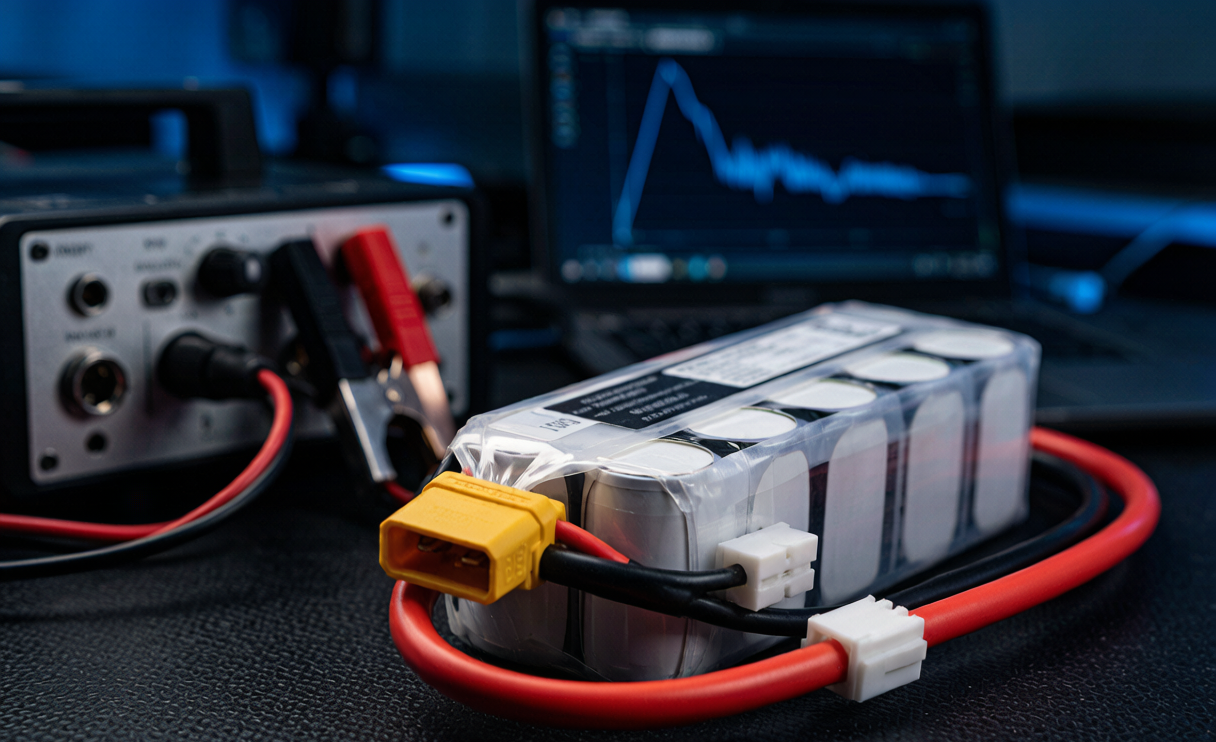
We run burst qualification in three stages. First, a constant-current step at the rated C-rate for 30 seconds to confirm the pack reaches the declared capacity without exceeding 60°C surface temperature. Second, a pulsed profile: 5 seconds at 60C, 10 seconds rest, repeated 20 times, while we log per-cell voltage, pack temperature, and internal resistance (DCIR) before and after. Third, a “worst-case” pulse of 90-110A for 3 seconds to capture the transient sag.
The pass criterion is simple but strict. Pack voltage under the worst-case pulse must stay above 3.3V per cell (for a 4S LiPo that is 13.2V pack minimum), temperature must not exceed 70°C at any point, and DCIR may rise no more than 15% across the 20-pulse block. If a lithium battery fails any of those three gates, it does not ship, regardless of what the label claims.
I also record the recovery slope. A healthy racing pack rebounds to within 0.05V of its resting voltage within 30 seconds of the pulse ending. A pack whose voltage crawls back slowly has internal damage or poor busbar welds – both disqualifying.
Vibration, Shock, and the UN 38.3 Mechanical Battery of Tests
Racing drones vibrate like a handheld angle grinder. Before any pack is cleared for flight, it must pass the mechanical abuse portion of UN 38.3, the international air-safety standard every commercial cell and pack is tested against. We run T.3 (vibration) and T.4 (shock) on every new drone battery design.
T.3 sweeps 7 Hz to 200 Hz and back over three axes, with a total displacement of 0.8 mm below 60 Hz. T.4 applies a 150 G half-sine shock for 6 milliseconds across each axis, both directions. The pass line is absolute: no leakage, no venting, no fire, no rupture, and a voltage drop of less than 20 mV after the sequence. We then X-ray the pack to confirm no cell delamination or tab fracture that the electrical test could have missed.
In my experience the shock test catches the failures vibration misses – specifically poor spot welds on nickel strips. A weld that survives 15 minutes of shake can still crack under a single hard landing impact, and T.4 is how we find it on the bench instead of in a customer’s aircraft.
Thermal Abuse and the IEC 62133-2 Safety Gates
UN 38.3 proves a pack is safe to ship. IEC 62133-2:2017 proves it is safe to use. For any drone lithium battery we sell into the EU or to OEMs with due-diligence requirements, IEC 62133-2 is non-negotiable. The key tests are external short circuit (Section 12), forced discharge, and the thermal abuse test at 130°C.
The thermal abuse test is the one customers never see but should care about most. We heat a fully charged cell to 130°C and hold it for 10 minutes; the pass condition is no explosion and no fire. On a racing pack the realistic risk is not the oven – it is a cell crushed against a motor bell during a crash, where localized heating can trigger thermal runaway. IEC 62133-2 is our proxy for that worst case.
We also run an accelerated “torture” cycle beyond the standard: 50 rapid charge-discharge cycles at 10C with only 3 minutes of rest between, logging capacity fade. A racing pack that loses more than 20% capacity in that block gets sent back to chemistry, not to the production line.
Building a custom battery solution Around a Real Flight Profile
Off-the-shelf packs are tuned for average use. A competitive pilot is not average use. When a team comes to us for a custom battery solution, the first thing I ask for is not a cell count – it is a flight log. We want the actual throttle curve, the motor KV, the propeller pitch, and the typical ambient temperature at the track.
From that data we build a representative load profile and size the pack around the 95th-percentile current, not the average. That usually means a higher-pulse cell than the pilot expected, sometimes a slightly heavier one, but the result holds voltage through the final corner instead of sagging. For a 5-inch quad pulling 90A peaks, we typically specify a high-discharge LiHV cell at 100-130C pulse rating and a busbar rated for 150A continuous.
The custom battery solution also lets us place the balance leads and XT60 connector where the frame actually routes them, which removes the strain-relief failures I see constantly on generic packs. Small mechanical decisions, measured on the bench, are the difference between a pack that lasts 200 cycles and one that fails on flight 12.
Air-Transport Compliance: FAA, EASA, and the 100 Wh / 160 Wh Lines
A racing pack is a dangerous-goods item the moment it leaves your hands for shipping. Under both FAA (14 CFR Part 117, aligned with IATA) and EASA rules, a drone lithium battery is carry-on only above 100 Wh and generally prohibited as checked baggage. Between 100 Wh and 160 Wh you need operator approval; above 160 Wh it moves as cargo under full dangerous-goods declaration.
That is why nearly every racing pack we qualify lands at 14.8V x 1300-1800 mAh – roughly 22-26 Wh, comfortably under the 100 Wh line so pilots can travel with spares in a LiPo bag without operator paperwork. When a customer needs a larger lithium battery for endurance classes, we split it into two sub-100 Wh packs rather than fight the 160 Wh ceiling. It is cheaper to engineer around the rule than to ship against it.
Frequently Asked Questions
How do you actually test burst current on a racing drone battery?
We use a programmable DC electronic load running a pulsed profile extracted from real flight logs – typically 5 seconds at 60C, 10 seconds rest, repeated 20 times – while logging per-cell voltage, pack temperature, and DCIR. The pass line is pack voltage above 3.3V per cell under a 90-110A worst-case pulse, below 70°C surface temperature, and less than 15% DCIR rise. This catches packs whose label C-rating collapses under real racing demand.
What UN 38.3 tests are mandatory before we ship a drone lithium battery?
Every commercial cell and pack must pass the full UN 38.3 battery of tests: T.1 altitude simulation, T.2 thermal, T.3 vibration, T.4 shock, T.5 external short circuit, T.6 impact/crush, T.7 overcharge, and T.8 forced discharge. For racing packs we specifically scrutinize T.3 vibration and T.4 shock because those replicate flight and crash loads. The pack must show no leakage, venting, fire, or rupture and under 20 mV voltage drop.
How many charge cycles should a racing drone battery reasonably last?
A well-qualified racing pack run at 60-70C peaks typically delivers 200-300 useful cycles before capacity drops below 80% of rated. Aggressive 100C+ use, storage above 4.2V, or leaving packs warm after flight can halve that. In our accelerated torture cycle we reject any design losing more than 20% capacity in 50 rapid 10C cycles.
Can I carry a custom battery solution on a commercial flight?
If the pack is under 100 Wh – which covers virtually all racing packs at 14.8V and 1300-1800 mAh – yes, in carry-on with the terminals protected, per FAA and EASA rules. Between 100 Wh and 160 Wh you need operator approval; above 160 Wh it ships only as declared dangerous goods. We engineer most custom packs under the 100 Wh line so pilots travel with spares without paperwork.
What is the safest lithium battery chemistry for FPV racing?
High-discharge LiPo and LiHV dominate racing because no other chemistry matches the pulse current, but “safe” depends on qualification. A LiPo that has passed UN 38.3, IEC 62133-2, and our burst and vibration protocol is far safer than a cheap cell with a big C-rating and no test data. For lower-risk applications we increasingly prototype semi-solid-state and sodium-ion cells, but for raw racing burst, qualified LiHV remains the standard.