Drone Battery for Search and Rescue Missions
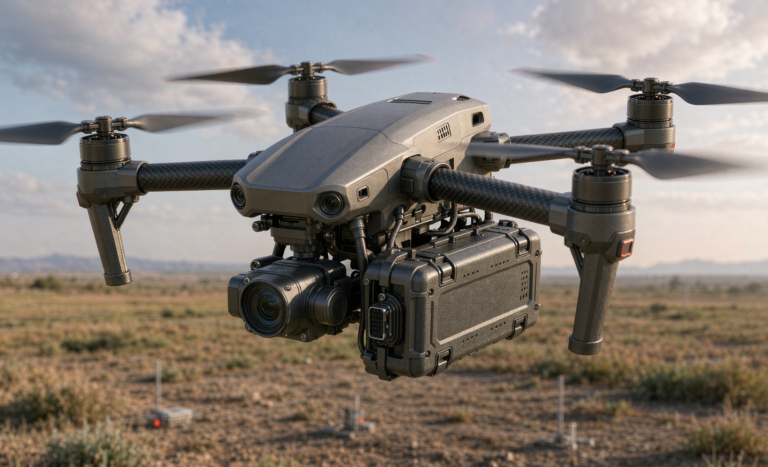
Over the last nine years as a senior lithium battery engineer I have supported emergency-response programs where the outcome was decided in the first thirty minutes. A hiker vanishes in a cloud forest at 2 a.m. A flood swallows a mountain road. A missing child is last seen near a frozen lake. In every one of those cases the aircraft in the air was only as good as the pack on its back. When you are running a drone battery search rescue mission, the energy source is not a subsystem you can compromise — it is the mission itself. In this article I walk through exactly how we engineer drone battery packs for search and rescue: the mission-profile math, the cold-weather behavior that quietly kills flights, the rapid-swap discipline that keeps aircraft airborne for hours, and the transport compliance that lets a team fly legally from a remote staging point.
Why Search and Rescue Is the Hardest Duty Cycle a Drone Battery Ever Sees
Most commercial flights are forgiving. A rooftop inspection or a pipeline survey runs on a predictable schedule, in daylight, with a known wind and a single sortie. A search and rescue operation is the opposite. The timeline is measured in minutes, the weather is hostile, the payload changes hour to hour (thermal camera, spotlight, loudspeaker, LTE relay), and the aircraft may fly five or six sorties back to back. A standard lithium battery sized for pretty aerial footage will collapse under that load.
In my lab we treat SAR as the stress ceiling. If a pack survives a 14-hour multi-sortie mountain rescue with thermal payload and sub-zero temperatures, it will survive anything your logistics or agriculture client throws at it. That is why SAR packs become the reference design for our whole custom battery solution line.
Mission-Profile Energy Budgeting: Sizing the Pack Before You Leave the Truck
The first rule of SAR power is that you never guess — you budget. Before launch we model the entire sortie in watts:
- Hover and cruise power: a typical 6S multirotor draws 600–900 W in forward cruise and 1,200–1,800 W in aggressive maneuvering.
- Payload draw: a thermal gimbal camera adds 12–40 W, a spotlight 20–60 W, a loudspeaker 5–15 W, and an LTE/radio relay another 5–10 W.
- Environmental margin: headwind and altitude thin air, so we add a 20–30 % reserve on top of nominal endurance.
A worked example: a 6S 22,000 mAh NMC pack at 44.4 V nominal stores roughly 977 Wh. With a thermal payload and cruise draw near 1,000 W, usable flight time lands around 45–50 minutes. Strip out 25 % for wind and emergency return and your effective on-station time is about 35 minutes. That single number, not the marketing “60-minute flight,” is what the incident commander plans the search grid around.
Cold-Weather Performance: The Silent Killer in Mountain SAR
Most rescue missions that fail on power do not fail because the pack is small — they fail because it is cold. Lithium-ion capacity and internal resistance are brutally temperature dependent. In our qualification data a healthy NMC cell at 25 °C delivers 100 % of rated capacity; at 0 °C that drops to about 85 %, at −10 °C to roughly 70 %, and at −20 °C to near 55 %. Worse, internal resistance climbs, so under load the pack sags in voltage and triggers a premature return-to-home long before the cells are actually empty.
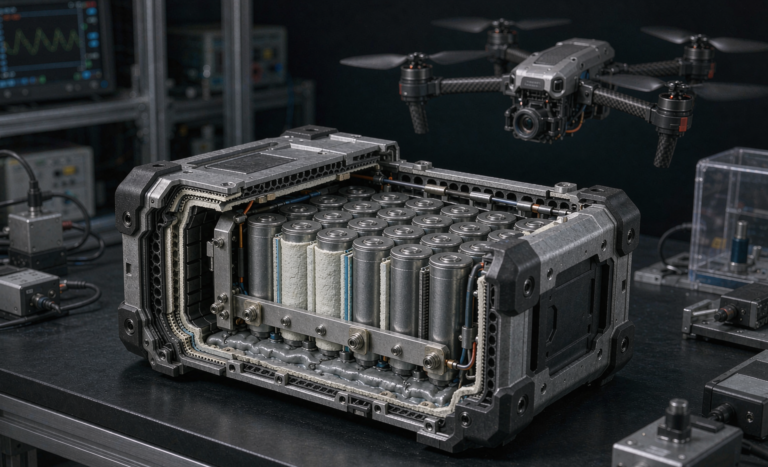
For alpine SAR we specify heated packs: thin polyimide film heaters wrapped around the cell stack draw 5–15 W to hold the core in a 10–25 °C window. The aircraft pre-warms the pack on the ground for three to five minutes before launch, and the BMS keeps the heaters on during climb. The energy cost is small against the recovery in usable capacity, and it is the difference between a drone that dies at the treeline and one that reaches the ridgeline where the survivor actually is.
Rapid-Swap Packs and Continuous Sorties
A single flight does not win a rescue; sustained coverage does. A two-person SAR team should field three to five packs per aircraft so the drone is never waiting on a charger. The discipline matters as much as the chemistry:
- Hot-swap in under 60 seconds with a tool-free latch, so a fresh pack goes in while the previous one cools.
- Label every pack with cycle count, baseline internal resistance, and last capacity, so a weak pack is never the one launched at hour eleven.
- Storage at 3.80–3.85 V/cell (about 50–60 % SoC) between sorts, rotated FIFO so no pack sits long enough to drift.
- Field charging at 1C–2C on a balance charger with a cooldown gate — no pack charges above 40 °C.
I have watched a well-run team keep a single airframe flying for nine continuous hours across a flood zone using exactly this rotation. The drone lithium battery is a consumable in SAR, and treating it like one is what buys you the search grid.
Redundancy and Fail-Safe for Life-Critical Flights
When the flight is literally looking for a person who may not survive the night, a single point of failure is unacceptable. Our SAR architecture builds in layers:
- Dual-battery fixed-wing and relay aircraft keep flying if one channel drops.
- Cell-level BMS monitoring for over/under-voltage, over-temperature, and over-current, with automatic return-to-home on any single-cell fault.
- Geofenced and altitude-capped missions so a lost link does not become a lost aircraft over a cliff face.
- Redundant telemetry (2.4 GHz plus a long-range 900 MHz fallback) so the operator never loses the bird at the worst moment.
None of this is optional in my book. A rescue drone that flies beautifully but silently fails is worse than no drone at all, because it costs the team its most precious resource: time.
Thermal-Imaging and Payload Power Budgets
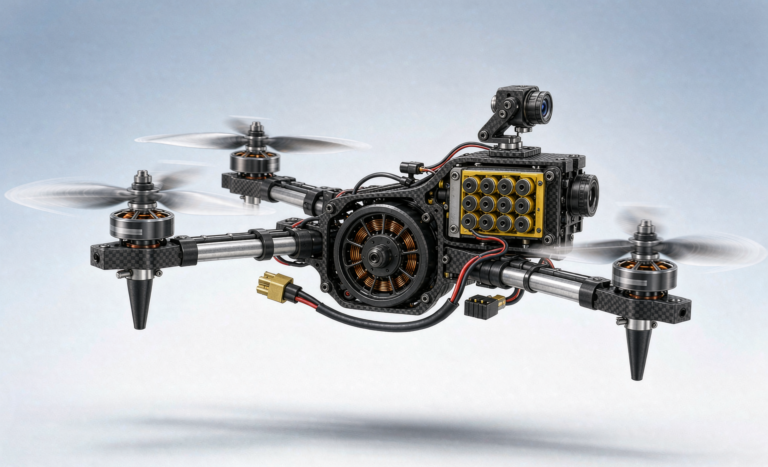
The single biggest endurance surprise for new SAR teams is how fast payloads eat the pack. A gimballed thermal camera alone can cost you eight to twelve minutes of flight. Add a spotlight and a loudspeaker and you have removed a third of your on-station time before the aircraft even climbs. This is where a real custom battery solution earns its keep: we tune cell count and discharge rating to the actual payload mix, and we balance capacity against mass because every 100 g of pack is roughly one minute of endurance traded away.
For a thermal-first night search we typically spec a higher-discharge NMC pack at a slightly lower capacity, because the camera and heater loads are bursty and the pack must hold voltage through them without sag. For a long loiter relay mission we flip the trade: higher capacity, lower discharge, fewer payloads. The pack is matched to the mission, not the other way around.
Ruggedization and Transport to Remote Staging
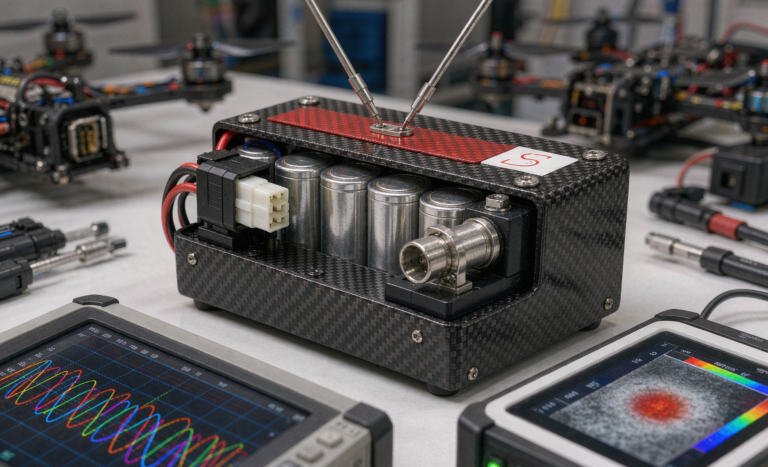
SAR rarely happens next to a lab. The pack must survive the ride to the trailhead and the drop onto a rock when someone fumbles it in the dark. We build to IP-rated enclosures against rain and dust, design for shock and drop per MIL-STD-810 class profiles, and pot the cell stack against vibration from rotor harmonics that would otherwise fracture welds over a season.
Then there is the legal layer. Every pack we ship for field teams is qualified to UN38.3 (tests T.1–T.8) and built to IEC 62133-2:2017, the cell and pack safety standard recognized by aviation authorities worldwide. For transport we follow UN3480/UN3481 markings, keep state of charge within IATA’s 30 % guideline for air movement, and respect FAA and EASA carry-on rules of 100–160 Wh per pack. Because most SAR teams drive to staging, they can run larger packs legally on site, but we still certify every configuration so a team can fly commercial to a national incident if called.
Regulatory Notes: Night Ops and BVLOS Energy Buffers
Most rescues happen when it is dark and the survivor is beyond line of sight. Under FAA Part 107 night operations and the EASA equivalent, we bake a hard 30 % state-of-charge reserve into every mission plan so a lighting failure or a sudden headwind never strands the aircraft. Anticollision lighting is part of the pack’s accessory bus, not an afterthought, and the energy for it is accounted for in the original budget above — not stolen from flight time at hour three.
FAQ
How long can a SAR drone stay airborne on one battery?
For a thermal-equipped multirotor on a 6S 22 Ah NMC pack, plan 35–45 minutes of effective on-station time after a 25 % weather and emergency reserve. Fixed-wing relay aircraft with lighter payloads can stretch past 90 minutes. Always budget from usable watt-hours, not the manufacturer’s best-case flight time.
Can drone batteries work in freezing conditions?
Yes, with engineering. Raw lithium-ion loses 30–45 % of usable capacity below −10 °C and sags under load, but heated packs that hold the cell core at 10–25 °C recover most of that capacity. Pre-warm on the ground and keep heaters on during climb for alpine rescues.
How many spare packs should a SAR team carry?
Three to five per aircraft for continuous coverage, labeled with cycle count and baseline internal resistance, stored at 3.80–3.85 V/cell and rotated FIFO. That lets one airframe fly for many hours across back-to-back sorties.
Are these batteries legal to transport to a remote site?
Our SAR packs are qualified to UN38.3 (T.1–T.8) and built to IEC 62133-2:2017, with UN3480/UN3481 markings. For air movement we keep state of charge within IATA’s 30 % guideline and follow FAA/EASA 100–160 Wh carry-on rules; teams driving to staging can run larger certified packs on site.
What makes a drone lithium battery fail during a rescue?
The usual culprits are cold-induced voltage sag, an unbalanced pack whose weak cell hits cutoff first, and a charger that runs a pack too hot in the field. All three are solved with heated cells, cell-level BMS balancing, and a cooldown-gated field charger — standard in a properly engineered SAR pack.