Drone Battery Cost Optimization for Mapping UAVs
Why Mapping UAVs Are a Cost Problem Before They Are a Range Problem
When a survey team asks me about a drone battery for mapping work, the first instinct is almost always “how far can it fly.” After fifteen years closing the loop between cell chemistry and field economics, I have learned that range is the wrong first question. For photogrammetry and corridor mapping the binding constraint is cost per hectare, not minutes in the air.
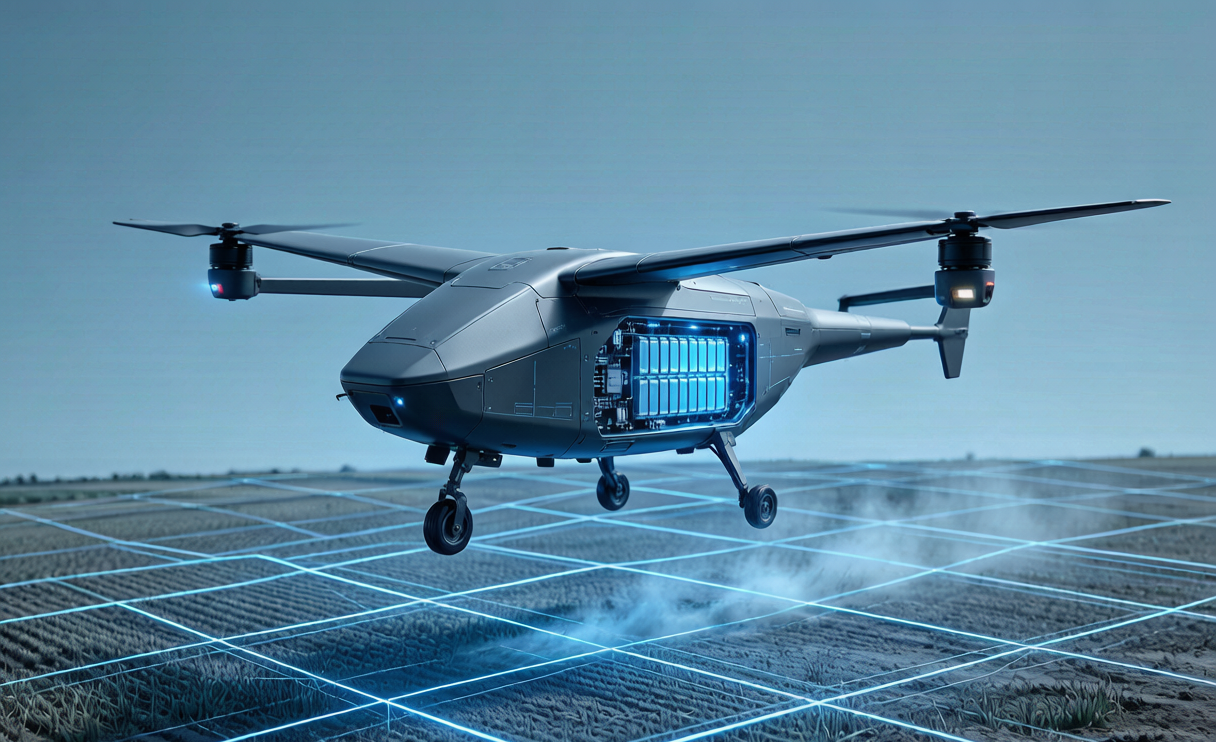
A mapping sortie is energy-limited and repetitive. The aircraft flies a predictable grid, captures overlapping frames, and lands. Over a season a fleet burns through hundreds of charge-discharge cycles, dozens of packs rotate through chargers, and crews spend real labor swapping, logging, and balancing cells. The lithium battery that looks cheapest on the purchase order can quietly become the most expensive line item on the project once you account for replacements, charging energy, and downtime. Cost optimization is therefore an engineering discipline, not a procurement afterthought.
The Real Unit of Value: Cost per Hectare Covered
In my proposals I never quote pack price in dollars per watt-hour to a survey client. I quote it as cost per hectare surveyed, because that is what their finance team actually pays for. The arithmetic is simple once you fix the mission.
Take a 250 ha cadastral job at 3 cm ground sample distance, 65% side overlap, flown by a 6 kg VTOL. From my field logs the effective line spacing works out near 42 m, roughly 38 flight lines, about 60 line-km, flown at 18 m/s for 56 minutes. The airframe draws about 0.74 kW in cruise, plus 40–60 Wh of transition energy, so the mission needs ~1.06 kWh installed after a 30% regulatory reserve under FAA Part 107 and EASA SORA. That is two 12S 12–14 Ah packs at ~0.55 kWh each, or one dual-pack sortie.
Now the cost lens: if a pack set costs $420 and survives 600 useful cycles before it drops below 80% state of health, and each cycle covers ~21 ha (250 ha over ~12 sorties per pack life), the cell cost alone is about $0.033 per hectare. Add charger energy at industrial rates (~$0.12/kWh × 1.06 kWh × 12 sorties = $1.50, or $0.006/ha) and the battery is roughly $0.04/ha in direct cost. The moment you choose a chemistry that halves cycle life or forces a 40% larger pack “for safety margin,” that number doubles. That is why I optimize cost at the hectare, not at the checkout.
Chemistry Choice Drives Most of Lifetime Pack Cost
For mapping UAVs the chemistry table is short but the price spread is wide. I spec against three families and I always show the client the ten-year total rather than the sticker.
- NMC / NCA (200–250 Wh/kg, 500–1000 cycles): the default for energy-limited mapping. You get the lightest pack for a given watt-hour, which matters when the aircraft is mass-constrained. At ~$0.30–0.45/Wh in volume custom battery solution pricing, a 0.55 kWh pack lands near $190–250. Over 600 cycles the levelized cost is low because you buy fewer grams of pack per hectare.
- LFP (120–160 Wh/kg, 2000–4000 cycles): heavier, so you trade aircraft endurance for cycle life. On a ground charging cart or a short-range multirotor it is unbeatable on cost per cycle, often 4–6× the cycle count of NMC for a small price premium per Wh. When the airframe can carry the mass, LFP is the cheapest mapping battery over a multi-season program.
- Semi-solid-state (250–300 Wh/kg, qualifying): the emerging option. Higher energy density than NMC with better thermal headroom, but today it carries a meaningful cost premium and is still qualifying in our fleet trials. I recommend it only where mass is the hard constraint and the program can absorb the early-adopter price.
The trap I see most often is specifying high-power LiPo “just in case.” A racing-grade cell at 150–200 Wh/kg with 3–6 mΩ internal resistance gives you pulse headroom a mapping grid never uses, while costing 20–30% more per Wh and dying faster. For a calm, energy-limited survey duty, that is pure waste.
Cycle Life, Retirement Cadence, and the Cost of Premature Swaps
The single biggest avoidable cost in a mapping fleet is retiring packs too early or too late. Retire too early and you throw away paid-for capacity; retire too late and a sagging cell corrupts the geotags on an entire block, forcing a reflight that costs far more than the pack.
My retirement rule is fixed and logged: pull a pack at 80% capacity, 2× baseline internal resistance, greater than 50 mV cell delta, or more than 5% puffing. The discipline that actually saves money is binning — I bin packs to ±2% capacity and ±5% DCIR at incoming inspection using a 1 kHz ACIR measurement and a 3C/10 s pulse. A fleet flying matched packs ages evenly, so you replace a whole cohort on a schedule instead of chasing individual failures at 2 a.m. before a dawn flight window.
Cold is the silent budget killer. Capacity fades from 100% at 25°C to ~85% at 0°C, ~70% at -10°C, and 55–60% at -20°C. A crew that flies a -10°C dawn window on summer-spec packs will record 30% shorter lines, spread the same job across 40% more sorties, and quietly inflate cost per hectare by a third. A 5–15 W pad heater holding cells at 10–25°C before launch pays for itself in the first cold week.
Charging Energy, Labor, and Field Logistics: The Opex You Forget
The purchase price is maybe 40% of true cost. The rest is opex, and most of it is logistics.
- Charging power: I gate charging at 40°C and run 1C–2C. A 1000 ha/day program is ~8 sorties, ~6 kWh delivered, which needs 8–12 packs and two 6-channel chargers at roughly 1 kW each. Specifying a custom drone battery with a consistent charge window lets you size the generator or solar buffer correctly instead of renting a bigger one on site.
- Labor: every swap, IR spot-check, and serial scan is paid time. FIFO rotation, QR/serial baselines, and 3.80–3.85 V/cell storage discipline sound like paperwork, but they cut misflights. A single reflight on a 250 ha job costs more than a crew member’s half-day.
- Three-zone staging: I lay out charging, cooling, and ready zones so a hot pack never re-enters the airframe early. Thermal abuse is what turns a 600-cycle pack into a 250-cycle pack, and cycle count is the dominant cost lever.
Specifying a Custom battery solution That Lowers Total Cost
Off-the-shelf packs are priced for hobbyists, not survey fleets. When I build a custom battery solution for mapping, I use a four-number method that ties spec to cost: longest leg in km, required cruise power in kW, number of sorties per day, and available charge power in kW. Those four numbers set voltage platform, capacity, and cycle-count target.
I almost always push the platform from 6S to 12S for mapping. Doubling voltage halves current and quarters I²R loss — at 10 mΩ pack resistance, 60 A on 6S dissipates 36 W of heat, while 30 A on 12S dissipates 9 W. Less heat means less puffing, longer life, lower cost. I keep interconnect resistance under 15% of pack resistance (≤1.5 mΩ) with XT150/AS150 connectors and 8 AWG silicone, and I add an isolated regulated payload rail with 20–40 ms holdup so motor transients never drop the RTK fix and force a reflight.
Compliance and Transport Cost
Cost optimization has to survive shipping. Every custom drone battery I deliver is built to UN38.3 T.1–T.8 and IEC 62133-2:2017, shipped at IATA 30% state of charge, and sized inside FAA/EASA 100–160 Wh carry-on limits where the client flies commercially. A pack that fails a compliance audit is not a cheap pack — it is a stranded pack, and the redeployment cost dwarfs the saving. Designing to the standard up front is the cheapest compliance you will ever buy.
Frequently Asked Questions
What is the cheapest drone battery chemistry for mapping UAVs?
For energy-limited survey flights, NMC/NCA at 200–250 Wh/kg is usually cheapest per hectare because you buy the least pack mass, while LFP wins on multi-season cost per cycle when the airframe can carry the extra weight. High-power LiPo is the most expensive mistake for this duty.
How much does a mapping drone battery really cost per hectare?
In my programs the direct battery cost runs about $0.03–0.04 per hectare once you divide pack price by useful cycles and hectares per cycle. The total program cost, including charging and labor, is typically 2–3× that, which is why logistics discipline matters as much as cell choice.
When should I retire a mapping drone battery to save money?
Retire at 80% state of health, 2× baseline internal resistance, more than 50 mV cell delta, or over 5% puffing. Binning packs to ±2% capacity at incoming inspection lets you replace whole cohorts on schedule instead of chasing individual failures.
Does a 12S battery platform actually lower cost versus 6S?
Yes. Doubling voltage halves current and quarters I²R heat loss, which reduces puffing and extends cycle life — the dominant cost lever. It also improves voltage stability for the RTK and camera payload.
How does cold weather affect the cost of a mapping survey?
Capacity fades to ~70% at -10°C and 55–60% at -20°C, which forces more sorties for the same area and can inflate cost per hectare by a third. A 5–15 W pad heater holding cells at 10–25°C before launch recovers most of that loss.