Drone Battery Design for Inspection UAVs: Engineering for
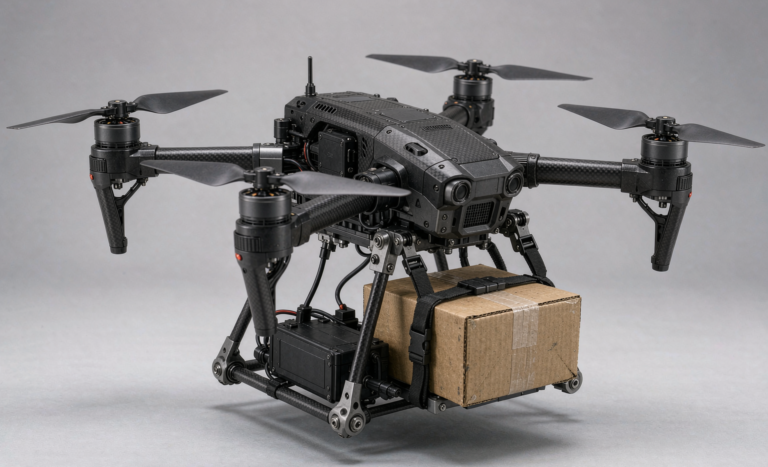
As a senior lithium battery engineer at Horizon Power, I have spent the better part of a decade designing power systems for commercial inspection UAVs — the kind that crawl along high-voltage power lines, fly inside confined industrial tanks, and map pipelines across frozen tundra. When operators talk about drone battery design for inspection UAVs, they are rarely asking about peak discharge alone. They are asking how a pack survives the real world: a −20 °C pre-dawn takeoff, salt spray at a coastal refinery, a 40-second battery swap on a windy rooftop. Inspection drones are not toys — they carry five-figure sensors and often fly beyond visual line of sight, so the power system is a safety-critical component, not a consumable. This article walks through the integration design decisions that separate a lab-rated drone lithium battery from one that earns its place in a harsh-field inspection program.
Defining the Inspection Mission Envelope
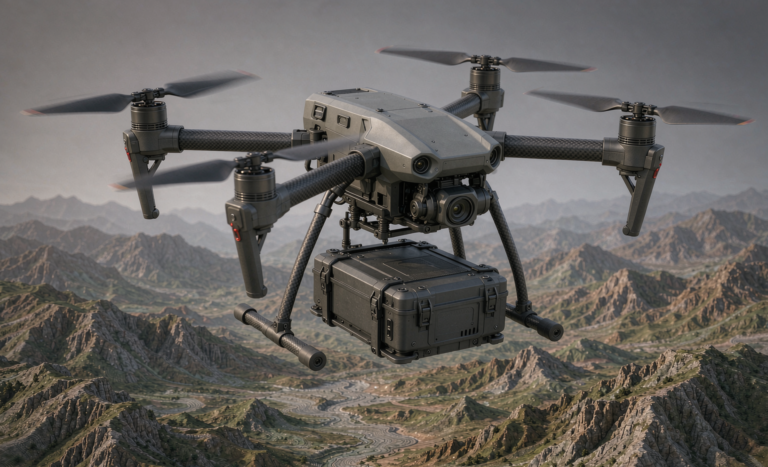
Every credible drone battery design inspection UAVs project starts with the mission envelope, not the cell datasheet. An inspection airframe has a very different duty cycle from a racing or cinematic drone: it loiters, it creeps, it holds position against wind, and it carries a heavy payload (LiDAR, gas sniffer, thermal camera). For a typical 2.5 kg quad with a 1.2 kg sensor payload, I budget 480 W in hover, 320 W in cruise, and up to 1,400 W in a vertical climb. The pack sees a temperature excursion from a −15 °C cold-soak on the launch pad to roughly 45 °C at the cell surface under sustained climb current.
Translating that into capacity: a 6S 3000 mAh pack holds about 66.6 Wh. At a loiter-heavy average draw of 360 W that is roughly 11 minutes of usable flight, and I always reserve 15 % for the return-to-home buffer mandated by most BVLOS waivers. Because inspection packs usually stay under the 100 Wh FAA / EASA air-travel threshold, they also remain shippable under IATA Section II without full dangerous-goods handling — a real logistics advantage for multi-site programs. That single duty-cycle profile dictates the lithium battery chemistry, the cooling margin, and the connector rating. I always hand the airframe team a one-page duty-cycle sheet before we commit to a topology. A pack designed against a generic “22.2 V 3000 mAh” spec will fail the first time the drone meets a real headwind.
Mechanical Integration and Quick-Swap Design
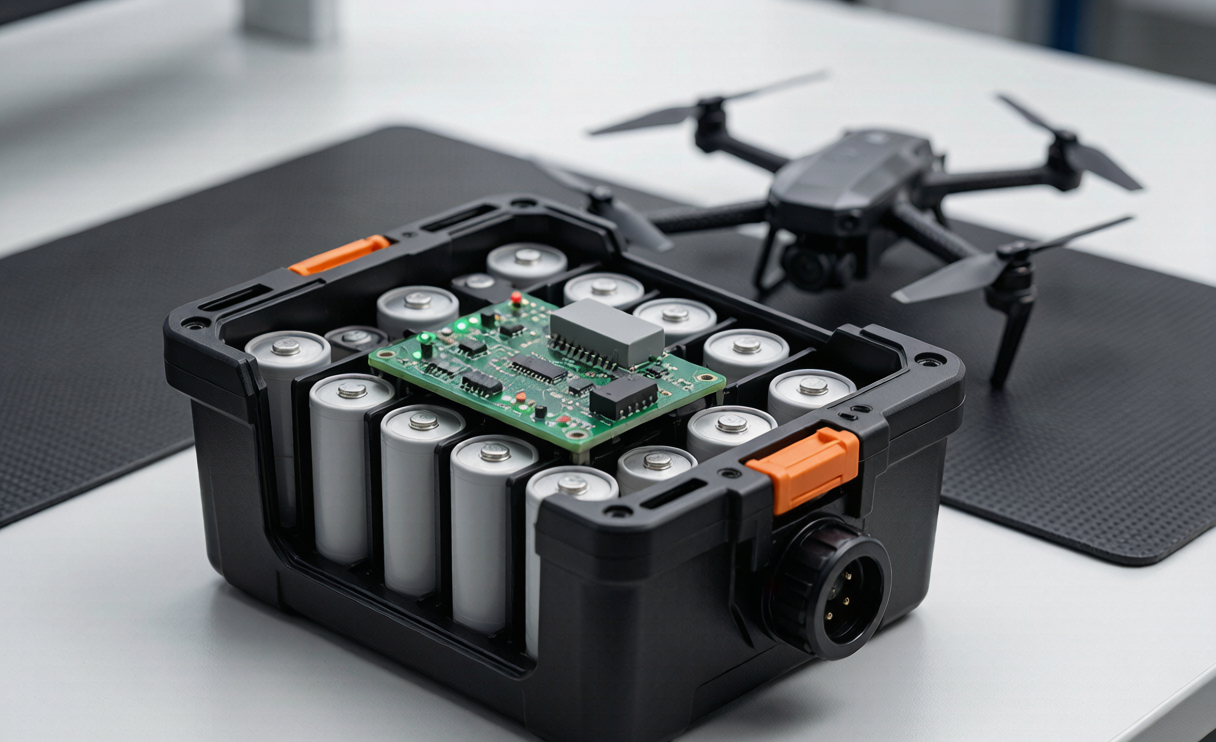
Inspection fleets live and die by turnaround time. A pack that takes five minutes to bolt in is a pack that grounds the aircraft between sorties. My standard approach is a low-mounted 6S enclosure that sits between the arms to keep the center of gravity stable, held by a tool-free quick-swap latch with a hall-effect confirmation switch so the flight controller knows the drone battery is physically seated before it will arm.
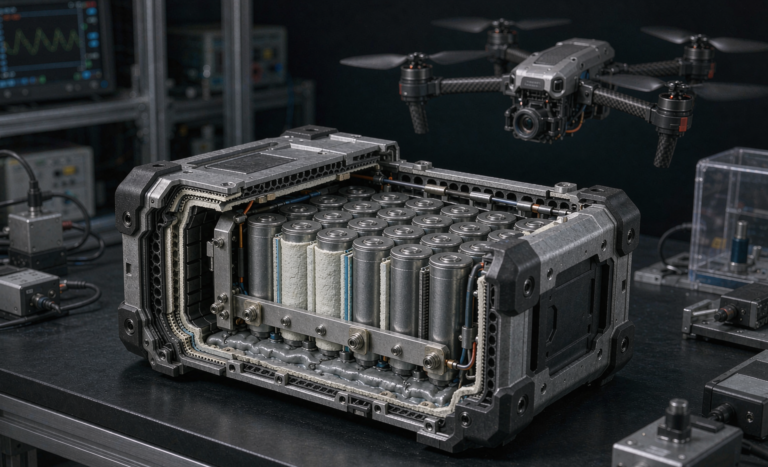
Mechanically, the pack must survive the environment it inspects. I specify silicone grommet isolation rated to 15 g RMS random vibration, loosely following the spirit of MIL-STD-810H Method 514.8, and I pot the cells in internal foam so a hard landing does not puncture a can. A real custom battery solution here accounts for the airframe’s mechanical tolerances — not just its electrical ones — because a pack that rattles loose mid-flight is a total loss regardless of its capacity. I also add a captive tether so a dropped pack cannot fall into the asset being inspected.
Electrical Design for Cold-Weather Reliability
Cold is the silent killer of inspection programs in northern grids and high-altitude sites. Below 0 °C, a standard Li-ion pack loses usable capacity rapidly, and its internal DCIR can roughly double near −20 °C, collapsing the voltage under climb load. To make the effect concrete: a cell with a benign 35 mΩ DCIR at 25 °C can climb past 70 mΩ at −20 °C, so at a 60 A burst the pack loses an extra 2 V to internal heating alone — often the margin between holding altitude and sinking.
My design answer is a self-warming architecture: a thin polyimide heating film laminated to the cell stack, driven by a thermostat that holds a tight 10–15 °C pre-flight warm-soak and limits the ΔT across cells to avoid localized stress. Cell selection matters too. For energy-dense inspection missions I favor NMC 21700 cells with low DCIR; where safety margin outweighs range, LFP is the conservative alternative. Either way, the heater’s own draw must be budgeted into the mission energy — a detail many generic drone lithium battery vendors ignore, which is exactly why their packs underperform on the first cold morning.
Connector and Power-Bus Derating Design
Undersized power buses are the number-one field failure I see in cheap packs. At 1,400 W peak on a 6S 3000 mAh pack, the bus can momentarily carry 60–70 A. I specify gold- or silver-plated contacts rated above 100 A and then derate to 70 % for field reliability. My target is a contact resistance under 1 mΩ with a total voltage-drop budget below 0.3 V at peak, plus strain relief and a locking mechanism so vibration cannot work the connector loose.
This is where drone battery design inspection UAVs work diverges from hobby builds: a 0.5 V sag at the connector during a climb is the difference between holding altitude and dropping into a structure. The lithium battery may be perfect; the bus kills the mission. I validate every connector with a 200-cycle insertion test and a thermal camera sweep at rated current before it enters production.
Ingress, Humidity, and Corrosion Protection
Inspection drones work where chemicals, fog, and seawater live. A pack without environmental protection is a short circuit waiting to happen. I conformal-coat the BMS PCB (urethane or parylene), seal the enclosure to IP67, and add a desiccant pouch plus VCI (vapor-phase corrosion inhibitor) paper around the contacts. Material choice is deliberate: 6061 aluminum with hard anodize and stainless fasteners, avoiding dissimilar-metal pairs that would galvanically corrode.
For altitude-changing flights I add a pressure-equalization vent built on an IP68-rated ePTFE membrane so the enclosure breathes without letting water in. A drone lithium battery exposed to coastal aerosol without these measures typically fails within a single season — an unacceptable rate for a paid inspection contract.
Smart Telemetry Integration for Inspection Fleets
A modern inspection pack should not be a dumb brick. I wire the BMS to the flight controller over SMBus or CAN, reporting state-of-charge, state-of-health, cycle count, per-cell voltage, and temperature in real time. The flight controller then enforces a pre-flight health gate: it will not arm if state-of-health has dropped below 80 % or if any cell differs from its neighbors by more than 50 mV.
Fleet operators get the bigger prize. Horizon Power pushes per-pack telemetry to a dashboard so a manager can see exactly which packs degrade fastest under which mission profile, and can rotate weak packs out before they ever ground a flight. This turns a consumable drone battery into a managed, predictable asset — the foundation of any serious inspection operation — and it feeds directly into the maintenance scheduler so no pack quietly exceeds its safe cycle count.
Redundancy and Fail-Safe Design for Critical Inspections
When an inspection flight carries a $40,000 sensor over a populated area, graceful degradation beats binary failure. I design single-cell fusing, a BMS watchdog with a redundant temperature sensor, and a controlled-landing routine triggered by any single-string fault. For beyond-visual-line-of-sight (BVLOS) pipelines I often propose a hot-swappable or dual-pack redundant architecture so one pack’s failure never means a lost airframe.
The goal of every custom battery solution we ship is the same: the drone comes home, the data is captured, and the next sortie starts on schedule.
Certification and Compliance for Commercial Inspection
Commercial inspection drones are regulated assets, and the drone lithium battery must clear the same bar. Every pack we ship is validated to UN38.3 (the T.1–T.8 series: altitude simulation, thermal, vibration, shock, external short, impact, overcharge, and forced discharge) and built to the cell-level safety requirements of IEC 62133-2. For operators flying under FAA Part 107 or EASA rules, the 100 Wh per-battery limit is the practical ceiling that keeps a pack classed as carry-on-shippable, and our inspection envelopes are deliberately sized just under it. Transport between sites follows IATA Section II packing, which we document in the pack’s compliance file so the operator’s logistics team is never caught out at a depot.
Frequently Asked Questions
What battery chemistry is best for inspection UAVs?
For most inspection missions NMC lithium-ion offers the best energy density and low-temperature behavior, while LFP is preferred when safety margin and cycle life outweigh maximum range. The right answer depends on the mission envelope, not a generic ranking.
How cold can inspection drones safely fly?
With a self-warming drone lithium battery and a 10–15 °C pre-flight warm-soak, inspection flights are reliable down to about −20 °C. Without heating, capacity and power collapse well before that, and arming should be blocked.
How long does a typical inspection drone battery last?
A well-designed pack delivers 300–500 full cycles before state-of-health crosses the 80 % retirement line, which for an active inspection fleet is typically 12–24 months of field use.
Why does my drone battery lose range in winter?
Cold raises internal resistance and reduces usable capacity, so the same lithium battery that flew 28 minutes in summer may manage only 18 in winter. Pre-heating and chemistry selection are the engineering fixes.
How should fleets manage battery health?
Equip each pack with smart telemetry, enforce a pre-flight health gate, and track state-of-health centrally. This converts battery management from guesswork into a measurable, scheduled process.
Conclusion
Great drone battery design for inspection UAVs is integration engineering, not cell selection. It is the latch, the heater, the derated connector, the conformal coating, the telemetry, and the certification file that together decide whether a drone lithium battery performs on a windy rooftop at −15 °C. At Horizon Power we treat every inspection pack as a custom battery solution built around the operator’s real mission — because in the field, the details are the difference between a completed inspection and a lost aircraft.