Drone Battery Testing for Racing Drones: Track-Side
As a senior lithium battery engineer who has qualified packs for competitive FPV circuits, I have learned one hard truth: a pack that passes every bench specification can still fail on the track. The laboratory tells you what a cell is rated to do. The track tells you what it actually does when a pilot yanks the throttle from hover to full collective in 80 milliseconds, with ambient humidity climbing and a crosswind shaking the airframe. That gap is exactly why drone battery testing for racing drones cannot stop at the workbench. In this article I walk through the track-side validation protocol my team uses to qualify race-day packs, the telemetry we capture, and the go/no-go gate we apply before a battery ever leaves the pit.
Why Track-Side Testing Beats Bench Testing Alone
A bench rig is deterministic. You set a discharge current, you read the voltage, you log the temperature. That is necessary, but it is not sufficient. A racing drone lithium battery lives in a stochastic world: uneven throttle, repeated hard accelerations, vibration from the props, and thermal soak from a hot afternoon. The bench cannot reproduce the coupling between aerodynamic load and pack temperature.
In my experience the most informative failures surface only under live flight. A cell that looks healthy at 25°C on the bench may show a 12–18% voltage sag under real burst demand because its internal resistance climbs with both current and temperature. That is why we treat field validation as the final, non-negotiable stage of our drone battery testing program for racing drones.
Building the Track-Side Telemetry Rig
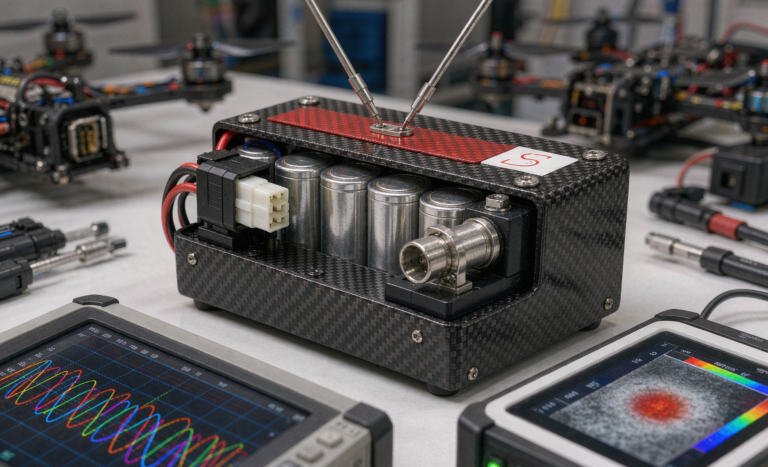
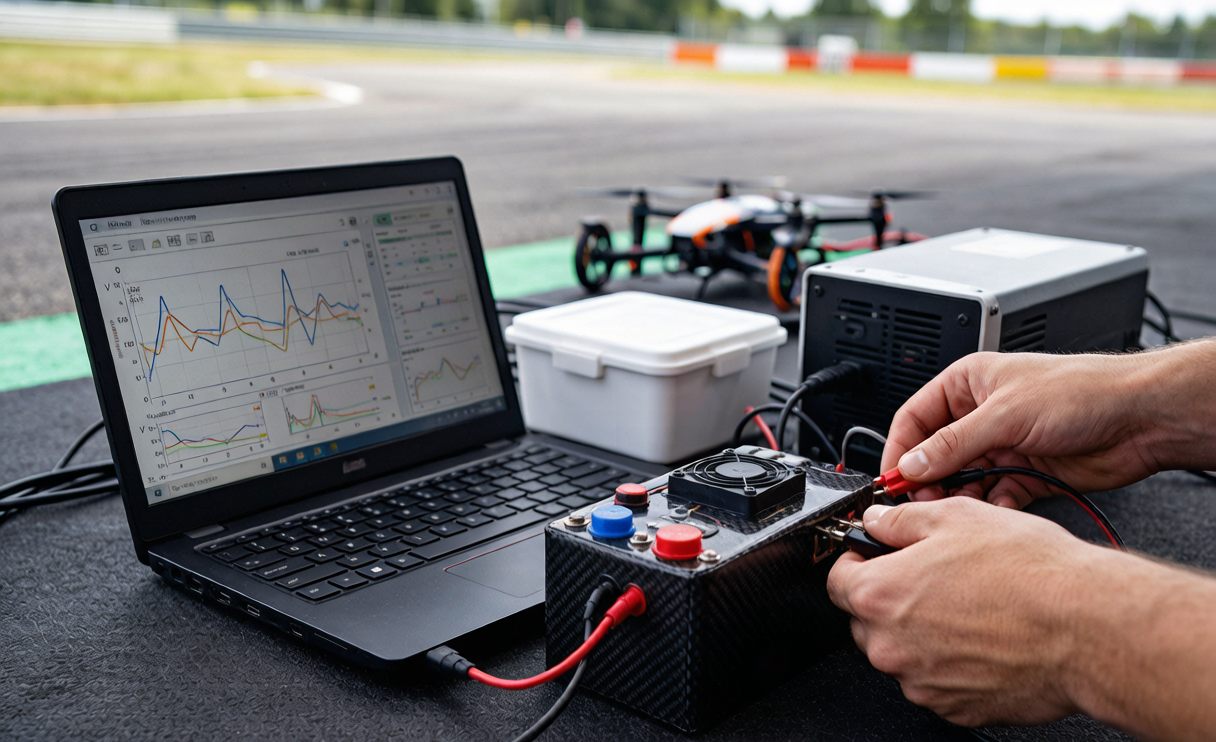
The core of track-side validation is a lightweight data logger that rides with the pack or taps the power bus. We record four channels at a minimum: pack voltage, per-cell or total current, pack surface temperature, and ESC throttle command. Sampling at 50–100 Hz is enough to capture the sub-second transients that define a race lap.
I pair the logger with a pit laptop running a simple strip-chart view. During a practice session the pilot flies a representative heat — not a gentle cruise, but the actual mix of launches, splits, and final dives we expect in qualifying. The goal is to capture the worst-case 2–3 second window where the drone lithium battery is stressed hardest.
- Voltage floor during peak burst (we flag anything below 3.5 V/cell under load).
- Peak current versus the rated continuous and burst C-rate.
- Temperature rise per lap and the cooling slope between laps.
- Recovered resting voltage after a full heat (a health indicator we track over the pack’s life).
Designing a Realistic Burst-Discharge Race Simulation
Not every track day allows unlimited flight time, so we also run a controlled burst-discharge simulation on a dyno or thrust-stand when the drone is unavailable. The key is to replay the real current profile we logged, not a flat C-rate. A flat 30C discharge hides the truth; a replayed profile with 80A spikes every 4 seconds exposes weak cells.
For a typical 6S 1300 mAh racing pack, a replayed profile might peak at 90–110 A for 0.5–1.0 s, settle to 40–55 A in corners, and repeat for 90 seconds. We run three back-to-back simulations to mimic a qualifying session and record how much capacity remains and how hot the pack gets. This is where a custom battery solution with matched cells pays for itself — cell-to-cell variance shows up immediately as an unbalanced recovery curve.
Comparative Flight Testing of Candidate Packs
When we are qualifying a new chemistry or a new build, we never test a single pack in isolation. We flight-test a cohort of three to five candidate units under identical conditions on the same track and the same pilot. Identical conditions matter: wind, temperature, and pilot input are the variables we want to hold constant so the battery differences become visible.
We score each pack on a simple matrix: lap-time consistency across three heats, voltage sag under the worst burst, post-heat temperature, and capacity retained after ten cycles of the simulated profile. A lithium battery that wins on raw capacity but loses two seconds per lap to sag is a poor race-day choice. The comparative method removes confirmation bias — I have killed more than one “favorite” pack this way.
Environmental Field Validation: Heat, Humidity, and Cold
Race days are rarely climate-controlled. We deliberately validate across the environmental envelope the pack will see. On hot afternoons we log the cooling slope between laps; if the pack cannot shed heat fast enough, we de-rate the burst allowance or specify a vented shroud. In humid or light-rain conditions we verify enclosure sealing and connector integrity — a corroded balance lead is a silent failure waiting for lap three.
Cold is the opposite problem. Below about 10°C a lithium battery loses both capacity and power as internal resistance climbs. We field-test cold-soaked packs to measure the real penalty and set a pre-warm protocol. For northern indoor seasons we sometimes specify a low-temperature formulation or a brief warm-up cycle before the first heat.
The Race-Day Qualification Gate
Before any pack is cleared for a competitive heat, it must pass a go/no-go gate we call the qualification checklist. This is the practical output of our drone battery testing for racing drones program:
- Internal resistance within 8% of the cohort median (rejects weak or aged cells).
- No single cell sagging more than 0.15 V below pack average under peak burst.
- Surface temperature under 60°C at end of a full simulated heat.
- Recovered resting voltage above 3.7 V/cell after cool-down.
- Visual and connector inspection clean, with no swelling or heat discoloration.
A pack that fails any single line is benched, not patched. In a race, a patched battery is a liability, not an asset.
Compliance and Safe Handling on Site
Even on the track, safety standards apply. Every pack we field qualifies under UN38.3 (the T.1–T.8 battery transport test sequence) and IEC 62133-2 for secondary lithium cells. For travel to events we keep individual packs under the 100 Wh FAA / EASA air-travel threshold and ship them per IATA Section II when needed. None of this changes because we are racing — if anything, the higher abuse level makes the certifications more important, not less.
I also keep a LiPo-safe charging bag, a thermal blanket, and a fire extinguisher rated for lithium at every pit. Field testing means field risks, and a disciplined custom battery solution program plans for the worst case rather than hoping it never arrives.
From Test Data to a Better Build
The real value of track-side testing is the feedback loop. Every logged heat goes into a build review. If sag correlates with a specific cell batch, we change sourcing. If temperature climbs lap over lap, we open the shroud or switch to a lower-resistance bus. Over a season this loop is how a generic drone lithium battery becomes a purpose-built race pack — and how a lithium battery that merely works becomes one that wins.
Frequently Asked Questions
How is track-side drone battery testing different from lab testing?
Lab testing is deterministic and controlled; it confirms ratings and safety. Track-side testing captures real flight loads, vibration, and thermal coupling that a bench cannot reproduce. We use both, but treat the field validation as the final qualification stage because that is where packs actually fail.
What telemetry should I log during a race-pack validation?
At minimum log pack voltage, total or per-cell current, pack surface temperature, and ESC throttle command at 50–100 Hz. The voltage-floor-under-burst and post-heat recovered voltage are the two signals I watch most closely for race-day readiness.
How many packs should I test together?
I recommend a cohort of three to five identical candidate packs flown by the same pilot in the same conditions. Testing in isolation hides cell-to-cell variance and confirmation bias; a comparative cohort makes weak packs obvious.
What temperature is unsafe for a racing drone battery?
We set a hard qualification limit of 60°C surface temperature after a full simulated heat, and we watch the cooling slope between laps. Above that, we de-rate burst or improve cooling rather than risk a thermal event on the track.
Do racing drone batteries still need UN38.3 and IEC certification?
Yes. Higher abuse levels make certifications more important, not less. Every fielded pack meets UN38.3 (T.1–T.8) and IEC 62133-2, and we keep individual units under the 100 Wh FAA / EASA travel threshold for event transport.