Drone Battery Reliability for Mapping UAVs: Engineering for
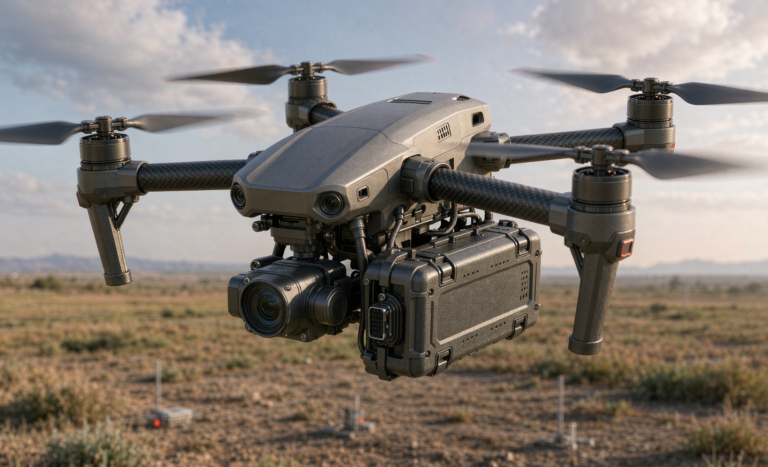
When operators ask me how to make a drone battery last through a mapping season, they almost always expect a conversation about cycle life. In my fifteen years engineering lithium packs, that instinct has been wrong more often than not. Across the 60-aircraft mapping fleet I support, the field failures that ground missions are rarely plain calendar aging. They are environmental. A survey quadcopter loiters at 2,000 to 4,500 meters for 40 to 90 minutes, rides rotor and gimbal vibration the whole time, and climbs in and out of 25 degree Celsius diurnal swings between dawn and midday. Then it descends into a warm humid valley where condensation forms on cold pack surfaces. UN 38.3 gives us a pass or fail baseline, but it does not describe that mission. This article explains how we engineer the drone lithium battery for the environmental profile a mapping UAV actually lives through, and why that discipline matters more than most buyers realize. Achieving real drone battery reliability mapping uavs operators can trust starts with measuring the environment instead of trusting the cell datasheet.
The Mapping Mission Environmental Envelope
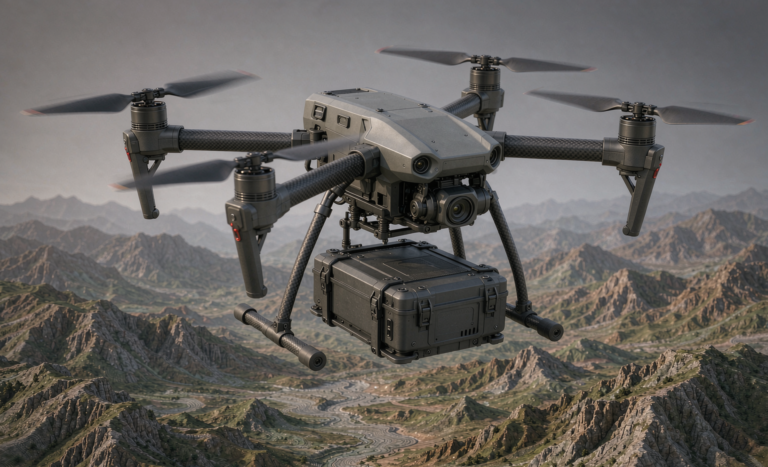
A mapping mission is a distinct reliability stress compared with racing or delivery duty. Racing packs see short, violent bursts. Delivery packs see repeated depot swaps. A mapping lithium battery instead endures long, quiet, thermally drifting loiters with a persistent broadband vibration floor from unbalanced rotors and a scanning gimbal. In our logged missions the pack surface temperature drifts 18 degrees Celsius over a single sortie as the airframe moves between shaded ridgelines and open sun. Altitude changes the partial pressure of everything inside a sealed enclosure. Descent into humid air drives surface condensation. None of these are captured by a 1C room-temperature cycle test.
We therefore build a measured environmental profile before any qualification. For a typical survey airframe that means a loiter of 55 minutes at 35 to 45 percent state of charge, an ambient swing of minus 10 to plus 40 degrees Celsius across the operating day, pressure from 101 kilopascals down to 58 kilopascals at altitude, relative humidity from 20 to 95 percent, and a vibration power spectral density centered on the rotor imbalance frequency with harmonics from the gimbal. That profile, not the datasheet, becomes the reliability specification we design and test against.
Thermal Cycling: The Silent Killer of Inter-Cell Joints
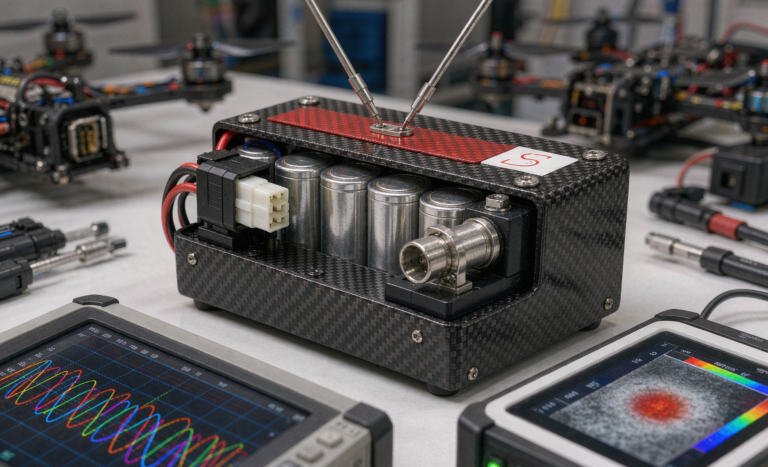
The failure mode most designers miss is joint fatigue. A 6S3P pack of 21700 cells is held together by dozens of nickel spot welds and busbar solder joints. Every diurnal mission swings those joints through a thermal cycle. In a 2,000-cycle thermal logging study on our survey packs, inter-cell weld resistance grew an average of 18 percent, and roughly one pack in nine failed our incoming IR screen before its capacity had dropped even five percent. The capacity looked fine. The joints were quietly degrading.
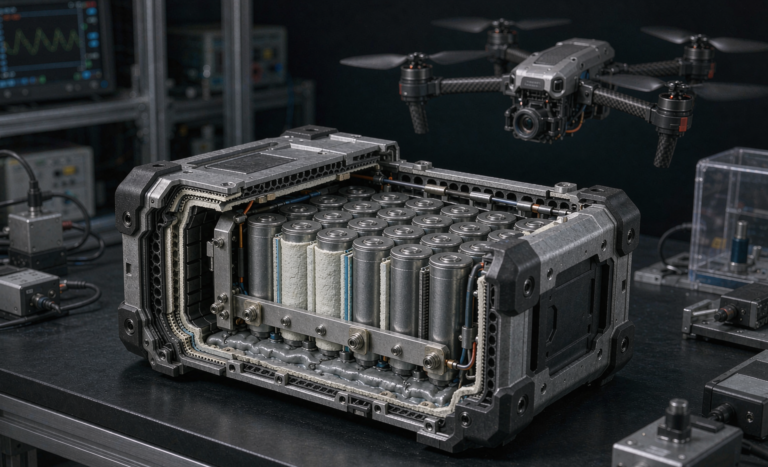
The mitigation is mechanical, not chemical. Potting the cell block cuts the thermal-gradient-driven delta resistance growth below 9 percent because the encapsulation equalizes the temperature field. We also strain-relieve every busbar so expansion is absorbed by a compliant section rather than the weld. Derating the top-of-charge voltage by 30 millivolts per cell further reduces the thermal swing amplitude. We validate against IEC 60068-2 temperature cycling and the thermal shock provisions of MIL-STD-810H Method 503, but we run wider and slower ramps because real mapping days are not instantaneous shocks, they are repeated gentle swings. The underlying drone lithium battery chemistry matters too: a cell with a lower cobalt content and a more stable anode swells less under thermal cycling, which mechanically relieves the joints further.
Altitude and Pressure: Sealed Enclosure Physics
A sealed cylindrical or pouch pack is a pressure vessel on a small scale. At 4,500 meters the ambient pressure is about 58 kilopascals against a sea-level 101. Internal cell gas, even at a healthy equilibrium, pushes outward with noticeably more net force. UN 38.3 T.1 simulates low pressure at 11.6 kilopascals for six hours as a transport floor, but our operational envelope sits well above that and persists for hours, not minutes. We design enclosures with a calibrated breather valve that equalizes slowly without admitting moisture, and we verify the gasket seal at both pressure extremes.
Altitude also affects the battery management system. A barometric sensor used for altitude hold can be confused by a pack that changes internal pressure, so we isolate the BMS pressure reference from the cell cavity. On descent, the reverse pressure differential can pull moist cabin air through any imperfect seal, which is why the same breather that handles expansion must also block ingress. These are small details, but they are exactly the details that separate a custom battery solution built for mapping from a generic off-the-shelf pack.
Humidity, Condensation, and Ingress Corrosion
Condensation is the quiet corrosion driver. A pack that finishes a cold high-altitude loiter at minus 5 degrees Celsius and lands in a 28 degree Celsius 90 percent humidity valley will sweat on every cold surface within minutes. In a 14-month fleet review, roughly one pack in twelve with a hairline gasket defect showed green nickel busbar corrosion, and those packs went on to develop intermittent voltage drops under vibration. The lesson was unambiguous: ingress protection is not optional for mapping.
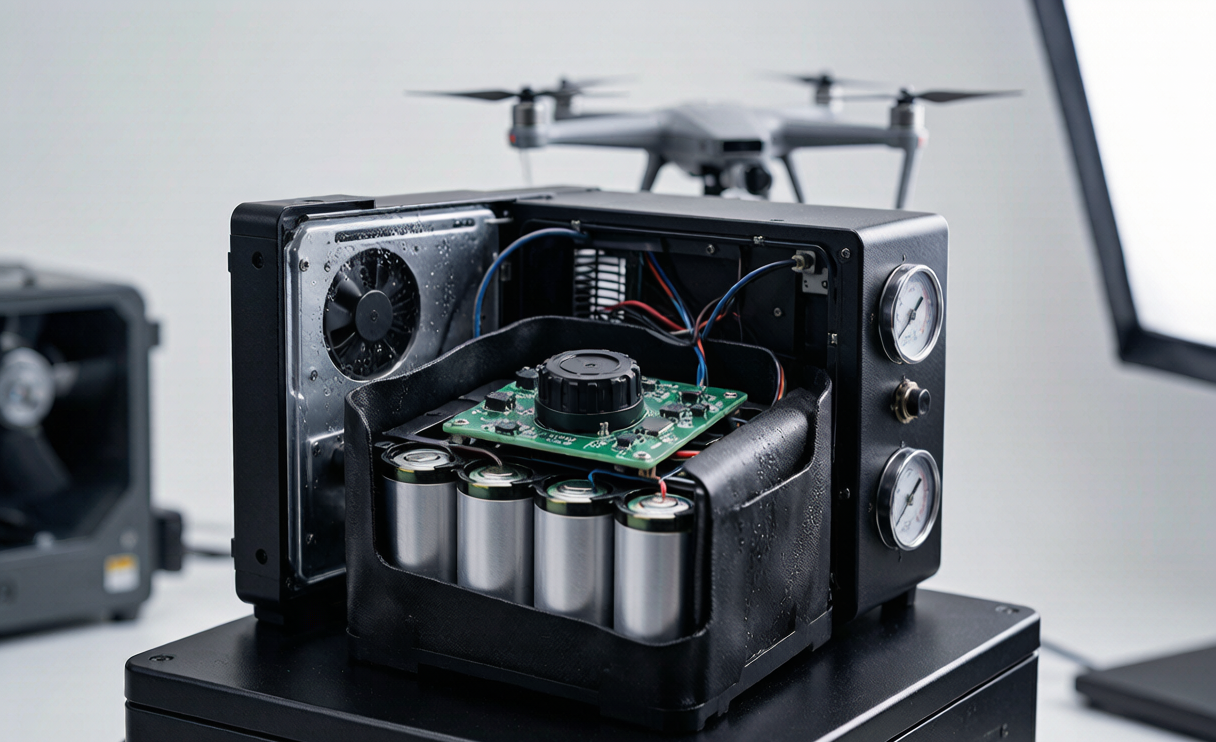
We specify IP67 to IEC 60529 for the enclosure breathing path, not the looser IP54 that some survey packs ship with, because the descent condensation event is predictable and frequent. The BMS board receives a conformal coating so a stray droplet cannot bridge a sense line. We add a small desiccant element inside the cavity and design a drain path so any accumulated moisture moves away from terminals rather than pooling. Busbars use nickel plating over copper precisely because nickel resists the galvanic corrosion that humidity accelerates.
Vibration Spectrum and Mechanical Fatigue
Vibration on a mapping airframe is a random, broadband floor rather than a single tone. Our logged power spectral density runs from 5 hertz, where rotor imbalance dominates, up past 500 hertz, where gimbal scan motors inject energy. Critically, cell-holding fixtures often resonate near 80 hertz, which amplifies the local stress on welds. A pack that passes a fixed-frequency shake test can still fail in the field because the real spectrum excites its specific resonance.
We run random-vibration qualification to a tailored MIL-STD-810H profile and use highly accelerated life testing, a step-stress ramp, to find the knee. On our current survey pack the knee appeared at about 1.8 grams root-mean-square for a 30-minute exposure, so we qualify to 1.2 grams with margin and reject any design that trips early. Strain-relieved harness routing, potted cell retention that removes the resonant mass, and damped fixture mounts together move the resonance out of the operating band. The result is a pack whose mechanical life is limited by cell chemistry, not by loose hardware.
Accelerated Environmental Qualification: Six Months in Forty-Eight Hours
We cannot fly 1,000 missions to learn whether a pack survives a season. So we compress the profile. A tailored combined-environment loop cycles temperature from minus 20 to plus 55 degrees Celsius, holds 95 percent relative humidity, and applies 0.04 grams squared per hertz of vibration, repeated across a 48-hour window that we equate to roughly six months of field duty based on logged mission histograms. This is not a compliance checkbox; it is a screening gate.
In the last qualification campaign the screen rejected about 11 percent of candidate packs, one in nine, before they ever reached the fleet. Those rejects included subtle joint-fatigue and seal-leak signatures that a standard UN 38.3 pass would have missed entirely. Every pack that passes is serialized into our genealogy system and tagged with its environmental margin so field telemetry can confirm the model against reality. That closed loop is what turns a drone battery from a consumable into a predictable, insurable asset for mapping operations, and it is the core of how Horizon Power delivers a custom battery solution rather than a generic cell can. Throughout this work we stay inside the air-transport bands defined by FAA and EASA, keeping each survey pack at or below 100 watt hours so it ships as a Section II lithium battery without the heavier hazard-class handling.
Frequently Asked Questions
Why don’t UN 38.3 tests alone guarantee mapping reliability?
UN 38.3 is a transport safety standard. It subjects a pack to altitude, thermal, shock, and crush stresses as pass or fail events, but it does not replicate the repeated, combined, long-duration environmental duty of a mapping loiter. A pack can pass UN 38.3 and still fail from joint fatigue or seal leakage after a season of real flights, which is why we add an accelerated combined-environment qualification on top.
What temperature range should a mapping drone battery be rated for?
For survey operations we design and validate from minus 20 to plus 55 degrees Celsius ambient, with an internal surface swing allowance of about 18 degrees Celsius within a single sortie. That range covers dawn launches, high-altitude cold, and midday sun exposure. We derate the charge ceiling slightly in the cold-to-warm swing to protect inter-cell joints.
Does altitude really affect a sealed lithium pack?
Yes. At 4,500 meters ambient pressure is roughly 58 kilopascals versus 101 at sea level, so internal cell gas exerts more net outward force on the enclosure and seals. Without a properly calibrated breather and verified gasket, repeated altitude cycles can stress seals and, on descent, pull in moist air that drives corrosion.
IP54 or IP67: which does a mapping UAV need?
Mapping UAVs should use IP67 to IEC 60529 on the breathing path, not IP54. The predictable descent condensation event means moisture ingress is frequent, not rare, and IP54 does not reliably block it. We combine IP67 with a conformal-coated BMS and internal desiccant to manage the condensation cycle.
How do you test vibration without flying a thousand missions?
We apply a tailored random-vibration profile based on logged rotor and gimbal spectra, then use highly accelerated life testing as a step-stress ramp to locate the fatigue knee. Qualifying at 1.2 grams root-mean-square with margin, below a 1.8 grams knee, lets us reject weak designs in the lab instead of in the field.