Drone Battery Performance for Racing Drones: Engineering (3)
I have spent the better part of a decade building competitive packs at Horizon Power, and if there is one misconception I hear in every pit lane it is this: racers size a drone battery by its printed “C rating” and its watt-hours, then assume the job is done. It is not. A race is not a continuous discharge curve you can read off a bench — it is a violent, repeating burst duty cycle. Over the last ten articles in this racing series we have covered seasonal decay, race-day sag, the thermal envelope, turnaround logistics, cell matching, electro-thermal twins, charge termination, discipline-matched packs, the connector-and-busbar path, and on-board telemetry. This eleventh piece is about the two variables that actually decide whether your quad punches out hard on the third lap or sags into the deck: the burst power envelope of the pack, and the discipline of racing on a partial state of charge.
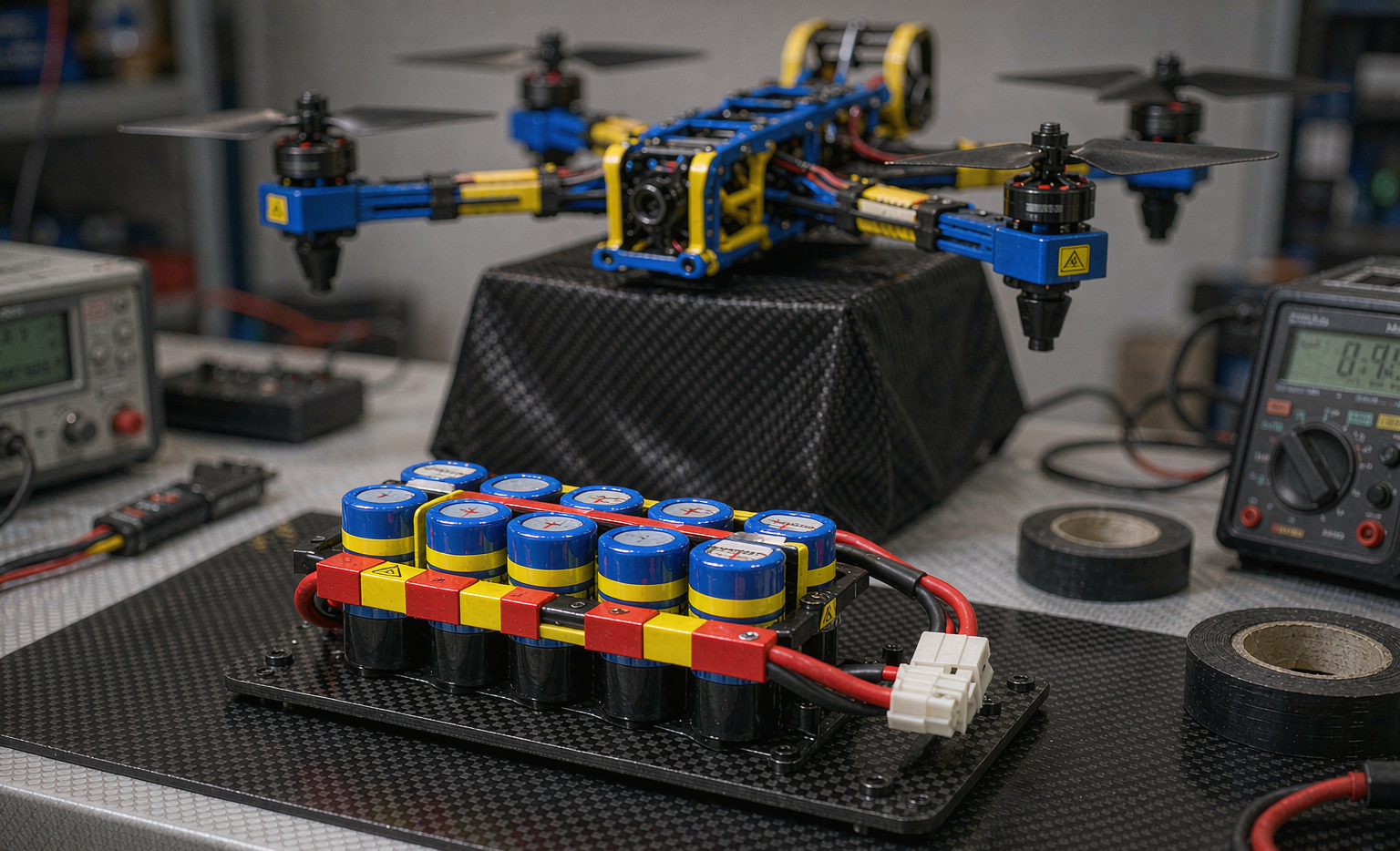
A Race Is a Burst Duty Cycle, Not a Steady Load
Let us start with what the pack actually sees. A typical FPV or spec-class race is a loop of punch-out, cruise, recover, repeat. The punch-out — full throttle off the gate or out of a corner — pulls 120 A to 180 A on a 6S pack for two to three seconds. Then you cruise or charge at 20 A to 40 A for four to eight seconds. The pack never reaches a thermal or electrical steady state; it lives in transients. Between bursts there is a short recovery window where cell surface temperature falls a few degrees and inter-burst voltage rebounds.
This matters because a drone lithium battery is specified on continuous numbers that the race never uses. A 6S 1500 mAh 120C pack is nominally 1.5 Ah × 120C = 180 A peak, at 22.2 V nominal (25.2 V full). But that 180 A is a peak pulse, not a sustainable draw, and the race only asks for it in 2–3 s bites separated by recovery. If you design and test around the continuous rating, you will mis-size the pack and you will mis-read its health. The duty cycle is the spec.
Here is a concrete burst budget I use when qualifying a pack. Take that 6S 1500 mAh pack at 25.2 V. A punch-out drawing 150 A for 2.5 s consumes 150 A × 2.5 s = 375 A·s ≈ 0.104 Ah, or about 2.6 Wh per burst. A three-minute race with a punch every 6 s is roughly 30 bursts — call it 80 Wh of burst energy plus cruise losses, comfortably inside the pack’s 37.8 Wh usable if you stay in the high-power band. The mistake is sizing for endurance (Wh) when the race is won on the 2.5 s window (W/kg). Every drone battery I release for racing ships with this burst budget stamped into its genealogy record so the pilot knows the pack’s real ceiling.
Pulse Capability Beats the Label C-Rating
The single most abused number in racing is the “C rating.” A cell marketed as 120C is usually defined as the current at which terminal voltage sags to some vendor-chosen cutoff — not a figure you can run lap after lap. What actually governs punch is the pack’s pulse capability over the real burst window and its recovery between bursts. The metric to watch is DCIR (direct-current internal resistance), not capacity.
Voltage sag under burst is simply V_sag = I_burst × R_pack. For a 6S 1500 mAh pack, pack resistance typically sits at 4–8 mΩ when fresh. At 150 A that is 0.6–1.2 V of pack-level sag — and that is the difference between a crisp launch and a mushy one. I measure DCIR on every incoming lot: a healthy pack reads 5–7 mΩ, and I retire it when it climbs past 9–11 mΩ, where sag has grown ~40% and you are losing 0.3–0.5 V per lap off the same throttle. Engineering the burst envelope means qualifying cells on pulsed DCIR at the real burst duration, not on a brochure C-number.
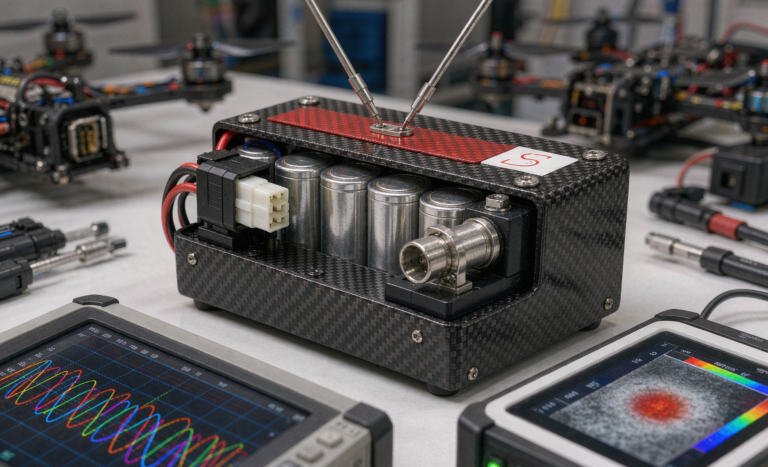
The measurement discipline matters as much as the number. I use a four-wire (Kelvin) DCIR method: a 2 s, 40 A pulse on a rested pack at 25 °C, ΔV/ΔI, repeated three times and averaged. Doing it on a two-wire meter or on a warm pack off the charger inflates the reading by 15–30% and hides the very degradation you are trying to catch. When a customer sends me a “weak” drone battery for analysis, nine times out of ten the problem is not the cells — it is that nobody measured pulsed DCIR correctly, so the pack was flown past its real burst limit until the sag became visible on the gate.
The Partial-SoC Racing Strategy: Stay in the High-Power Band
Here is the lesson most pilots learn the hard way: both open-circuit voltage and internal resistance get worse as state of charge drops. A lithium battery delivers its lowest DCIR and highest terminal power in the band of roughly 70% to 95% SoC — about 3.9–4.15 V per cell. Below roughly 3.5 V/cell you enter the high-resistance knee: the same throttle produces more sag, less punch, and measurably faster DCIR growth.
The fix is to race on a partial state of charge. Swap the pack when it reaches 3.6–3.8 V/cell rather than draining to the 3.3 V/cell cutoff. You give up maybe 8–12% of the nominal energy, but you avoid the knee where sag roughly doubles and where pack aging accelerates. On a 6S 1500 mAh pack at 22.2 V, stopping at 3.6 V/cell (21.6 V pack) instead of 3.3 V/cell (19.8 V) trades a sliver of runtime for punch that stays consistent from lap one to lap three. In my test logs, packs managed this way hold within ~3% of their fresh burst voltage across a full race; packs drained to cutoff drift 10–15% by the final lap.
Temperature and SoC interact, and ignoring that interaction is the second rookie mistake. A drone lithium battery at 10 °C has roughly 1.4–1.7× the DCIR it has at 25 °C, so a cold pack on a partial charge sags almost as badly as a warm pack on empty. The practical rule: keep the pack in the 25–35 °C window and above 3.6 V/cell, and you stay inside the high-power band where every throttle input translates directly to thrust. Below that band, you are spending battery on heat and resistance instead of altitude.
Gravimetric Power Density, Not Wh/kg, Wins Racing
The classic Ragone trade-off says you cannot maximize both energy density (Wh/kg) and power density (W/kg) at once — chasing high C-rate cells costs you energy. For racing, the metric that matters is power density. A 6S 1500 mAh pack at 25.2 V holds 37.8 Wh; at a 180 A peak that is 4.5 kW, and at ~220 g pack mass that is roughly 20,000 W/kg of peak power density. That number, not the Wh, is what launches you.
This is why discipline-matched sizing beats “biggest pack you can strap on.” Size the pack to the burst energy of your race — bursts × burst energy — not to three minutes of cruise endurance you will never use at race pace. Carrying unused Wh is just dead mass that slows you and heats the pack. This is exactly where a proper custom battery solution earns its keep: we tune cell format (high-discharge 21700 cylindrical versus pouch) and parallel count to the discipline’s specific burst profile, so you arrive at the gate with maximum W/kg and minimum grams.
Burst Cycling Ages Packs Faster — and Unevenly
High-C burst cycling is brutal on a pack, and it ages cells unevenly. The stresses are mechanical (fatigue at welds and tabs from current pulsing), electrochemical (lithium plating when you pull high C at low temperature), and thermal (localized hot spots between center and edge cells). In our field data, a pack raced all the way to the 3.3 V/cell cutoff loses about 25% of its burst capability by cycle 60. The same chemistry managed with a partial-SoC strategy and a 35 °C charge-temperature gate retains roughly 90% of burst capability to cycle 80.
The practical discipline is genealogy and gates. Every Horizon Power racing pack carries a DataMatrix code so we log per-pack cycle count and DCIR trend. We retire at DCIR +30% or when cell-to-cell spread exceeds 40 mV, whichever comes first. That single rule has prevented more mid-race sag failures than any chemistry tweak. A disciplined custom battery solution is as much about retirement logic as it is about cell selection.
Standards You Still Cannot Skip for a Racing Pack
Even a competition drone battery has to travel to events and be handled safely in a pit. The safety baseline does not disappear because you are racing. We qualify every racing design to UN38.3 T.1–T.8 — altitude simulation, thermal test, vibration, mechanical shock, external short circuit, impact, overcharge, and forced discharge — and to IEC 62133-2 for secondary-cell safety. For transport to and from the field, a typical 6S 1500 mAh 22.2 V pack is about 33 Wh, far under the FAA/EASA 100 Wh air-transport ceiling, and it ships under IATA Section II. Knowing those limits is part of being a responsible racer and a responsible pack builder.
Frequently Asked Questions
What C-rating should I actually trust for racing?
Trust pulsed DCIR measured at your real burst duration and current, not the brochure number. A 120C label can hide a pack that sags 1.2 V at 150 A; a well-built 80C pack with low DCIR may out-punch it. Ask your builder for a burst-DCIR curve, not a sticker.
Why does my pack punch less on lap three?
Two reasons, both manageable. DCIR grows with cumulative burst cycles, and if you are draining to the low-SoC knee, internal resistance climbs exactly when you need power. Race on a partial state of charge and retire packs at the DCIR +30% gate, and lap-three sag largely disappears.
Is it better to run a smaller pack at higher SoC?
Often yes for punch, with a runtime cost. A smaller pack kept in the 70–95% SoC high-power band delivers consistent W/kg, but you must pit-swap sooner. For spec classes with fixed pack rules, the lever is managing SoC within the pack you are given — swap earlier, never hit the knee.
How do I tell a pack has lost its burst?
Measure pack-level sag at a known burst current (e.g., 150 A for 2 s) and track DCIR session to session. A fresh racing pack reads 5–7 mΩ; once it crosses 9–11 mΩ, or cell spread exceeds 40 mV, it has lost the burst and should be retired from race duty.
Do racing drone batteries need UN38.3 certification?
Yes. Any drone lithium battery that is shipped — to events, to customers, across borders — must meet UN38.3 T.1–T.8 and travel under IATA rules. Competition use does not exempt a pack from transport and handling safety; build and buy certified cells and packs only.