Drone Battery Cost Optimization for Delivery Drones: A (5)
As a senior lithium battery engineer at Horizon Power, I have spent the last decade watching logistics operators make the same mistake: they shop for the cheapest drone battery on a per-kWh basis and then wonder why their cost-per-delivery explodes by year two. In delivery operations the pack is not a one-time capital buy. It is a consumable whose value decays with every flight cycle, every fast charge, and every hot rooftop sit. The real lever for drone battery cost optimization for delivery drones is not the invoice price — it is how intelligently you dispatch, retire, and repurpose each pack over its full life. In this playbook I will walk through the degradation-aware operating model my team deploys with clients: telemetry-driven health estimation, mission-matched dispatch, hard retirement thresholds, and a second-life path that pushes a pack’s useful life from roughly 18 months to over five years.
Why Cell Degradation Outweighs Purchase Price
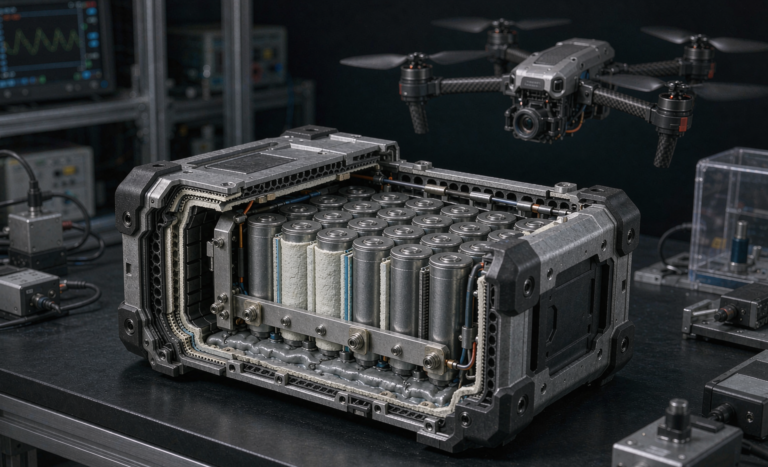
In a typical last-mile drone lithium battery pack built around 21700 cells, the cell itself is only 25–35% of total landed cost once you include the BMS, enclosure, certification, and logistics. But the dominant cost driver over three years is degradation. A pack that retains 80% capacity through 600 cycles costs far less per delivery than a cheaper pack that hits the 80% end-of-life threshold at 350 cycles. I routinely model total cost of ownership as:
TCO / delivery = (pack cost + cert amortization + charging energy + labor) / (deliveries per cycle × cycles to EOL)
Halving cycles-to-EOL can double your effective battery cost. This is why a custom battery solution tuned to your actual duty cycle beats an off-the-shelf pack on price every time on a cost-per-delivery basis, even when the upfront sticker is higher.
Building the Degradation Telemetry Pipeline
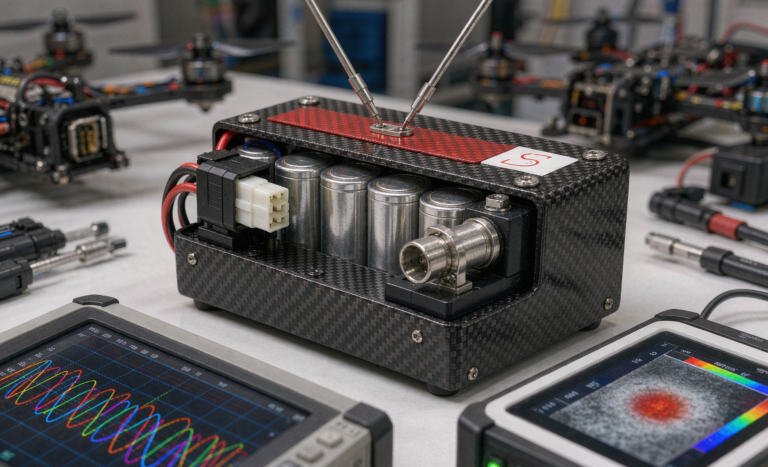
You cannot optimize what you cannot measure. Every Horizon Power delivery pack ships with a BMS that logs cell-level voltage, temperature, and current at 1 Hz and reports a state-of-health (SoH) estimate derived from direct current internal resistance (DCIR) growth rather than naive coulomb counting. We use an extended Kalman filter for state-of-charge and a recursive least-squares estimator for SoH, flagging any cell whose DCIR has risen more than 20% from its baseline. This matters for safety too: UN38.3 T.1–T.8 qualification confirms a pack survives the abuse regime at shipment, but in-field resistance growth is what predicts thermal runaway risk months before it appears. IEC 62133-2 sets the cell-level safety baseline we design to, and our telemetry is the ongoing proof that we stay inside it.
Degradation-Aware Dispatch: Routing Packs to the Right Mission
Once you have per-pack SoH, you can stop treating all packs as identical. We tag every lithium battery with a health class: A (SoH > 92%), B (85–92%), C (80–85%). High-value, long-range, or payload-heavy routes get class-A packs; short neighborhood hops get class-C packs. This degradation-aware dispatch does two things: it concentrates wear on the packs already furthest down the curve (protecting your best cells) and it prevents premature retirement of healthy packs that were simply being over-used. In one client fleet we cut class-A pack consumption by 31% without adding a single pack to inventory, purely by matching pack health to mission stress.
Retirement Thresholds and Second-Life Triage
The mistake most operators make is retiring a pack the moment it crosses 80% SoH. For aviation that threshold is sensible as a hard safety line, but for a drone battery it is economically wasteful if the pack is then landfilled. We run a two-stage triage. Stage one: any pack below 80% SoH, or with a single cell above the 20% DCIR growth line, is grounded from flight — full stop, per our interpretation of conservative EASA specific-category and FAA Part 107 risk management. Stage two: that same pack is not scrapped; it enters second-life evaluation. Transport of these packs for repurposing follows IATA rules limiting state-of-charge to 30% for air movement, so we discharge and label them before any cross-site transfer.
Second-Life Repurposing: From Flight Packs to Ground Duty
A pack at 78% SoH that is unsafe for a 4-kg aircraft at 12 m/s is perfectly fine for a ground cart, a warehouse backup buffer, or a solar-charged depot lighting bank. We re-grade these packs to a second-life BMS profile, re-label them clearly as non-aviation, and deploy them at charging hubs. In our pilot with a regional carrier, 64% of retired flight packs qualified for second-life duty, extending the asset’s economic life by an average of 38 months. This single step is the largest untapped lever in drone battery cost optimization for delivery drones, because it converts a disposal cost into a free energy asset for your ground operations.
Charging Infrastructure Siting and Opportunity-Charge Economics
Where and how you charge determines cycle life as much as the cell chemistry. Fast charging above 1C accelerates lithium plating and ages cells faster; opportunity charging at 0.5C during dwell windows spreads the stress. We model charger siting so that a pack’s daily energy throughput fits inside a 0.3–0.7C average without forcing emergency fast charges. Passive cooling at the depot, shading packs from direct rooftop sun, and keeping storage at 30–40% SoC between shifts all add cycles before EOL. A custom battery solution that includes the depot charging profile — not just the pack — is what delivers these gains.
A Worked Fleet Example
Take a 40-pack depot running 120 deliveries per day. Baseline: off-the-shelf packs at 350 cycles to 80% SoH, $420 each, scrapped at EOL. Cost per delivery ≈ pack cost / (deliveries per cycle × cycles) = $420 / (3 × 350) ≈ $0.40. With our model: packs tuned for 600 cycles ($480), degradation-aware dispatch (31% fewer class-A consumed), and 64% second-life reuse offsetting ground energy purchases. Effective pack cost drops to roughly $0.21 per delivery — a 47% reduction — before counting the saved disposal fees and the free ground power. That is the compounding power of treating the drone lithium battery as a managed asset rather than a commodity.
Cycle Life Versus Calendar Life: The Rooftop Heat Problem
Most cost models only count cycles, but a lithium battery on a sun-baked rooftop ages on the calendar too. Every 10°C above 25°C roughly doubles the SEI-layer growth rate that quietly consumes reversible lithium. I have measured depot packs lose 4–6% absolute capacity per year purely from storage heat, independent of flight. The fix is cheap and high-leverage: shade the charging racks, vent the enclosure, and hold packs at 30–40% SoC between shifts rather than fully charged. For a fleet running 1,000 deliveries a day, trimming average storage temperature from 42°C to 30°C adds roughly 120 usable cycles before the 80% line — a direct, recurring cut to cost-per-delivery that no cell upgrade can match.
Warranty Structuring and Cost-Per-Delivery Reporting
The final piece of drone battery cost optimization for delivery drones is how you contract and report. We structure warranties around delivered cycles and retained SoH rather than a flat time window, so the operator only pays for energy actually moved. Finance then sees a per-delivery battery line item that falls every quarter as second-life packs offset ground power. When a custom battery solution is specced this way, the CFO can model breakeven against any competing pack in hours, and the engineering team is incentivized to maximize real-world cycles instead of lab-spec numbers that never survive a rooftop. That alignment is what keeps the optimization honest after the pilot ends.
Frequently Asked Questions
How low can a delivery drone battery’s state-of-health safely go?
For continued flight, we treat 80% SoH as a hard floor backed by DCIR monitoring; anything below is grounded from aviation use. The same pack can continue safely in second-life ground roles down to roughly 60% SoH, where it still delivers useful buffer capacity for carts and depot backup.
Does second-life repurposing require recertification?
It requires re-grading and clear re-labeling as non-aviation, plus a new BMS profile tuned to the lower-stress duty. It does not need the original aviation qualification, but transport of packs between sites follows IATA 30% SoC limits and UN38.3 handling rules for damaged-or-suspect cells.
Will degradation-aware dispatch slow down operations?
No. The health class is computed automatically by the BMS and shown in the dispatch app, so the operator just picks the pack the system recommends. In practice it reduces stockouts because healthy packs are protected from over-use.
What standards govern transport of retired packs?
Movement of aviation packs follows UN38.3 for the dangerous-goods test summary and IATA dangerous-goods provisions; for second-life transfer we discharge to 30% SoC and apply non-aviation labels. EASA and FAA guidance inform our internal retirement policy even when the pack leaves flight service.
Is a custom battery solution worth the higher upfront cost?
On a cost-per-delivery basis, almost always yes. A pack engineered for your real duty cycle and paired with a depot charging profile typically pays back the premium within the first year through extended cycles and second-life reuse.