Drone Battery Testing for Racing Drones: Abuse
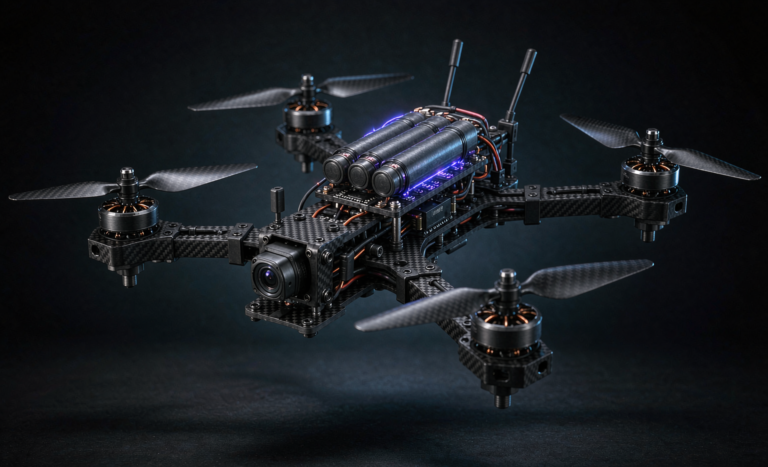
Every racer remembers their first pack fire. Mine was at a regional FPV meet in 2019, when a hard crash folded a 6S LiPo against a tree root and the pack went into thermal runaway in roughly nine seconds. Since then, as a Senior lithium battery Engineer at Horizon Power, I have treated drone battery testing for racing drones as something far more serious than a discharge-rate curve on a lab bench. Racing packs live in the most abusive duty profile we build: 80–150C bursts, repeated hard landings, and ambient swings from a cold pit lane to a hot canopy in direct sun. In this article I explain the qualification strategy we use — abuse tolerance, HALT/HASS environmental screening, and race-day verification — so your custom drone battery survives not just the flight, but the crash.
Why Racing Packs Need a Different Test Philosophy
Standard consumer drone battery testing stops at capacity and a UN38.3 pass. That is not enough for racing. A mapping UAV flies a gentle 1–2C profile; a racing drone sees a square-wave current: near-zero between gates, then a 120C spike on punch-out, repeated 40–60 times per lap. The cell also takes mechanical shock from every landing and thermal shock from every sprint. So our drone lithium battery qualification plan layers three tiers: (1) abuse tolerance to guarantee a single failure does not become a fire, (2) HALT to find infant-mortality and margin limits, and (3) HASS plus race-day checks to keep the fleet honest. This is the same discipline a drone battery manufacturer uses for certified aerospace cells, just tuned to the racing envelope.
Abuse Qualification — What Happens When Things Go Wrong
Abuse testing answers one question: when a cell is damaged, does it fail safe or fail violent? We run the UN38.3 T.1–T.8 battery transportation test series as a baseline, then go harder. The goal is never to prove the pack is indestructible — it is to prove a single damaged cell cannot propagate into a pack-level fire during a race or while a pilot walks over to retrieve a crashed airframe.
Crush and Impact (UN38.3 T.4 / T.6)
T.4 drop and T.6 crush apply a defined force onto a sample cell. For racing we exceed this at the pack level, because in a real crash the hardcase cells are compressed by the frame, not by an abstract test platen. We measure surface temperature and check that no venting ignites. A good lithium battery for racing vents through a designed pathway rather than rupturing, and the frame must not crush the can past its safe limit. We log the crush distance at which venting begins — that distance is your mechanical safety margin.
External Short Circuit and Overcharge (UN38.3 T.5, UL 1642)
T.5 short-circuits the cell through a low-resistance load and requires the case temperature stay below the limit with no fire for the observation period. We add an UL 1642 overcharge to well above rated voltage at several times max charge current to confirm the protection topology. The point is to validate the protection IC and the custom battery solution’s fuse and busbar layout, not just the bare cell. A protection chip is only as good as the trace that carries its command to the MOSFET.
Thermal Runaway Propagation (UL 2580)
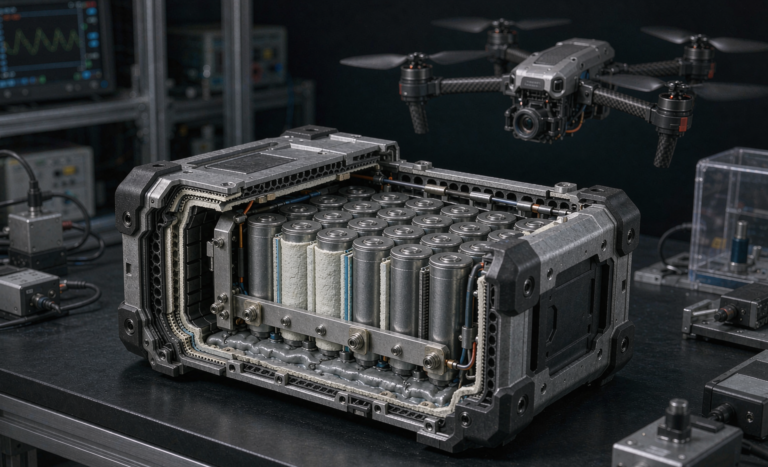
UL 2580 propagation testing is what separates a safe pack from a grenade. We trigger one cell into runaway and verify the rest of the pack does not propagate within the required observation window. For a 6S pack this means inter-cell insulation, flame barriers, and a vent channel — design choices a drone battery manufacturer must make before the first race, not after. We record the time-to-propagate and the peak pack temperature; if propagation is uncontrolled, the pack geometry goes back to the drawing board.
HALT — Finding the Weak Link Before the Race Does
HALT (Highly Accelerated Life Test) stresses beyond the operating envelope to expose design margins. We run it on prototype packs only — it is a development tool, not a production screen.
Thermal Shock and Rapid Temperature Cycling
A racing drone can sit in a 4°C pit and launch into a 38°C canopy. We cycle packs from −20°C to +75°C at ramp rates a real day never sees, looking for delamination at the electrode–current-collector interface and solder-joint cracking on the BMS. The failure temperature, not the pass temperature, is the data we keep. That failure point becomes the guard band for your operating limits.
Multi-Axis Vibration and Combined Stress
Real crashes are multi-axis; a single-axis shaker misses them. We use combined temperature plus random vibration (broadband, several Grms) and watch for intermittent open circuits — the kind that cause mid-air cutouts. This is where many a cheap custom drone battery fails: the interconnect is fine on the bench and dead after 30 hard landings. Our HALT rig intentionally reproduces that cumulative damage so we can fix it in the design phase.
HASS — Screening Every Production Pack
HASS (Highly Accelerated Stress Screen) applies a fraction of HALT stress to every production unit to catch infant mortality: a cold solder joint, a loose busbar, a mis-seated balance lead. We do a short thermal step-stress and a burst of vibration, then a full functional discharge. A custom battery solution that skips HASS ships latent defects straight to your starting line. We log every pack’s pre- and post-screen impedance so a drifting unit is caught before it ever flies, and the data rides with the pack into our race-day logbook.
Race-Day Verification: From Bench to Track
All the bench work means nothing if the pack on the line is different from the one we qualified. So we close the loop at the track.
Pre-Flight Impedance Gate
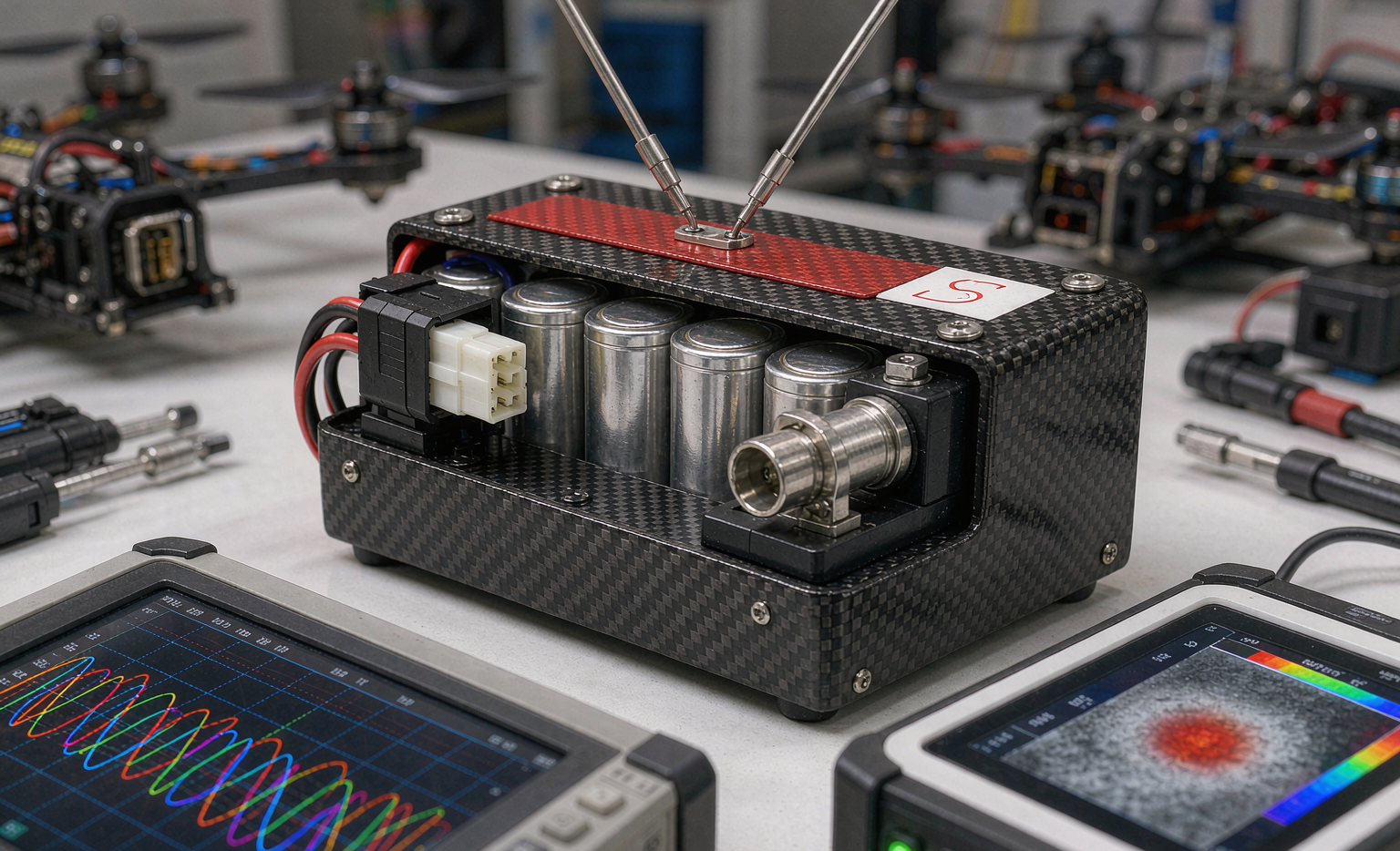
Before every round we measure pack AC impedance at a fixed state of charge with a 1 kHz bridge. If the value drifts more than about 15% from the pack’s HASS baseline, it does not fly. This single gate has caught more failing drone battery units than any other check — a cell on its way out shows rising impedance weeks before capacity drops. It takes ninety seconds and has saved more than one race weekend.
Post-Race Telemetry and the Battery Logbook
Each pack carries a logbook: flight count, peak current, max temperature, and end-of-race internal resistance. After a hard crash we pull the data before disposing. Over a season this builds a field-failure database that feeds back into the next design — exactly the closed loop a serious drone battery manufacturer runs. Our custom battery solution customers receive this dataset with every fleet order, turning every race into a qualifying test.
Building the Qualification Test Plan
If you are specifying your own pack, demand a written test plan that includes UN38.3 T.1–T.8 transportation safety, IEC 62133-2 construction safety, UL 1642 / UL 2580 abuse and propagation, a HALT margin profile, and a HASS screen rate. For flight and shipping, remember FAA Part 107 and EASA rules cap battery energy on board, and IATA requires packs shipped at ≤30% SoC. A qualified lithium battery is one where every one of these boxes is ticked and documented — not assumed. Treat drone battery testing for racing drones as a program, not a single report, and your failure rate will show it.
Frequently Asked Questions
How is racing drone battery testing different from normal drone testing?
Normal drone testing assumes a gentle 1–2C profile and focuses on capacity and endurance. Racing testing must qualify bursty 80–150C loads, crash-level mechanical shock, and thermal shock between pit and canopy. The abuse and HALT/HASS tiers exist specifically because the racing envelope is far harsher than survey or cinema flight.
What standard covers thermal runaway propagation in racing packs?
UL 2580 is the reference for propagation testing: one cell is forced into runaway and the pack must not propagate within the observation window. We pair it with UN38.3 T.1–T.8 for transportation safety and IEC 62133-2 for cell construction. A documented propagation result is the strongest evidence a pack is crash-safe.
Do I really need HALT if UN38.3 already passed?
Yes. UN38.3 is a pass/fail transportation safety minimum; it tells you nothing about your design margin or infant-mortality rate. HALT finds the weak link — a solder joint, a delaminating electrode, an intermittent interconnect — before a race does. Skipping it trades a known margin for blind optimism.
How often should I impedance-check my race packs?
Before every flying round, at a fixed state of charge, against the pack’s HASS baseline. A drift beyond about 15% is a no-fly signal. Post-race, log the end-of-race internal resistance so you can trend degradation across the season and retire packs before they fail in the air.
Can a custom battery solution be qualified for both racing and shipping?
It can, and it should. The same pack needs UN38.3 and IEC 62133-2 for safety, a HALT/HASS plan for reliability, and IATA ≤30% SoC plus FAA Part 107 / EASA energy limits for transport. A competent drone battery manufacturer documents all of these in one qualification file so the pack is legal to ship and safe to fly.