Lithium Battery Manufacturing for UPS Systems
When a data center loses grid power, the uninterruptible power supply (UPS) has milliseconds to take over before the load browns out. Over the last nine years building lithium battery packs at Horizon Power, I have come to treat UPS cells as a distinct engineering discipline rather than a repackaged consumer product. A lithium battery destined for float service behaves nothing like the cells in your phone, and pretending otherwise is how you end up with field failures three years in. This article walks through how we actually manufacture lithium battery systems for UPS, from electrode chemistry to the certification paperwork, based on what has survived real production lines and real warranty claims.

Why UPS Systems Demand a Different Lithium Cell Architecture
The defining constraint of a UPS is not peak power, it is availability over a decade. A telecom site or hospital backup bank will sit at 95% state of charge for years, taking maybe a few dozen shallow discharge cycles across its life. That duty profile punishes chemistries tuned for deep cycling. We therefore lean toward lithium iron phosphate (LFP, LiFePO4) for most UPS builds: its flat voltage curve, thermal stability, and tolerance to high sustained SoC make it forgiving in float. Where footprint is tight and energy density wins, nickel-manganese-cobalt (NMC) enters the picture, but only with stricter battery management and ventilation margins.
I have watched teams spec a lithium-ion battery pack for a UPS using the same cell they shipped in a power tool. The tool cell sees 500 aggressive cycles and retires. The UPS cell must hold 80% capacity after ten years of near-constant charge. The manufacturing line that builds them must be tuned to that difference, not just scaled up.
Cell Selection and Chemistry Tuning for Long Float Life
Before any line runs, we lock the cell. For LFP UPS packs our design targets are explicit: calendar life ≥ 10 years at 25°C, capacity retention ≥ 80% at end of warranty, self-discharge < 3%/month, and a float window of 3.40–3.45 V/cell. We reject any incoming cell lot whose initial DC internal resistance (DCIR) sits more than 10% above the lot mean.
- Anode/Cathode loading: We reduce electrode porosity slightly versus cycling cells to suppress lithium plating during long float, trading a little power for stability.
- Electrolyte additives: Film-forming agents are tuned for SEI stability at high SoC, the opposite of what a high-rate drone battery cell needs where low resistance rules.
- Formation protocol: A slower, multi-step formation at 0.05C–0.2C builds a denser SEI, which we have measured to cut capacity fade roughly 15% over 5 years in accelerated storage tests.
The Manufacturing Line: From Electrode to Pack
A UPS pack is not one cell, it is a welded assembly of modules, a BMS, fuses, and an enclosure. Our line runs in discrete stations, each with a first-pass-yield gate:
- Module welding: Pure nickel or nickel-plated steel busbars are laser- or ultrasonic-welded. We hold weld peel strength ≥ 50 N and verify with periodic destructive pull tests. A weak weld is the single most common root cause of field thermal events I have investigated.
- Insulation and potting: Cells are isolated with flame-retardant mica or PET film, and high-voltage buses get conformal coating. Thermal interface material sits between cells and the enclosure wall to manage heat during the rare full discharge.
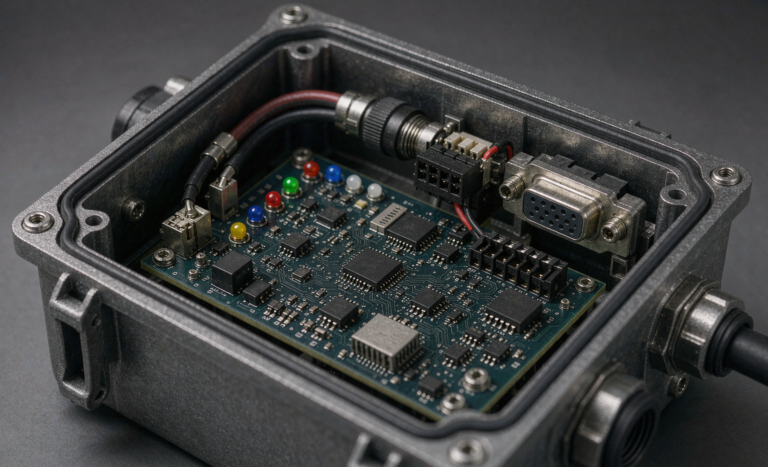
- BMS integration: The battery management system is the brain. For UPS we insist on redundant voltage sensing per series group, cell balancing current ≥ 50 mA, and a contactor pre-charge circuit so inrush never welds the main relay shut.
- Enclosure and comms: IP20–IP54 depending on siting, plus Modbus or CAN reporting so the UPS inverter knows state of charge, temperature, and fault flags in real time.
Quality Gates and In-Line Testing That Actually Catch Defects
Testing is where a lithium battery manufacturing process earns its reliability, or fakes it. We run three tiers:
- Cell-level: 100% capacity grading and DCIR sorting. Cells in a module are matched to within 2% capacity and 5% DCIR so the pack ages evenly.
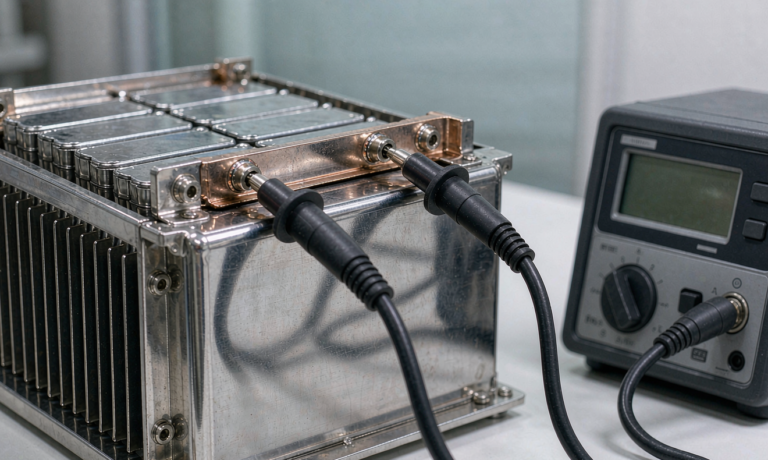
- Module-level: Hi-pot to 1500 V DC for one second, insulation resistance > 500 MΩ, and a thermal imaging pass to catch hot spots at 1C.
- Pack-level: A full charge-discharge-characterization at the rated UPS current, plus a 24-hour soak at float to confirm self-discharge is in spec.
The data from every pack is logged to its serial number. When a customer calls two years later, we can pull the original test curve. That traceability is part of the custom battery solution we sell, not an optional extra.
Compliance and Certification Path
No UPS lithium battery leaves our dock without its certification trail. The baseline stack we build to:
- UN38.3: The transport test (T.1–T.8) covering altitude simulation, thermal, vibration, shock, external short, impact, overcharge, and forced discharge. Mandatory before the pack can legally ship.
- IEC 62133-2: The cell and pack safety standard for portable lithium systems, covering short circuit, overcharge, and temperature abuse.
- UL 1973: The stationary battery standard for the North American market, covering the pack enclosure, BMS, and abuse tolerance.
- UL 9540A: The thermal runaway propagation test that many AHJ and insurance carriers now require for installed energy storage behind a UPS.
- IEC 62619 / IEC 62485: Industrial battery safety and stationary lead-acid-equivalent installation rules we map our Li-ion packs onto for European projects.
For aviation-linked or mobile UPS (think ground-support equipment), we align sub-assemblies to FAA RTCA DO-160 and EASA environmental profiles where the customer’s downstream product demands it. The paperwork is as much a deliverable as the cells.
Scaling From Pilot to Volume Without Losing Yield
A pilot line can hit 95% first-pass yield in the lab and collapse to 70% at volume if the process is not locked. Our rule is simple: a parameter that is not measured is not controlled. When we scaled our 10 kWh UPS module from pilot to 200 units/month, we instrumented weld energy, dispensing weight, torque, and test results into a single line dashboard. First-pass yield climbed from 82% to 93% over four months as we tightened the coating-weight coefficient of variation below 2.5% and the DCIR spread below 10%.
We also keep a frozen custom battery solution baseline: once a UPS pack design is qualified, the bill of materials and process window are locked. Any change triggers re-qualification. That discipline is what keeps a 2026 unit identical to a 2024 unit a customer is expanding.
Why We Treat UPS Packs as a Custom Battery Solution
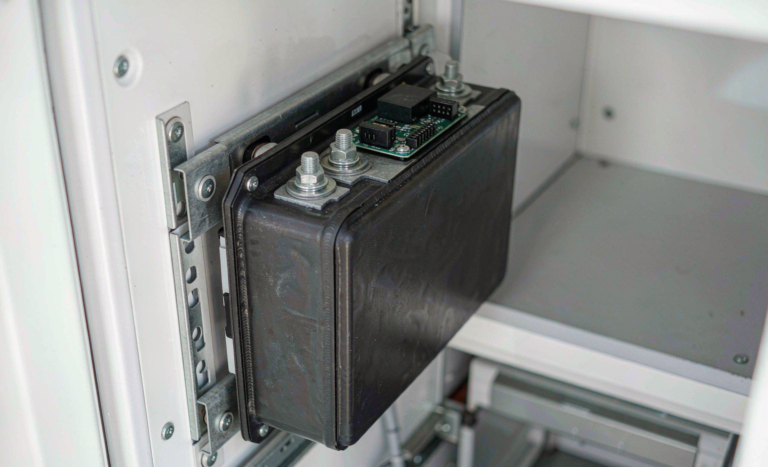
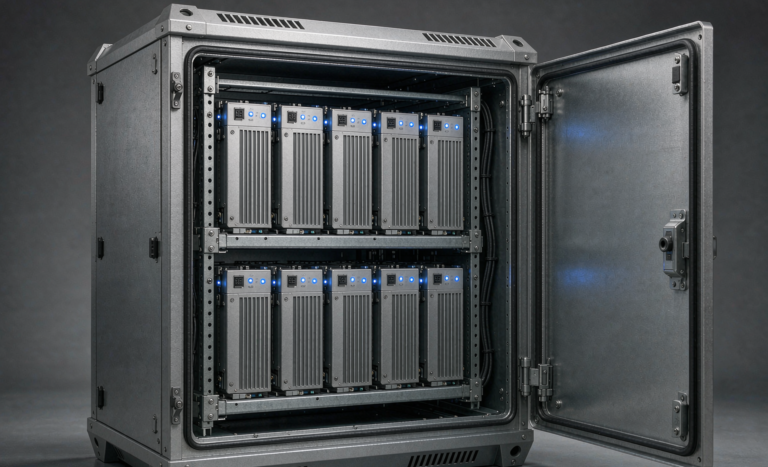
No two UPS cabinets are the same. Voltage (48 V, 192 V, 240 V), communication protocol, rack depth, and ambient temperature all vary. We rarely ship a catalog part; we ship a lithium battery system engineered to the inverter’s charge algorithm and the room it lives in. That is the heart of a custom battery solution: the cell is commodity, the integration is the product. A well-built UPS lithium battery pack should be invisible, which is the highest compliment a backup system can receive.
In my experience the UPS lithium battery projects that succeed are the ones where manufacturing discipline matches the duty profile. Pick the cell for ten years of float, build the line around measured parameters, certify to the standard the installation actually requires, and treat every pack as a documented custom battery solution. Do that, and the battery becomes the most boring, most reliable component in the whole backup chain, which is exactly what a UPS is supposed to be.
Frequently Asked Questions
How long does a lithium UPS battery last compared with lead-acid?
In float service, a properly built LFP lithium battery typically delivers 8–12 years versus 3–5 years for VRLA lead-acid, with no equalization charging and roughly half the footprint and weight. The higher upfront cost is usually recovered inside the first replacement cycle.
Can I retrofit lithium into an existing UPS designed for lead-acid?
Often yes, but the charge voltage window must match. Lead-acid chargers that hit 2.40 V/cell will overcharge LFP. We either reprogram the UPS charge profile or add a controller that presents a compatible voltage to the inverter while protecting the cells. Never drop in lithium without addressing the charge algorithm.
What capacity UPS pack do I need?
Size to your critical load and required runtime: capacity (Ah) × pack voltage ÷ load (W) ≈ runtime at that load. We always add a 20% margin for cell aging and temperature derating, and confirm the inverter’s minimum battery voltage cutoff so the pack is never deep-discharged.
Is UL 9540A required for every UPS lithium battery?
Not universally, but it is increasingly demanded by code officials and insurers for installed storage. We build to it as a default for stationary UPS deployments because passing thermal-runaway-propagation testing de-risks the whole installation and smooths permitting.
Why choose LFP over NMC for backup power?
For UPS, LFP wins on safety margin, cycle/calendar life at float, and lower cost per watt-hour over the warranty. NMC’s higher energy density only justifies itself where space is the binding constraint, and even then we add ventilation and tighter BMS limits.