Sodium-Ion Battery Safety for Backup Power
Every backup power system sells itself on uptime, but the engineering reality is that safety — not energy density — is the property that decides whether a sodium-ion battery bank survives a decade of idle standby, a lightning surge, or a warehouse fire next door. I’m Karl Huang, Senior lithium battery Engineer at Horizon Power, and over the last nine years I’ve qualified stationary packs for telecom sites, data closets, rural clinics, and grid-edge cabinets. In this piece I’ll walk through how we engineer sodium-ion battery safety for backup power from the cell outward — because in stationary storage, safety is a system property, not a cell spec.
Why Backup Safety Is a System Property, Not a Cell Spec
A cell can pass UN38.3 with flying colors and still let a pack burn in the field. I’ve seen it happen: the lithium battery that passed the nail test was perfectly fine; what failed was the busbar weld that fatigued after 18 months of daily transfer-switch cycling, arced, and ignited the enclosure. Backup duty is uniquely unforgiving because it combines three stressors that rarely coincide in a mobility pack — long idle at high state-of-charge, rare but high-consequence deep discharge, and violent transfer-switch transients when the grid drops. The safety envelope of any sodium ion battery backup installation is therefore defined by the weld, the battery management system, the enclosure, and the commissioning checklist at least as much as by the chemistry inside the pouch.
That is the frame I want you to hold for the rest of this article. Sodium-ion gives us a wider intrinsic safety margin than nickel-manganese-cobalt chemistries, but margin is not a free pass. We still design barriers, still grade cells, and still commission every cabinet as if a single fault will occur — because in a 10-year standby service life, it eventually will.
What Makes Sodium-Ion Intrinsically Safer for Stationary Backup
Three intrinsic properties make a sodium-ion battery a strong candidate for always-on backup, and all three reduce the probability and severity of a thermal event:
- No lithium dendrite plating at low temperature. Lithium-ion cells grow metallic lithium dendrites during cold charging that can pierce the separator and short the cell from the inside. Sodium does not form the same dangerous dendrite mechanism, so a sodium-ion battery left in an unheated telecom shelter behaves far more predictably through winter standby.
- Higher thermal-runaway onset. Sodium-ion layered-oxide cathodes show thermal-runaway onset at or above 270 °C — in the same band as lithium iron phosphate (LFP) and well above the ~210 °C onset of NMC. That extra 60 °C of headroom is the difference between a fault that the cooling system can absorb and one that cascades.
- Lower stored energy density. Because sodium-ion packs hold less energy per liter than NMC, a single-cell event releases less total heat. The peak dT/dt is lower, giving barriers and the BMS more time to act.
We also see more thermally stable electrolytes in many sodium formulations and a hard-carbon anode that is mechanically robust. The honest caveat: this is a margin, not immunity. A sodium-ion battery is still a high-energy electrochemical system, and I treat it with the same respect I give any lithium battery in our product line.
Cell-Level Abuse Qualification Before a Pack Ever Ships
Safety starts at incoming inspection. Every production lot is graded on capacity coefficient of variation (<6%), 4-wire Kelvin DCIR coefficient of variation (<10%), and K-factor self-discharge (<1.0 mV/day), with a DataMatrix genealogy stamp so a field return can be traced to a specific cell. Then we run the full abuse-qualification stack:
- UN38.3 T.1–T.8 — altitude, thermal shock, vibration, mechanical shock, external short circuit, impact/crush, overcharge, and forced discharge.
- IEC 62133-2 — safety requirements for secondary cells and batteries.
- IEC 62619 — safety for industrial stationary applications.
- IEC 62477 — power electronic system safety, including insulation-monitoring requirements.
- UL 1973 — safety standard for stationary storage batteries.
For the nail-penetration and crush tests, both LFP and sodium-ion show no propagation at the cell level in our benches. We record peak temperature and dT/dt and feed those numbers into the barrier design below. A custom battery solution that skips this qualification step is, in my view, not shippable.
Thermal Runaway Propagation Barriers Still Apply
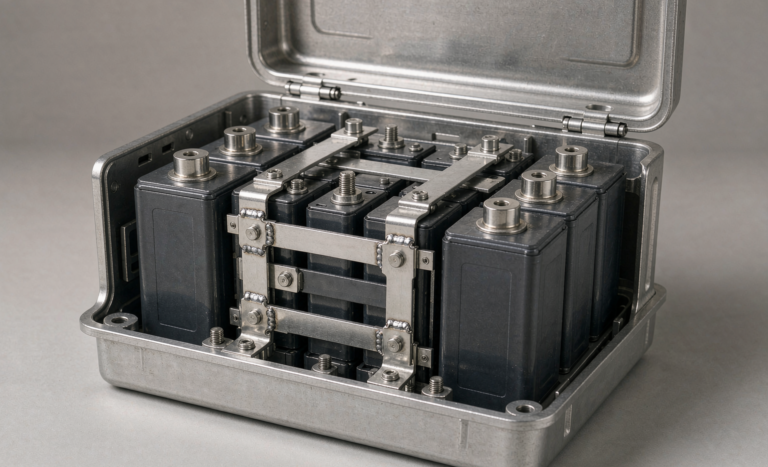
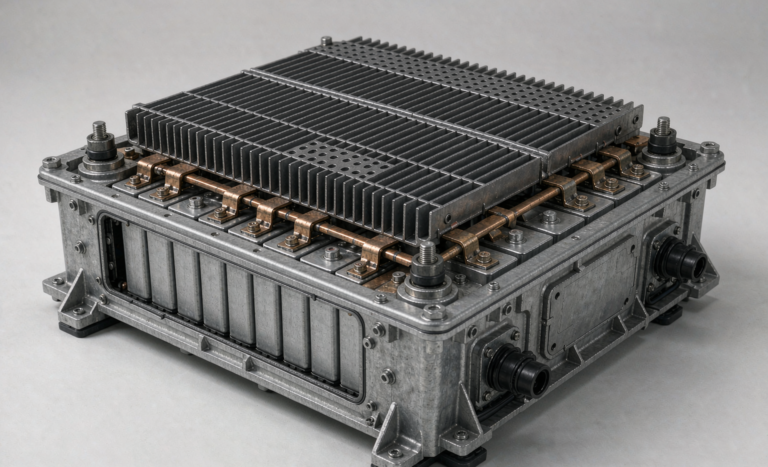
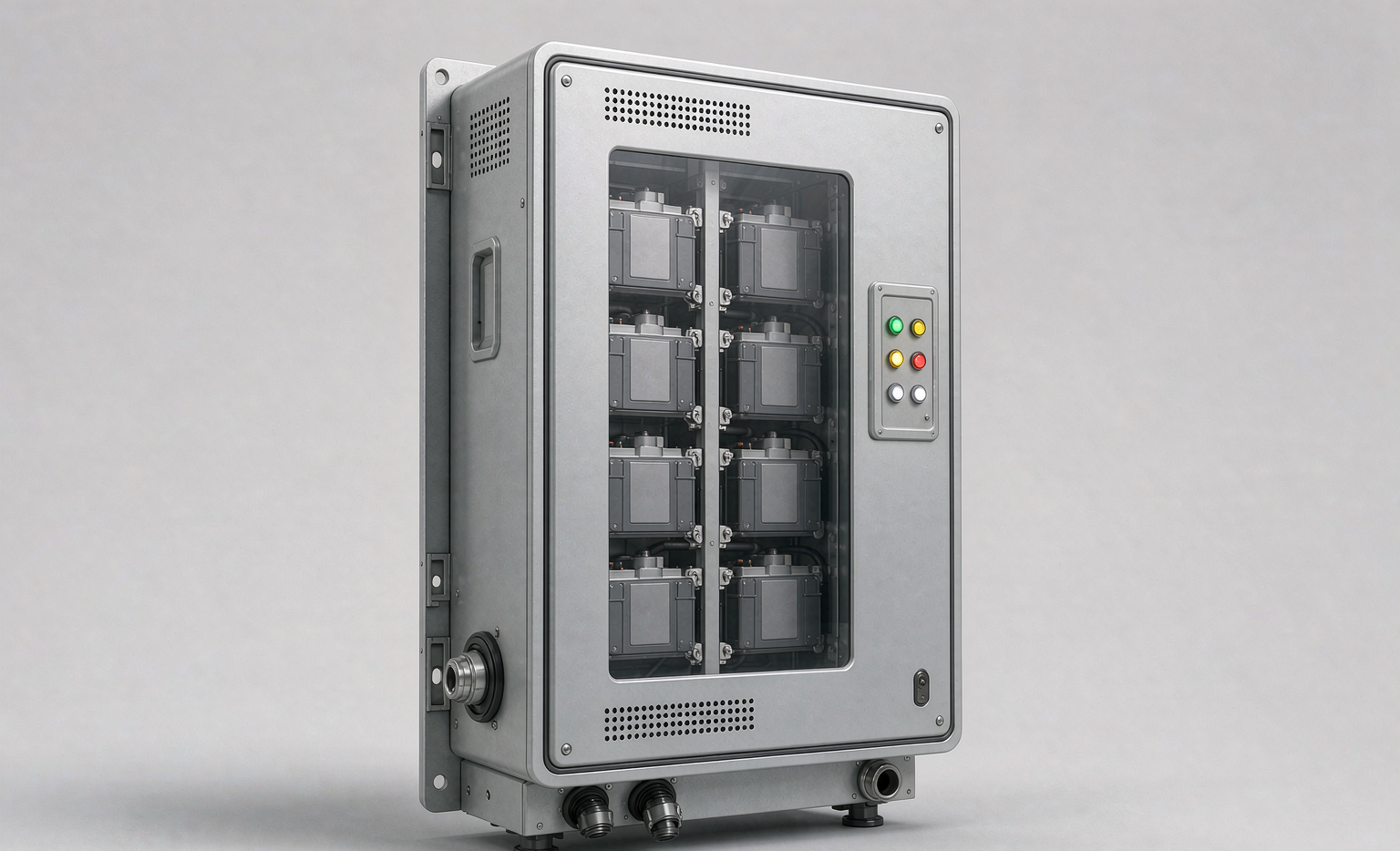
Even with a safer chemistry, a well-engineered backup cabinet must contain a single-cell thermal-runaway event so it cannot propagate to neighbors. Our module architecture uses aerogel or mica barriers between cells, directional venting into a protected plenum, and a minimum 150 mm clearance per NFPA 855. The compartmentalization is validated to UL 9540A, both at the unit level (within the enclosure) and, where the authority having jurisdiction requires it, at the installation level (the room).
There is a real cost to this. Barrier spacing typically costs 10–15% of pack volume, but it buys a 5-minute propagation-delay window — enough time for the BMS to isolate the string and for fire systems to act. In a worked 50 kWh cabinet built from 1P52S modules, we used a 2 mm mica sheet plus a 2 mm air gap per cell column and confirmed no propagation across the module boundary in a deliberately triggered single-cell test.
The Backup-Specific BMS Safety Architecture
The battery management system is where most field safety is won or lost. For backup we specify a dual independent sense architecture — separate current and voltage channels that cross-check each other — with the following hard gates:
- Over-current protection under 200 ms and short-circuit protection with pre-charge inrush limiting (<5 A, 90% ramp in <300 ms).
- Isolation-resistance monitor holding earth leakage above 500 kΩ per IEC 62477, with a contactor weld-detect open-load test on every cycle.
- Pyro-fuse for hard faults and a <0 °C charge lockout — sodium can still plate at extreme cold, and charging a frozen cell defeats formation.
- dT/dt trip on any cell rising faster than 1 °C/s, backed by a firmware hash lock to stop field tampering.
- Anti-islanding and backfeed prevention for grid-tied backup, per IEEE 1547 and NEC 690·706, verified through the transfer-switch interlock.
This is the same discipline we apply to our lithium battery packs, but tuned for the standby profile: the BMS spends most of its life asleep at float, so its self-test and wake-up paths have to be bulletproof.
Stationary Fire Containment and Room Design
UL 9540A is the backbone of stationary safety. We select unit-level or installation-level propagation testing based on the AHJ, then design the room around the cabinet: 150 mm side clearance, 300 mm top clearance, non-combustible wall backing, a dedicated disconnect, and smoke detection on the same loop as the building system. We generally avoid placing combustible ceiling material directly above the bank. Whether you choose a clean-agent suppression system or a sprinkler depends on the protected load — a clinic with a 2-minute transfer budget leans clean-agent, a warehouse often leans sprinkler — but the enclosure design does not change either way.
Commissioning Safety: A Six-Point Field Checklist
The single biggest cause of early backup failures I investigate is a skipped commissioning step. Our field teams run a six-point safety gate before a cabinet is declared live:
- Insulation-resistance test (>500 kΩ) before any energization.
- Pre-charge verification — inrush <5 A, 90% ramp in <300 ms.
- Contactor weld-detect open-load test on each switching cycle.
- State-of-health gate — capacity >98%, DCIR within +10%, cell voltage spread ≤30 mV.
- Transfer-switch interlock and anti-islanding functional test under simulated grid loss.
- 72-hour float burn-in with thermal logging, followed by the end-of-line gate above.
Any cabinet that fails one point goes back to the bench. A custom battery solution that ships without this gate is a liability waiting for a power outage to expose it.
Transport and Handling: IATA Sec II and Field Cross-Links
Backup cabinets are large, so transport matters. We ship at ≤30% state-of-charge under IATA Section II (UN3480), labeled but not under full dangerous-goods regulation when below the threshold — a meaningful logistics saving at fleet scale. The same carriage logic applies to our aerial line: a drone battery we build for survey UAVs travels under the identical Section II 30% SoC protocol, and a custom battery solution should reuse one validated transport dossier rather than reinventing it per product. One qualification file, many form factors — that is how we keep both cost and risk down.
Are sodium-ion batteries safer than lithium-ion for backup power?
Intrinsically, yes — in the relevant ways. Sodium-ion avoids lithium dendrite plating at low temperature, shows thermal-runaway onset at or above 270 °C (versus ~210 °C for NMC), and stores less energy per liter, so any single-cell event is less severe. It is not immune, but the margin is materially wider than NMC and comparable to LFP.
What standards certify sodium-ion backup batteries?
The floor we build to is UN38.3 T.1–T.8, IEC 62133-2, IEC 62619, IEC 62477, UL 1973, UL 9540A, NFPA 855, IEEE 1547, and NEC 690·706. Transport follows IATA Section II at ≤30% SoC, and grid interconnection follows IEEE 1547 anti-islanding rules.
How do you prevent thermal runaway from spreading in a backup cabinet?
By compartmentalizing the module: aerogel or mica barriers between cells, directional venting to a protected plenum, 150 mm clearance per NFPA 855, and UL 9540A-validated unit-level containment. The goal is a 5-minute propagation delay that lets the BMS isolate the string and fire systems respond.
Can sodium-ion backup batteries be transported at full charge?
Not economically or compliantly. We ship at ≤30% SoC under IATA Section II (UN3480). Full-charge transport triggers full dangerous-goods regulation, higher cost, and tighter handling — unnecessary for a product that will sit at float for months anyway.
What is the safest state-of-charge window for idle backup storage?
We commission and store backup banks at 30–60% SoC float with a periodic top-up to counter self-discharge, and we lock charging out below 0 °C. This minimizes calendar aging and eliminates the cold-charge plating risk while keeping enough reserve for an immediate grid-loss event.