Battery Solution Maintenance for Sensors
Introduction
The first sensor network I was asked to keep running had eleven hundred nodes on a pipeline right-of-way and a maintenance plan that consisted of a spreadsheet column marked “battery due.” Every three years, a crew drove the route and changed every cell they could reach. It worked, in the sense that the network stayed up, and it was ruinously expensive, in the sense that roughly two-thirds of the cells they pulled still had most of their life in them. When I finally put a load-pulse protocol on the nodes and started dispatching by condition and by geography instead of by date, the visit count fell by a little over half in the first year and the outage rate went down. That experience reframed the problem for me permanently: a battery solution for a distributed sensor fleet is not judged by how long the cell lasts, it is judged by how few times you have to send someone to look at it.
I am Karl Huang, a senior lithium battery engineer, and most of my field work sits at the unglamorous end of this industry: enclosures on poles, nodes in classified areas, solar panels covered in dust, and the slow arithmetic of truck rolls versus ampere-hours. This article is the maintenance guide I wish had existed when I inherited that pipeline network, and it is written for the engineers and technicians who own a fleet rather than a single device.
It covers the failure modes that actually take nodes down, the state-of-health signals you can extract from a radio that reports little more than a voltage, the dispatch logic that turns those signals into fewer visits, a ten-step field procedure that prevents repeat callouts, and the logistics and compliance details, hazardous-area certification, storage temperatures, dangerous-goods shipping, that quietly determine whether a maintenance programme survives contact with reality. Whether you run primary lithium cells on a five-year budget or a rechargeable lithium battery pack behind a photovoltaic harvester, the economics are the same: the cell is consumable, the visit is the cost, and every decision below follows from that one fact. Where the pack itself is concerned, a custom battery solution with a standardised footprint, a polarised connector and a single certified cell family will save you more money over ten years than any incremental gain in cell chemistry, because it makes the maintenance system simple enough that people actually follow it.
One more framing note before the technical detail. Maintenance is not the opposite of design; it is the feedback loop that makes the next design better. Every cell you pull carries information about how the node was really used, and if you are not capturing that information, you are paying for the visit and throwing away the only thing of lasting value it produced.
Why Sensor Network Maintenance Is a Dispatch Problem, Not a Battery Problem
I have spent enough nights on hold with logistics coordinators to say this plainly: in a distributed sensor deployment, the battery is rarely the expensive part. The expensive part is the person who drives to it. A primary lithium D-cell pack for a remote node costs somewhere between eight and forty dollars depending on chemistry, certification and connector. The truck roll to replace it costs, in every fleet I have audited, between one hundred and fifty dollars for an easily accessible urban node and well over five hundred dollars when the node sits on a tank farm perimeter, behind a permit barrier, or requires a confined-space attendant.
That ratio, sometimes thirty to one, is the single fact that should shape how you engineer maintenance for sensor batteries. And yet most maintenance programmes I inherit are built the other way around. They optimise the cell, they specify a ten-year shelf life, they buy the premium bobbin-type lithium thionyl chloride cell instead of the spiral-wound one, and then they dispatch a technician whenever a node reports a low-battery flag. The result is a fleet where the battery lasts eight years and the operating budget is consumed by visits that each cost more than every battery in the cabinet.
What follows is the maintenance discipline I have built for wireless sensor networks over roughly fifteen years of field work, on everything from a dozen vibration nodes on a pump skid to several thousand soil-moisture and pipeline-cathodic-protection nodes spread across a few hundred square kilometres. It is written for the people who have to keep those networks alive, and it is deliberately different from the maintenance advice you will find for a robot or an electric vehicle, because the economics are inverted. In a robot, the battery is a significant fraction of the asset value and you maintain the pack. In a sensor network, the battery is consumable and you maintain the dispatch decision.
Everything below assumes a custom battery solution of some kind, whether that is a simple two-cell primary holder with a polarised connector or a rechargeable lithium battery pack with a solar harvester and a protecting BMS. The maintenance logic is the same in both cases; only the state-of-health signals differ.
What Actually Kills Sensor Node Batteries in the Field
Before you can maintain anything, you need an honest failure-mode list. In my root-cause files, field batteries die for reasons that fall into six buckets, and only two of them are “the cell reached end of life.”
Genuine capacity exhaustion
The node drew the ampere-hours the designer budgeted, over the years the designer budgeted, and the cell is simply empty. This is the failure mode everyone designs for and it is, in healthy fleets, less than half of actual replacements. When it dominates, your design margin was too thin, not your maintenance.
Thermal acceleration
Self-discharge and chemical ageing follow Arrhenius behaviour, and the rule of thumb I use in the field is that the rate roughly doubles for every ten kelvin rise. A node mounted inside a dark grey enclosure in full sun routinely runs twenty to thirty kelvin above ambient. In a summer climate that puts the cell at seventy degrees or more for weeks, and a cell sitting at seventy degrees ages several times faster than the same cell at twenty-five. I have opened enclosures in August and measured internal temperatures that no amount of datasheet reading would have predicted.
Ingress and corrosion
Water does not usually kill the cell. It kills the interface. A few hundred milliohms of corrosion on a spring contact turns a healthy cell into a node that browns out on every transmit burst. The failure is intermittent, worse in the morning, and maddeningly hard to reproduce on the bench. This is why I care more about the contact system and the cable gland than about the last two percent of cell capacity.
Configuration and firmware drift
Someone with good intentions increases the reporting interval from once an hour to once every ten minutes to debug a coverage problem, and never sets it back. The node now draws four to six times the design current. Multiply by a few hundred nodes and your spares forecast is meaningless. I have run audits where a quarter of the fleet was running a configuration nobody had approved.
Wrong replacement parts
A node specified with a bobbin-type lithium thionyl chloride cell gets a spiral-wound cell because that is what the distributor had in stock. The spiral cell has better pulse capability and worse self-discharge and a different safe operating area. It may work, but it voids the certification and, in a hazardous area, it voids the installation. I will come back to this because it is the most dangerous item on the list.
Over-the-air updates
A firmware image pushed to a fleet without a state-of-charge precondition bricks nodes. The classic sequence: the node begins an update, the pack sags under the flash-write current, the update is interrupted, and the node is now both unrecoverable and unreachable. Ten percent brick rate on a five-thousand-node fleet is five hundred truck rolls created by one button press.
Remote State of Health: What You Can Estimate and What You Cannot
The central technical problem of sensor battery maintenance is that you usually cannot measure the thing you want. You want remaining capacity. What you have is a radio that reports a voltage, sometimes a temperature, and occasionally a coulomb counter that has been drifting since commissioning.
Why voltage alone misleads you
Both dominant primary chemistries, lithium thionyl chloride at 3.6 volts nominal and lithium manganese dioxide at 3.0 volts nominal, have famously flat discharge curves. A lithium thionyl chloride D cell sits near 3.6 volts for most of its life and then falls off a cliff in the last ten percent. That is excellent for circuit design and terrible for state-of-charge estimation. For rechargeable lithium iron phosphate the problem is even worse: the OCV curve between roughly twenty and eighty percent state of charge moves only a few millivolts per percent, so open-circuit voltage is nearly useless as a fuel gauge.
What voltage is good for is detecting the cliff. A node reporting 3.2 volts on a lithium thionyl chloride pack is close to done and should be dispatched within days, not at the next scheduled round.
Loaded pulse testing, the practical answer
The method I specify on every network I work on is a standardised load pulse. At a fixed cadence, typically once per day, the node applies a defined current step, of a defined duration, at as close to a defined temperature as the hardware allows, and records the loaded voltage and the recovery. That pair of numbers gives you an internal resistance proxy and a capacity proxy, and the trend over months is far more informative than any single reading.
This is the same DCIR concept I use on large packs, scaled down. On a lithium battery pack for industrial equipment I set thresholds at 1.15 times the commissioning baseline for scheduling, 1.3 times for planned replacement, and 1.5 times for retirement. For a sensor node I use the same shape of logic but express it against the load-pulse voltage instead, because a node cannot afford a real EIS sweep. The absolute number matters less than the fact that it is measured the same way every time.
The passivation trap
Lithium thionyl chloride cells grow a passivation layer on the lithium anode during storage. That layer is what gives the chemistry its extraordinary shelf life, sometimes better than one percent self-discharge per year, but it also causes voltage delay: when a load is applied after months of rest, the terminal voltage sags hard before the layer breaks down and the cell recovers.
The operational consequence is real. A healthy cell can look dead on the first pulse and perfectly fine on the third. I instruct field technicians never to condemn a primary cell on a single loaded reading, and I build the node firmware to take three pulses a few seconds apart when the first one trips a low threshold. Distinguishing passivation from depletion without a truck roll is worth a measurable fraction of the maintenance budget.
Coulomb counting and why I still ask for it
Coulomb counting drifts, because the current sense has offset and because the node’s sleep current is not constant across temperature. But it is the only signal that tells you about abnormal consumption, and abnormal consumption is where the interesting failures live. I ask for a coulomb counter even on primary-cell nodes, and I calibrate it against the load-pulse estimate at commissioning and at every visit. When the two diverge by more than about fifteen percent, something about the duty cycle has changed and it is worth investigating before the node dies.
What you genuinely cannot see remotely
You cannot see contact corrosion, you cannot see a cracked potting compound, you cannot see a cell that has been mechanically crushed by an over-tightened clamp, and you cannot see the moisture that condenses inside a sealed enclosure every night. This is why the field procedure below devotes as much attention to the mechanical and the environmental as to the electrical.
Replacement Thresholds: Moving From Calendar to Condition
Most fleets I audit replace on a calendar: every three years, or every five, whatever the original design note said. Calendar replacement is safe and wasteful. It also hides design errors, because a cell that was over-stressed in a hot enclosure gets quietly swapped on schedule and nobody learns anything.
Condition-based replacement is better but only if the condition signal is trustworthy, which brings me to the threshold rule I actually use. A node should be scheduled for replacement when its predicted remaining capacity is less than the consumption until the next planned visit opportunity, multiplied by a safety factor of one and a half.
That phrase, “next planned visit opportunity,” is the important one. On a pipeline or a tank farm, site access is not continuous. There may be a shutdown in April and another in October. If a node is predicted to die in the interval, it gets added to the April list even if it would, strictly speaking, survive to June. The alternative is a dedicated visit for one fifteen-dollar cell, which is precisely the economic error this entire discipline exists to avoid.
For primary cells I also apply a hard floor: never dispatch a replacement to a node that still has more than about twenty-five percent remaining unless the visit has another purpose. The residual capacity you throw away is cheaper than the trip.
Clustered Dispatch: The Algorithm That Pays for Itself
Once you have a per-node predicted time to threshold, and you have the access calendar, the dispatch problem becomes tractable. My rule set is simple enough to run in a spreadsheet and it consistently cuts truck rolls by forty to sixty percent in the first year.
- Rank every node by predicted time to threshold, shortest first.
- Overlay the access calendar. Any node whose prediction falls before the next window plus safety margin is a candidate.
- Cluster candidates geographically. On a distributed network I use a cluster radius derived from actual walking time on site, not straight-line distance. In a plant, the equivalent unit is the permit area.
- Dispatch when a cluster reaches a minimum count, or when a single node’s prediction falls below the emergency margin. The minimum count is set by the visit cost divided by the cost of the residual capacity you will discard; in practice I land between four and ten nodes per dispatch.
- Always over-serve a cluster. If six nodes are candidates in one area, replace every node in that area that is past two-thirds of design life. You are already standing there.
That last rule is the one that generates the savings, and it is the one that procurement departments resist, because it means discarding cells that would have lasted another year. The arithmetic settles it. On a fleet of five thousand nodes with a five-year design life, calendar replacement implies roughly a thousand visits a year. At two hundred and fifty dollars a visit that is a quarter of a million dollars annually, against twenty thousand dollars of cells. Cutting visits by half is worth far more than squeezing the last year out of the batteries.
Field Service Procedure: The Ten Steps That Prevent Repeat Visits
A battery swap on a sensor node looks like a five-minute job, which is exactly why it gets done badly. The node that fails again three months later is nearly always a node where someone skipped one of these steps. I have written this as a laminated card for field crews and I reproduce it here unchanged.
Step one: read before you open
Pull the node’s last thirty days of telemetry before you touch it. You want the load-pulse trend, the temperature history, the coulomb counter and the fault log. If the node reports clean telemetry and a healthy pulse voltage, the problem is not the cell. Opening the enclosure first destroys the evidence and wastes the visit.
Step two: photograph the installation
One photo of the closed enclosure showing its surroundings, one of the interior before disconnection, one of the cell label. These three images resolve the majority of later disputes, and they cost thirty seconds.
Step three: check the environment before the cell
Look for water tracks from the cable glands, rust on the hinge, a compromised gasket, a gland that is finger-tight, an enclosure in full afternoon sun, a breather vent that is blocked or missing. Note the internal temperature if the node logged it. If the enclosure is running hot, replacing the cell without fixing the thermal situation guarantees a return visit.
Step four: measure before you remove
Open-circuit voltage, then voltage under the standardised load pulse, then repeat the pulse three times to clear passivation. Record all four numbers. Then measure contact resistance if your meter can do it: more than about fifty milliohms across a cell holder or connector on a low-current node is a defect, not a characteristic.
Step five: confirm the replacement is the correct part
Part number, chemistry, construction type, and certification. On a primary lithium node the construction type matters: a bobbin cell and a spiral cell of the same size and nominal voltage are not interchangeable in a certified design. In a hazardous area they are emphatically not interchangeable, and I will explain why in a moment.
Step six: handle the cells correctly
Primary lithium cells are not rechargeable, and charging one is how people get hurt. I specify mechanically keyed holders so that a rechargeable cell physically cannot be inserted into a primary holder and vice versa. If your design does not have that keying, the label is your only defence, and labels get ignored at two in the morning.
Step seven: replace as a set, never singly
In a multi-cell pack, replace every cell. A fresh cell in series with a depleted one will be driven into reversal as the weak cell empties, and a cell driven into reversal vents. In a parallel configuration, a fresh cell and a depleted cell will circulate current between themselves until they equalise, at a rate limited only by the internal resistances, which is a heating event inside a sealed enclosure. There is no economic argument for partial replacement.
Step eight: torque to a number, and mark it
Small terminals are where I see the worst work, because people either barely tighten them or strip them. For the sizes typical in sensor nodes I specify roughly 0.5 to 0.8 newton-metres for M3, 1.5 to 2.0 for M4, and 2.5 to 3.5 for M5, verified against the connector manufacturer’s rating before the job starts. Use a calibrated driver, not a wrist, and apply a torque mark so the next technician can see at a glance whether the joint has moved. I do not accept the manufacturer’s datasheet torque as sufficient evidence during commissioning; I want the torque audit recorded.
Step nine: restore the environmental seal
Clean the gasket seating surface, inspect the gasket, replace it if it is compressed or nicked, confirm the enclosure rating is intact at IP66 or IP67 as designed, and verify that the breather vent is present and unobstructed. A vented enclosure with a functioning hydrophobic membrane equalises pressure and stops the thermal pumping that draws moist air past imperfect seals. A sealed enclosure without a vent will find its own way to breathe, usually through the glands.
Step ten: verify, do not assume
Watch the node rejoin the network, confirm a successful transmit at full power, confirm the telemetry now reports the expected load-pulse values, and record the new baseline in the asset record. A swap that is not verified is a swap you may repeat next month.
Hazardous Areas: Where “Equivalent” Is Never Equivalent
This section is the one I refuse to let a client skip. A large fraction of industrial sensor networks include nodes in classified areas, and in those areas the battery is not a commodity. It is part of the safety concept.
Under the intrinsic safety concept used in IEC 60079 and the ATEX and IECEx schemes, a device certified as Ex ia is safe because the energy available in its circuit is limited below the ignition threshold for the gas group in question, with defined fault margins. The battery and its protection network are in that calculation. The certification describes a specific cell, or a specific set of entity parameters, and substituting a different cell means the calculation no longer applies.
In practice, the replacement rule is straightforward and non-negotiable: replace with the exact certified part, or with a part explicitly listed in the certification documentation, and record the substitution in the installation file. If the original part is obsolete, the correct response is a formal reassessment by the certifying body or the manufacturer, not a search for a cell with the same voltage and dimensions.
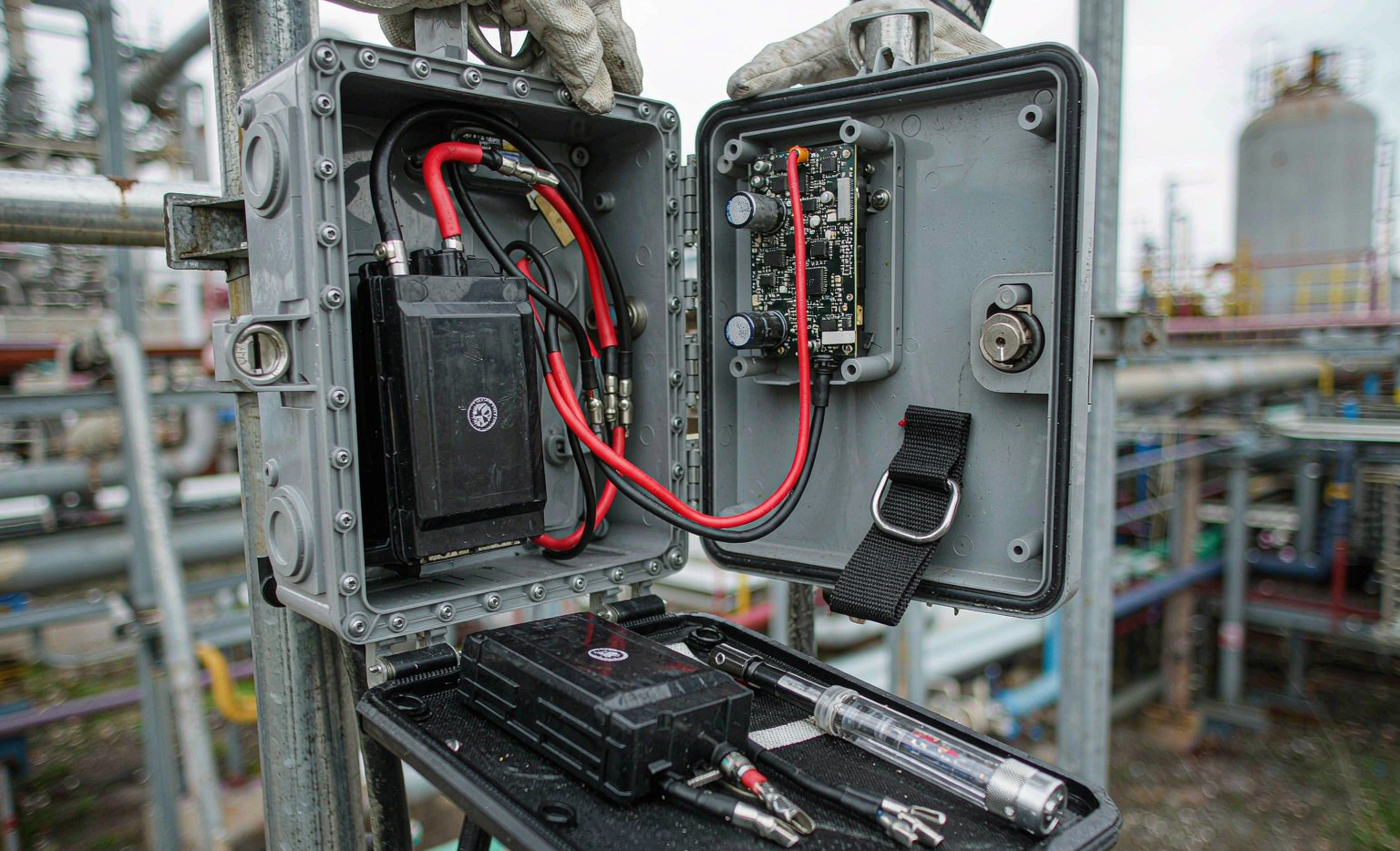
There is a second, more mundane hazard. Replacing a battery inside a classified area is itself a controlled activity. It requires the permit, the gas clearance where applicable, and in many facilities it requires the area to be de-energised. This is a strong argument for designing nodes so that the battery compartment can be changed as a unit with the enclosure remaining closed, and it is one of the reasons I push clients toward a custom battery solution with a sealed, keyed, certified replaceable module rather than loose cells in a holder.
Solar Rechargeable Nodes: The Winter Problem
Where nodes use a rechargeable lithium battery pack with a photovoltaic harvester, the maintenance picture changes completely. You no longer replace on capacity; you replace on cycle life and calendar life, and your dominant failure mode is energy starvation in the worst month of the year.
The design error I see most often is sizing the panel on annual average insolation. A node that averages surplus energy across twelve months will still die in December, because at mid-latitudes the worst month delivers a fraction of the best month and the load does not reduce to match. I size on worst-month insolation, with a derating for panel soiling of five to fifteen percent depending on the environment, and I require the system to hold a defined depth-of-discharge reserve through a run of consecutive worst-case days.
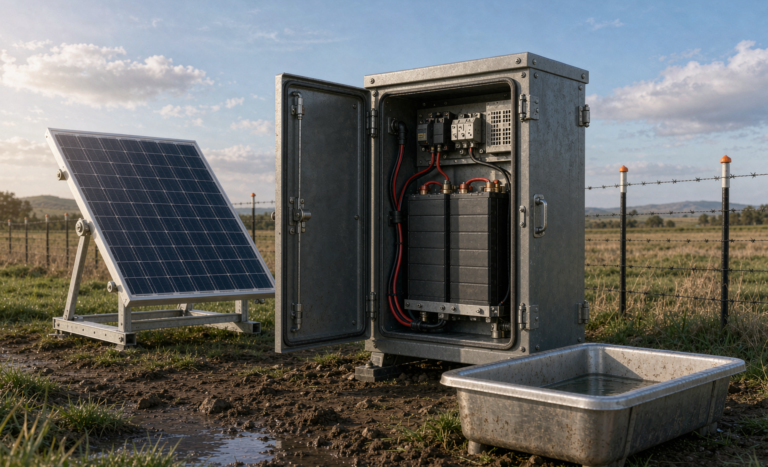
Maintenance then becomes largely about the harvester. Panels get dusty, bird droppings are a genuine outage cause, tilt and azimuth get changed by whoever last serviced the pole, and vegetation grows. On rechargeable nodes my field card puts panel cleaning and tilt verification ahead of anything electrical.
On the cell side, respect the chemistry. Lithium iron phosphate must not be charged below zero degrees celsius, and the recovery hysteresis should be set three to five kelvin above the cut-off so that the node does not chatter across the threshold on a cold morning. Where nodes operate in genuinely cold climates, a sodium-ion pack is worth evaluating: it retains a large majority of its room-temperature capacity at minus twenty degrees and accepts a modest charge current there, which deletes the heater, the contactor, the control loop and the parasitic load. That is a design decision, but it is a decision that eliminates an entire category of maintenance.
Spares, Storage, and the Van That Cooks Your Inventory
One of the most reliable sources of premature failure I have documented is not in the field at all. It is in the service vehicle. A van parked in summer sun reaches interior temperatures above sixty degrees, and a stock of rechargeable lithium cells stored at full state of charge in that environment for a season will arrive at the node having already lost a meaningful part of its life.
Store rechargeable spares at roughly forty to sixty percent state of charge, in a cool dry place, and rotate stock first-in first-out. Primary lithium cells are far more forgiving, with shelf lives commonly quoted at ten years or more, but they still belong in a temperature-controlled store rather than a hot vehicle.
On quantity, I size the spares pool from the dispatch model rather than from the node count. For a fleet on clustered dispatch, the pool needs to cover the largest planned cluster visit plus the expected emergency visits between resupply cycles, with a modest margin. For rechargeable packs in a newer chemistry I hold a slightly deeper pool than I would for a mature product, because the supply chain is less predictable.
Transport is the other half of the logistics problem. Lithium cells and batteries are dangerous goods. Air shipment requires the UN38.3 test summary, which has been mandatory to make available since 2020, correct packing instructions and, for lithium-ion cells shipped by air, a state-of-charge limit of thirty percent. Lithium metal primary cells fall under a different packing instruction with its own limits. Getting this wrong does not just risk a fine; it means your spares sit in a warehouse while the fleet degrades.
Firmware and Configuration: The Maintenance Nobody Schedules
When I ask a client what their maintenance plan covers, they describe batteries, enclosures and antennas. Almost nobody describes firmware, even though a single badly managed over-the-air campaign can cost more than a year of battery replacements.
The rules I specify are not complicated. Gate every update on a state-of-charge precondition, typically above seventy percent for a primary node and above fifty percent with the charger active for a solar node. Gate it on temperature as well, because a flash write during a cold morning on a depleted cell is exactly the combination that produces a brick. Stage the rollout: a small canary cohort first, then a pause to check telemetry, then the remainder in waves. Require an atomic update with rollback, so an interrupted write returns the node to its previous image rather than to nothing.
Configuration deserves the same discipline. Put the sampling interval, transmit power and sleep strategy under version control, and alert when a node’s configuration differs from the approved baseline for its class. The audit finding I mentioned earlier, a quarter of a fleet running an unapproved faster report rate, is invisible without that check, and it silently invalidates every forecast you make.
Data Hygiene: What to Keep, and Why It Decides Warranty Claims
The difference between a warranty claim that is paid and one that is argued for a year is usually the commissioning record. Keep, per node: the load-pulse baseline and the raw voltage trace behind it, not just the derived number; the coulomb counter calibration; the serial numbers of the cells installed; the torque audit; the insulation or contact-resistance measurement where applicable; and the installation photographs.
Keep the full telemetry history rather than a rolling window if you can afford the storage. When a node fails at fourteen months against a five-year design, the question is almost never “did the cell fail,” it is “what changed,” and the answer is in the trend: a step change in consumption after a date, a temperature profile that shifted when vegetation was cleared, a load-pulse series that degraded after a firmware push.
I also insist on one unglamorous practice: keep the failed parts. Bag them, label them with the node identity and the date, and retain them for at least the warranty period. More than once, the ability to hand a supplier a physical cell with an intact lot code has converted a disputed claim into a settled one.
When to Stop Maintaining and Start Redesigning
A maintenance programme that only replaces parts is a programme that never improves. I use two triggers to escalate from maintenance back to engineering.
The first is the battery-attributable visit fraction. If more than about fifteen percent of your dispatches are triggered by battery state rather than by another cause that happened to include a battery swap, the energy budget is wrong for the duty cycle and the design should be revisited. The usual fixes are a larger cell, a lower sleep current, or energy harvesting, and all three are cheaper than a permanent increase in the dispatch rate.
The second is the repeat-visit rate on the same node within twelve months. A well-executed swap should be a five-year event. If nodes come back, the cause is environmental or mechanical, and no amount of better batteries will fix it.
When the redesign happens, spend the extra effort on interface standardisation. A single mechanical footprint, a single polarised connector and a single certified cell family across every node generation means one spare SKU covers the fleet, one field procedure covers every visit, and the next generation can be deployed without retraining the crew. That is the practical value of a custom battery solution: not a marginally better cell, but a fleet where the maintenance system is simple enough that it actually gets followed.
What I Tell Clients at the Start of Every Programme
Three sentences, which I have repeated often enough that my colleagues can recite them.
Maintain the dispatch decision, not the cell. The cell is cheap, predictable and disposable; the visit is expensive, constrained and the real object of optimisation.
Measure the same way every time. A load-pulse protocol applied identically for years beats any clever estimator applied inconsistently, because maintenance runs on trends and trends require comparable data.
Write down what you did. The photograph, the torque mark, the recorded baseline and the retained failed part are what turn a maintenance programme from a cost centre into an engineering feedback loop.
Do those three things and the battery becomes the least interesting component in the network, which is exactly where it belongs.
Frequently Asked Questions
How often should sensor node batteries actually be replaced?
Rarely on a calendar, and never on a calendar alone. Use the predicted remaining capacity compared against the consumption until the next planned site visit, with a safety factor of about one and a half. In practice, on a well-designed primary-cell network with a five-year energy budget, that lands on five to seven years for indoor and temperate nodes and three to five years for nodes in hot enclosures or high-duty applications. Solar rechargeable nodes are replaced on cycle or calendar life of the lithium battery pack, commonly eight to twelve years for lithium iron phosphate, with the panel cleaned far more often than the pack is changed.
Can I use a higher-capacity cell of the same size to extend intervals?
Sometimes, and only after checking three things. First, pulse capability: a bobbin-type lithium thionyl chloride cell has low rate capability, and a network that transmits at high power on a weak cell will brown out regardless of nameplate ampere-hours. Second, certification: in a hazardous area the cell is part of the intrinsic safety assessment and a substitution invalidates it. Third, the self-discharge and temperature behaviour of the specific construction, because a spiral-wound cell trades shelf life for pulse power. I have seen “upgrades” shorten service life by two years.
Why do my nodes fail in summer and not in winter?
Heat, almost always. An enclosure in full sun can run twenty to thirty kelvin above ambient, and ageing rates roughly double for every ten kelvin. A cell that would give seven years at twenty-five degrees may give less than three at sixty-five. The fixes are unglamorous: relocate to a shaded aspect, use a light-coloured or reflective enclosure, add a radiation shield, improve ventilation or fit a hydrophobic breather vent, and re-evaluate the energy budget at the real operating temperature rather than at the temperature in the datasheet.
Is it worth switching to rechargeable lithium iron phosphate with solar?
It depends on the access pattern rather than the technology. Where visits are genuinely expensive, meaning remote sites, permit-controlled areas or confined spaces, harvesting converts a recurring dispatch into an occasional panel clean, and it pays back quickly. Where the node sits in a plant that technicians walk past daily, a primary cell with a ten-year budget is simpler, cheaper and more reliable, because it has no charge controller, no panel and no low-temperature charging restriction to manage. I have moved clients in both directions.
What should I do about cells that have been in service and still read full voltage?
Leave them alone. On a flat discharge curve, a healthy-looking open-circuit voltage tells you only that the cell is not yet on the cliff. Use the load-pulse trend and the coulomb counter, and replace on predicted time to threshold against the next access window. Replacing healthy cells because the calendar says so is the single most common source of waste I find in mature programmes.
Can I mix a fresh cell with a partially used one in a two-cell node?
No. In series, the weaker cell empties first and is then driven into reversal by the stronger one, and a reversed cell vents. In parallel, the two equalise at a rate limited only by their internal resistances, which is a heating event inside a sealed enclosure. Replace every cell in the pack as a set, and record the set as a single line item in the asset record.
Do I really need a UN38.3 test summary for shipping spares?
Yes. Making the test summary available has been a mandatory requirement since 2020, and carriers and inspectors do ask for it. You also need the correct packing instruction for the chemistry and, for lithium-ion cells offered for air transport, a state-of-charge not exceeding thirty percent. Lithium metal primary cells and lithium-ion rechargeable cells fall under different packing instructions with different limits, so do not assume one procedure covers both. Budget for this in the logistics plan, because a shipment held at a depot is a fleet that is quietly ageing.
How do I know when the problem is the installation rather than the battery?
Look at the repeat-visit rate and the contact measurements. If a node needs attention twice within a year, or if a cell holder or connector measures more than about fifty milliohms, or if there are water tracks at the gland, the battery was never the fault. In my audits, corrosion, thermal exposure and configuration drift together account for more replacements than genuine capacity exhaustion, and none of them are fixed by a better cell.