Sodium-Ion Battery Deployment for Forklifts
Introduction
The forklift fleet that taught me the most about industrial power was a 34-truck operation in a frozen food distribution centre outside Ningbo. Every truck ran a 48 V lead-acid pack of roughly 775 Ah, every pack was swapped twice a day, and the battery room was a 90-square-metre heated box with hydrogen detection, forced ventilation, acid spill containment and a wash-down floor. The maintenance manager’s real problem was not the electricity. It was the room, the water, the swap crew and the fact that every truck was out of service for twenty minutes twice a shift.
When we first quoted a lithium conversion for that fleet, the proposal failed for a reason that had nothing to do with chemistry: the trucks needed ballast. A counterbalance forklift is a stability machine, and the traction battery is a designed part of its counterweight. Remove 400 kg and the rated capacity at the load centre is no longer valid. That constraint is exactly where a sodium-ion battery becomes interesting, and it is why the last four years of my work on industrial motive power has moved steadily toward sodium.
This guide covers what I have learned specifying, commissioning and auditing sodium-ion battery deployment for forklifts — the sizing math, the mechanical and electrical integration, the standards that actually apply, the failure modes I have had to diagnose, and the numbers that decide whether a conversion pays for itself.
Why the forklift is a different engineering problem from every other battery application
Almost every battery brief I receive optimises for one thing: energy density. Grams per watt-hour, range per kilogram. A forklift inverts that priority completely. In material handling, mass is a specification, not a penalty.
A 2.5-tonne electric counterbalance truck is rated to lift a defined load to a defined height at a defined load centre, and that rating is proven on a stability rig against ISO 22915-series tilt tests with a battery of a defined minimum mass installed. The battery compartment is dimensioned, but it is also a ballast bay. Truck data sheets commonly specify both a maximum and a minimum battery weight, and some European manufacturers list tolerance bands as narrow as ±5%.
That single fact shapes the whole conversion:
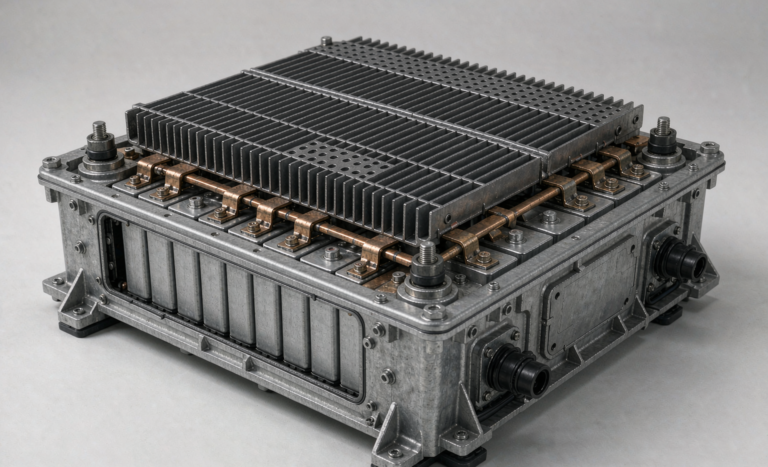
- Lead-acid traction batteries are heavy — a 48 V / 775 Ah pack typically lands between 1,100 and 1,350 kg including the steel tray. The mass is a feature.
- LFP replacements weigh roughly a third of that. Many conversions require bolt-on ballast plates to restore the truck’s stability rating, which eats the packaging advantage and adds a fabrication step.
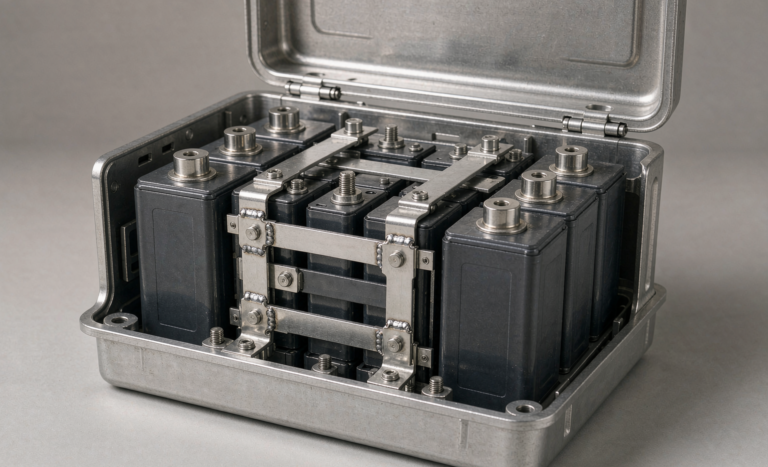
- A sodium-ion battery pack sits between the two. With cell-level energy density currently in the 100–160 Wh/kg band against 160–180 Wh/kg for LFP, the pack is naturally closer to the truck’s designed ballast mass.
The second difference is the environment. Material handling equipment lives in places that are hostile to batteries: freezer aisles at −25 °C, beverage plants that are hosed down twice a shift, fertiliser and salt warehouses with aggressive dust, ports with salt fog. A chemistry that charges at low temperature without a heater is not a convenience in those sites, it is the difference between one battery per truck and two.
Sizing the pack: duty cycle first, chemistry second
I refuse to quote a sodium-ion battery pack for a forklift fleet until I have seen at least ten working days of logged data per truck class. Nameplate capacity guesses are the single largest source of under-performing conversions. What I instrument:
- Energy per shift — integrate pack voltage × current over the shift. In high-throughput 3-shift distribution, a Class I counterbalance truck commonly consumes 18–32 kWh per shift; a Class III powered pallet truck in the same building may use less than 2 kWh.
- Peak and RMS current — hydraulic lift and tilt produce short 2–5 second pulses that are frequently 3–5C for the pack, while travel is more typically 0.5–1.5C. The pack’s continuous rating is sized off RMS; the BMS and contactor are sized off peak.
- Regenerative acceptance — trucks with regenerative braking or regenerative lowering return current to the pack. If the battery is cold, near full, or a chemistry that cannot accept charge at that temperature, the truck controller will derate or the mechanical brake will absorb the energy. This is where low-temperature charge acceptance stops being a datasheet curiosity.
- Dwell windows — how long each truck sits idle at breaks, shift handover and loading bays. Fifteen-minute windows at 1C are worth more than a full overnight charge on a three-shift site.
From the logged data I size to a simple rule: usable energy at end of specified life must cover 1.25 × the worst observed shift energy, with the depth of discharge capped at 90% for sodium-ion. Because sodium-ion cells tolerate deep discharge and can be stored and shipped at 0 V, the bottom of the window is far less fragile than with lithium, but I still hold 10% in reserve so drivers never see a truck that dies against a deadline.
On the cold-chain project I mentioned, the measured worst-case shift was 27.4 kWh on the freezers. The specified pack was 48 V nominal, 720 Ah — 34.5 kWh nameplate, roughly 31 kWh usable, giving 1.13× against worst case before the customer accepted an opportunity-charging window of two 20-minute breaks, which lifted the effective margin to about 1.5×. The trucks finished shift three at 35–40% SoC.
Mechanical and electrical integration: where conversions actually go wrong
Chemistry arguments are easy. The failures I get called about are almost never chemistry. They are interface failures, and there are six of them that recur.
1. Compartment dimensions and the ±3 mm problem
Battery compartments on European and Japanese trucks are built to DIN 43589-A and related envelopes, but published drawings and as-built steel differ, and a 20-year-old truck has been repaired. I now require a physical survey of at least one truck per model with a laser measure, including the height to the underside of the seat deck and the clearances at the roller rails, before any pack is fabricated. Design target is 3 mm clearance per side; anything tighter will bind once the truck frame flexes under load.
2. Ballast and the stability rating
Before delivery I ask the truck OEM or its authorised dealer for written confirmation of the minimum battery mass, and I have the pack ballasted to that figure as a hard design input. If the truck has an OEM lithium option, that option’s published weight is the safest target. Do not let a site engineer delete ballast to save money; the load chart becomes invalid and so does the insurance position.
3. Connectors and the pre-charge circuit
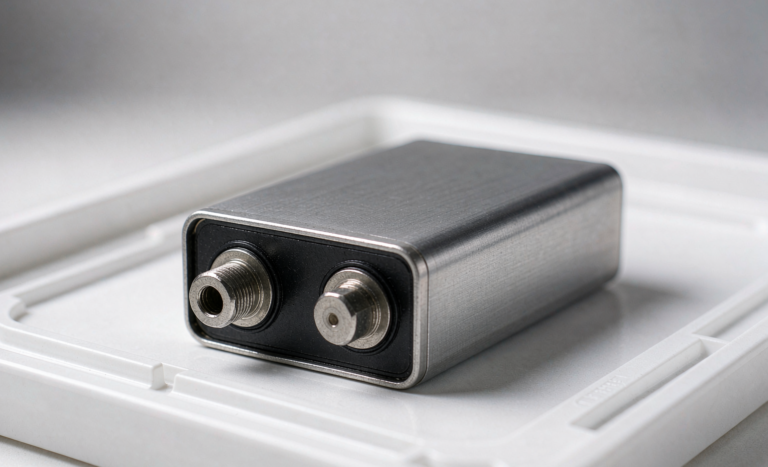
Most inrush failures are contactor welds. The truck controller has substantial input capacitance, and closing a contactor into it produces a current spike orders of magnitude above nominal. Every pack I specify includes a pre-charge path — typically a resistor of a few tens of ohms in parallel with a small pre-charge contactor, energised for 200–500 ms before the main contactor closes. Connector choice is equally unforgiving: SB175-class and DIN 43589 plugs are common, but I specify keyed, colour-matched, mechanically polarised connectors with a documented mating cycle rating, because a connector that lets a technician mate a 48 V pack to an 80 V truck is a lawsuit waiting to happen.
4. Charger compatibility
This is the most common budgeting error. Existing lead-acid chargers follow a multi-stage profile with an equalisation phase at voltages well above the safe maximum for sodium-ion. They cannot simply be reused. Either the site replaces chargers or it installs chargers that talk to the pack BMS over CAN and follow the pack’s requested voltage and current limits in real time. On a 30-truck fleet the charger line item is routinely 25–35% of the project cost, and hiding it in the quote is how conversions get cancelled after the pilot.
5. Telemetry and truck controller integration
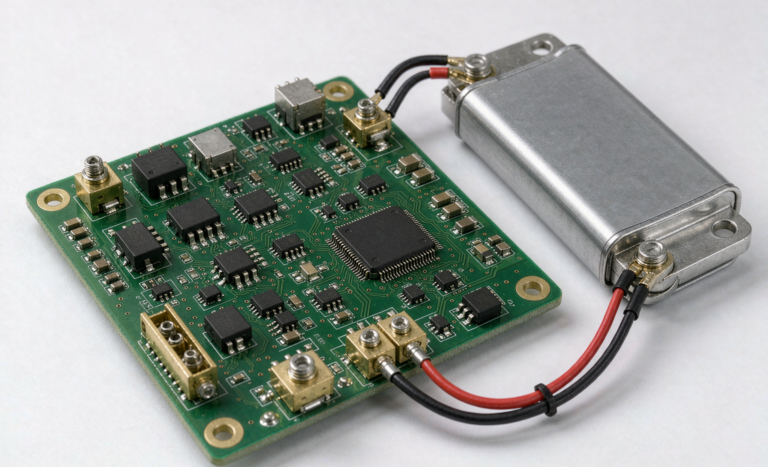
Sodium-ion cells have a slightly different open-circuit-voltage curve and a wider usable window than LFP, so the truck’s fuel gauge will lie unless it is recalibrated or the pack’s own SoC report is fed to the display over CAN. I insist on the pack BMS exposing SoC, SoH, pack temperature, cell voltage extremes and any latched fault over CAN or RS-485 in a documented message format, with the DBC or Modbus map handed to the customer at commissioning. Without it, nobody can diagnose a truck that keeps derating.
6. Ingress protection and the breather vent
IP66 is the practical minimum for anything that sees wash-down. But a sealed enclosure that cannot breathe will pull moisture in through its cable glands every time the pack cools after a shift and the internal pressure drops. Every pack I sign off carries a hydrophobic breather vent, and the vent is on the quarterly inspection sheet, because a blocked vent is a slow, invisible path to a corroded busbar.
Safety and compliance: the standards that actually apply
Sodium-ion is not a regulatory free-for-all, but the standards landscape is genuinely less settled than it is for lithium, and customers deserve to be told that plainly. In practice I certify at three levels.
Cell and pack level
Cells are sourced with a valid UN38.3 test summary — publicly available from the manufacturer since the 2020 revision made disclosure mandatory — and a CB certificate against IEC 62133-2, which is the general safety standard for sealed secondary cells and batteries for portable and, by extension, many industrial applications. Dedicated sodium-ion performance and safety standards are still progressing through IEC committees, so any supplier claiming a mature, fully harmonised sodium-ion IEC standard should be asked to produce the document number and date.
Installation and charging infrastructure
This is where the lithium-era standards do apply directly and where the savings are real. IEC 62485-3 covers safety requirements for traction batteries in industrial trucks, and EN 50272-3 covers the safety of battery installations for motive power. Lead-acid charging rooms exist because charging vents hydrogen; they need ventilation, gas detection and acid containment. A well-engineered sodium-ion installation with a compliant charger and BMS oversight removes the gassing source, and on more than one project I have seen the entire battery room decommissioned and released back to the warehouse as racking. That floor area is often worth more per year than the energy saved.
Truck level
The modified truck still has to meet ISO 3691-series safety requirements for industrial trucks and the electrical requirements in EN 1175-1, and for North American deployments UL 2580 is the pack standard most authorities having jurisdiction will ask for. A conversion that changes battery mass, connector type and charge profile without a documented reassessment against those documents is a compliance risk regardless of how well it performs on shift.
Where sodium-ion wins and where it does not
I am not going to tell a customer that sodium-ion is the answer to everything. Honest engineering means naming the limits.
It wins in cold chain. A sodium-ion battery can typically accept charge at −20 °C at 0.2–0.3C and deliver a high fraction of room-temperature capacity at that temperature. An LFP pack cannot be charged below 0 °C without a heater. In a −25 °C freezer, deleting the heater, the heater contactor, the control loop and the parasitic load that feeds it removes cost, failure points and warm-up time. It is the single strongest business case I have for the chemistry.
It wins on ballast match. As discussed, the pack mass lands closer to the truck’s design intent than LFP does, which simplifies the stability reassessment and can remove the ballast plate entirely.
It wins on transport and storage logistics. Sodium-ion cells can be safely taken to 0 V for shipment, which is categorically not true of lithium-ion, where IATA limits state of charge to roughly 30% for air freight and cells must never be fully discharged. For spares held in a container for six months, and for shipping prototype packs between factory and site, this removes a whole layer of dangerous-goods paperwork.
It also wins on supply-chain risk. Sodium is not subject to the same price volatility as lithium carbonate or nickel, and sodium-ion cells can use aluminium current collectors on both electrodes, avoiding copper entirely on the anode side.
It loses on energy density. In a truck where the compartment is tight and the ballast requirement is already met by the chassis, or in an automated guided vehicle with a hard mass ceiling, LFP still packs more kWh into the same box.
It loses on maturity. Field data on five-to-eight-year sodium-ion traction duty is thinner than it is for LFP. I mitigate that by specifying a cell cycle-life warranty written against the application profile — depth of discharge, ambient temperature band and charge rate stated explicitly, not a generic “3,000 cycles” claim — and by requiring cell traceability to the production lot.
Commissioning and the maintenance regime I hand over
A conversion is not finished when the truck drives. The handover package I insist on, and the schedule that keeps the fleet honest:
- Commissioning baseline — full-charge capacity test, DC internal resistance per module, insulation resistance, torque audit on every busbar and terminal to the specified value with a calibrated wrench, and a thermal image of the pack under a full-load lift. That baseline is the reference for every future warranty discussion.
- Quarterly — visual and gland inspection, breather vent check, connector wear and mating inspection, insulation resistance test, firmware version audit against the approved baseline.
- Annually — capacity verification against the commissioning baseline, cell balance review, full torque re-audit, and a review of the charger event log for repeated temperature or voltage cutbacks.
- Data discipline — retain per-truck charge and discharge logs for the full warranty period, keyed to pack serial number. When a customer calls about a truck that “has always been weak,” the third-shift current trace is what settles it.
- Failed parts retention — bag, label and store every replaced module with its lot code for the full warranty term. I have turned two contested warranty claims into same-day closures with nothing more than a stored part and a good logbook.
On the Ningbo fleet, the first-year numbers were a 41% reduction in energy cost per pallet moved, elimination of the watering contract, and — the number the customer actually cared about — recovery of roughly 21 minutes of truck availability per shift across 34 trucks once battery swapping stopped.
FAQ
Can a sodium-ion battery replace lead-acid in my forklift without modifying the truck?
Mechanically, usually yes — packs are built to the DIN 43589-A envelope of the tray being replaced. Electrically, almost never without work. The charger must be replaced or reprogrammed, the truck’s SoC display must be recalibrated or fed from the pack BMS, and the pack must be ballasted to the truck manufacturer’s stated minimum battery mass so the stability rating stays valid.
How long does a sodium-ion forklift battery last?
Currently available cells are typically warranted for 2,000–6,000 cycles depending on depth of discharge and temperature, which on single-shift duty is comfortably eight to ten years. Insist that the warranty states the duty profile it was written against, not a bare cycle count, and require the pack BMS to report state of health so you can verify it.
Is sodium-ion safe in a −25 °C freezer warehouse?
It is the strongest use case for the chemistry. Sodium-ion cells retain a high fraction of room-temperature discharge capacity at −20 °C and, critically, can accept charge at reduced rate at that temperature, so the pack heater and its control hardware can be deleted. The enclosure still needs IP66 sealing, a hydrophobic breather vent and a condensation-management review of the cable glands.
Does sodium-ion work with my existing lead-acid charger?
No. Lead-acid chargers use multi-stage profiles with an equalisation voltage far above the sodium-ion maximum, and running one against a sodium-ion pack is how packs get destroyed in the first month. Budget for replacement or BMS-communicating chargers; on a 30-truck fleet that is typically 25–35% of project cost.
How does sodium-ion compare with LFP for forklifts?
LFP has higher energy density and a much longer field history. Sodium-ion is heavier, which helps where the battery is part of the counterweight, charges at sub-zero temperatures without a heater, can be transported at 0 V, and is not exposed to lithium price volatility. For cold chain, multi-shift operations with opportunity charging, and fleets that want to decommission a lead-acid charging room, I now recommend sodium-ion as the default.
What certifications should I require from a sodium-ion battery supplier?
At minimum: a UN38.3 test summary for the exact cell, IEC 62133-2 cell safety certification, pack-level documentation against IEC 62485-3 and EN 50272-3 for the installation, and — for North America — UL 2580 for the pack. Ask for cell traceability to production lot and a written statement of which sodium-ion-specific standards the cells were tested against, since the dedicated IEC sodium-ion series is still being finalised.
Should I convert the whole fleet at once?
No. Convert one truck per class, instrument it for at least eight weeks, and compare measured energy per shift against the logged baseline before committing. On the Ningbo project the pilot found a charger-derating issue on the freezer trucks that would have affected the entire fleet had we gone straight to full rollout.