Lithium Battery Deployment for UPS Systems
Over the last decade I have signed off on lithium battery deployment for UPS systems in facilities ranging from a two-cabinet edge closet to a multi-megawatt colo hall with four separate UPS plants. The pattern is always the same: the chemistry decision gets all the attention, and the deployment decision — the part that actually determines whether the estate is more reliable on Friday than it was on Monday — gets a spreadsheet and a purchase order.
A lithium battery swap in a live data center is not a procurement event. It is a construction and commissioning program executed inside a facility where the cost of an unplanned outage dwarfs the cost of the batteries by two or three orders of magnitude. This article is the deployment playbook I hand to a project team before the first cabinet lands: how to baseline what you actually have, how to size what you actually need, how to reconcile a modern lithium string with a UPS that was designed around valve-regulated lead-acid (VRLA), how to run the cutover without betting the facility, and how to prove at acceptance that the runtime you bought is the runtime you got. Along the way I will point out the specific traps that turn a two-week project into a six-month one.
Deployment Is a Different Discipline From Integration
Teams routinely collapse these two, and the confusion is expensive. Integration is the electrical, mechanical and protocol question: does this lithium battery pack close into the DC bus, does it fit the room, does its BMS speak to the DCIM. Deployment is the program question: in what order do we touch two hundred sites, who signs the method of procedure, what happens when the third site’s floor loading turns out to be 40 % below the nameplate, and how do we prove at handover that the strings will carry the load.
Integration is a prerequisite. Deployment is where projects fail. A perfectly integrated cabinet that arrives three months late because nobody booked a hazmat-trained carrier, or that fails its acceptance discharge because the legacy rectifier was never re-programmed, is a deployment failure — and those are the failures I see.
Step 1: Baseline the Estate Before You Buy Anything
The single most valuable week in the whole program costs nothing but labour: measure what you have. Most facilities have a battery inventory document that is optimistic by several years, and an assumption about load that is wrong by a factor of two.
Run a capacity test on every VRLA string to the discipline of IEEE 1188 for VRLA (or IEEE 450 for vented cells), discharging to 1.67 V/cell while logging individual unit voltages. Record a conductance or impedance baseline at the same time. The conventional replacement trigger is a string falling below 80 % of rated capacity, and in a typical estate of any age you will find 20–40 % of strings already there or close. That is your real replacement urgency, and it is what justifies the project — not a vendor’s TCO slide.
Then measure the load. Walk the plant with a clamp meter at the UPS output and at each distribution panel. Data centre UPS modules are very commonly loaded at 20–40 % of nameplate because they were sized for a build-out that never happened or for a redundancy scheme that changed. If your 500 kVA module is carrying 140 kW, the battery requirement is completely different from what the original design brief assumed, and any lithium deployment sized off that brief is buying runtime nobody needs.
Step 2: Right-Size the Runtime Requirement
With measured load in hand, write down the requirement in three numbers: required minutes at measured kW, growth allowance over the plan horizon, and redundancy topology (N, N+1, 2N, or distributed redundant). Then resist the urge to replace amp-hour for amp-hour.
Lithium changes the sizing arithmetic in two directions. On one hand it is far better at high-rate delivery: LFP cells in a purpose-built UPS battery routinely sustain 3–5C for a 5–15 minute discharge, where VRLA blocks are already heavily derated by Peukert behaviour at those rates. A 15-minute VRLA string and a 15-minute lithium string are not the same physical size, and the lithium one will be smaller. On the other hand, if you specify the same amp-hour capacity you will pay for energy you cannot use in a 10-minute window.
In practice, on the estates I have worked, honest right-sizing lands between 25 % and 45 % lower than a naive like-for-like swap once measured load replaces design load. That is real money, but it must be signed off by whoever owns the resilience policy, and the growth allowance has to be documented — a battery room sized to today’s load with no headroom is a problem you will meet again in year three.
Step 3: Reconcile the Lithium String With a Legacy VRLA UPS
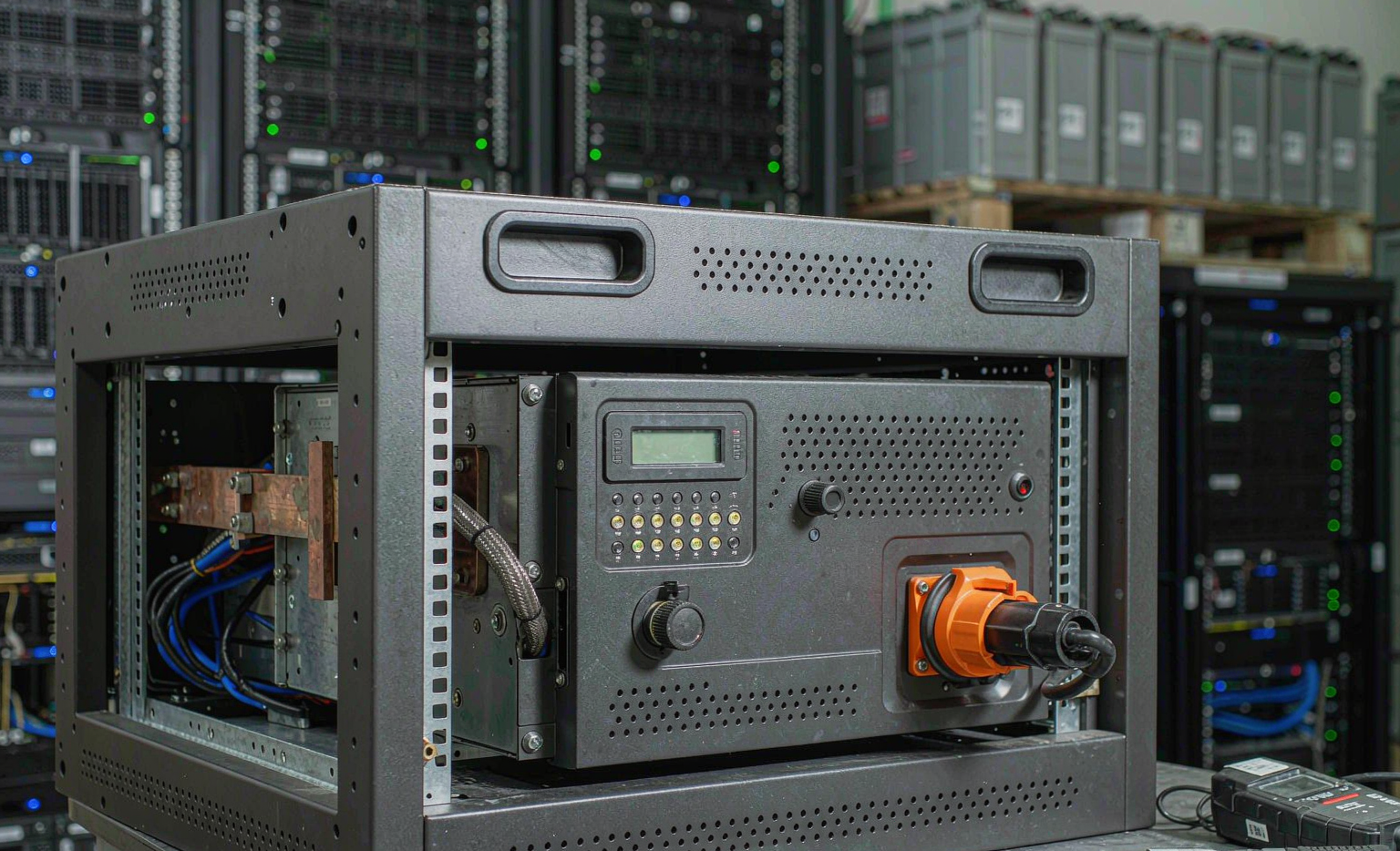
This is where most of the engineering time goes, and where the surprises live. Your UPS was designed around a 240-cell VRLA string on a nominal 480 V DC bus. A lithium string has a different voltage curve, a different charging philosophy, and a contactor that will open without asking permission.
Float voltage and temperature compensation
A VRLA string floats at roughly 2.25–2.30 V/cell at 25 °C, which is about 540–552 V on a 240-cell string. An LFP string of 150 cells in series gives the same 480 V nominal (150 × 3.2 V), but it does not want to sit at 3.65 V/cell indefinitely. The float setting I specify for LFP is typically 3.40–3.45 V/cell — around 510–518 V on that string.
Two checks before you commit. First, can the UPS charger actually be set that low? Some legacy machines have a hard floor on the float setting. Second, and this catches people constantly: disable temperature-compensated float charging. VRLA chargers apply roughly −3 mV/°C/cell. Applied to a lithium string that compensation has no physical justification and simply drives the pack to a different SoC as the room cycles seasonally. I have found lithium strings sitting at 100 % SoC in a 32 °C battery room for months because nobody turned this off.
Recharge current and ripple
Legacy rectifiers were sized to recharge a VRLA string in 8–10 hours. Lithium will happily accept 0.5C or more, so the rectifier, not the battery, becomes the limit. If the business case assumes a one-hour recharge after an event, verify the rectifier can deliver it — usually it cannot, and the honest answer is that you accept a 3–5 hour recharge or you fund a charger upgrade. Be explicit about this in the design; it is a genuine resilience difference between two sites that look identical on a datasheet.
Ripple deserves a specific test. Older six-pulse and twelve-pulse SCR rectifiers put meaningful AC ripple on the DC bus. VRLA does not care. A lithium BMS measures current and voltage continuously and will trip on ripple outside its envelope, or worse, will silently heat the cells. Measure ripple voltage and current at the battery terminals under load before procurement, and put the number in front of the lithium battery manufacturer for written confirmation of compatibility.
End-of-discharge and BMS disconnect behaviour
VRLA sags gradually to 1.67 V/cell and the UPS decides when to shut down. A lithium string holds a flat voltage and then the BMS opens the contactor at its own undervoltage threshold, abruptly. If that threshold is below the UPS input window, the UPS sees a step change to zero volts rather than a battery-end-of-discharge alarm, and the shutdown may not be graceful.
Specify the BMS disconnect threshold to sit above the UPS’s minimum DC input, with margin, and agree the sequencing: the BMS should signal “reserve exhausted” to the UPS or the DCIM with enough lead time for a controlled shutdown, not simply drop out. Test this in the factory or on the bench. It is a two-hour test that prevents a class of outage nobody recovers from quickly.
Ground-fault detection and bus topology
VRLA systems frequently have a grounded or midpoint-referenced DC bus and a ground-fault detection circuit that injects or measures a small signal. Lithium packs are usually floating with their own insulation monitoring device. Two monitoring systems on one bus will disagree, and a lithium pack with significant Y-capacitance may read as a permanent ground fault to the legacy detector. Decide which system owns ground-fault detection, and disable or re-range the other during commissioning — with the decision documented, because it is a safety function.
Step 4: Physical Deployment — Floor, Seismic, Thermal
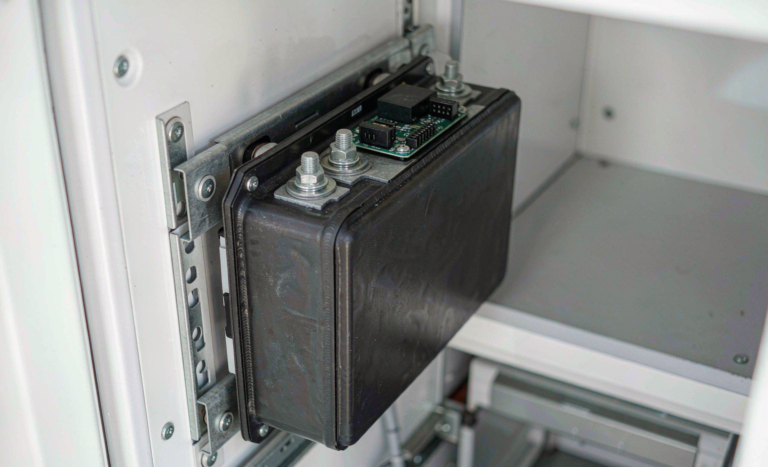
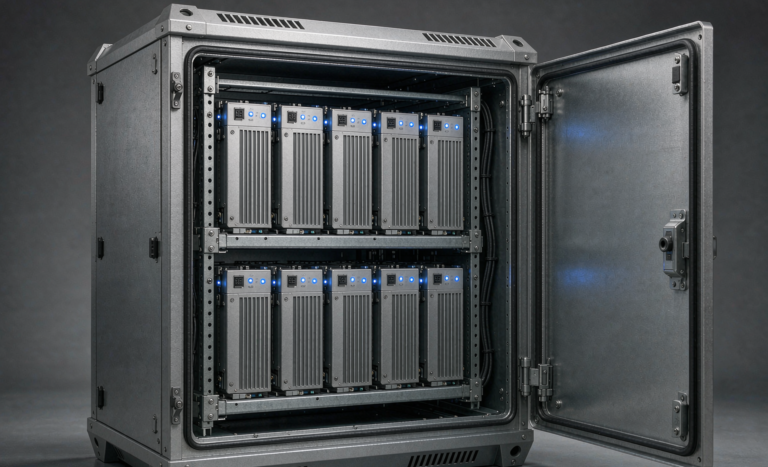
Lithium is dramatically lighter and smaller for the same duty, and that changes what is possible. Typical outcomes across projects I have run: 40–70 % weight reduction and 50–70 % floor-space reduction for equivalent runtime. In a raised-floor facility or an upper-floor plant with a 12–15 kN/m² slab limit, this converts “structurally impossible” into “straightforward”. Confirm the actual slab rating and the route from loading dock to battery room before you ship — elevator capacity and door widths end more deployment schedules than any electrical issue.
Seismic is non-negotiable and jurisdiction-specific: anchorage is designed to the applicable building code and its seismic provisions, and the equipment must be certified or evaluated for the site’s design category. Get the anchorage calculations stamped and inspected; this is one of the few items where a shortcut is genuinely dangerous.
Thermally, lithium gives you options VRLA did not. VRLA life roughly halves for every 8–10 °C above 25 °C, which is why battery rooms are kept cold. LFP tolerates a much higher continuous ambient, and industry guidance such as the ASHRAE data-centre thermal classes recognises IT equipment operating envelopes well above 25 °C. Raising the battery room setpoint from 22 °C to 30 °C is a real cooling saving, but only claim it after confirming the specific product’s rated operating range — some lithium UPS cabinets are rated to 40 °C, others to 35 °C with derate, and the difference matters.
Step 5: Plan the Critical Path Around Hazmat Logistics
Lead-acid blocks ship as non-spillable batteries under UN2800 and turn up on a normal truck with a stocked distributor. Lithium does not. Standalone lithium batteries ship as UN3480 under the UN Manual of Tests and Criteria, with a valid UN 38.3 test summary that must accompany the consignment and be available to the carrier and the authority having jurisdiction. Air freight is generally restricted to around 30 % state of charge.
The schedule consequences are real: hazmat-trained packing and documentation, possible sea or ground routing instead of air, and a customs and dangerous-goods paperwork chain that can add weeks. Add to that a manufacturing lead time that is typically in the 12–20 week range for engineered cabinets, versus “on the shelf” for commodity VRLA. If your deployment plan does not have lithium logistics on the critical path from day one, it is not a plan.
Compliance on arrival matters too. Stationary lithium installations are covered by IEC 62619 for industrial secondary lithium cells and batteries, with installation safety addressed by IEC 62485-5, and in North America by UL 1973 for the battery and UL 9540 / UL 9540A for the energy storage system and its thermal runaway propagation characteristics. Installation is governed by NFPA 855 and, for IT environments, NFPA 75. Have the UL 9540A report in the submittal package — the fire marshal will ask for it, and a project that reaches the inspection stage without it loses weeks.
Step 6: The Cutover — Never Parallel Old and New
The question I get asked most often is whether we can run the new lithium string in parallel with the existing VRLA to de-risk the change. The answer is no, not as a steady-state configuration, and the reason is physics.
Lithium has a much flatter voltage curve and far lower internal resistance than VRLA. On a shared DC bus during discharge, the lithium string will deliver the overwhelming majority of the current while the VRLA contributes very little — you have bought a parallel string that does almost nothing. Worse, at rest the two chemistries sit at different open-circuit voltages for the same nominal string voltage, and that mismatch drives circulating current between them.
The method of procedure I use is a sequenced transfer, not a parallel run:
- Install, torque and mechanically complete the lithium string on its own breaker, physically isolated from the DC bus.
- Commission it fully — charge, balance, communications, alarm simulation — before it ever sees the bus.
- Confirm the UPS is on a known-good source and that a temporary generator or a second UPS path is available for the window.
- Transfer: open the VRLA string breaker, close the lithium breaker, verify string voltage and current under load, confirm the UPS reports battery-present and charger-active.
- Verify a short discharge at the new string before declaring the window closed — even 60 seconds at load tells you the contactors hold and the sag is as predicted.
- Keep the VRLA string de-energised but in place until the lithium has passed its acceptance test, as a physical rollback.
Write the MOP for the worst site, not the best one. Every cutover should have a named rollback point and a decision-maker in the room with authority to use it.
Step 7: Commissioning Tests That Actually Prove Something
A deployment is not finished when the cabinets are bolted down. The acceptance protocol is what converts hardware into a resilience claim, and it should be written before the first cabinet ships.
- Mechanical and torque verification. Every busbar joint and terminal to the manufacturer’s specified value with a calibrated torque wrench, documented per bolt. Use the manufacturer’s value, not a generic table; a loose DC joint at several hundred amps is a fire.
- Insulation resistance — with a caveat. Meggering a lithium pack is a known way to destroy it. High test voltages can damage BMS semiconductors, and the pack’s EMI filter capacitance will read as leakage. Only test using the manufacturer-approved method, usually with electronics isolated, and never exceed the stated dielectric rating.
- Polarity, string voltage and module balance. Confirm every module SoC is within the specified delta before closing the contactor; a large spread on day one is a manufacturing or storage problem, not a commissioning one.
- Communications and alarm simulation. Poll every register, then deliberately create a fault — pull a module sense lead, open a door interlock, trip a breaker — and confirm the alarm reaches the DCIM with the right text and a usable timestamp. An alarm that arrives as generic “battery fault” is useless at 3 a.m.
- Recharge time test. After a discharge, time the actual recharge to 95 % SoC and compare it to the design assumption.
- Runtime verification. A full-load discharge to end-of-discharge is the only unambiguous proof, and it is expensive in risk and window time. A defensible alternative is a partial discharge — 30–50 % depth at measured load — extrapolated with the manufacturer’s temperature-corrected discharge tables, anchored to the measured cell voltages. Do the full discharge at least once per site archetype in the pilot phase, then rely on trending for the fleet.
- Thermal imaging under load. Scan every terminal, busbar and contactor during and after discharge. A connection running more than about 10–15 K hotter than its neighbours at the same current is actionable. Re-torque after the first thermal cycle.
Step 8: Baseline, Alarm Mapping and Monitoring Onboarding
The day you commission is the only day you will ever know the pack’s true beginning-of-life condition. Capture it: DC internal resistance per module at a defined SoC and temperature, minimum and maximum cell voltage, cell delta in millivolts, module temperatures at a known ambient, and full charge/discharge energy at a stated rate.
That baseline is what makes every future measurement meaningful. A DCIR that has grown 25–30 % from baseline is a story; the same absolute number with no baseline is a number.
Define the minimum telemetry set your DCIM must poll: string voltage and current, SoC, state of health, maximum and minimum cell voltage, cell delta, at least two temperature points per cabinet, contactor state, and alarm codes with parameter snapshots. Event data wants 1 Hz or better; trend data at one-to-five minute resolution is plenty for the whole estate.
One more item that is now standard in my specifications: network segmentation. Battery telemetry belongs on a managed, segmented network with credentials changed from default. A BMS with a web interface on the flat corporate network is an attack path into facility infrastructure, and this comes up in every serious enterprise security review.
Step 9: Spares and the SoC-Matching Trap
Lithium changes the spares model. With VRLA you replace whole strings. With lithium you replace modules — and the failure mode that catches teams out is state-of-charge mismatch.
A spare module sitting at 100 % SoC dropped into a string at 50 % will exceed the pack’s cell-delta limit, and passive balancing currents of a few hundred milliamps will take an impractically long time to close a 30 Ah gap. The result is a cabinet that runs in a protective derate for weeks.
My standing rule: store spare modules at 30–50 % SoC in a 10–25 °C space, re-check them every six months, and pre-condition the spare to within about 5–10 % SoC of the string before insertion. Also match internal resistance to the string within roughly 20–25 % — a module that is electrically very different from its neighbours will always be the one that trips. Stock roughly one spare module per cabinet or about 5 % of the fleet, whichever the supplier’s lead time justifies.
Step 10: Decommissioning VRLA and Closing the Loop
Nobody budgets this and everybody regrets it. Lead-acid recycling is a mature, well-regulated stream with high material recovery and, in most markets, positive residual value — the removal may partly pay for itself. End-of-life lithium is the opposite: collection and recycling infrastructure is still scaling, transport of spent or damaged lithium is itself a dangerous-goods operation, and in many regions the disposal is a net cost rather than a credit.
Price the removal, the transport and the recycling documentation before the project is approved, and get written confirmation from the recycler about what documentation you receive for your ESG reporting. It is not a large number compared to the batteries, but it is a number that appears late and unbudgeted.
The Economics of a Phased Deployment
Lithium capital cost for equivalent duty typically runs 1.5–2.5× VRLA. The justification is service life and operating cost, and it only holds if you stop counting replacements: over a 12-year horizon a VRLA estate commonly consumes two to three string replacements, each with its own outage windows, disposal and labour, while a single LFP installation is designed to run the whole period.
Layer on the elimination of most routine impedance and capacity rounds, the floor space returned to revenue-generating use, the weight and structural savings, and the cooling allowance from a higher permitted ambient, and the comparison usually moves decisively. What it never justifies is a big-bang rollout.
The cadence that works: pick one or two representative but non-critical pilot sites, run them through the full protocol, monitor for 60–90 days, then fix the deployment template — one site-readiness checklist, one bill of materials, one MOP, one commissioning report format. After that, roll at a pace the operations team can genuinely absorb, typically two to four sites a month. The template is the deliverable; the first site is where you pay to build it.
When a Standard Cabinet Is Not Enough
Most sites are served by a catalogue product. The situations that push a project into a custom battery solution are specific and worth recognising early, because a custom battery pack design cycle adds lead time:
- A legacy UPS whose float voltage cannot be set low enough for the chemistry — solved by changing series count, or by a DC-DC interface, not by hoping the BMS copes.
- Physical constraints that the product range does not fit: restricted loading dock, low elevator capacity, a room dimension or a slab rating that rules out the standard cabinet.
- Environment beyond catalogue ratings — sustained ambient above 40 °C, high altitude with reduced convection, or a corrosive or washdown industrial atmosphere.
- Seismic design categories at the top of the range, or a specific approval regime such as railway or marine.
- A DCIM or BMS protocol the standard gateway does not speak, where integration must be closed-loop rather than alarm-only.
- Runtime requirements long enough that module-level thermal behaviour, not cell energy, becomes the design driver.
When two or more of those apply, bring the lithium battery manufacturer into the design early. It is much cheaper to change a drawing than a delivered cabinet.
One note on chemistry selection, since it comes up in every steering committee. LFP is the default for stationary UPS: long cycle and calendar life, strong thermal behaviour, and a voltage that matches legacy 48 V and 480 V architectures cleanly. NCM buys energy density where space is genuinely constrained, at some cost in life and thermal margin. sodium ion battery technology is appearing in stationary designs where low-temperature charging and material cost matter more than volumetric density. semi-solid state battery designs promise higher energy in the same envelope but are not yet the conservative choice for a facility whose resilience policy depends on a proven field history. Choose based on the duty cycle you measured in Step 1, not on what is newest.
The good news for anyone running a multi-chemistry portfolio is that the platform work is shared. The cells and BMS logic we qualify for high-rate drone battery packs and for residential home energy storage cabinets are validated against the same core abuse tests — UN 38.3 for transport, IEC 62619 for stationary safety, IEC 62133-2 for the cell-level standard — so a supplier with a mature lithium ion battery qualification programme is not starting from zero on your UPS programme.
Frequently Asked Questions
Can we run lithium and VRLA strings in parallel during the cutover?
Not as a steady-state arrangement. The lithium string’s flatter curve and much lower internal resistance mean it carries nearly all of the discharge current, and the open-circuit voltage mismatch drives circulating current at rest. Use a sequenced transfer with the VRLA retained in place as a rollback, not a parallel run.
How long does a lithium battery deployment for UPS systems actually take per site?
Once the template exists, the on-site work is usually days: mechanical install, termination, commissioning and a verification discharge. What dictates calendar time is manufacturing lead time — commonly 12–20 weeks for engineered cabinets — plus hazmat logistics. Plan the critical path around those, not around the installation.
Do we still need to capacity-test lithium strings every year?
Less often, and differently. What you must do continuously is watch the trend data: cell delta, DCIR per module against the commissioning baseline, and temperature. A periodic verification discharge — annually or biennially depending on your policy — validates the trend, but the trend itself is the monitoring instrument. Impedance rounds as a substitute for understanding are a VRLA habit worth unlearning.
Will the existing UPS charger work with a lithium string?
Usually, with programming changes. Verify three things in writing: that the float voltage can be set to the chemistry’s recommendation, that temperature-compensated charging can be disabled, and that the DC ripple at the battery terminals is within the BMS envelope. Recharge speed will be limited by the legacy rectifier, not the battery.
What is the biggest schedule risk in a multi-site rollout?
Logistics and paperwork. Hazmat classification, the UN 38.3 test summary, carrier acceptance and the UL 9540A documentation for the authority having jurisdiction all sit on the critical path. Sites also fail on access — dock height, elevator rating and door width — far more often than on anything electrical.
How do we prove the runtime we bought is the runtime we get?
At least once per site archetype, run a full-load discharge to end-of-discharge during the pilot phase. For the rest of the fleet, a partial discharge of 30–50 % depth at measured load, extrapolated using temperature-corrected manufacturer discharge tables and anchored to measured cell voltages, is defensible — provided you captured a proper commissioning baseline.
Is it safe to megger a lithium battery string?
Only by the manufacturer’s stated method. Test voltages appropriate for a lead-acid string can destroy BMS electronics, and the pack’s filter capacitance makes the reading look like leakage. If an insulation test is required, do it with the electronics isolated and within the specified dielectric rating.
What should we do with the removed VRLA blocks?
Recycle them through a licensed lead-acid recycler, and budget the job properly before project approval. Unlike lithium, lead-acid recycling is mature and generally carries positive residual value, but the transport and documentation still need planning.