Home Energy Storage Maintenance for Apartments
I have spent the last twelve years designing and servicing lithium battery systems, and I will say this plainly: home energy storage maintenance apartments require a different discipline than the same hardware in a garage or a farm shed. An apartment is a confined, shared, code-sensitive space. The battery lives close to your family’s sleeping rooms, the ventilation is poor, and your neighbors share a wall with it. In my service work I have opened apartment cabinets that were two years old and internally spotless, and others of the same age with dust-clogged filters, loose terminal torque, and a battery management system (BMS) that had never received a firmware update. The difference was never luck; it was a service routine. This playbook is that routine, built from commercial inspection logic and scaled down to what a resident can safely do and what a technician must do.
Why Apartment Installations Need Stricter Maintenance Than Houses
A house system usually sits in a garage with several square meters of air volume around it. An apartment cabinet often sits in a closet of half a cubic meter, sometimes beside a kitchen, sometimes on an enclosed balcony. That confinement changes three things that drive maintenance decisions.
First, thermal load. A 10 kWh lithium iron phosphate (LFP) battery cycling daily dissipates roughly 2 to 4 percent of throughput as heat. In open air that is nothing. In a sealed closet the ambient can drift 8 to 12 °C above room temperature on a summer afternoon, and every sustained 10 °C increase roughly doubles the calendar aging rate of the cells. I have pulled packs from unventilated closets that had lost 15 percent capacity in two years while identical units in ventilated rooms lost 5 percent. The battery did not fail; the installation starved it.
Second, clearance and fire compliance. Standards such as UL 9540A test data reviews and NFPA 855 guidance exist to keep thermal events survivable. In a single-family garage you have latitude. In an apartment building, your property manager and your insurer care deeply about clearances, non-combustible mounting surfaces, and smoke detection. Maintenance is how you keep the installation in the state it was approved in — clearances do not erode on their own, but storage boxes, laundry racks, and stacked cardboard migrate into that space within months if nobody checks.
Third, access and shared walls. An apartment balcony cabinet sits one gesture from a neighbor’s window and one floor slab above someone’s ceiling. Coolant leaks are rare on LFP systems, but a failed AC connection, a scorched conduit, or a tripped breaker nobody notices for weeks is a shared-building problem. Frequent, lightweight inspections catch those issues while they are still cheap.
The Apartment Owner’s Monthly Routine: Fifteen Minutes, No Tools
You do not need to be an electrician to run the monthly layer of maintenance. You need fifteen minutes and your eyes and ears. This is the checklist I give residents:
- Clearance check. Confirm at least 150 mm of free air above and around the cabinet, and that nothing combustible — cardboard, fabric, paper — sits within 900 mm. This mirrors the clearance logic of NFPA 855 and is the single highest-value item on the list.
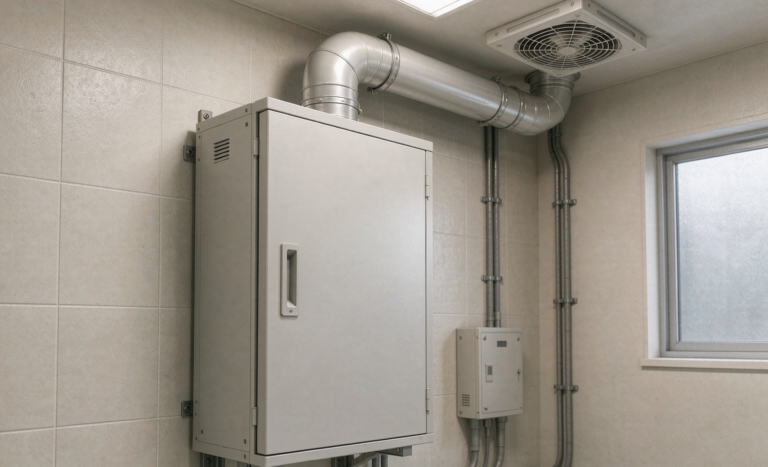
- Ventilation path. Wipe the intake louvers with a dry cloth. If your closet has an exhaust fan, verify it actually runs; a dead fan is the most common root cause I find behind accelerated aging.
- Visual inspection. Look for discoloration on the enclosure, any bulge in the case, residue or dust trails near terminals, and corrosion (a green-white bloom) on exposed connectors. Photograph anything unusual so you can compare next month.
- Listen. A healthy system is silent except for occasional contactor clicks and fan noise. Continuous buzzing from a relay, or a fan that never stops, is an early fault signature.
- App review. Open the monitoring app. Record the pack voltage, state of charge (SoC), and the day’s charge and discharge energy. A two-minute note per month builds the trend history that makes diagnosis possible later.
- Indicator lights. Confirm the status LEDs match the documented normal state. A solid amber “derated” lamp that has been on for a month tells you the system is quietly limiting itself, usually for temperature.
That last point deserves emphasis. Modern LFP home batteries fail slowly and communicate their problems in data long before they fail loudly. The resident who keeps a twelve-month trend history gives the service technician exactly what is needed to distinguish a BMS calibration issue from genuine cell degradation.
The Quarterly Technician Visit: What a Professional Should Check
Twice to four times a year — I recommend quarterly for the first year, then semi-annually if the trend data is boring — a qualified technician should open the system. My field procedure covers five areas.
Terminal torque and connection resistance. Thermal cycling works terminals loose. We re-torque DC power terminals to the manufacturer’s specified value (typically 8 to 15 N·m on busbar bolts for residential modules) and log each value. On systems with accessible sense harnesses, we verify connector seating. A loose sense wire causes voltage-sampling errors that masquerade as cell imbalance.
Cell voltage balance and DC internal resistance (DCIR). With the pack resting, we record per-cell voltages. In a healthy LFP pack the spread should sit below about 50 mV at rest; more than 100 mV justifies a work order. Where the BMS exposes it, we capture DCIR at a defined SoC and temperature and compare against the commissioning baseline. A DCIR increase of 25 percent or more over baseline is the earliest quantitative signature of real aging — an absolute number means nothing without that baseline, which is why we always leave one behind at installation.
Capacity verification. Once a year we run a controlled deep cycle: full charge with an absorption window, then a timed discharge at a moderate rate with temperature logged. The result should stay at or above 80 percent of nameplate within the warranty window. For apartment systems we often run this overnight to avoid disturbing daytime solar harvesting.
Firmware and settings audit. BMS and inverter firmware updates are not cosmetic. I have audited apartment fleets where units running year-old firmware showed SoC estimation drift of up to 8 percent because of a charge-counter calibration bug fixed in a later release. We also confirm charge and discharge current limits, temperature cutoffs, and grid-export settings match the commissioning sheet — residents sometimes “adjust” settings through the app, and a charge limit quietly set to maximum is a real thermal risk in a small closet.
Thermal survey. An infrared camera pass over terminals, busbars, the contactor, and the inverter DC input finds hot spots before they become failures. Under comparable load, any terminal running 10 to 15 K warmer than its neighbors indicates rising contact resistance — usually a torque or oxidation problem — and gets corrected on the spot.
Environmental Controls: Ventilation, Heat, Humidity, and the Balcony Problem
The maintenance items above preserve the battery; the items in this section preserve the installation environment, and in apartments they matter more than anywhere else.
Temperature. LFP cells charge safely down to 0 °C and discharge lower, but sustained operation above 35 °C accelerates calendar aging. If your closet regularly exceeds 30 °C in summer, fix the airflow: a louvered door, a 50 to 100 CFM thermostatic exhaust fan, or relocation during the annual service. If your balcony cabinet sees winter lows below freezing, confirm the pack’s self-heating or the BMS charge-lockout below 0 °C is functioning — charging a cold LFP cell causes lithium plating, which is permanent and cumulative.
Humidity and corrosion. Kitchens, bathrooms, and coastal balconies push relative humidity past 75 percent for months. Unplated copper terminals and cheap connectors bloom green-white oxide within a year in that air. The maintenance response is preventive: dielectric grease on low-voltage signal connectors, inspection of any outdoor-rated enclosure’s door gasket, and replacement of any corroded terminal rather than cleaning it. A cleaned terminal with pitted plating has permanently raised contact resistance.
Dust. Apartment air is dustier than people assume — textile fibers, cooking grease aerosol, renovation dust from neighboring units. Grease-laden dust on intake louvers cuts airflow far faster than ordinary dust. Quarterly louver cleaning is not optional in city apartments; I treat it as a consumable service item, like an air conditioner filter.
Physical protection. In utility closets shared with water heaters or washing machines, verify drip protection: no water line routed above the cabinet, and the enclosure’s IP rating consistent with its location. A washing machine hose burst two meters from a battery cabinet is a more probable disaster than any cell fault.
Safety, Standards, and Emergency Preparedness
Every legitimate residential lithium battery pack ships as dangerous goods under UN 38.3 transport testing, and a properly built system carries cell-level certification under IEC 62133-2 or IEC 62619, with system-level fire characterization under UL 9540A. Those certifications describe how the hardware was tested; maintenance is what keeps your installation within the assumptions of those tests. Three rules follow.
First, never modify. No third-party expansion packs bolted onto a closed BMS, no DIY parallel strings, no relocated cabinet without re-verified clearances and cable lengths. An uncertified extension voids the system’s listing and your insurer’s goodwill. If your energy needs have grown, the correct path is a properly engineered custom battery solution from the manufacturer, matched to the same BMS architecture.
Second, know your disconnects. Every adult in the household should know where the battery DC isolator and the AC breaker are, and that the monitoring app’s emergency shutdown is not a substitute for physically opening the circuit. In my service training, I drill this before I drill anything else.
Third, prepare, don’t panic, for thermal events. Quality LFP cells in a listed enclosure essentially do not undergo thermal runaway in normal service. But smoke detectors near the electrical closet should be tested monthly, and the household should know the response: evacuate, call emergency services, and inform responders that a lithium battery system is installed. Do not open a smoking cabinet and do not fight a battery fire with water from inside the closet.
The Annual Deep Service: Balancing, Baselines, and Records
Once a year I recommend a half-day service that resets the system’s reference frame. The sequence matters:
- Log the full BMS snapshot: firmware versions, per-cell voltages, SoC, cycle count, DCIR, temperature history.
- Run the full-charge absorption and calibration cycle so the BMS’s SoC gauge re-learns true capacity. LFP’s very flat voltage curve makes coulomb counting the primary SoC method, and it drifts without periodic recalibration.
- Perform the timed capacity test and update the capacity-versus-time record.
- Re-torque all power connections, clean or replace intake filters, and re-grease exposed connectors.
- Verify the installation itself: clearances, mounting hardware, conduit integrity, door gaskets, smoke detector, labeling.
- Write the service report with new baseline numbers, compare against commissioning, and flag any trend line that predicts a warranty threshold within 24 months.
That report is the asset. When a capacity claim or an insurance question arises two years later, the difference between a painful dispute and a one-page resolution is whether the trend history exists. On the apartment fleets I manage, the annual report has paid for itself every time a warranty case opened.
Common Failure Patterns I See in Apartment Systems — and Their Fixes
- Chronic thermal derating. Symptom: summer capacity visibly drops, status LED amber. Root cause in roughly 80 percent of my cases: blocked louvers or dead closet fan, not cell aging. Fix: restore airflow; capacity recovers.
- SoC reading drift. Symptom: app shows 40 percent but system shuts down. Root cause: LFP flat-voltage drift plus firmware that never recalibrated. Fix: controlled full-cycle absorption calibration; firmware update.
- Connector oxidation on balconies. Symptom: intermittent communication faults between battery and inverter, worse in humid months. Fix: replace corroded connectors, apply dielectric grease, verify gasket sealing.
- App-change setting creep. Symptom: unexplained heat during charging. Root cause: charge current limits raised through the app by a curious resident. Fix: audit all settings at every service visit against the commissioning sheet.
- Nuisance breaker trips. Symptom: AC breaker trips on inverter start. Root cause: aging breaker or shared-circuit overload after the resident added appliances. Fix: dedicated circuit verification and breaker replacement — never a higher-rated breaker swap.
Frequently Asked Questions
Can I install and maintain a home energy storage battery in my apartment myself?
Installation should be done by a licensed electrician or the manufacturer’s certified installer, because it involves DC power work and building code compliance. Monthly maintenance — the clearance, cleaning, visual, and app checks I listed above — is well within a resident’s ability and needs no tools. Anything involving opening the enclosure, re-torquing terminals, or firmware changes belongs to a qualified technician.
How often should apartment battery storage be serviced?
Monthly by the resident (fifteen minutes), quarterly by a technician during the first year, and at minimum annually thereafter. If the system lives on a balcony, in a kitchen-adjacent closet, or in a coastal building with high humidity, hold the quarterly rhythm permanently.
Is it safe to keep a lithium battery in an apartment utility closet?
Yes, if the system is a certified LFP product (IEC 62133-2 / IEC 62619 cell certification, UL 9540A fire characterization) and the installation preserves clearances, ventilation, and smoke detection. The safety cases I have reviewed in apartments trace back to uncertified modifications or blocked ventilation, not to spontaneous cell failure.
What maintenance does a balcony-installed battery need in winter?
Verify the BMS blocks charging below 0 °C or that self-heating works, keep the enclosure’s gaskets sealed against driving rain, and expect some cold-weather capacity loss — LFP delivers roughly 70 to 80 percent of rated capacity at −10 °C, which recovers with temperature. Never attempt to charge a frozen pack.
How do I know when my apartment battery needs replacement?
Three triggers: measured capacity below 80 percent of nameplate, DCIR more than 35 percent above the commissioning baseline, or a resting cell voltage spread persistently above 100 mV after balancing. Any one of these starts a replacement conversation; two together make the decision for you.
Maintaining home energy storage in an apartment is not harder than maintaining it in a house — it is stricter about environment and documentation. Clear the air path, respect the clearances, keep the firmware current, re-learn the SoC gauge once a year, and write down what you measured. Do that, and the same LFP pack that disappoints a neglected closet at year six will still be delivering above 85 percent capacity at year ten. I have seen both outcomes, and the fork in the road was always the service routine, not the hardware.