Sodium-Ion Battery Cost Optimization for Forklifts: An
I manage battery programs for a living, and no application teaches you about cost faster than a material handling fleet. A forklift battery is not a purchase — it is a ten-year subscription paid in kilowatt-hours, labor hours, and downtime. When a warehouse manager asks me whether a sodium-ion battery can beat a lithium-ion pack on cost, my honest answer is: sometimes, and the reasons why are rarely the ones quoted on the sales sheet. The purchase price per kWh of a sodium-ion battery is still 10–30% higher than lithium iron phosphate (LFP). Yet on a three-shift operation, I have watched sodium-ion fleets close a total cost of ownership (TCO) gap and occasionally overtake LFP — because the savings show up in the building, the charger room, and the maintenance schedule, not on the cell datasheet.
This article is the playbook I use when a client asks for sodium-ion battery cost optimization for forklifts: where the chemistry genuinely saves money, where it does not, and the engineering decisions that decide which side of the ledger you land on.
Why Forklift Battery Cost Is a Ten-Year Problem, Not a Purchase Price
When I quote a forklift battery project, I never start from the price per kWh. I start from the duty cycle, because the duty cycle determines everything that follows. A single-shift warehouse running eight hours a day has a completely different cost structure from a cold-chain distribution center running three shifts with 20-minute turnaround windows.
The cost components that actually matter over a ten-year life are:
- Energy consumed — including round-trip efficiency losses, which nobody audits and everybody pays for.
- Labor and infrastructure — battery swaps, watering (lead-acid only), ventilation of the charging room, and floor space given up to spare batteries.
- Downtime — every minute a truck waits for a charge or a swap is a minute of paid labor doing nothing.
- Replacement cadence — lead-acid motive packs typically need replacement at 1,200–1,500 cycles; a well-managed lithium or sodium pack should outlive the truck.
- Demand charges and peak pricing — when and how you charge can cost more than what you charge.
Lead-acid fleets routinely spend 3–4× the purchase price of the battery over the truck’s life on electricity, labor, cooling, and acid management. That is the pool of money a sodium-ion or LFP conversion is fishing in. Understanding this framing is step one; the chemistry choice is step two.
Where Sodium-Ion Genuinely Saves Money in a Forklift Fleet
Sodium-ion cells have three properties that map unusually well onto warehouse duty, and each one converts directly into cost.
1. Opportunity charging without calendar-aging penalties
Warehouse fleets live on opportunity charging — plugging in during breaks and shift changes. That means the pack sits at high state of charge (SoC) in a warm building almost constantly. This is precisely the condition that kills NMC chemistry (6–9% capacity loss per year at 100% SoC and 45 °C in our validation data) and hurts LFP (2–4%). Sodium-ion tolerates it remarkably well: in our 30-day calendar tests at 45 °C and 100% SoC, sodium packs lost under 1% of capacity. Practically, that means you can run a sodium-ion battery at high SoC all day, opportunity charge freely, and skip the SoC-management discipline that LFP fleets need. The saving is not on the datasheet — it is the avoided cost of capacity degradation and the avoided labor of managing charge windows.
2. No thermal management system in ambient warehouses
Our sodium packs discharge 90% of rated capacity at −20 °C without heating, and they accept full charging in ambient temperatures where LFP needs a heated blanket below 0 °C (lithium plating risk). For chilled-dock and unheated yard operations, that eliminates heater boards, insulation, and the parasitic load that heats batteries instead of moving trucks. In a standard ambient warehouse it mostly means one less thing to spec, cool, and fail — but at the dock doors and in cold rooms, it is a real BOM saving of $150–$400 per truck depending on pack size.
3. No battery room, no ventilation, fewer spare packs
Compared with lead-acid, the saving is structural. A sodium-ion fleet needs no acid watering, no dedicated ventilated charging room (you remove the hydrogen-evolution requirement of lead-acid), and no 1:1.5 ratio of spare packs rotating through a swap station. One pack per truck, charged in place during breaks. On a 20-truck fleet, I have measured the swap-room footprint recovered at 40–80 m² — floor space that in most distribution centers is worth more per year than the battery premium.
The Honest Cost Gaps: Where Sodium-Ion Still Loses
I will not sell you a chemistry on its strengths alone. Three gaps remain, and your fleet profile decides whether they matter.
Round-trip efficiency
Sodium-ion sits at 88–91% round-trip efficiency at 0.5C in our DC-DC testing, versus 94–96% for LFP. On a truck consuming 10 kWh per shift, that is roughly 0.4–0.6 kWh of extra grid energy per shift. At industrial tariffs, the difference between a sodium and an LFP fleet is usually $15–$40 per truck per year — real, but small. It only becomes significant if your electricity is expensive and your shifts are long.
Energy density and pack weight
Sodium-ion cells deliver 140–160 Wh/kg versus 180–210 Wh/kg for current LFP. For the same usable energy, a sodium pack is 25–35% heavier and bulkier. On a counterbalance forklift, ballast weight is partly a feature — the truck needs counterweight anyway, and some OEMs offset steel ballast with battery mass. On a narrow-aisle reach truck where every kilogram costs lift capacity, this is a genuine constraint. My rule: sodium-ion for counterbalance and tow tractors; stay with LFP for reach trucks unless the vendor has specifically engineered the envelope.
Supply maturity and batch spread
Sodium-ion manufacturing is scaling fast, but DCIR (DC internal resistance) can vary 5–8% between batches from the same supplier over six months. That spread matters for fleets because mismatched packs age unevenly. This is not a reason to avoid the chemistry; it is a reason to enforce acceptance testing, which I cover below.
Right-Sizing the Pack: The Biggest Cost Lever Nobody Uses
The most expensive mistake in forklift electrification is oversizing the battery “to be safe.” Every excess amp-hour is purchased capacity that never earns a return. Here is the sizing workflow I use:
- Log the duty cycle first. A $200 current logger on three representative trucks for two weeks beats any spreadsheet estimate. Typical counterbalance duty lands at 8–14 kWh per 8-hour shift.
- Size to the real worst day, plus 20%. If your logged maximum is 13 kWh and opportunity charging is available at lunch and shift change, a 20 kWh usable pack (25 kWh nominal at 80% usable window) covers you. Do not buy 40 kWh because a brochure said so.
- Exploit the wide SoC window. Sodium-ion handles 0–100% SoC cycling without the degradation penalties that push LFP fleets toward 20–90% windows. That means a sodium pack’s nameplate is closer to its usable capacity than an LFP pack managed conservatively — effectively letting you buy a smaller pack.
- Voltage architecture follows the truck. 48 V for classes I–III up to ~3.5 t, 80 V for heavier counterbalance. Higher strings add balancing cost; stay with what the truck’s drive and hydraulic systems were designed around.
On a recent retrofit program, disciplined sizing shaved the pack from 32 kWh to 24 kWh — a 25% BOM reduction — with zero missed-shift complaints over eight months of telemetry. That single decision saved more than any supplier negotiation.
Charging Infrastructure: Where the Silent Savings Live
The charger is half of the forklift battery system, and sodium-ion changes the arithmetic in three ways.
Charge when power is cheap
Because sodium packs tolerate high SoC and warm temperatures, you can schedule bulk charging into off-peak tariff windows without capacity penalties, then top up opportunistically during breaks. Pairing packs with a simple load-managed charging sequencer (stagger trucks so the site never exceeds its demand threshold) routinely cuts demand charges by 10–20% on electrified fleets. I have seen sites where demand-charge management saved more per year than the entire premium of the battery conversion.
No equalization, no cooling, less copper
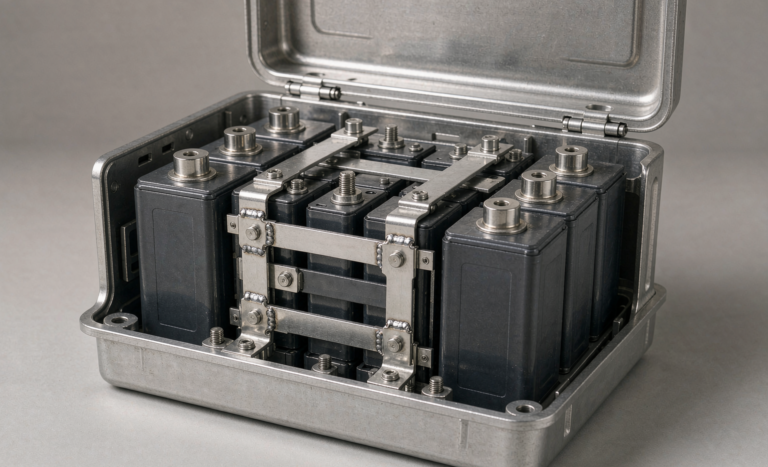
Lead-acid equalization charges are long, hot, and ventilator-hungry. Sodium-ion needs none of that. Charger requirements are modest — most sodium forklift packs charge at 0.5C continuous, so a 25 kWh pack needs a 12–15 kW charger, typically air-cooled wall units rather than liquid-cooled cabinets. That is a meaningful installation saving across a fleet.
Spec the charger protocol openly
Insist on CAN or RS-485 communication with a published register map between the battery management system (BMS) and charger. Black-box charging profiles are where conversion projects go to die — I have audited fleets where a mis-profiled charger quietly floated lithium packs at the wrong voltage and aged them three times faster than the warranty model assumed.
Procurement Levers That Actually Move TCO
Once you have sized correctly, these are the negotiation and quality levers that protect your investment:
- Cell date codes under nine months. Calendar aging starts at the factory, not at commissioning. Rejecting old stock is free money.
- Acceptance-test every batch. Require DCIR curves at three temperatures and three SoC levels, plus a 100% SoC / 45 °C / 30-day calendar-aging report. Suppliers who cannot produce these documents are telling you something.
- Certification stack as a floor, not a differentiator. UN 38.3 for transport, IEC 62619 for industrial stationary/mobile use, UL 1973 for North America, and IEC 62660-2/-3 performance and abuse testing. Any forklift battery — lithium or sodium — missing these should not be on your shortlist.
- Warranty on throughput, not just years. A “5-year warranty” that expires at 2,000 equivalent full cycles is worse than a 3-year, 4,000-cycle warranty for a two-shift operation. Read the throughput clause; it is where warranty claims are won and lost.
- Dual-source the cells where volumes allow. Sodium-ion supply is maturing but concentrated; a qualified second source is cheap insurance for a ten-year fleet plan.
A Worked TCO Example: 20-Truck Fleet, Three-Shift Warehouse
Here is a simplified model from a real evaluation (figures rounded; your tariffs will differ):
| Cost line (10 years, 20 trucks) | Lead-acid | LFP | Sodium-ion |
|---|---|---|---|
| Battery purchase + 1 mid-life replacement (lead-acid) | $260k | $220k | $260k |
| Spare packs / swap infrastructure | $70k | $15k | $15k |
| Energy + efficiency losses | $150k | $95k | $105k |
| Charging room, ventilation, watering labor | $85k | $18k | $12k |
| Downtime & maintenance allowance | $90k | $35k | $32k |
| Total | $655k | $383k | $424k |
The pattern repeats across nearly every model I run: lead-acid is not competitive in multi-shift operations; LFP usually wins on raw energy economics in climate-controlled sites; sodium-ion closes to within 5–15% of LFP — and overtakes it — when cold exposure, high-SoC opportunity charging, or calendar-aging risk dominates. The decision is never “which chemistry is cheapest per kWh.” It is “which chemistry is cheapest for this building, this tariff, and this duty cycle.”
FAQ
Are sodium-ion forklift batteries cheaper than lithium-ion?
Per kWh at purchase, no — expect a 10–30% premium over LFP today. Over ten years, sodium-ion can match or beat LFP in fleets with heavy opportunity charging, cold exposure, or high ambient temperatures, because it avoids the thermal management, SoC management, and calendar-aging costs that LFP incurs.
Can I convert my lead-acid forklift fleet to sodium-ion without replacing trucks?
Usually yes. Most retrofits match the lead-acid tray envelope and voltage (24/48/80 V) with a BMS that speaks the truck’s CAN protocol. The main check items are tray dimensions, connector type, weight distribution, and charger compatibility. A quality custom battery solution provider will validate all four before quoting.
How long do sodium-ion forklift batteries last?
With opportunity charging and ambient warehouse conditions, our fleet data supports 4,000+ equivalent full cycles to 80% capacity — typically beyond the service life of the truck itself. Calendar aging, not cycle aging, is the limiting factor in most warehouses, and sodium-ion’s tolerance of high SoC is its key advantage there.
Do sodium-ion batteries need special chargers?
They need chargers with a sodium-ion charge profile (nominal voltage around 3.0–3.1 V per cell, not the 3.65 V of LFP) and CAN/RS-485 communication with the BMS. Using an LFP-profile charger on a sodium pack will chronically undercharge it; using a lead-acid charger will damage it. Budget for charger conversion if you are switching chemistry.
What certifications should I require when buying a forklift battery?
At minimum: UN 38.3 (transport), IEC 62619 (industrial battery safety), UL 1973 (North American mobile applications), and abuse/performance test reports per IEC 62660-2/-3. For cold-chain or outdoor yards, also ask for low-temperature discharge test data, not just datasheet claims.