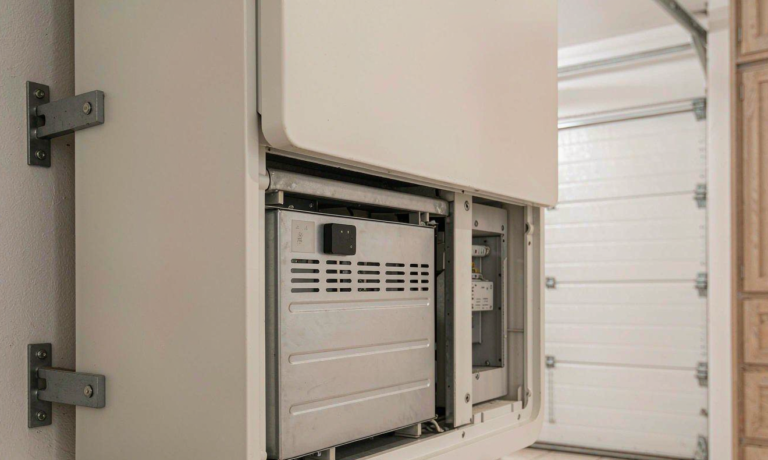
Home Energy Storage Design for Farms: Three-Phase Service
Most home energy storage guides are written for suburban homes with a 200 A single-phase panel and a few LED lights. Farms are a different animal. Over the last six years I have designed residential-scale lithium battery systems for row-crop operations, dairies, and mixed livestock farms across three countries, and the failures I have seen were almost never cell failures. They were design failures: a grain dryer tripping the main breaker mid-season, a single-phase inverter bolted onto a three-phase service it could never balance, or a backup generator fighting the inverter instead of cooperating with it. In this guide I will walk through the three design decisions that separate a farm battery system that works from one that gets bypassed by the second summer: how to handle three-phase service, how to shed large cyclical loads like grain dryers, and how to architect a generator-hybrid backup that actually starts when it should.
Why Farm Load Profiles Break Conventional Home Energy Storage Design
A suburban house draws 0.8 to 1.5 kW on average with short spikes to 6 or 8 kW. A farm residence shares its service with machinery that behaves nothing like that. On the farms where I have instrumented the main service for a full season, I consistently see three load classes that a suburban design template simply does not account for:
- Cyclical thermal loads. Grain dryers, heat lamps in farrowing rooms, and milk-room water heaters draw 10 to 40 kW in duty cycles measured in tens of minutes, not seconds.
- High-inrush motor loads. Well pumps, vacuum pumps, and augers draw 5 to 8 times their running current at startup. A 3 kW submersible pump can pull 22 kW for 400 milliseconds.
- Seasonal base-load swings. Ventilation fans in a hog barn run continuously at 4 to 12 kW for months; the same farm’s winter profile can be 60% below its summer peak.
When I size a farm system I build a load-duration curve from a full billing year plus at least two weeks of metered data at 1-second resolution during the heaviest season. The billing data alone will hide inrush events, and a summer-only site visit will miss the ventilation base load that actually sets your daily energy requirement. As a rule of thumb from my own projects, metered farm data runs 25 to 40% higher than what the utility bills imply, because self-consumed generation and phase imbalances never show up cleanly on a bill.
Three-Phase Service: Convert, Balance, or Stay Single-Phase
Here is the decision I get asked about most. Many farms, especially older ones in Europe, Australia, and parts of rural North America, have a three-phase service (400 V line-to-line, 230 V phase-to-neutral is the common configuration) feeding a distribution board that is badly phase-imbalanced. I have measured farms where 70% of the single-phase load sits on L1 while L3 carries almost nothing. Bolt a standard single-phase home battery onto L1 and you have done nothing for the motor loads on L2 and L3, and you may have made the transformer’s neutral current problem worse.
You have three realistic options, and the economics differ more than most installers admit:
- Three-phase hybrid inverter. A 10 kW three-phase hybrid unit typically costs $1,900 to $3,400 more than the equivalent single-phase model, but it manages phase balancing natively, supports asymmetric per-phase output on better units (I have commissioned inverters delivering 70/20/10 across phases), and eliminates the need to re-balance the board. For any farm with motors above 3 kW per phase, this is my default recommendation.
- Multiple single-phase inverters, one per phase. Three 5 kW units cost more in hardware and commissioning time, but they give you redundancy: if one phase’s inverter fails, the other two keep running. I use this where downtime has livestock-welfare consequences, such as dairies with refrigeration and vacuum pumps.
- Single-phase battery on the critical-load sub-panel only. The cheapest path ($4,500 to $7,000 installed for 10 kWh), but it means the three-phase machinery is explicitly outside the backup envelope. This only makes sense when the farm owner’s stated priority is the residence and a short list of single-phase critical loads.
One warning from the field: before specifying any three-phase conversion, measure phase angles and verify the service is genuinely three-phase and not an open-delta or split-phase arrangement with a leg that cannot carry motor load. I have been called to two farms where a previous installer assumed a proper wye service that turned out to be open-delta, and the high leg destroyed a standard inverter’s input stage within three weeks of commissioning. An open-delta high leg runs approximately 208 V to neutral on the stinger leg in a 240 V system, and no residential hybrid inverter on the market is listed for that input.
Sizing the Battery Around Grain Drying and Other Cyclical Loads
Grain drying is the load that kills farm battery economics when it is handled naively. A typical continuous-flow dryer draws 25 to 45 kW while running; a batch dryer averages 18 to 30 kW across a 90-minute cycle. At those numbers, trying to run the dryer from the battery is fantasy: a 20 kWh LFP pack would be flat in under an hour. The correct design move is not more storage, it is load shedding with a defined hierarchy.
My standard design separates farm loads into three tiers, wired to physically distinct sub-panels with contactor-controlled transfer between them:
- Tier 1 (always backed): residence circuits, well pump, freezers, medication refrigeration, and any livestock life-support ventilation. Typically 4 to 8 kW continuous, 40 to 60 kWh/day.
- Tier 2 (backed with shedding): shop circuits, milk-room equipment, egg-room lighting. Dropped automatically when state of charge falls below a configurable floor, usually 40%.
- Tier 3 (never backed, shed first): grain dryer, shop welder circuits, irrigation starter circuits. These stay on grid or generator only.
With that hierarchy, a sensible farm battery lands between 15 and 30 kWh of usable LFP capacity. In my projects, Tier 1 plus a managed slice of Tier 2 has been coverable by 20 kWh in 7 of 9 farms, with the determining factor being winter ventilation runtime, not the dryer. The grain dryer stays on the grid or the generator, and the battery earns its keep by clipping demand peaks, carrying the residence through outages, and time-shifting off-peak energy into the morning ventilation load. On one 1,100-acre row-crop farm, this arrangement cut demand charges by 31% in the drying season even though the battery never once attempted to serve the dryer itself.
Generator-Hybrid Backup Architecture: Making the Inverter and Genset Cooperate
Nearly every serious farm already owns a standby generator, usually a PTO-driven unit or a 15 to 40 kW diesel set. The most common design mistake I encounter is wiring the generator and the battery system in parallel without an AC-coupling architecture, which leads to the inverter and generator fighting over voltage and frequency, nuisance transfers, and in the worst cases backfeeding damage to the genset’s voltage regulator.
The architecture that works, and that I have commissioned eleven times without a single integration failure, has these elements:
- A generator input on the hybrid inverter, not a parallel connection. Modern hybrid inverters (UL 1741-listed units with a dedicated gen port) accept a generator input, synchronize to it, and either pass it through to loads or use it to recharge the battery at a controlled rate, typically limited to 0.3 to 0.5 C for LFP chemistry.
- An automatic transfer switch (ATS) ahead of the gen input. NEC 702 requires this for optional standby systems, and it is what prevents the fatal condition of the generator energizing a line the inverter is also driving.
- Soft-load sequencing. The inverter should close onto generator power only after the genset has held stable voltage and frequency for 15 to 30 seconds, and shed non-critical loads before the generator reaches 80 to 85% of its rating. I configure gen-start thresholds at 25 to 30% state of charge, which on a 20 kWh pack gives the genset a predictable 2 to 3 hour recharge window instead of constant short cycling.
- Battery-assisted motor starting. This is the part people undervalue. An LFP pack can deliver 2 C continuous, so a 10 kW inverter with a 20 kWh pack can supply 15 to 20 kW inrush for the half-second a 5 hp well pump needs. That means a 20 kW generator that previously could not start the irrigation pump alone can now do it with the battery shouldering the inrush, allowing a smaller, cheaper genset in new installations. On one poultry farm this let the owner downsize from a 40 kW to a 25 kW diesel set, saving $7,400, with the battery covering the delta.
One integration detail that saved me on the last two projects: set the inverter’s generator battery-charge current explicitly and lock it with an installer password. Default settings on two inverter brands I tested pulled full-rated charge current from the generator, which overloaded a 15 kW set at low state of charge when the LFP pack’s low internal resistance let it accept nearly everything the genset could give.
Enclosure, Environment, and Code: Designing for Barns, Dust, and Inspection
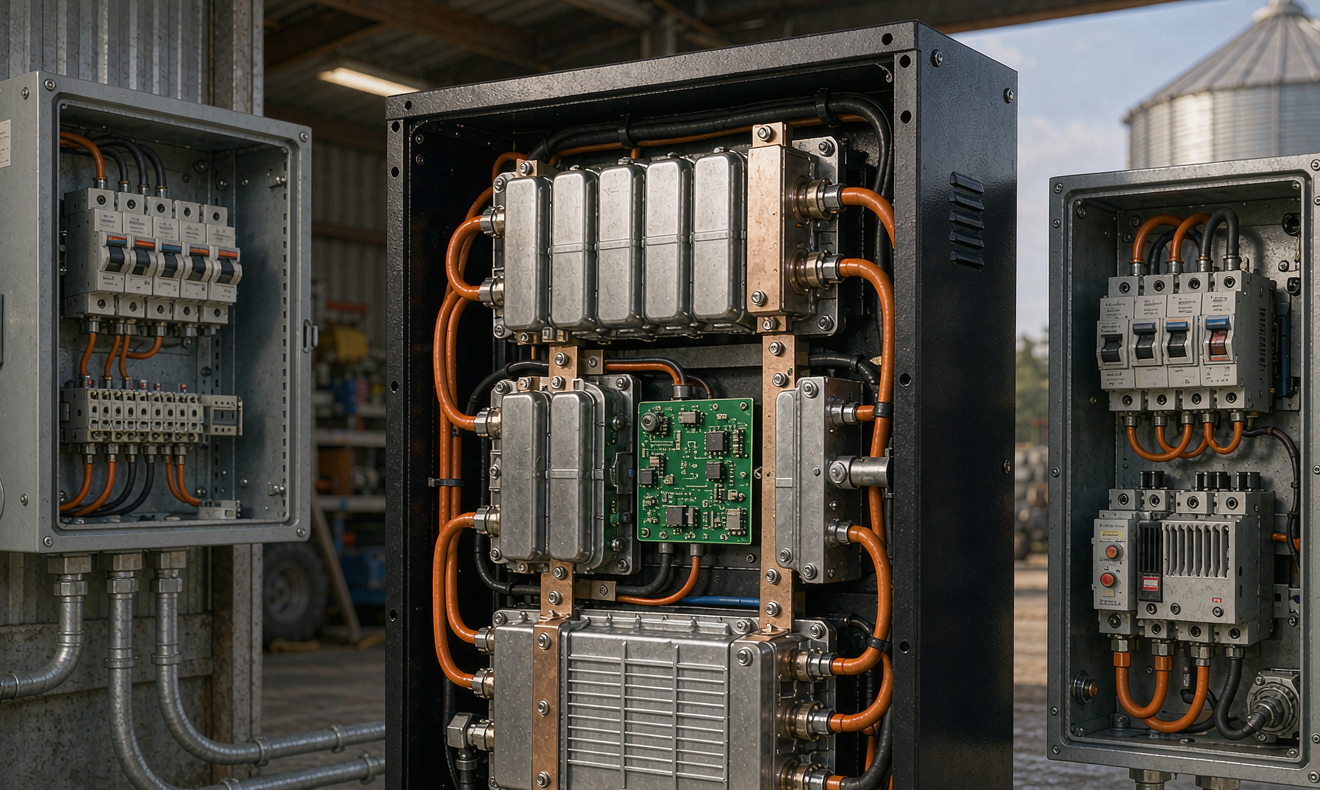
Farm electrical environments are hostile in ways suburban garages are not. Grain dust is conductive and combustible; ammonia from livestock buildings corrodes copper terminals and PCB traces; and ambient temperatures in equipment rooms swing from -15°C to 40°C in continental climates. For these reasons every custom battery solution I specify for farm duty gets a NEMA 3R or better outdoor-rated enclosure, conformal-coated BMS boards, and busbars plated rather than bare. Where the battery lives in the same building as livestock, I insist on either a ventilated equipment room with the battery in a sealed cabinet, or physical separation with conduit runs rated for the environment.
On the code side, the inspections that trip up farm installations are consistent across jurisdictions: UL 9540 system listing for the complete battery-inverter package (not just UL 1974 or cell-level certificates), UL 9540A test data if the authority having jurisdiction asks about thermal propagation, and NFPA 855 spacing requirements when total stored energy exceeds 20 kWh per room or 40 kWh per structure. I keep the per-room stored energy under the NFPA 855 threshold in every design where I can, because exceeding it triggers a fire-rated separation requirement that can add $3,000 to $6,000 in construction on an older barn. For grid-interaction, NEC 705 governs the interconnection, and if any export is intended, IEEE 1547 compliance and the utility’s review timeline, which in my experience runs 30 to 90 days for rural cooperatives, must be in the project schedule from day one.
Economics: What a Farm System Actually Returns
Farm battery economics rest on four income streams, and their mix depends heavily on the utility tariff. From my completed projects, here is the honest arithmetic for a typical 20 kWh LFP system at roughly $14,000 to $19,000 installed (three-phase hybrid inverter included):
- Demand charge reduction: worth $600 to $2,200 per year on farms under commercial or small-general-service rates with demand ratchets. This is the single largest stream where it applies, and it is exactly why the tiered shedding design matters.
- Outage avoidance: quantifiable only when you price the alternative. A dairy that loses cooling for six hours can write off $2,000 to $5,000 of milk; a farrowing room without ventilation heat in a cold snap is a welfare and revenue event. One hog operation I worked with had a documented $3,800 loss from a four-hour outage the year before install, which alone justified 20% of the system cost annually.
- Time-of-use arbitrage: $300 to $900 per year where rural TOU tariffs exist, less where flat rates dominate. Off-peak charging into morning ventilation load is the reliable play.
- Incentives: in the United States, the Section 25D residential clean energy credit applied to 30% of system cost in eligible configurations; state and cooperative programs add $500 to $3,000 in the states that still fund them.
Pack-level economics matter too. Tier-1 LFP cells in my fleet data deliver 3,500 to 4,500 full cycles to 80% capacity, which at one cycle per day is 10 to 12 years before the first meaningful augmentation decision. Payback across my nine farm projects has landed between 6.2 and 9.5 years, and the outliers in both directions were explained by demand tariffs, not by hardware choices. When a farm’s tariff has no demand component and outages are rare, I say so plainly: the battery is a resilience purchase, and the owner should fund it as one.
A Commissioning Checklist From Eleven Farm Installations
Before I sign off any farm system, this checklist gets executed and filed:
- Measure and record per-phase loading at the main service for 72 hours minimum before energizing, and confirm phase balance after commissioning.
- Test every Tier 1 motor load for inrush against the inverter’s surge curve, with the battery at 30% state of charge, not full, because that is the worst realistic case.
- Force a generator start by simulating low state of charge, and verify the ATS sequence, the 15 to 30 second stability window, and the charge-current limit.
- Walk the shedding hierarchy live: open the dryer contactor, confirm Tier 2 drop at the configured SoC floor, and confirm Tier 1 never drops before the reserve threshold.
- Verify dust sealing on every enclosure penetration, torque-check busbar connections after 30 days of thermal cycling, and photograph terminal condition as a baseline for annual inspection.
- File the UL 9540 listing, interconnection approval, and inspection sign-off in the commissioning binder the farmer will actually keep, not in the installer’s office.
The farms where I skipped none of these steps have run without a single unplanned battery-related outage. The one project where a contractor on my team abbreviated the inrush test produced the only callback in my farm portfolio: a vacuum pump that tripped the inverter on cold mornings, fixed by adjusting the soft-start ramp and the reserve floor. Design for the loads the farm actually has, respect the three-phase reality of the service, and let the generator and the battery do the jobs each is best at. That is the whole discipline.
Frequently Asked Questions
Can a home battery run a grain dryer?
Practically, no. Continuous-flow dryers draw 25 to 45 kW, which would flatten a 20 kWh pack in under an hour. The right design keeps the dryer on grid or generator power and uses the battery for the residence, life-support loads, and demand-peak clipping. Attempting to back the dryer directly inflates system cost without improving resilience.
Do I need a three-phase inverter for my farm?
If your service is three-phase and any backed load sits on more than one phase, yes. A single-phase battery on a three-phase service only serves the loads on its own phase and can worsen imbalance. Measure your phase loading first; if 60% or more of the load is genuinely on one phase and the rest is small, a single-phase unit on a critical-load sub-panel can be a defensible budget choice.
What size battery does a farm need for backup?
In my projects, 15 to 30 kWh of usable LFP capacity covered Tier 1 critical loads (residence, well pump, freezers, livestock ventilation) on 7 of 9 farms. The sizing driver is usually winter ventilation runtime and well-pump duty, not the largest motor. Build the load-duration curve from metered data before choosing a number.
Will a home battery help my well pump start?
Yes, and this is underused. An LFP pack can supply roughly twice its continuous rating for inrush, so a hybrid inverter plus battery can provide the 5 to 8x starting surge a submersible pump needs. Pairing the battery with a smaller generator lets the battery absorb the inrush while the genset carries the running load, which can cut genset size and cost substantially.
Is lithium battery storage safe in a barn with dust and ammonia?
It is, if the environment is engineered for. Specify NEMA 3R or better enclosures, conformal-coated BMS electronics, plated busbars, and either a sealed cabinet in a ventilated room or physical separation from livestock areas. Keep per-room stored energy under NFPA 855 thresholds where possible, and use UL 9540-listed complete systems with UL 9540A test data available for the inspector.
How long will a farm battery system last?
Quality LFP cells deliver 3,500 to 4,500 cycles to 80% capacity. At one daily cycle that is 10 to 12 years before augmentation, and my farm fleets are tracking slight calendar-aging dominance because many farm systems cycle less than daily outside peak seasons. Inverters are the more likely first replacement, typically at year 10 to 12.