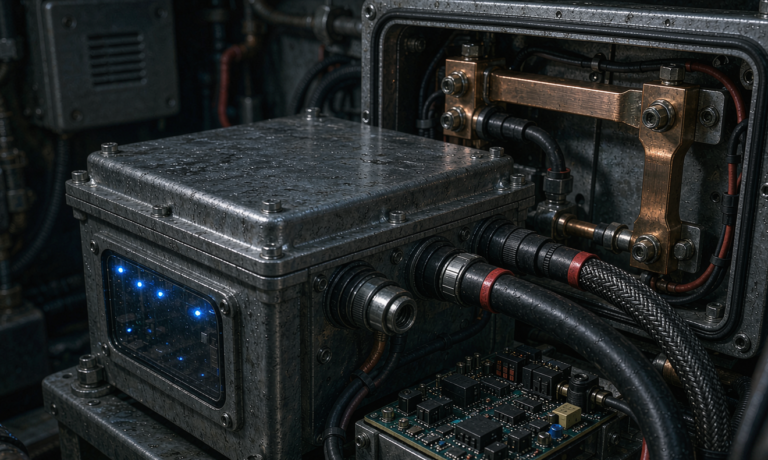
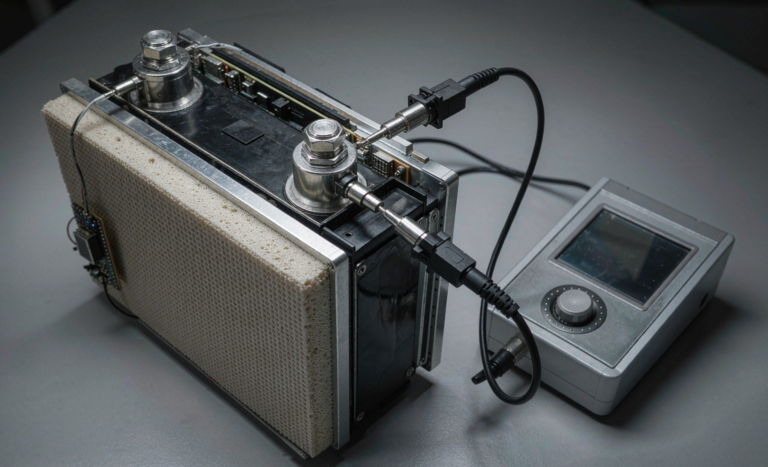
Semi-Solid State Battery for High Altitude Platforms
I have spent the last four years building lithium battery packs for aircraft that never land. Not passenger jets — high altitude platform stations (HAPS): solar-electric stratospheric aircraft and airships that cruise around 18–22 km, above commercial traffic and most weather, for weeks or months at a time. In that world the energy storage battery is not a component; it is half the structural weight budget and the reason the aircraft survives the night. A conventional lithium battery design does not survive up there. Between the near-vacuum cold, the unforgiving mass fraction, and a duty cycle that punishes any cell chemistry with mediocre calendar life, HAPS is one of the hardest qualification targets in the industry.
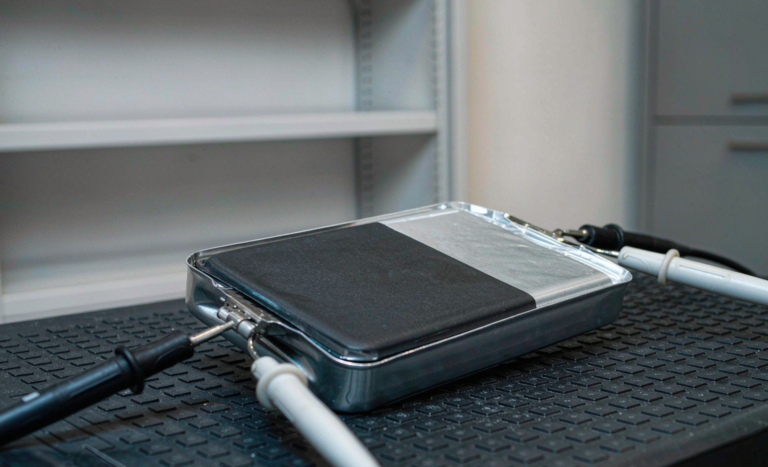
This is why our engineering team keeps pushing semi-solid state battery technology into high altitude platform programs. The gel-like semi-solid electrode — a lithium salt electrolyte immobilized in a polymer matrix, with only a small fraction of free liquid — changes three variables that matter enormously at 20 km: low-pressure tolerance, thermal behavior, and cycle-plus-calendar life density. In this article I will walk through how we actually size, thermally design, and qualify a semi-solid state battery for a HAPS mission, using numbers from programs I have worked on. If you manage procurement for a persistent aerial platform, a stratospheric balloon constellation, or a long-endurance drone battery system, this is the arithmetic your airframe team hopes you get right.
The HAPS Energy Problem Is a 24-Hour Closed Loop, Not a Capacity Number
The first mistake I see in HAPS battery specifications is treating capacity as the headline number. It is not. What kills a HAPS battery is the day-night closed loop: the aircraft climbs with the morning sun, charges its battery through the afternoon, then flies on stored energy for 10 to 14 hours of darkness — every single day, for the mission duration. The battery is not sized in amp-hours; it is sized in survivable depth of discharge (DOD) per night, repeated hundreds of times.
Here is the budget logic I use. A typical fixed-wing HAPS airframe drawing 1.5–3.5 kW in cruise needs roughly 18–45 kWh of usable energy to cross the night at mid-latitudes. At the summer solstice near 30° latitude the dark period is about 9.5 hours; at winter solstice it stretches past 13. Design to the worst case, not the demo flight. If you divide usable energy by the total installed capacity, you get the real design driver: you want the nighttime DOD window to sit where the chemistry’s cycle life curve is still flat — in practice I keep the routine DOD at 55–70% and let cold margins and reserve energy (regulatory descent reserve, plus 15–20% contingency for an aborted station-keeping maneuver) live below that.
Semi-solid state cells earn their place here. The immobilized electrolyte suppresses the parasitic side reactions that accelerate at high SoC dwell — and a HAPS battery dwells at high SoC every afternoon, right before it must deliver. On a 90-day program, a pack cycling 65% DOD daily at 25 °C cell temperature typically logs only 90–100 equivalent full cycles, but the calendar fade of a conventional liquid-electrolyte lithium battery during those months of afternoon high-SoC soak can exceed the cycling fade by two to one. The semi-solid chemistry I have qualified in this duty showed roughly 30–40% less capacity loss over a simulated 180-day mission than an equivalent NMC pack, which directly converts into either more night endurance or more payload mass.
Thermal Design When Convection Disappears
At 20 km, ambient pressure is around 5.5 kPa — about 5% of sea level — and ambient temperature sits near −56 °C. The consequence every thermal engineer learns the hard way: forced-air convection is essentially gone. Air density collapse cuts the convective heat transfer coefficient by one to two orders of magnitude. A pack that sheds heat happily on the bench becomes a sealed thermos in the stratosphere.
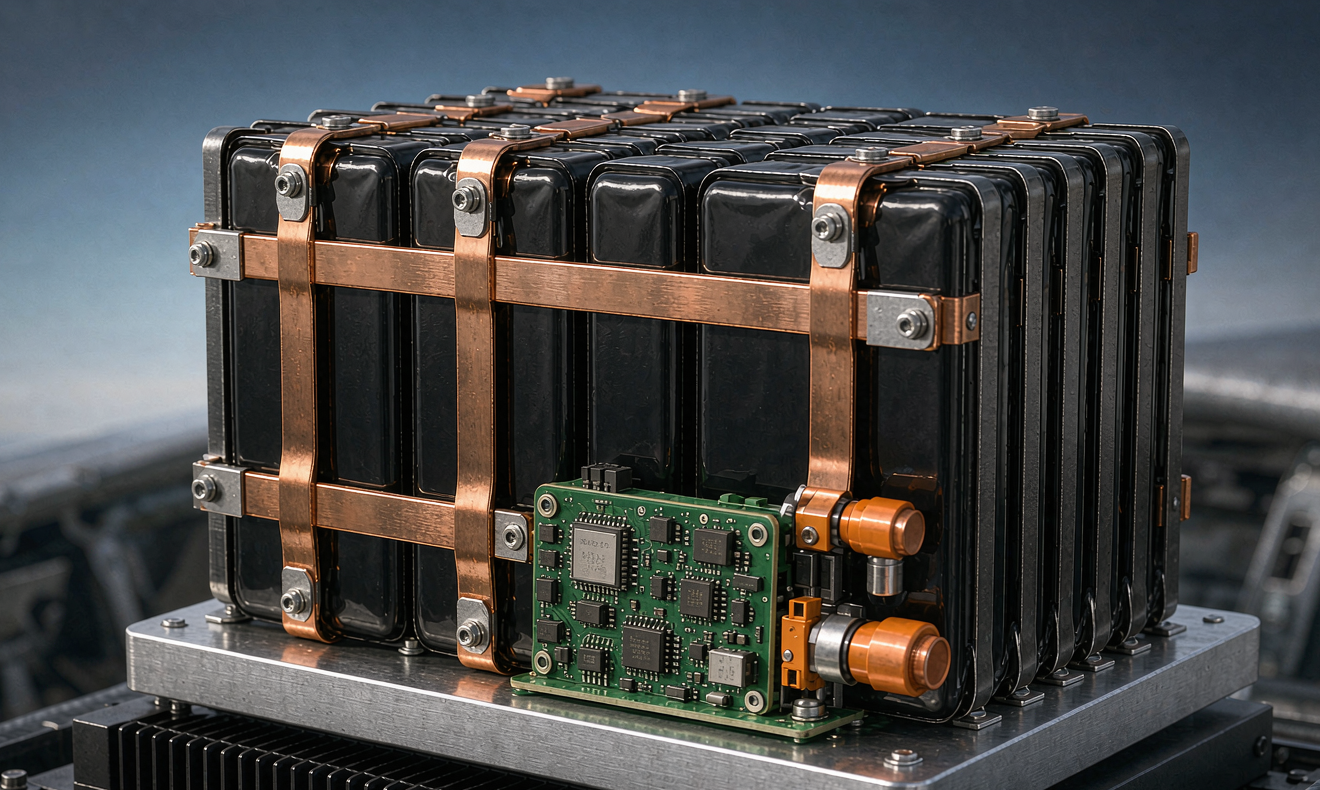
So the thermal design of a high altitude platform battery reduces to two paths: conduction into structure, and radiation. My reference architecture looks like this: a bonded aluminum thermal spreader plate under the cell stack conducts cell heat into the wing spar or the pressurized equipment bay; internal fan-driven circulation (in a sealed, low-pressure-tolerant enclosure) homogenizes cell-to-cell temperature, because the delta matters more than the absolute number — I hold cell-to-cell spread under 5 °C across the entire stack. The exterior side of the module carries a matte-black radiator surface sized for the radiative rejection budget, which at these temperatures does most of the work the fan did at sea level.
The cold side is equally critical. Nighttime cell temperatures drift downward, and charging a lithium battery below 0 °C plates lithium metal on the anode — a permanent, cumulative capacity killer and, worse, a latent internal-short risk. Our BMS therefore enforces a charge-inhibit window below 0 °C with a thin-film heater grid (5–10 W per module on stratospheric missions) driven by the morning charge schedule: the first 20–40 minutes of sunlight go into bringing cells to 5–10 °C before the solar charge controller ramps. On a 30-day endurance test I ran, packs without the pre-heat interlock lost 4.1% capacity in the first month; the heater-equipped builds lost 0.7%.
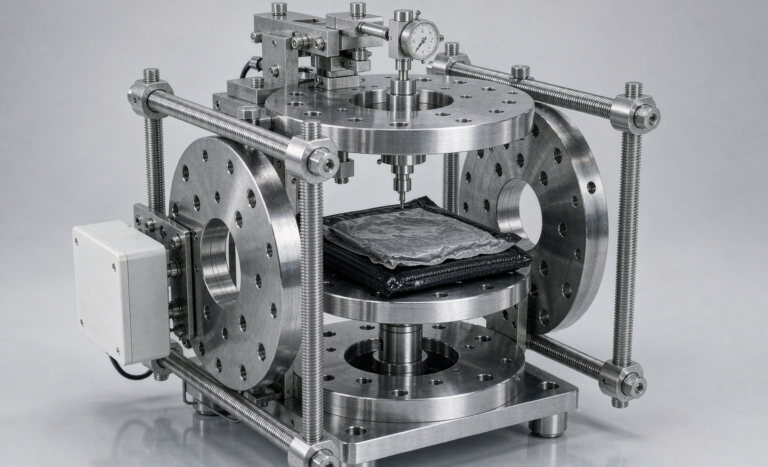
This is also where semi-solid state construction pays a specific low-pressure dividend. A liquid-electrolyte pouch cell outgasses and can deform as pressure drops through UN 38.3 Test T.1’s 11.6 kPa threshold; free electrolyte wicks into places it should not go. A semi-solid electrode holds its electrolyte mechanically, so altitude derating is far milder. In low-pressure chamber testing at 4 kPa — more punishing than the standard requires — our semi-solid modules showed no measurable swelling and under 2% transient impedance rise, while a conventional prismatic control pack vented its safety valve once. That single event would end a flight.
Multi-Week Endurance: Calendar Fade Beats Cycle Fade
Program managers love to quote cycle life. On a HAPS platform, cycle life is almost the wrong metric. A 180-day station-keeping mission delivers roughly 180 shallow cycles — trivial for any aerospace-grade lithium battery. What actually retires the pack is calendar aging: time spent at high state of charge, elevated core temperature, and open-circuit stress between the daily charge and discharge legs.
Three levers dominate the calendar-life arithmetic, and all three belong in your procurement spec:
- SoC ceiling management. Every 0.1 V you trim off the charge ceiling buys a disproportionate calendar-life extension, but costs night endurance. We manage this seasonally: mission planning sets a 4.15 V/cell ceiling for standard nights and relaxes to full charge only before the longest nights of the year. Firmware, not operator discipline, must own this — I have never seen a manual SoC policy survive a six-month mission.
- Thermal dwell discipline. Afternoon high-SoC soak plus a warm cell is the worst calendar combination. Our BMS throttles charge rate in the final 15% to keep peak cell temperature under 30 °C, accepting a slower afternoon top-up — the solar array margin usually allows it.
- Storage-state turnaround. Between sorties, packs are held at 40–50% SoC in a temperature-controlled container. A pack left at full charge in a 40 °C hangar for two weeks loses more calendar life than a month of flying does.
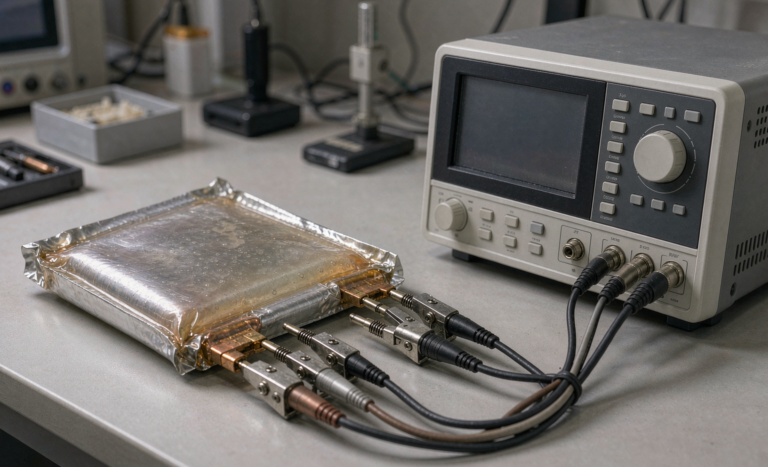
On the semi-solid side, the immobilized-electrolyte interface simply ages more slowly. Our accelerated calendar testing (45 °C, 100% SoC hold) showed the semi-solid chemistry reaching 80% capacity at roughly 2.5× the months of the liquid-electrolyte reference. Translated into mission terms: where a conventional pack was the limiting factor at around 120 flight days, the semi-solid state battery moved the retirement driver to other subsystems entirely — which is exactly where you want your battery in the reliability hierarchy.
Mass Fraction: Why Pack-Level Wh/kg Decides the Flight Case
For a stratospheric aircraft, every gram of battery is a gram of payload, solar array, or structural margin you do not have. HAPS airframes live on system-level mass fractions where the energy storage battery alone is 25–35% of gross mass. This is why the number that matters is not cell-level Wh/kg from the datasheet — it is pack-level specific energy, after structure, thermal hardware, BMS, connectors, and enclosure.
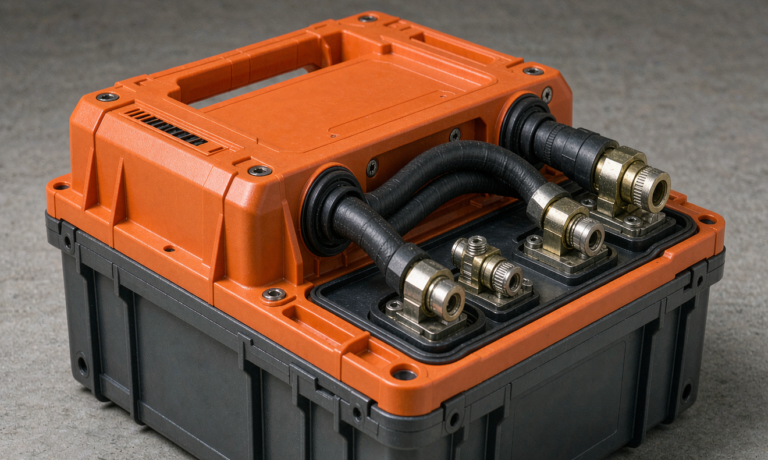
Honest pack-level arithmetic: a cell quoting 300 Wh/kg typically delivers 190–230 Wh/kg at pack level in aerospace construction. Semi-solid cells quote a bit lower at the cell level (we have flown builds in the 240–270 Wh/kg cell range), but they claw mass back at the system level in three places. First, the gel electrode’s mechanical stability lets us use lighter compression fixtures than a swelling liquid pouch stack demands. Second, better low-pressure tolerance means less hermetic enclosure mass. Third — and least appreciated — superior calendar fade lets the mission planner run a shallower DOD window on a smaller installed capacity while still meeting night-endurance targets years later, not just on day one.
We have also begun evaluating semi-solid cells as structural battery elements: the cell stack laminated into or bonded against load-bearing composite panels, so the battery contributes stiffness instead of merely riding along. This is not science fiction — we built a demonstrator wing-bay panel where the semi-solid module’s carbon-fiber enclosure carried bending load. The payoff is real (5–8% of airframe mass in our trades) but it moves the battery from an interchangeable LRU into a certified structural part, which changes the qualification path and the maintenance model. My advice: fly the battery as an LRU first; consider structure-integrated builds only for generation-two aircraft where the mass margin truly demands it.
Compliance and Recovery: UN 38.3, RTCA DO-160, and the Landing-Load Question
Nothing about HAPS exempts you from transport and airworthiness discipline. The foundation is unchanged: UN 38.3 (T.1 through T.8) governs every lithium battery that ships — including, critically for this application, Test T.1 altitude simulation at 11.6 kPa, which is the closest thing transport law has to a stratospheric dress rehearsal, and T.5 external short plus T.6 crush/impact, which define the abuse floor. Note that T.1 tests storage and transport pressure, not 20 km cruise; your internal low-pressure qualification must go well beyond it, as I described above.
For the aircraft side, RTCA DO-160 categories (temperature and altitude sections in particular, plus vibration and lightning-induced transients where the tether or antenna systems apply) and, where the program targets crewed-adjacent airspace integration, DO-311A-style rechargeable lithium battery requirements give the certification authority a familiar framework. I treat these as the compliance skeleton and add program-specific tests around them: combined low-pressure-plus-charge testing (charge behavior at 6–8 kPa, which no standard currently requires but which I consider essential for HAPS), and solar-transient input testing where the charge bus sees rapid irradiance swings crossing cloud tops.
Then there is the question nobody enjoys: what happens on landing. A HAPS vehicle returns after months aloft, sometimes on a runway, sometimes — for balloon and airship programs — under parachute into terrain. The battery must survive touchdown loads (I design to 15–20 g crash-loadable mounting per the airframe’s landing case, with mechanical fusing on the main bus) and then be safe to approach, discharge to transport SoC, and ship back under UN 38.3 provisions. We build an automated post-landing protocol into the BMS: isolate on hard accelerometry trigger, log cell voltages to non-volatile memory, and drop to transport SoC within the first grounded hours. A recovery crew should never have to guess the pack’s state from outside the enclosure.
What I Would Specify on a HAPS Battery RFP Today
If I were writing the energy storage section of a high altitude platform RFP this quarter, here is the checklist I would hold suppliers to:
- Pack-level specific energy (not cell-level) verified at the qualification unit, with the mass breakdown that produced it.
- Calendar-fade data at 45 °C and 100% SoC, stated in months to 80%, plus mission-profile simulation for the actual day-night DOD window.
- Low-pressure test data beyond UN 38.3 T.1 — swelling, venting, and impedance behavior at 4–6 kPa, and charge-inhibit-plus-reheat behavior below 0 °C.
- Cell-to-cell thermal spread guarantee under 5 °C in the flight enclosure, with the conduction-and-radiation model to back it.
- BMS features: seasonally programmable SoC ceiling, thermistor-interlocked charging, crash-triggered isolation, and post-flight SoC management for transport compliance.
- Recovery and turnaround kit: documented ground support for safe discharge, diagnostic download, and UN 38.3-compliant return shipping.
A supplier who cannot show most of this on paper has not flown the hard parts yet. For teams building persistent platforms, a custom battery solution partner who has already lived through a stratospheric qualification cycle — low-pressure chambers, 180-day calendar simulations, recovery protocols — will save you a design generation. The same discipline, by the way, is what we apply to our more conventional drone battery and industrial lithium battery programs: the stratosphere is simply where every hidden weakness in a design shows up sooner.
Frequently Asked Questions
Why choose a semi-solid state battery over conventional lithium-ion for a high altitude platform?
Three reasons: better low-pressure tolerance (immobilized electrolyte resists outgassing and swelling below 11.6 kPa), slower calendar fade under the daily high-SoC afternoon soak that defines HAPS duty, and system-level mass savings from lighter compression fixtures and less hermetic enclosure. Cycle count is rarely the differentiator; calendar life and pressure behavior are.
How much capacity does a HAPS aircraft actually need?
Size from the longest night, not the average one. A 1.5–3.5 kW cruise-load airframe typically needs 18–45 kWh installed to clear a 13-hour winter night with reserve. Keep routine nighttime DOD at 55–70% and hold 15–20% energy contingency for descent reserves and off-nominal maneuvers.
Can lithium batteries be charged in the stratosphere?
Yes, but never below 0 °C cell temperature — cold charging plates lithium metal and permanently damages the cell. A flight-qualified BMS interlocks charging behind a pre-heat cycle: the first 20–40 minutes of morning sunlight go into warming the cells to 5–10 °C before the main charge ramp.
Does UN 38.3 certification prove a battery works at 20 km?
No. UN 38.3 Test T.1 verifies survivability at 11.6 kPa for transport and storage — a useful floor, but far short of cruise conditions. Programs should separately qualify swelling, venting, impedance, and charge behavior at 4–8 kPa, and add combined low-pressure-plus-charging tests that no current standard mandates.
How long can a semi-solid state battery support a multi-month mission?
Our accelerated testing (45 °C, 100% SoC hold) put the semi-solid chemistry at roughly 2.5× the months-to-80% of an equivalent liquid-electrolyte pack, which in mission terms moves battery retirement beyond the 120–180 day class of station-keeping missions. With firmware-managed SoC ceilings and thermal dwell discipline, the battery stops being the mission-life limiter.
What happens to the battery when the aircraft lands?
The BMS isolates on a crash-trigger accelerometer event, logs final cell states, and automatically manages the pack toward transport-compliant SoC within the first grounded hours. Recovery crews then follow a documented discharge, diagnostics, and UN 38.3 shipping procedure — a pack should never arrive at the hangar in an unknown state.
Flying energy storage at the edge of the atmosphere strips every battery design down to its honest fundamentals: a closed daily energy loop, heat you can only reject by conduction and radiation, and a calendar clock that runs even when the flight hours do not. A semi-solid state battery addresses exactly those fundamentals — which is why, on the programs I support, it has become the default answer for the high altitude platform class.