Battery Solution for Film and Television Field Kits
I have spent more than ten years specifying and qualifying lithium cell packs for broadcast, cinema and field-production customers, and the same conversation happens on almost every job: the director wants a smaller kit, the DIT wants a bigger cart, the gaffer wants a 300 W panel running off the same bricks as the camera, and the line producer wants the whole thing to clear airport security in Reykjavik without a paperwork crisis. A battery solution for film and television field kits is not a shopping decision about which brick to buy. It is a power system design problem with hard electrical limits, hard transport regulations and hard schedule consequences when it is done wrong.
What follows is the same engineering sequence I walk through with rental houses and owner-operators: build a real power budget, pick the pack architecture that fits it, check the transport rules before you book flights, size the DC distribution so the camera does not brown out at the far end of a 5 m cable, then work out how you are going to recharge all of it at 6 a.m. in a hotel room or off a generator in a canyon. Every number here is the kind I use in a real bill of materials or a test report.
Start With a Power Budget, Not a Battery Catalogue
The single most common failure I see is a kit specced by capacity in watt-hours while nobody added up the load in watts. Watt-hours are energy; the draw is power. A 98 Wh brick will run a 12 W mirrorless rig for eight hours and a 150 W large-format cinema build for about thirty-five minutes. Everything in between is arithmetic.
Here are the measured ranges I work from when I build a load table with a crew. They are typical, not universal, but they are close enough to size a system:
- Digital cinema camera body: 80–120 W for a Super-35 class body with viewfinder; 150–250 W for large-format bodies with an EVF, onboard monitor and lens motors.
- Mirrorless / compact cine body: 12–25 W.
- On-camera 7-inch monitor at full backlight: 8–18 W. Turning the backlight down to 60% typically saves 30–40% of the panel draw, which is the cheapest endurance win on any kit.
- Wireless video transmitter: 6–15 W depending on RF power and mode.
- Follow focus and lens motors: 10–25 W peak, low duty cycle.
- 1×1 LED panel: 100–150 W; 2×1 fixtures run 250–350 W.
- Sound bag (mixer, receivers, recorder): 5–15 W.
- DIT / mobile editorial cart: 200–350 W continuous — a workstation laptop at 80–120 W, a RAID array at 40–80 W, a reference monitor at 20–40 W, plus router and card readers.
- Aerial unit: a separate power world. A cinematic multirotor draws 800–2000 W at hover and its packs are a dedicated flight battery programme, not something you borrow from the camera truck.
Once the load table exists, energy is just power multiplied by hours, and then you apply three multipliers I insist on: a 1.25× duty-cycle factor because nobody draws constant power, a 1.2× design margin because capacity fades over the life of the pack, and a hard 20% reserve that the crew is not allowed to touch. A camera build that measures 120 W average over a ten-hour day needs 120 × 10 × 1.25 × 1.2 ÷ 0.8 ≈ 2250 Wh of installed capacity, which is roughly eight 290 Wh bricks or one well-designed 2.4 kWh cart battery.
Pack Architecture: 14.4 V V-Mount, Gold Mount, and 26 V High-Voltage Systems
Nominal voltage is the most under-appreciated variable in a field kit battery solution. A conventional V-mount or Gold-mount brick is 14.4 V nominal — a 4S lithium-ion stack with a 12.0 V to 16.8 V working range. Push 250 W through that and you are pulling around 17 A. Current is what heats cables, drops voltage and limits how far you can run a lead.
High-voltage mounts (26 V nominal, roughly 20.5–33.6 V working) halve the current for the same power. At 250 W you are at about 9.5 A. That matters for three reasons: resistive loss in the cable scales with I²R, so halving current cuts cable loss to a quarter; thinner, lighter cable becomes viable; and the voltage at the far end of a long run stays inside the camera’s input window instead of tripping its under-voltage lockout. If you are building a new kit for a large-format camera, I would spec high-voltage distribution from day one rather than retrofitting it after the first brown-out.
Capacity tiers worth knowing: 98 Wh is the largest pack that flies as carry-on with no airline approval anywhere in the world, 150–160 Wh is the practical ceiling for approved carriage, 190–300 Wh bricks are for truck-based and studio work, and anything above roughly 600 Wh belongs on a cart with wheels and a proper DC distribution panel rather than on a belt.
Airline-Compliant Watt-Hour Planning for Fly-Away Shoots
This is where productions lose days. lithium battery air transport is governed by the IATA Dangerous Goods Regulations and by ICAO technical instructions, and the watt-hour rating of the pack decides which bucket it falls into. The rules I design packs against:
- Up to 100 Wh: permitted in carry-on as a spare with no airline approval. Many carriers still apply a practical limit of around 20 spare packs per passenger; check the operator before you book eight bricks on one ticket.
- 100–160 Wh: permitted in carry-on with airline approval, normally capped at two spares per passenger. Get the approval in writing before you travel, not at the check-in desk.
- Above 160 Wh: not permitted in passenger baggage at all. These ship as cargo under UN3480 (batteries alone) or UN3481 (batteries packed with, or contained in, equipment) as fully regulated Class 9 dangerous goods.
- Every pack must have passed UN 38.3 (the T.1–T.8 test series covering altitude simulation, thermal cycling, vibration, shock, external short circuit, impact, overcharge and forced discharge), and a UN 38.3 test summary must be available from the manufacturer.
- State-of-charge limits for standalone cells and batteries shipped as air cargo are being phased in at 30% SoC, so cargo-shipped packs travel part-charged, not full.
My practical advice for a fly-away: design the airborne kit around 98 Wh bricks so the whole system is unconditionally carry-on legal, and plan to source or ship the big cart batteries at the destination. Weight is the other reason — 98 Wh of NMC cells is about 550–650 g, and eight of them plus chargers is already a 6 kg allowance bite. Also mark every pack with its Wh rating on a durable label. Security officers read the label, not the spec sheet, and an unlabelled brick is a confiscated brick.
DC Distribution: Connectors, Cable Gauge and Voltage Drop
Field power fails at the connectors and the cable far more often than it fails in the cells. On a 14.4 V system, the arithmetic is brutal. 18 AWG copper is about 21 mΩ per metre. A 3 m run is 6 m of conductor once you count the return path, so roughly 0.126 Ω. At 10 A that is a 1.26 V drop — nearly 9% of nominal — and 12.6 W of heat inside a coiled cable on a set. Step up to 14 AWG (about 8.3 mΩ/m) and the same run drops 0.5 V, around 3.5%, which most camera inputs tolerate comfortably.
Connector discipline matters just as much. Push-pull circular connectors (2-pin and 3-pin types) lock and will not vibrate loose on a vehicle mount; barrel connectors and unlatched D-taps are the two things I see taped up on every location. Keep a single connector standard across the whole kit so a spare cable fits any device, label both ends with voltage and polarity, and never cascade adapters to borrow power between a 12 V device and a 16.8 V hot brick without a regulated D-tap converter in line.
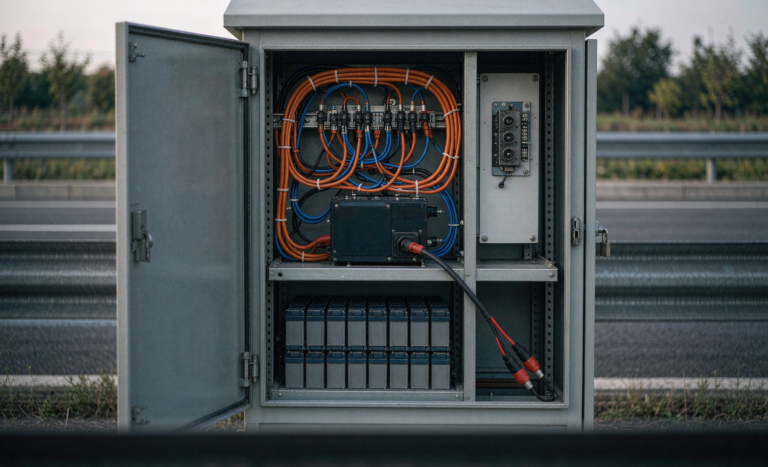
For cart builds I spec a distribution panel with individually fused outputs, a voltmeter and an amp-meter on the main bus, and reverse-polarity protection. Fusing is not optional: a 300 Wh brick can deliver several hundred amps into a dead short, and the thing that protects the cable is the fuse, not the battery management system.
Charging Logistics: Generators, Vehicle Inverters and Multi-Bay Chargers
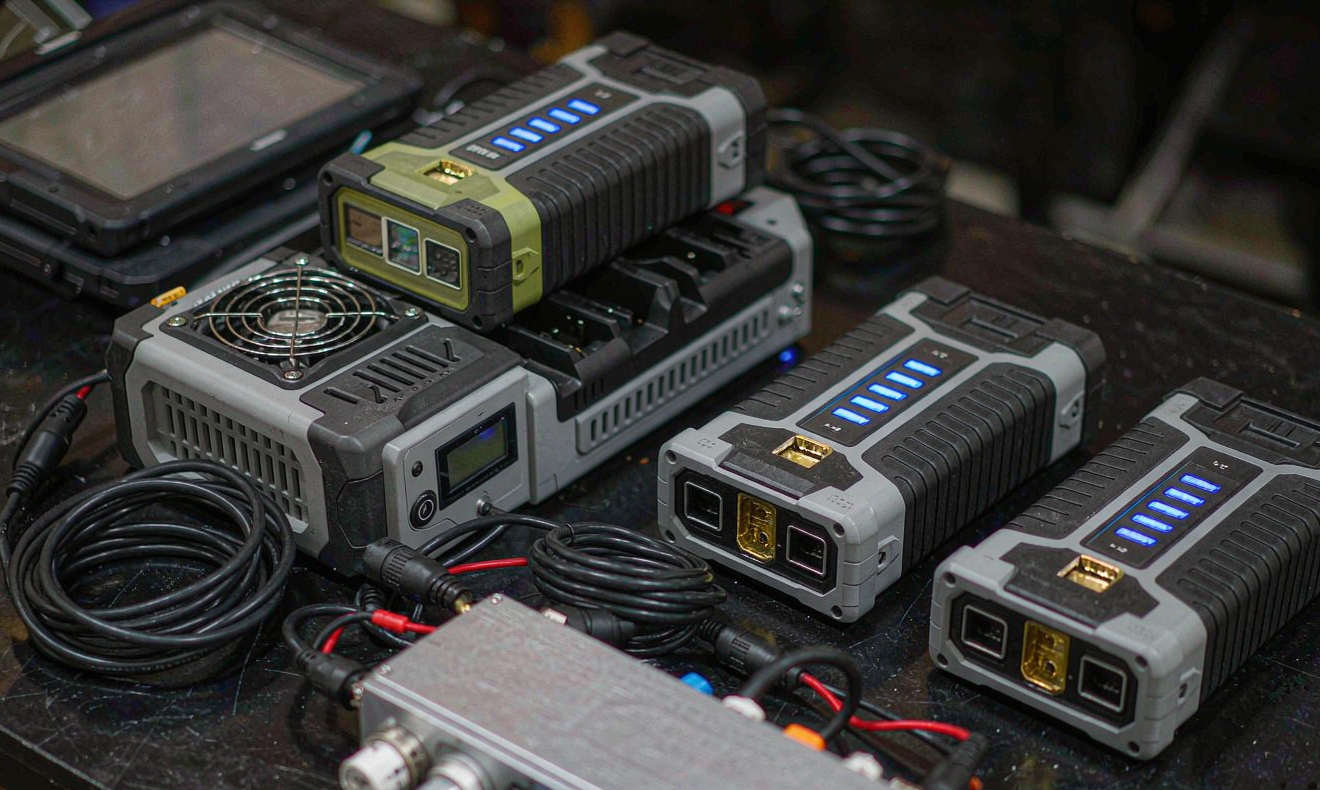
A charging plan is a schedule, not a charger. A typical four-bay desktop charger delivers around 2.5 A per channel at 16.8 V, which is about 42 W per channel. A 98 Wh pack needs roughly 2.8 hours from empty; a 290 Wh brick is between 7 and 8 hours. Fast chargers at 6 A cut a 98 Wh pack to about 1.2 hours, but charging at 2C or higher costs cycle life — I see 15–25% fewer cycles to 80% capacity on packs that live their lives on fast charge. My rule: fast charge on the day, standard charge overnight.
On generator power, insist on a pure sine wave inverter unit with total harmonic distortion under 5%. Switch-mode chargers on a dirty square-wave generator run hot, fold back their output current and occasionally fail outright. Size the generator with headroom: eight channels at 42 W is 336 W of charging load, and a 1 kW unit running at 34% is quieter, more fuel-efficient and more reliable than a 400 W unit running flat out.
Vehicle charging is the option crews abuse most. A 1500 W inverter on a 12 V vehicle system draws around 125 A from the alternator. With the engine off, that is a flat starter battery in under an hour on most production vans. If you need vehicle charging, install a properly sized DC-DC charger on a fused auxiliary circuit and keep the engine running or on an automatic start-stop guard.
Cold, Heat and Altitude: Derating the Pack On Location
Temperature is the difference between the number on the label and the number on the set. At −20 °C the internal resistance of a conventional liquid-electrolyte lithium-ion cell can rise 3–6× and deliverable capacity falls to 50–70% of rated. Worse, the fuel gauge reads capacity, not available power, so a pack showing 40% can hit its under-voltage cut-off the moment a camera punches to 200 W. That is the classic “it died at 40%” call I get every winter.
Three mitigations, in order of effectiveness: keep bricks in an insulated case with a passive or 12 V heated liner; never charge a pack below 0 °C — lithium plating on the anode is permanent capacity loss and a safety issue, so preheat to at least 5 °C first, ideally with a 5–10 W pad per module for 20–40 minutes; and de-rate your Wh planning by 30% for sub-zero days. Above 45 °C the problem flips to accelerated ageing — a pack stored at 45 °C and 100% state of charge loses far more capacity per month than one stored at 25 °C and 40% SoC. Desert shoots need shade and a cool-box more than they need extra capacity.
Choosing the Chemistry: Lithium, Semi-Solid State and Sodium-Ion
Different parts of a field kit want different cells, and treating “lithium” as one thing is a mistake.
- NMC / NCA lithium-ion: 200–260 Wh/kg at cell level, 500–800 cycles to 80% capacity at 1C and 100% depth of discharge. This is the default for camera bricks where mass is everything.
- LiFePO4: 90–120 Wh/kg but 2000–3000 cycles, far better thermal stability and a flat 3.2 V discharge curve. For a DIT cart or a base-camp power store that gets wheeled rather than carried, the cycle life wins outright and the weight penalty is irrelevant.
- Semi-solid-state: cells at 300–400 Wh/kg with dramatically reduced free liquid electrolyte. In field terms that means less gassing, less swelling over a multi-year rental life and better capacity retention in packs that sit at high state of charge for weeks between jobs — the exact duty cycle of a rental-house brick.
- Sodium-ion: 100–160 Wh/kg today, but genuine −40 °C discharge capability, strong abuse tolerance and no supply exposure to lithium or cobalt pricing. For winter-location cart power, base camp lighting and any application where the pack is heavy and stationary, a sodium-ion battery solution is now a serious engineering option rather than a lab curiosity.
Fleet Management: What Rental Houses Get Right
Owner-operators buy bricks; rental houses manage fleets, and the difference is data. A pack that has been through 400 cycles is not the pack that left the factory, and the only way to know is to log it. The system I recommend is a QR code on every pack tied to a record that captures: cycle count from the fuel-gauge IC, date of last capacity verification, measured internal resistance, and any physical event (drop, water ingress, connector damage).
Verification cadence of every six months or every 100 cycles, whichever comes first. The retirement criteria are simple and worth writing into a rental contract: capacity below 80% of nameplate, internal resistance above 1.5× the value measured at acceptance, any cell-group imbalance above 30 mV at rest, or any housing damage. Packs that fail cell-level criteria go back for rebuild rather than into a skip — the aluminium housing and connectors are the expensive part.
Certifications to demand from any supplier: IEC 62133-2 for the cell and battery, UN 38.3 with a current test summary, and ideally UL 2054 or UL 2056 for the pack assembly. If a supplier cannot produce a UN 38.3 test summary on request, they are not a supplier you want on a production that flies.
When a custom battery solution Is the Right Answer
Off-the-shelf bricks cover 80% of field-kit needs. The other 20% is where a custom battery solution pays for itself: a cart pack shaped to fit a specific rack dimension, a hot-swap dual-input design so the cart never powers down between takes, an SMBus fuel gauge that reports true state of charge instead of four blinking LEDs, an IP65 housing for a marine unit, or a pack built to exactly 98 Wh so it clears every airline rule without paperwork. The conversation always starts with the load table and the transport route, never with the cell.
If you are speccing a kit today, my closing recommendation is boring and it works: build the load table, buy 98 Wh bricks for anything that flies, put the cart on a fused distribution panel with proper cable gauge, log every cycle, and keep 20% of your capacity in reserve for the day the schedule goes long. Power failures on location are almost never battery failures. They are planning failures that happen to show up as a dead brick.
Frequently Asked Questions
How many watt-hours do I need for a half-day shoot?
Add up the real measured draw of every device in watts, multiply by hours, then multiply by 1.25 for duty cycle and 1.2 for design margin, and divide by 0.8 to leave a 20% reserve. A run-and-gun build measuring 90 W average over six hours works out to about 1010 Wh installed — roughly four 260 Wh bricks, or one 98 Wh brick for a 12 W mirrorless rig on the same day.
Can I fly with 190 Wh V-mount batteries?
Not as passenger baggage. Packs up to 100 Wh are carry-on with no approval, 100–160 Wh need airline approval and are normally limited to two spares, and anything above 160 Wh must ship as cargo under UN3480 or UN3481 as fully regulated Class 9 dangerous goods. Design airborne kits around 98 Wh and source the big cart batteries at the destination.
Is a 26 V high-voltage mount worth it over 14.4 V?
For large-format cameras drawing over 150 W, yes. Halving the current cuts cable losses to a quarter and keeps the voltage at the end of a long run inside the camera input window. For a 20 W mirrorless rig the benefit is negligible and the cost is not justified.
Why does my battery shut down in cold weather while still showing 40%?
Because the gauge reports remaining capacity, not deliverable power. At −20 °C cell internal resistance rises several-fold, so the voltage sags below the pack’s under-voltage cut-off the moment a high load is applied. Keep packs warm, de-rate capacity by about 30% for sub-zero work, and never charge below 0 °C without preheating to at least 5 °C.
Should I choose LiFePO4 for a DIT cart battery solution?
If the pack is wheeled rather than carried, usually yes. You give up roughly half the gravimetric energy density of NMC but gain three to four times the cycle life, better thermal stability and a flatter discharge curve. For a cart that charges and discharges every day for five years, cycle life is the number that matters.
What certifications should a field kit battery solution carry?
UN 38.3 with a current manufacturer’s test summary is mandatory for any pack that ships or flies. IEC 62133-2 covers cell and battery safety. UL 2054 or UL 2056 adds pack-level assurance. Ask for the documents before you buy, not after customs does.
When does a custom battery solution make sense for a small production?
When the shape, the connector set, the hot-swap behaviour or the transport constraint is specific. The most common small-crew custom request I build is a pack sized to exactly 98 Wh in a form factor that mounts to a particular cage or cart — maximum legal carry-on energy in the volume the rig actually has.