Sodium-Ion Battery Hard Carbon Anode Explained: Microstructure, First-Cycle Efficiency and Sourcing Guide
If you have been evaluating a sodium-ion battery for stationary storage, low-temperature equipment, or a cost-sensitive fleet application, you have probably noticed that most of the marketing conversation stops at the cathode: layered oxide, Prussian blue, or polyanion. In my fifteen years designing lithium and sodium packs, I can tell you that the real differentiator sits on the other electrode. The hard carbon anode is the single component that determines whether a sodium-ion cell delivers 3000 cycles or 800, whether it works at −20 °C, and whether its capacity curve is usable for your BMS. Get the anode specification wrong and no cathode chemistry will save the pack.
In this guide I will walk you through what hard carbon actually is at the microstructure level, why graphite—the backbone of every lithium battery ever mass-produced—simply does not work for sodium, how the storage mechanism shapes the voltage curve your BMS has to interpret, and what first-cycle efficiency numbers you should demand from a supplier. Everything here comes from cell teardown data, formation-line records, and supplier audits I have personally been part of, not from brochure claims.
Why the Anode—Not the Cathode—Defines Sodium-Ion Cell Performance
A sodium-ion battery is often described as a “drop-in” technology that reuses lithium-ion production lines, and that is largely true for the cathode side, where aluminum foil current collectors, water-based processing, and layered oxide or Prussian blue active materials follow familiar coating logic. The anode is where the two technologies diverge completely.
The root cause is ionic size. A sodium ion (Na⁺) has an effective radius roughly 55% larger than a lithium ion. Graphite’s interlayer spacing is 0.335 nm—fine for lithium, which slips between layers to form LiC₆. Sodium simply does not form a stable graphitic intercalation compound under normal conditions. Thermodynamically, NaC₈-type binary graphite intercalation compounds are not accessible in the carbonate electrolytes used in commercial cells. So the entire graphite supply chain—roughly 80% of the world’s anode capacity, centered on synthetic and natural graphite—is unusable for sodium chemistry.
That is why every commercial sodium-ion cell on the market today uses hard carbon. It is not a transitional compromise; it is the only anode class that currently delivers the combination of capacity, cycle life, and low-temperature performance that makes sodium-ion batteries viable. When I audit a sodium-ion supplier, I spend more time on their anode line and carbon sourcing than on anything else.
What Hard Carbon Actually Is: Microstructure From the Inside
Hard carbon is a disordered, non-graphitizable carbon. Heat it to 3000 °C the way you would graphitize petroleum coke, and it still refuses to develop long-range ordered graphite stacking. That stubbornness is exactly what makes it useful.
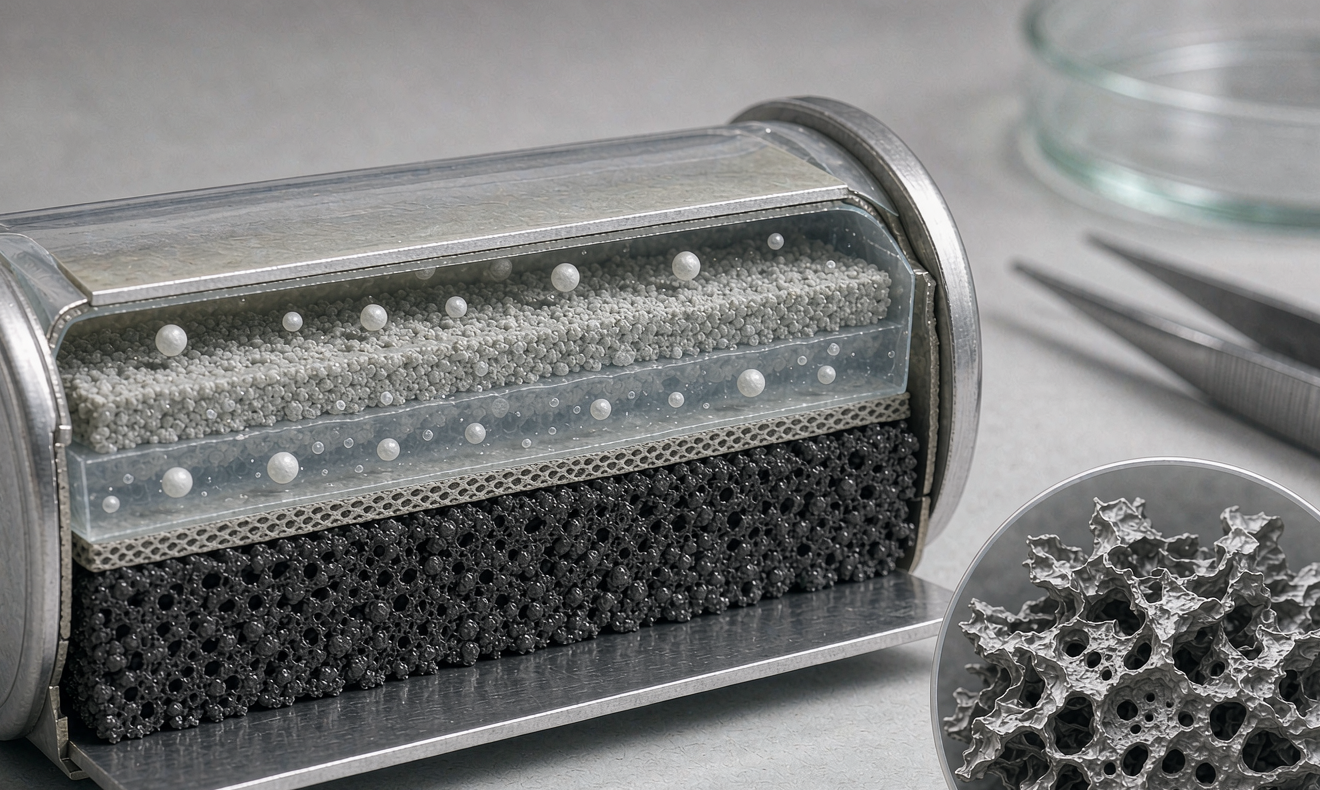
Structurally, hard carbon is best described by the “house of cards” model that has become the working consensus in the field:
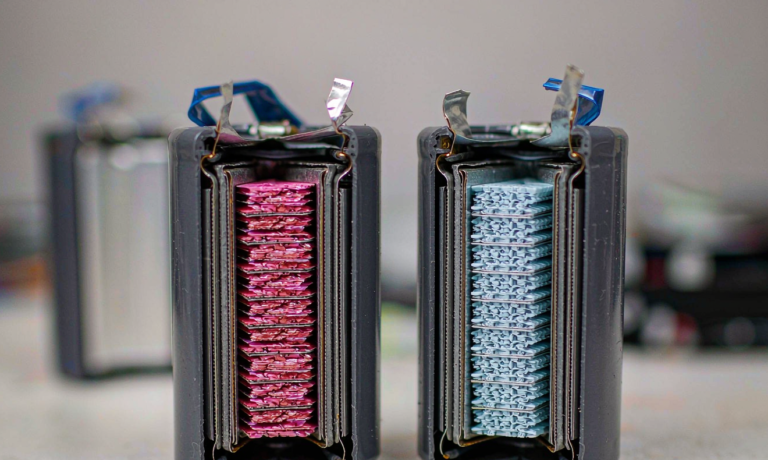
- Short, curved graphene-like domains stacked in a turbostratic fashion—layers are parallel locally but rotated randomly relative to their neighbors, with no ABAB registry.
- Widened interlayer spacing of 0.37–0.40 nm, compared with 0.335 nm in graphite. That extra 0.04–0.06 nm is what gives Na⁺ enough room to adsorb between layers.
- Closed nanopores in the 0.5–2 nm range, created by the curly, cross-linked stacking. These voids are where a large fraction of sodium is stored at low voltage.
- Defect sites and surface functional groups on particle edges that act as high-energy adsorption sites.
The microstructure is inherited from the precursor, and this is where sourcing strategy begins. Commercial hard carbon anodes are made from four main precursor families, each with a distinct cost and performance profile:
- Biomass (coconut shell, lignin, cellulose, bagasse): cheapest at $2–5/kg raw, but batch-to-batch ash content and pore distribution vary, requiring tight supplier QC. Well-engineered biomass carbon routinely reaches 300–330 mAh/g.
- Phenolic and epoxy resins: highly controllable nanostructure, 300–350 mAh/g achievable, but resin cost of $6–12/kg pushes cell-level cost up. This is the usual choice for premium low-temperature cells.
- Petroleum pitch and coal tar pitch: moderate cost, benefits from existing pitch infrastructure; needs oxidation stabilization and typically lands at 250–300 mAh/g.
- Anthracite and other cheap carbons: as low as $1–3/kg and used in some Chinese cost-optimized cells, generally 220–270 mAh/g with wider capacity spread.
Pyrolysis happens at 1000–1500 °C under inert atmosphere, often followed by acid washing or halogen treatment to remove metallic impurities and by mild milling to set the particle size distribution (D50 typically 5–10 µm). Two hard carbons with identical capacity on the datasheet can behave completely differently in cycle life if their closed-pore fraction differs by 10%, which is why datasheet-only comparison of any sodium-ion battery is a mistake I see B2B buyers make constantly.
How Hard Carbon Stores Sodium: Adsorption, Pore-Filling, and the Two-Region Voltage Curve
Understanding the storage mechanism is not academic—it directly dictates how your fuel-gauge algorithm works. Sodium storage in hard carbon proceeds through two distinct regimes that show up as two regions on the discharge curve:
Sloping region (roughly 1.2 V down to 0.1 V): sodium adsorbs on defect sites, surface groups, and between the turbostratic layers. This region contributes typically 40–50% of total capacity, with a smoothly sloping voltage.
Plateau region (below 0.1 V): sodium deposits into the closed nanopores, ideally as quasi-metallic clusters. This region delivers the remaining 50–60% of capacity on a flat, low-voltage plateau.
Total reversible capacity for commercial-grade hard carbon runs 250–350 mAh/g, against graphite’s 372 mAh/g. That, combined with sodium’s higher atomic mass, is the fundamental reason a sodium-ion cell lands at 100–160 Wh/kg at cell level versus 180–280 Wh/kg for mainstream lithium-ion.
The plateau carries three practical consequences that I deal with in every pack design:
- SoC estimation: a long flat plateau at ~0.1 V vs. Na/Na⁺ means open-circuit voltage is a poor SoC indicator across the middle of the charge range. Your BMS needs coulomb counting with periodic full-cycle recalibration, similar to what LFP packs require—expect 3–5% SoC error without a proper algorithm.
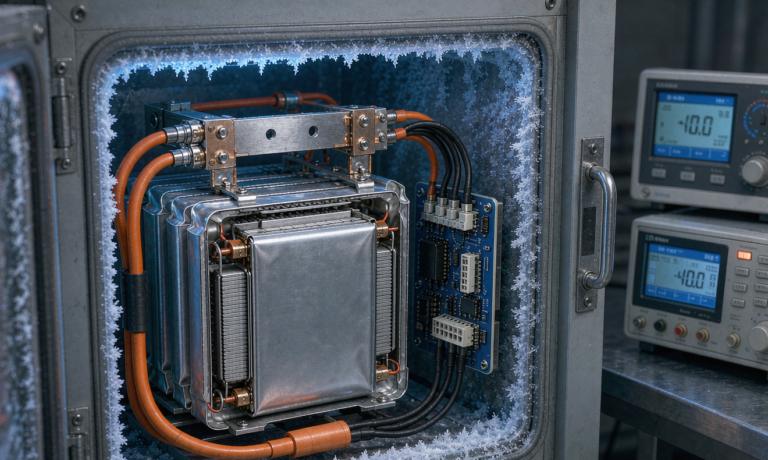
- Plating risk margin: the plateau sits dangerously close to 0 V vs. Na/Na⁺, the sodium plating potential. Fast charging at low temperature pushes the anode potential negative and plates metallic sodium. This is why a sodium-ion battery tolerates cold discharge beautifully (88–92% capacity at −20 °C for well-made cells) but still needs charge-rate derating below 0–5 °C.
- Cut-off voltage discipline: over-discharging below the specified cell cut-off (typically 1.5 V at pack level, corresponding to full de-sodiation) erodes the structure and accelerates capacity fade. Your BMS under-voltage thresholds must be tuned per supplier curve, not copied from a lithium template.
First-Cycle Coulomb Efficiency: The Number I Check Before Anything Else
On every hard carbon anode specification sheet, the figure I look at first is initial coulomb efficiency (ICE). During the first charge, electrolyte decomposes on the high-surface-area carbon surface and forms the solid electrolyte interphase (SEI), permanently consuming lithium—in this case, sodium—and some of the electrolyte. Hard carbon’s huge specific surface area (often 5–15 m²/g after processing) makes this loss significant.
Commercial sodium-ion hard carbon anodes typically show ICE between 85% and 92%. Every percentage point of ICE below 92% is cathode capacity that had to be oversized at the factory to compensate, which costs energy density and money. Cell makers mitigate first-cycle loss in three ways:
- Electrolyte additives such as FEC (2–5%) and VC (1–2%) that form a denser, more stable SEI in the first cycle.
- Carbon surface pre-coating or mild oxidation to reduce reactive edge density without killing capacity.
- Precycloped or pre-sodiated anodes (still mostly at pilot scale) where sacrificial sodium salt additives deliver sodium during formation, pushing effective first-cycle efficiency at cell level above 95%.
Beyond the first cycle, a well-made sodium-ion cell stabilizes quickly, but budget for reality: expect an additional 2–4% capacity loss across the first 100 cycles before the curve flattens, after which good cells hold 3000–6000 cycles to 80% retention. If a supplier’s cycle data jumps straight from cycle 5 to cycle 500, ask for the first-100-cycle record. Gaps there have historically hidden exactly the kind of early-fade problems that show up in the field within a year.
Manufacturing Hard Carbon Anodes: What Changes Versus a Graphite Line
Because sodium-ion reuses so much lithium-ion equipment, I am often asked whether a custom battery solution built on a sodium platform needs an entirely new anode production line. The honest answer: mostly no, with four important exceptions that I verify during every supplier audit.
1. Calendering pressure is lower. Hard carbon is softer and more brittle in compression than graphite, and its pore structure—the storage mechanism itself—collapses under aggressive densification. Anode density targets are typically 1.1–1.4 g/cm³ versus 1.5–1.7 g/cm³ for graphite, with calendering pressure tuned accordingly. Over-calendered hard carbon loses its closed pores and, with them, its plateau capacity.
2. Moisture control differs. Sodium salts (NaPF₆ in particular) are if anything more moisture-sensitive than LiPF₆—hydrolysis above roughly 20 ppm water generates HF that attacks both electrodes. Anode rooms for sodium lines run at dew points of −40 °C or better, and hard carbon’s hygroscopic surface means bake-out before coating is non-negotiable.
3. No copper foil—both electrodes use aluminum. Sodium does not alloy with aluminum, so the anode current collector is aluminum foil, the same as the cathode side. This removes copper entirely from the cell bill of materials (a real cost win—copper is roughly ten times the price of aluminum per kilogram) and enables a genuinely useful trick: the cell can be shipped and stored at 0 V without copper dissolution damage. For air-freight logistics, 0 V shipping simplifies UN38.3 state-of-charge constraints dramatically—I have used this to move sodium cells as fully-dead cargo where equivalent lithium packs would have needed careful SoC management below 30%.
4. Formation protocols are different. Formation on our reference lines runs 0.05C to a defined voltage hold, then staged 0.1C cycling over the full window, totaling 60–100 hours—longer than typical graphite-anode lithium formation—because SEI quality on high-surface-area carbon determines the entire cycle-life trajectory. K-value screening after formation (self-discharge below 0.05 mV/day at 30–35 °C) is the pass/fail gate I trust most for separating good anode batches from marginal ones.
Hard Carbon vs. Graphite: A Buyer’s Comparison Table
To put the sodium-ion battery hard carbon anode in context against the lithium incumbent, here is the comparison I present to engineering teams choosing between platforms:
| Parameter | Hard Carbon (Na-ion) | Graphite (Li-ion) |
|---|---|---|
| Reversible capacity | 250–350 mAh/g | 355–372 mAh/g |
| Interlayer spacing | 0.37–0.40 nm | 0.335 nm |
| Voltage vs. metal | ~0.1 V plateau (sloping above) | ~0.08 V flat |
| First-cycle efficiency | 85–92% | 90–95% |
| Current collector | Aluminum (both sides) | Copper |
| 0 V shipping | Yes, safe | No (Cu dissolution) |
| Raw material cost | $2–10/kg, non-critical supply chain | $5–20/kg, geographically concentrated |
The strategic point behind that table: hard carbon’s raw materials are abundant, non-critical, and can be sourced regionally—coconut shell carbon from Southeast Asia, pitch from any refinery, resin from any chemical supplier. For buyers burned by graphite and lithium supply concentration, this is one of the strongest arguments for the sodium platform, independent of chemistry performance.
Six Questions to Ask Any Sodium-Ion Cell Supplier About Their Hard Carbon
Before you commit a design to a sodium-ion battery, put these questions to the supplier in writing. The quality of the answers tells you more than any datasheet:
- What is the precursor and its supply redundancy? Single-source biomass from one processor is a supply risk; resin-based with dual qualification is stronger.
- What is the guaranteed ICE range, not the typical? Demand a minimum spec (I accept nothing below 88% for stationary products) and the SPC data behind it.
- What closed-pore fraction and D50 does the spec hold? These determine the plateau share and rate capability; vague answers mean loose process control.
- Show me first-100-cycle capacity data at 25 °C and −10 °C, full cycles, not normalized percentages.
- What is the K-value screen after formation, and what fraction of lots fails it? A mature line rejects 2–5% of cells; a line that rejects 0% is not screening.
- Is the anode powder qualified in IEC 62133-2 and UN38.3 test reports under the exact electrolyte formulation shipped today? Electrolyte changes silently invalidate old abuse-test data.
If you are specifying a pack rather than bare cells—say a rack-mounted system or an off-highway vehicle battery—a capable manufacturing partner will run this audit for you as part of cell qualification. This is a standard part of any serious custom battery solution engagement, and I would be suspicious of any supplier who resists sharing anode-level detail.
Where Hard Carbon Development Is Heading
Three directions are moving the needle right now, and they shape what you should expect from cells purchased in 2027–2028:
Higher ICE through electrolyte and interface engineering. The gap between 88% and 93% first-cycle efficiency is worth roughly 5–8% cell energy density. Additive packages (FEC/VC systems, and newer sulfate- and borate-based film formers) plus pre-sodiation additives are closing it; leading suppliers already quote cell-level first efficiency above 95% in internal data.
Higher capacity via controlled closed porosity. Lab-scale hard carbons exceeding 400 mAh/g now exist, built by precursor design that increases closed-pore volume while keeping the sloping-region adsorption sites stable. The trade-off is rate capability—pore-filled sodium diffuses slowly—so expect the first commercial use in stationary storage where C-rates are low.
Hard carbon–graphite hybrid thinking. For lithium applications, some anode makers are adding 5–15% hard carbon to graphite blends to improve fast-charge and low-temperature behavior. The materials science flows in both directions, and several hard carbon producers are the same companies that will sell into lithium anode blends—worth knowing when you assess supplier longevity.
Frequently Asked Questions
Why can’t sodium-ion batteries use graphite anodes like lithium-ion batteries do?
Sodium ions are too large (about 55% larger than lithium) to intercalate stably between graphite layers spaced 0.335 nm apart. Binary sodium-graphite intercalation compounds do not form in conventional carbonate electrolytes, so graphite delivers near-zero reversible capacity with sodium. Hard carbon’s wider, disordered structure (0.37–0.40 nm spacing plus closed pores) is the practical host.
What is a good first-cycle coulomb efficiency for a hard carbon anode?
For commercial cells today, 85–92%, with premium anodes at 90% or above. Below 85% signals poor SEI control, excessive surface area, or moisture contamination—treat it as a red flag and ask for lot-level SPC data.
Does the hard carbon anode affect how the BMS measures state of charge?
Yes, significantly. The long low-voltage plateau means OCV-based SoC estimation is unreliable through the middle of the charge range. Your BMS should use coulomb counting with periodic recalibration, and under-voltage/over-voltage thresholds must be tuned to the supplier’s specific curve rather than copied from a lithium template.
Is hard carbon safe and can sodium-ion cells ship at 0 V?
Hard carbon itself is not a safety liability—thermal runaway onset in commercial sodium-ion cells typically exceeds 200 °C. Because both electrodes use aluminum current collectors, sodium-ion cells can be transported and stored fully discharged at 0 V without the copper dissolution that makes 0 V lithium storage destructive, which simplifies UN38.3 logistics considerably.
How much does the hard carbon anode contribute to sodium-ion battery cost?
Raw material is cheap—$2–10/kg versus $5–20/kg for battery-grade graphite—but processing (inert-atmosphere pyrolysis at 1000–1500 °C, purification, milling) dominates cost. At scale, hard carbon anode finished powder lands around $4–8/kg, competitive with or below graphite, and it avoids critical-mineral exposure entirely.
Can hard carbon anodes work in cold climates?
Yes, and this is where sodium-ion beats mainstream LFP. Cells with well-engineered hard carbon retain 88–92% of capacity at −20 °C (versus roughly 60–70% for LFP), and hard carbon’s adsorption mechanism does not slow down as severely as graphite intercalation. Charging below 0 °C still requires current derating and ideally preheating, but cold-weather discharge is a genuine sodium advantage.
Will hard carbon be replaced by alloy anodes or other new materials?
Not in this product generation. Sodium alloy anodes (Sn, Sb, Bi, phosphorus) promise 400–1500 mAh/g but suffer 200–400% volume expansion, destroying cycle life without major electrode engineering. For the 3–5 year horizon, hard carbon with incremental ICE and capacity improvements remains the anode of record for commercial sodium-ion batteries.