Sodium-Ion Battery for Residential Solar Self-Consumption
I have spent the last decade specifying cells for UAV packs, telecom backup strings and, more recently, for the garage wall. In the last three years the question I get most often from homeowners and small EPC partners is no longer whether to store solar energy, but which chemistry to store it in. This article is my field answer, written for people who have to sign off on a sodium-ion battery for residential solar self consumption and then live with it for fifteen years.
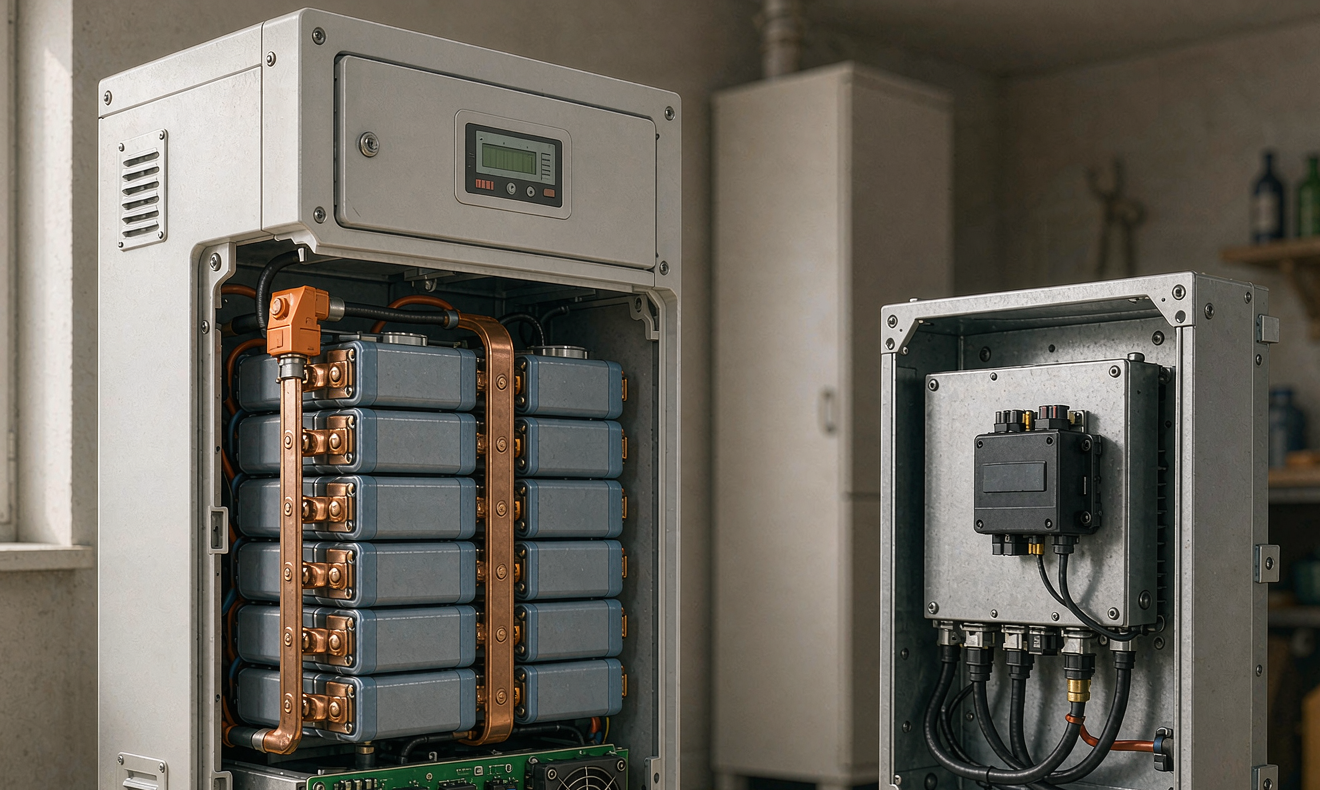
Self-consumption is the fraction of your own rooftop generation that you use behind the meter instead of exporting it. Export tariffs have fallen from the generous feed-in levels of the 2010s to a few cents per kilowatt-hour in most markets, while retail electricity has gone the other way. When the export price is a quarter of the import price, every kilowatt-hour you store and reuse is worth roughly four times what it earns you on the grid. That arithmetic, not chemistry fashion, is what is pushing households toward a battery.
Why Self-Consumption Is the Only Number That Matters
A typical four-person household in a temperate climate consumes between 4,500 and 6,000 kWh a year, or roughly 12 to 16 kWh a day. A 6 to 8 kWp rooftop array in the same climate produces 7,000 to 9,000 kWh a year. Without storage, the overlap between when the roof produces and when the house consumes is poor: the array peaks at midday when the house is empty, and the evening load peak from 18:00 to 22:00 happens after sunset. Measured across the sites I have commissioned, the direct self-consumption rate without a battery is 30 to 40 percent.
Add a 10 kWh usable battery and that figure moves to 60 to 70 percent. Add 15 to 20 kWh, or a heat pump and a smarter load schedule, and you reach 75 to 85 percent. The curve is non-linear: the first 5 kWh buys you a large share, and each additional kilowatt-hour buys progressively less. This is why sizing discipline matters more than raw chemistry choice, and why I start every project with a load audit rather than a product catalogue.
Sodium-Ion Chemistry in Plain Engineering Terms
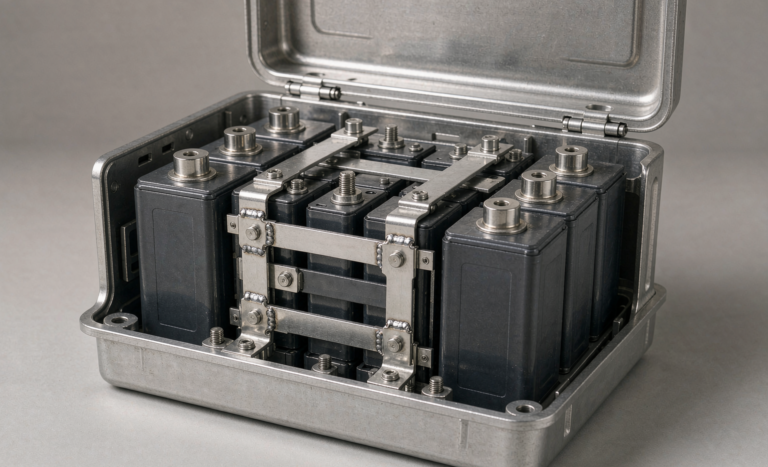
A sodium-ion battery works on the same rocking-chair principle as a lithium battery: cations shuttle between a layered cathode and an anode through a liquid electrolyte, and electrons take the external circuit. The differences that matter to a system designer are these.
- Charge carrier. Sodium ions are roughly 55 percent larger in ionic radius than lithium ions. That costs you energy density and rules out graphite as the anode, so the industry uses hard carbon, a disordered non-graphitizable carbon with closed nanopores.
- Current collectors. Sodium does not alloy with aluminium at the anode potential, so both electrodes use aluminium foil and copper is eliminated from the cell entirely. That removes a costly, heavy, price-volatile metal.
- Voltage window. A sodium cell runs roughly 1.5 V to 3.9 V with a nominal around 3.0 V, against 3.6 to 3.7 V nominal for an LFP cell. Fewer cells in series for a given pack voltage, but less energy per cell.
- Transport state. A sodium-ion cell can be discharged to zero volts and remain stable and recoverable. This is genuinely transformative for shipping and long-term storage, and I will come back to it in the FAQ.
On the specification sheet, expect 100 to 160 Wh/kg at cell level and 70 to 110 Wh/kg at pack level, with volumetric density of 180 to 260 Wh/L for cells. Against LFP that is roughly 60 to 75 percent of the gravimetric number, so a sodium pack is 25 to 40 percent larger and heavier for the same nameplate energy. In a garage with a load-bearing wall that is a manageable trade. In a balcony apartment it may not be.
Sizing a Sodium-Ion Battery for a Home: The Load-Audit Method
I do not size from the roof. I size from the load. The procedure takes about an hour with a year of interval data.
Step 1: Build the hourly load profile
Pull 15-minute or hourly consumption for twelve months. Separate weather-driven loads (heat pump, air conditioning) from behavioural loads (cooking, laundry, EV charging). A house with a 9 kW heat pump in January has a very different storage requirement than in May, and a battery sized for the annual average will disappoint you in the coldest month.
Step 2: Overlay the generation profile
Use PVWatts or a local equivalent with your real tilt, azimuth and shading. I derate modelled annual yield by 6 to 10 percent for soiling, module mismatch, inverter clipping and cable losses.
Step 3: Choose the target self-consumption band
Most households find the economic optimum between 65 and 80 percent. Pushing above that requires a large battery that only reaches full charge on a handful of days a year.
Step 4: Convert to usable capacity
A practical rule from the field: usable capacity in kWh should be roughly 0.5 to 0.7 times average daily consumption. For a 14 kWh-per-day house, that is 7 to 10 kWh usable. Remember to convert nameplate to usable by the allowed depth of discharge a 10 kWh nameplate pack at 90 percent DoD gives you 9 kWh usable, and the BMS will reserve a buffer below that anyway.
Step 5: Check the charge power constraint
This is the step most people skip. A 10 kWh pack that needs to be filled in the four-hour solar window requires at least 2.5 kW of charge power, or 0.25C. Sodium cells comfortably accept 0.5C continuous charge and 1C peak in current designs, so this is rarely a limit, but a cold garage in February is a different story.
Round-Trip Efficiency, Depth of Discharge and Usable Capacity
Measured DC round-trip efficiency for current sodium-ion cells is 88 to 93 percent at 25 degrees C and 0.3C. Include the hybrid inverter and budget 85 to 90 percent AC-to-AC. LFP sits a few points higher, typically 92 to 95 percent DC. On a 10 kWh daily cycle a four-point gap is about 150 kWh a year. It is real, but it is not the deciding factor.
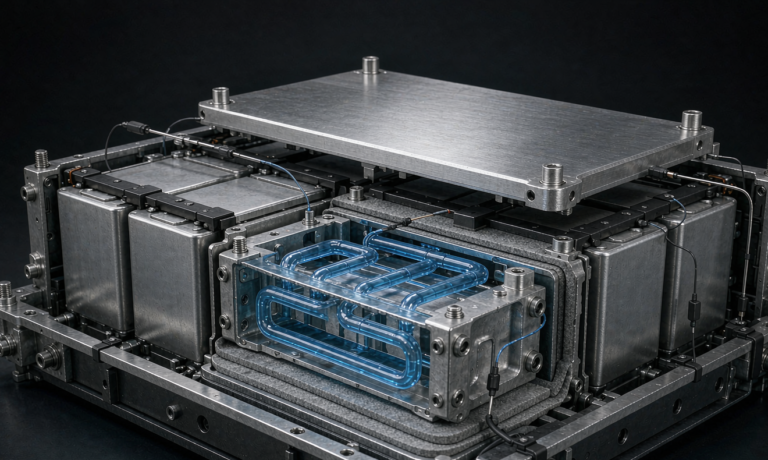
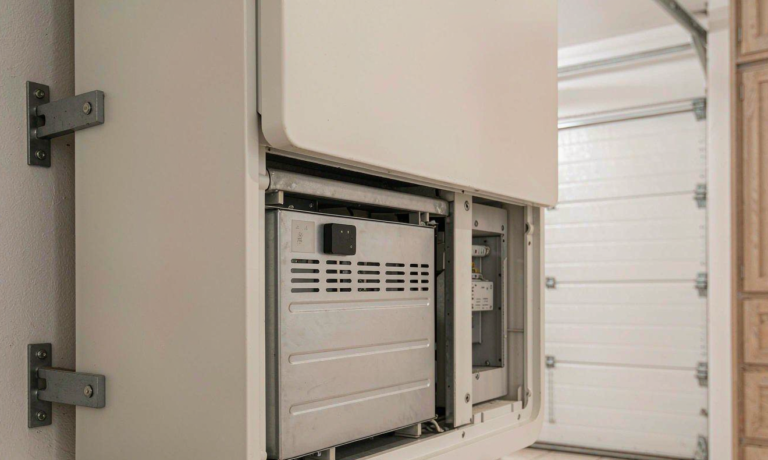
The more important number is usable energy over the warranty period. Sodium cells in production today are specified at 3,000 to 6,000 full equivalent cycles to 80 percent of beginning-of-life capacity at 25 degrees C, with some hard-carbon designs claiming beyond 8,000 cycles at shallow depth of discharge. At one cycle a day, 4,000 cycles is eleven years. Calendar degradation runs 0.3 to 0.5 percent a year at 25 degrees C, and it roughly doubles for every 10 degrees C rise in cell temperature, which is why I insist on a ventilated wall and never a sealed south-facing cabinet.
One honest caveat: hard carbon anodes have a lower first-cycle coulombic efficiency than graphite, typically 85 to 92 percent at cell level versus 92 to 95 percent for LFP. The sodium inventory consumed forming the solid electrolyte interphase in the first cycles is gone for good. In practice this shows up as 2 to 4 percent of extra capacity fade in the first 100 cycles, after which the curve flattens. I write this into the acceptance criteria so nobody panics at the first capacity check.
Low-Temperature Behaviour and Garage Installations
Cold performance is where sodium earns its place in a home. At minus 20 degrees C and 0.3C discharge, sodium cells I have tested retain 85 to 92 percent of room-temperature capacity, against 65 to 75 percent for comparable LFP. The larger sodium ion moves through the electrolyte and across the interphase with less kinetic penalty than you would expect from the radius difference.
Charging is a separate matter. Below 0 degrees C I derate to 0.1C and require the BMS to hold charge current at zero until a preheat film or the self-heating from discharge brings the cells above 5 degrees C. Plating risk exists for sodium as it does for lithium, and the mitigation is identical: current, not voltage, is the variable you control. For an unheated garage in a cold climate, budget 60 to 120 W of self-heating during the winter charge window and accept the 3 to 5 percent annual energy penalty. It is cheaper than replacing a plated pack.
BMS, Inverter Compatibility and Safety Compliance
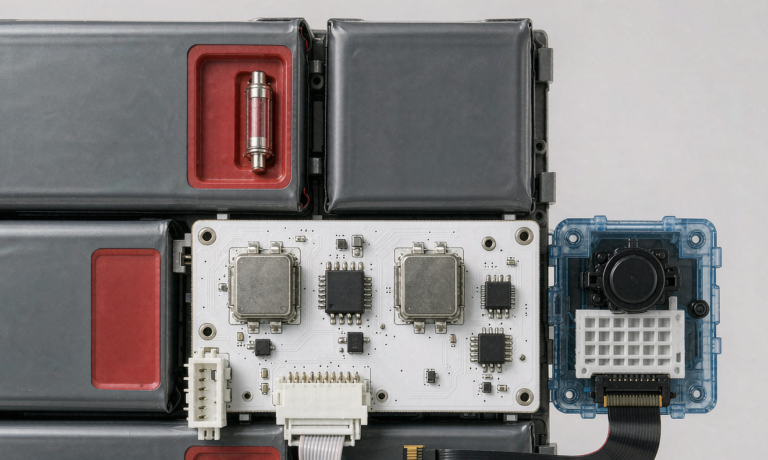
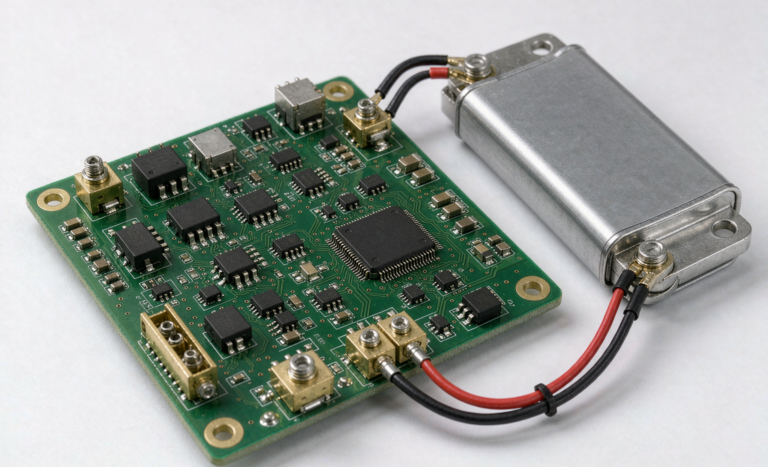
A sodium-ion battery for residential solar self consumption has one unexpected BMS advantage: the open-circuit-voltage versus state-of-charge curve is far more sloped than LFP’s, particularly below 30 percent and above 80 percent SoC. LFP’s flat plateau makes voltage-based SoC estimation almost useless, which is why lithium designs lean on coulomb counting and drift over long float periods. Sodium gives the estimator a usable voltage signal, and in my testing a well-tuned pack holds SoC error inside 3 percent with only periodic full-charge recalibration.
Balancing should be passive at 50 to 100 mA for a small residential pack, or active at 1 to 2 A above 20 kWh. Cell limits I specify are 1.5 V discharge cutoff and 3.9 to 4.0 V charge cutoff, with a hard contactor open at 4.05 V and pack-level second protection independent of BMS firmware.
On integration, confirm three things before you buy: the pack voltage window must sit inside the inverter’s battery input range (48 V low-voltage or 150 to 600 V high-voltage stacks); the communication protocol must be genuinely supported, not just listed, with CAN 2.0B at 500 kbit/s and RS485 Modbus RTU the common ones; and the charge algorithm must let you set custom voltage limits rather than forcing an LFP profile onto a cell with a different window.
For compliance, the documents I require in the file before energising are UN38.3 (T1 through T8) with a valid test summary, IEC 62133-2 for the cells, IEC 62619 for the pack, IEC 62477-1 for the power conversion equipment, UL 1973 and UL 9540 with a 9540A thermal runaway propagation report for North America, and the local grid code EN 50549 in Europe, IEEE 1547 in the United States, VDE-AR-N 4105 in Germany, G98 or G99 in the United Kingdom. Where the pack goes inside a dwelling or an attached garage, NFPA 855 spacing and the 20 kWh per fire-separated unit rule usually govern the layout.
What a Sodium-Ion Battery Actually Costs per Usable Kilowatt-Hour
I will not quote a single dollar figure, because it moves every quarter, but I can give you the structure. Cell pricing for early-production sodium is currently above LFP, not below it, because LFP has a decade of gigascale learning behind it and sodium has perhaps three years. The cost case for sodium rests on bill of materials, not on today’s quotes: no lithium carbonate, no copper foil, no cobalt and no nickel in the mainstream layered-oxide and Prussian-white cathodes.
What matters is cost per usable kilowatt-hour over the service life, which is pack price divided by usable capacity divided by warranted cycles. A pack that is 15 percent cheaper but 15 percent lower in energy density is not cheaper once you have bought the bigger enclosure and the stronger wall bracket. Ask your supplier for the figure on a per-usable-kWh-per-cycle basis and make them show the cycle test report behind it.
Commissioning: The Five Checks I Never Skip
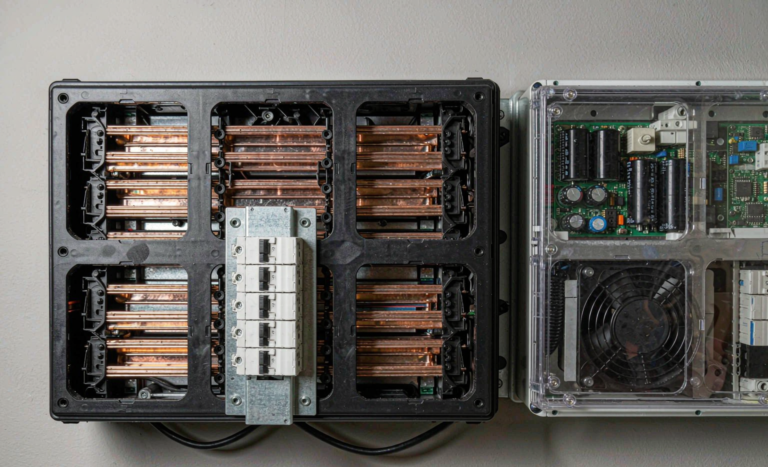
- Insulation and torque. Megger the DC bus at 500 V for residential systems and confirm greater than 1 megohm. Torque every busbar and connector to the printed value and mark it.
- Cell delta at rest. After a full charge and two-hour rest, cell voltage spread must be under 30 mV. Above 50 mV, investigate before you energise.
- Capacity verification. One full 0.2C discharge to cutoff, measured at the AC meter. The result must be at least 95 percent of usable nameplate after correcting for the first-cycle loss I described earlier.
- Protection trip test. Force over-voltage, over-current and over-temperature trips in a controlled bench test or by injecting the fault signal, and confirm the contactor opens and the inverter logs the event.
- Grid code function test. Loss-of-mains, anti-islanding and reconnection timers verified against the local standard, witnessed and signed.
Frequently Asked Questions
Is a sodium-ion battery safe enough to install inside a home or garage?
Yes, when it is certified and installed correctly. Sodium cells have a higher thermal runaway onset temperature than many high-nickel lithium cells, they contain no cobalt, and they can be stored at zero volts with no risk of the copper dissolution that makes a deeply discharged lithium cell hazardous. You should still require UL 9540A propagation test data, a smoke detector in the room, and compliance with your local fire code on unit spacing.
How much usable capacity do I need for self-consumption?
Budget 0.5 to 0.7 times your average daily consumption in usable kilowatt-hours. A 14 kWh-per-day household generally lands at 7 to 10 kWh usable, which is a 10 kWh nameplate pack at 90 percent depth of discharge. Going much beyond that has a poor marginal return unless you also run a heat pump or charge an electric vehicle.
Can a sodium-ion battery work with my existing hybrid inverter?
Often yes, but only if the pack voltage window falls inside the inverter’s battery input range and the manufacturer publishes a compatible protocol. Most residential sodium stacks are offered with CAN 2.0B and Modbus RTU and emulate common lithium protocols. The failure mode I see is an inverter that forces an LFP voltage profile onto a cell with a different window, so confirm custom voltage limits in writing.
How does cold weather affect a sodium-ion battery?
Discharge is the good news: 85 to 92 percent of room-temperature capacity at minus 20 degrees C, better than comparable LFP. Charging is the constraint. Below freezing, derate to 0.1C and do not charge at all until the cells are above 5 degrees C, using a preheat film if the room is unheated. Budget 60 to 120 W of heating during winter charge windows.
What lifetime and warranty should I expect?
Look for 3,000 to 6,000 full equivalent cycles to 80 percent capacity retention and a ten-year warranty that states the retained-capacity guarantee explicitly, not just a defect warranty. Calendar loss should be under 0.5 percent a year at 25 degrees C. Be sceptical of any cycle claim that does not state test temperature, rate and depth of discharge.
Does a sodium-ion battery make sense if I already have an LFP system?
Rarely as a replacement, sometimes as an expansion. Mixing chemistries on one DC bus needs separate BMS masters and careful inverter configuration, and I generally advise against it. If you need more capacity, the safer route is a second, independently controlled AC-coupled unit.
Where I Land on Sodium for the Home
If you live in a cold climate, have a garage wall that can take the weight, and are buying storage for self-consumption rather than for backup power in a tight space, a sodium-ion battery is a defensible and increasingly attractive choice today. If your constraint is volume or you need maximum energy in a cupboard, LFP still wins on density. The supply-chain argument for sodium is strong and getting stronger, and the chemistry has moved from laboratory curiosity to certified product faster than most of us in the industry predicted.
At Horizon Power we build custom battery solution platforms across lithium, sodium and semi-solid chemistries, and the honest answer is that the right choice depends on your load profile, your climate and your wall. Run the load audit first; the chemistry decision gets easy once the numbers are on the table.