Home Energy Storage in Hot Attics and Garages
Every residential installer has the same conversation weekly: “can we put the home energy storage battery in the garage, or up in the attic?” The answer is almost always yes — with conditions, and those conditions change the warranty, the usable capacity and occasionally the safety case. After eleven years specifying lithium battery packs for stationary storage and enough hot-climate field returns, I can tell you the failure rarely happens inside the cell. It happens in the ten centimetres of air around the enclosure.
This guide covers the thermal physics, the derating arithmetic, the enclosure options that actually survive a 55 °C attic, the code framework you will be inspected against, and the acceptance tests I run before signing off an installation. The numbers here are the ones I use in my own sizing spreadsheets, not marketing figures.
Why attics and garages are the worst place you can put a battery
A conditioned mechanical room sits between 18 °C and 26 °C all year. An attached garage in a temperate climate swings from about 5 °C in January to 38 °C in July. A dark, unventilated attic is far worse: I have logged 62 °C under the roof deck on a 34 °C afternoon in California, 58 °C in Arizona, 55 °C in southern Spain. The air is not the limit — the radiant load from the deck is.
Three things make these locations hard. Ambient temperature: the pack spends months above the 25 °C reference point behind every datasheet cycle-life number. Diurnal cycling: a 25 K daily swing means the enclosure breathes, and every breath pulls humid, dust-laden air past live conductors. Solar gain: a dark grey cabinet on an exterior wall runs 12–18 K hotter than the surrounding air at midday.
What heat actually does to LFP cells
Two independent degradation mechanisms run inside a lithium battery, and they behave differently with temperature.
Calendar fade is the slow growth of the solid electrolyte interphase and the loss of cyclable lithium while the cell simply sits there. It is Arrhenius-driven, so the rate roughly doubles per 10 °C. At 25 °C and 50% SOC a cell loses about 1.5–2.5% per year; at 35 °C, 3–4%; at 45 °C, plan for 6–8%. State of charge multiplies it: parked at 100% SOC and 40 °C I have measured 9–11% loss in a single year on cells that would have lost 3% at 50% SOC.
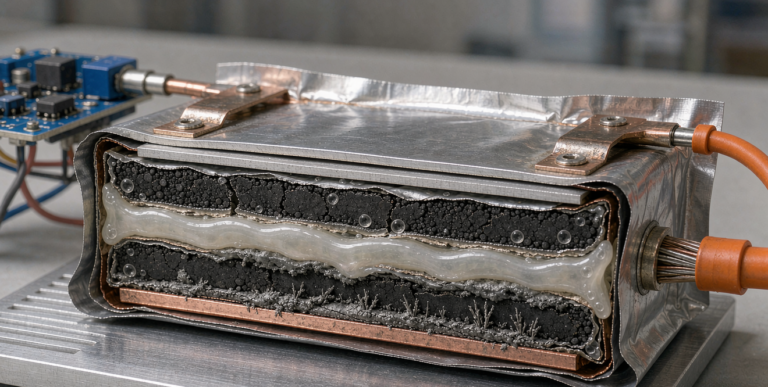
Cycle fade is mechanical: the graphite anode expands and contracts each charge, particle cracking accumulates, and the SEI repairs itself by consuming lithium. Temperature accelerates the parasitic chemistry alongside it. The same LFP cell that delivers 6,000 cycles to 80% capacity at 25 °C and 0.5C typically delivers 3,500–4,000 at 35 °C and fewer than 2,000 at 45 °C — a factor-of-three life difference from a location decision alone.
The chemistry comparison matters here. NMC cells carry more energy per kilogram — 240–280 Wh/kg against 150–180 Wh/kg for LFP — but their accelerating rate calorimetry self-heating onset is 110–140 °C against roughly 250 °C for LFP. In an attic that already reaches 60 °C that margin is everything. I specify LFP for unconditioned residential siting every time; if a client insists on NMC I require active cooling with redundant thermal cut-outs. Sodium-ion sits closer to LFP on onset at 200–230 °C and behaves better in the cold, but at 100–160 Wh/kg the enclosure grows 25–40% for the same kilowatt-hours.
Sizing with a real derating factor
Here is the arithmetic I teach every new engineer on my team. It has four terms, and three are routinely ignored.
Start from the critical load: whole-home backup for a 3 kW average draw over an 8-hour outage is 24 kWh delivered. Now divide by everything between that and the nameplate on the box:
- Depth of discharge — 0.90 for a quality LFP system whose BMS enforces it.
- Round-trip efficiency — 0.92 to 0.95 depending on inverter and charge rate.
- End-of-life margin — 0.80, because the warranty floor is 80% of nameplate and you must meet the runtime in year ten, not year one.
- Thermal derating — the one people forget: an enclosure that spends summers at 40 °C delivers neither full nameplate capacity nor datasheet cycle life.
24 ÷ (0.90 × 0.93 × 0.80) = 35.9 kWh nameplate. In a conditioned room I would specify 36 kWh. In a hot garage I add 10% and specify 40 kWh, because the alternative is a callback in year six.
That thermal term is not only about capacity on the hottest day; it is about the warranty claim. Most residential warranties guarantee 70% or 80% retained capacity at ten years with an operating temperature clause — commonly “continuous ambient above 35 °C voids the capacity guarantee”. Read it before you sign the submittal. I have seen two claims denied on exactly this language; in both, log data showed 1,900 hours above 40 °C.
Cooling options that survive an attic, and those that do not
Let me rank the options by what they actually achieve, because the marketing here is optimistic.
Passive convection only. Fine up to about 35 °C ambient; above that the cells simply track ambient plus self-heating. For a mild maritime garage this is genuinely adequate — I have nine-year-old packs in a UK garage with 84% capacity remaining and no fan at all.
Forced air with filtration. Buys 5–10 K for 20–40 W. The failure mode is not the fan, it is the inlet filter: dust and lint load it, airflow drops, and the margin disappears on the hottest day of the year. Commit to a service interval — quarterly in a garage, monthly in a workshop — and use G4 or better intake filtration with slight positive pressure so unfiltered air is not drawn in through the cable glands.
Phase change material and heat spreaders. Useful for peak shaving, not continuous load. A paraffin or salt-hydrate panel against the cell stack absorbs the morning ramp and blunts a 2–3 hour peak, buying 4–7 K. Once melted it is just insulation, so it does nothing for a sustained 50 °C afternoon. Use it in combination, never alone.
Mini compressor air conditioning. The only option that works when ambient exceeds 45 °C for weeks. At a COP of 1.5–2.5, a 300 W cooling load costs 120–200 W of overhead, or 1–1.7 MWh a year if it runs continuously. On a 20 kWh pack that is a real parasitic draw, so I specify a thermostat that engages on 35 °C cell temperature, not ambient.
Thermoelectric (Peltier) coolers. Do not. At a COP of 0.5–0.7 they move less heat than they generate, they fail silently, and in an attic they become a net heater within a season.
The cheapest 8–12 K you will ever get is not cooling at all — it is a radiant barrier under the roof deck, a light-coloured enclosure finish, and a shaded, ventilated position on an interior wall rather than the exterior one. That is a one-time cost with zero parasitic load, and it usually makes the difference between needing active cooling and not.
Siting rules I will not compromise on
These come from field experience with home energy storage installations and from the codes you will be inspected against, in roughly that order of strictness.
- Never on an exterior wall in full sun. Interior wall or shaded elevation; worth 8–12 K.
- Maintain 900 mm clear working space in front of the unit — a code requirement in most jurisdictions, and the difference between a serviceable installation and one a technician will refuse to touch.
- Elevate at least 450 mm above a garage floor. Vehicle impact, and petrol vapour is heavier than air.
- IP65 minimum in a garage or workshop, NEMA 3R or better outdoors, NEMA 4X with 316 stainless hardware on coastal sites.
- Fit a breathable ePTFE vent, never a sealed box: with 25 K diurnal swings a sealed enclosure condenses water inside within a year. I have pulled apart units with 40 ml in the bottom of the case.
- Conformal coat the BMS to IPC-CC-830 and use tin- or nickel-plated busbars wherever paint, solvents, fertiliser or pool chemicals are also stored.
- Keep the pack out of the vehicle impact path — a designated corner, never the swing zone behind a parking bay.
- Not below the flood line, not under a water heater, and not in an attic position directly beneath a plumbing run.
Fire safety, detectors and the code framework
The governing stack varies by jurisdiction, but this appears in almost every one I work in: UL 9540 for the system, UL 9540A for thermal runaway propagation, NFPA 855 for installation, IEC 62619 and IEC 62133-2 for cells and pack, UN 38.3 for transport (shipped at 30% SOC or less), and NEC Article 706 for the electrical connection. Indoors, most authorities also require a fire-resistance-rated separation — commonly one layer of 5/8 inch Type X gypsum — between the battery and living space.
Detector placement is where I see the sloppiest work. Smoke detectors are wrong for a garage: dust, exhaust and humidity cause nuisance trips and the unit ends up disabled. Install an interconnected rate-of-rise heat detector at the battery, plus a carbon monoxide detector in any attached garage. Where smoke detection is required, mount a photoelectric unit at least 900 mm clear of the enclosure and out of the fan airflow.
Know what UL 9540A does and does not tell you: it characterises propagation from a single cell and the gas generated, not a promise that a pack cannot burn, and not a substitute for clearances. I read the summary for two things — whether propagation was contained, and the maximum surface temperature.
Monitoring, SoH tracking and the maintenance nobody schedules
A hot-location installation is a monitoring installation. My minimum: cell voltage at 1 Hz or better, pack current at 1 kHz for protection, cell temperature at 10 Hz, and contactor open within 5 ms of a fault. Anything slower and you are relying on thermal mass to save you.
For state of health I run two estimators in parallel. Coulomb counting gives capacity under real load but drifts; a 1 kHz impedance measurement at fixed SOC and temperature gives the early warning, rising 25–30% some 300–500 cycles before the capacity curve visibly bends. In a hot attic that warning tells you to improve ventilation before the pack falls out of warranty.
The handover maintenance schedule is short and specific:
- Monthly, remote: review max cell temperature, cell delta and insulation resistance trend. Any delta above 30 mV at rest is a work order.
- Quarterly, on site: clean or replace the intake filter, check the fan spins freely, check the breather vent is clear.
- Six-monthly: infrared scan of every bolted termination under load; any joint more than 15 K above its neighbour gets re-torqued.
- Annually: a 0.2C capacity test — anything under 95% of expected gets investigated, not filed — plus a functional test proving the thermal cut-out interrupts the contactor rather than merely alarming.
Commissioning: five tests before I sign off
These five take under two hours and catch most site defects.
- Insulation resistance at 500 V. Above 100 MΩ is good; below 10 MΩ is do-not-energise. I have rejected three units on this test alone, all with moisture in the connector cavity from outdoor storage.
- Cell balance at rest. Charge to 100%, rest two hours, measure. Delta under 30 mV is acceptable; higher means the pack was never balanced or a cell is damaged.
- Capacity at 0.2C. Must return at least 95% of nameplate. This is your year-zero baseline; without it, year-five data is meaningless.
- Thermal imaging under full load after 30 minutes. Joint-to-joint delta above 15 K means re-torque and re-test.
- Charging interlock. Confirm the BMS blocks charge below 5 °C cell temperature — lithium plating is irreversible and the leading cause of cold-climate capacity loss — and derates above the high-temperature limit. Test it on the bench with a simulated sensor, not by waiting for winter.
When the answer is simply “not the attic”
There is a point at which mitigation stops making economic sense, and it is worth naming. If the attic sustains above 50 °C, or the request is to put a large pack where no practical ventilation path exists, the honest answer is a purpose-built outdoor enclosure — shaded elevation, NEMA 3R, its own ventilation and a slab. The enclosure and longer DC run usually cost less than the annual parasitic cooling load plus the accelerated replacement.
Attics and garages are workable for home energy storage — I have commissioned hundreds of them. They work because someone did the derating arithmetic, chose LFP, provided a shading and ventilation path, and set up monitoring that tells the truth about what the pack experiences. Skip one of those and you have built a callback with a ten-year warranty attached.
Frequently Asked Questions
How hot is too hot for a home energy storage battery?
For continuous operation, treat 35 °C ambient as the point where cycle life starts falling measurably and 45 °C as where most capacity guarantees stop applying. Absolute cell limits are typically 60 °C charging, 60–65 °C discharge, at which a correctly configured BMS derates or disconnects. Practically: an attic regularly above 50 °C needs active cooling or a different location.
Does installing a home battery in a garage void the warranty?
Not automatically, but it can void parts of it. Most residential warranties carry an operating temperature clause — commonly continuous ambient above 35 °C or 40 °C excludes the ten-year capacity guarantee. Attached garages in hot climates routinely exceed that. Read the environmental specification before signing the submittal and budget for ventilation or cooling to stay inside it.
How much capacity do I lose by putting the battery in a hot attic?
Capacity on the day is a small loss, 3–8% at 45 °C against 25 °C. The real loss is life: LFP that would deliver 6,000 cycles at 25 °C delivers roughly 3,500–4,000 at 35 °C and under 2,000 at 45 °C, while calendar fade goes from about 2% per year to 6–8%. In sizing terms I add 10% nameplate for an unconditioned hot location.
Do I need active cooling for a garage battery installation?
Usually not in a mild maritime climate — passive convection plus a shaded interior wall is adequate to about 35 °C. Where sustained summer garage temperatures exceed 40 °C I specify filtered forced air, and above 45 °C a small compressor air conditioner. Avoid thermoelectric coolers entirely; at a COP of 0.5–0.7 they add more heat than they remove and fail silently.
What fire rating and separation does a garage battery need?
Requirements are local, but the common pattern is NFPA 855 for installation, UL 9540 for the system, UL 9540A for propagation data, and a fire-resistance-rated separation from living space — usually one layer of 5/8 inch Type X gypsum . Confirm with the authority having jurisdiction before rough-in, because the separation drives where you can mount the unit.
Should I use a smoke detector or a heat detector with my battery?
Use an interconnected rate-of-rise heat detector at the battery. Photoelectric smoke detectors in garages nuisance-trip on dust and exhaust and end up disconnected, which is worse than none. Where smoke detection is required, mount it at least 900 mm clear of the enclosure and out of the fan airflow.
Can I charge a lithium battery in a cold garage in winter?
Not below 5 °C cell temperature. Charging near or below freezing plates metallic lithium on the anode — permanent capacity loss and a nucleation site for internal shorts. A quality BMS enforces the interlock; if the pack has no low-temperature inhibit, add a 1.5–3 kW heating pad and budget 3–6% of daily throughput for winter heating.
Is LFP or NMC better for a hot garage or attic installation?
LFP, without hesitation. It trades energy density — 150–180 Wh/kg against 240–280 Wh/kg for NMC 811 — for a self-heating onset around 250 °C against 110–140 °C, plus 4,000–6,000 cycles against 2,000–3,000. In a space that may reach 60 °C, thermal margin and cycle life are worth far more than weight saving.
Further Reading
References