Lithium Battery for Street Sweeper and Municipal Fleets
By Karl Huang, Senior lithium battery Engineer, Horizon Power
I have spent fifteen years specifying lithium battery packs for vehicles nobody writes poetry about: refuse trucks, terminal tractors, airport tugs, and street sweepers. Municipal fleets are where electrification either pays for itself or quietly becomes a very expensive lesson. A sweeper is not a delivery van with a broom bolted on. It runs a 7 to 15 kW vacuum blower for eight hours straight, idles in place for a third of its shift, breathes its own dust, and gets pressure-washed at the end of every day. Size the pack the way you would size a van pack and you will be replacing it in year four.
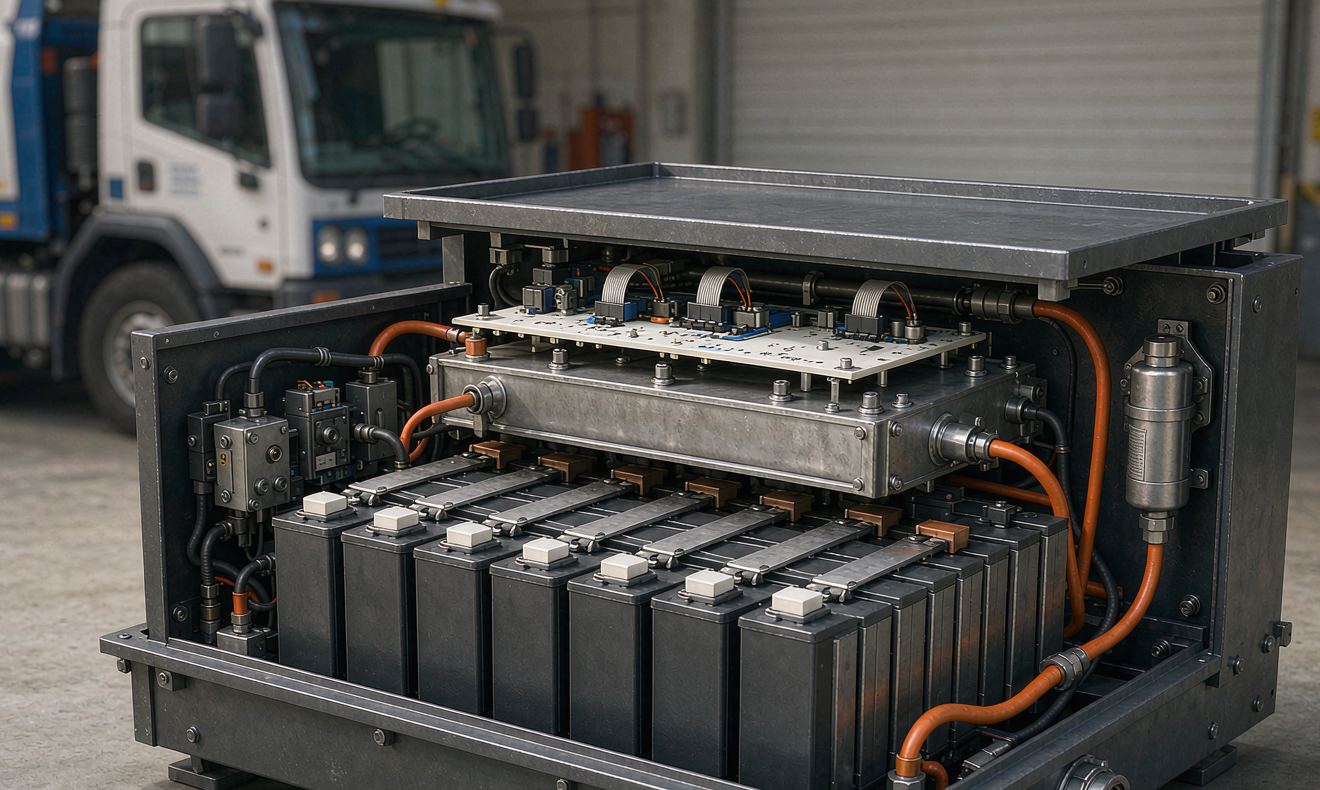
What follows is how I actually approach a sweeper program: the duty cycle, the arithmetic that turns duty cycle into kilowatt-hours, why LFP wins this application almost every time, what thermal and ingress protection the depot environment demands, and the acceptance tests I insist on before a pack ships.
Why a Sweeper Is a Harder Load Than a Delivery Van
The first thing to internalize is that the traction motor is not the dominant load. On a mid-size machine, traction averages 5 to 12 kW while sweeping at 5 to 15 km/h. The auxiliaries dwarf it: the vacuum blower that pulls debris into the hopper draws 7 to 15 kW continuously, gutter and main brooms take 2 to 4 kW, the dust-suppression water pump 0.5 to 1.5 kW, the hopper lift 1 to 2 kW in bursts, and cab HVAC another 1.5 to 3 kW in summer.
That is a peak auxiliary draw of 30 to 45 kW and a sustained average of 15 to 22 kW through a sweeping shift, with peaks touching 55 to 70 kW for a few seconds. Very different from a van that averages 8 kW with brief transients.
The second thing is duty hours: 8 to 10 hours a day, 250 to 300 days a year, over an expected 8 to 12 year service life. Regenerative braking is essentially worthless here — at 5 to 15 km/h with constant stop-start you recover less than 5% of what you put in. Every kilowatt-hour has to come out of the pack.
Sizing: Turning a Duty Cycle Into Kilowatt-Hours
Here is the arithmetic I run with fleet managers, using a typical mid-size sweeper.
- Average auxiliaries while sweeping: 18 kW
- Average traction: 8 kW
- Shift length: 9 hours including two dump runs at reduced load
- Effective average draw: roughly 24 kW
- Daily energy: 24 kW × 9 h = 216 kWh at the pack terminals
Now divide by the efficiency and headroom stack, which is where most first-time buyers go wrong: usable depth of discharge 0.90, discharge efficiency 0.95, end-of-life capacity retention 0.80.
216 ÷ (0.90 × 0.95 × 0.80) = 316 kWh nameplate. Most depots will not accept a machine that big, so the real conversation is about narrowing the duty: zoning routes so the high-dust industrial sector gets a smaller service area, opportunity charging during the mid-shift break, or keeping the big unit for arterial roads only. A common compromise is a 150 to 200 kWh pack with a 25 to 30 minute opportunity charge at 100 kW during the lunch window.
The key discipline: size to end-of-life, not to day one. A pack that only just covers the route when new starts failing routes in year five, and that is when the fleet manager starts shopping for someone to blame.
LFP or NMC for Municipal Service
I have yet to see a sweeper program where NMC made sense. LFP delivers 150 to 180 Wh/kg and 350 to 400 Wh/L, with 4,000 to 6,000 cycles to 80% capacity at 25°C and 80% DoD, and accelerated rate calorimetry self-heating onset around 250°C. NMC811 gives 240 to 280 Wh/kg and 550 to 700 Wh/L, 2,000 to 3,000 cycles, and an ARC onset of 110 to 140°C.
NMC offers roughly 60% more energy per kilogram. On a sweeper you do not need it. The machine already carries a 2,000 to 4,000 kg chassis plus 1,500 to 3,000 kg of debris and water. Saving 300 kg of cell mass is not worth trading 2,000 cycles of life, and it is certainly not worth taking a chemistry with a 130°C thermal onset into a depot that parks next to diesel tanks and welding equipment.
Cycle count is the whole ballgame. At 250 full equivalent cycles a year, a twelve-year service life needs about 3,000 cycles with margin — squarely LFP territory. NMC would force a mid-life pack replacement, and a mid-life replacement on a 200 kWh pack is a six-figure line item no city budget has a slot for.
Watch calendar ageing too: at 25°C and 50% state of charge LFP loses 1.5 to 2.5% per year, and at 40°C that roughly doubles. Most municipal machines sit outside, which argues for active thermal management.
Thermal Management: Summer Asphalt and Winter Salt
Sweeping season in a hot climate means a pack sitting over 50°C asphalt with the blower at full tilt. I have logged pack inlet air at 48 to 55°C on July afternoons in southern Europe. Cell temperature is the biggest lever on cycle life: 6,000 cycles at 25°C becomes 3,500 to 4,000 at 35°C and drops below 2,000 at 45°C.
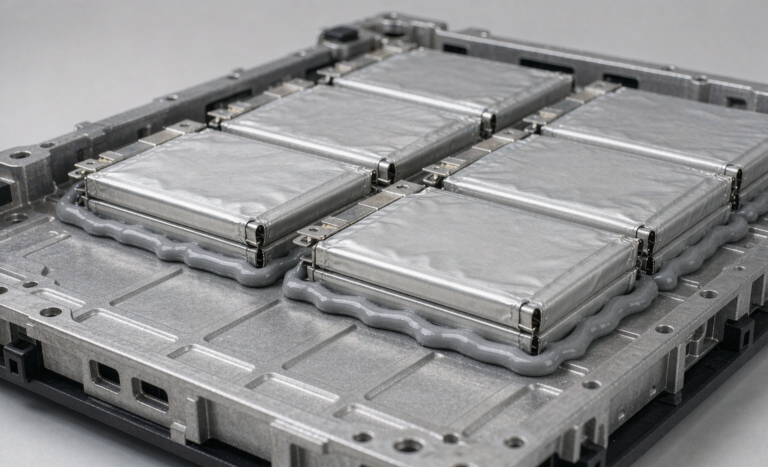
Above about 80 kWh I specify liquid cooling. A 50/50 glycol-water loop with an aluminum cold plate holds cell-to-cell spread under 5 K and drops peak cell temperature 12 to 18°C versus forced air. Air cooling has a specific failure mode here: the intake filter clogs with the very dust the machine is collecting, airflow drops, and the pack derates on the hottest day of the year.
Winter brings the opposite problem. Below 0°C you must not charge a lithium battery at any meaningful rate — lithium plates onto the anode instead of intercalating, and that damage is permanent and invisible. At -10°C you also see only 75 to 85% of nameplate capacity. My standard spec is a 1.5 to 3 kW coolant or pad heater on shore power before the shift, plus a BMS interlock capping charge current at 0.05C until cells clear 5°C. Budget 3 to 6% of daily energy for heating in a Nordic winter.
Vibration, Washdown and Corrosion
A sweeper is a vibrating machine, and the pack is usually mounted low on the frame where it gets all of it. I test to IEC 60068-2-64 random vibration profiles and 5 to 15 g shock, and mount the enclosure on elastomer isolators tuned to an 8 to 12 Hz natural frequency so it does not sit at a chassis resonance.
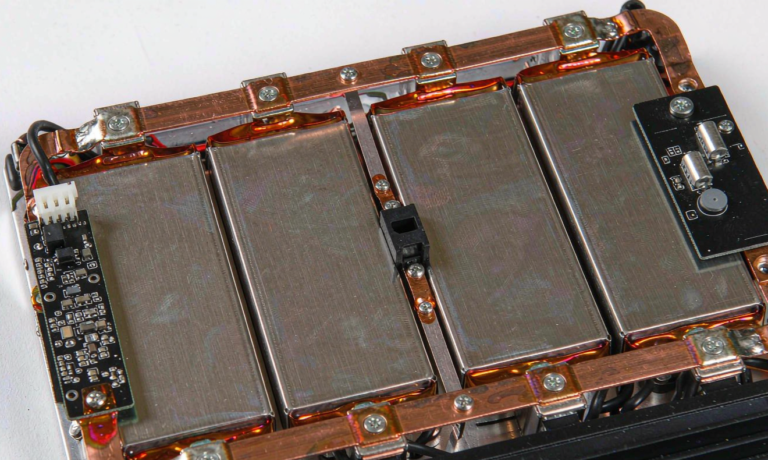
Inside, every cell-to-busbar joint is laser-welded or uses a serrated-flange nut on a stud with a torque stripe. Crimped ring terminals work loose under this profile; I have opened packs at 4,000 hours where a crimp had backed off enough to arc. Use welded or studded connections and torque-mark everything.
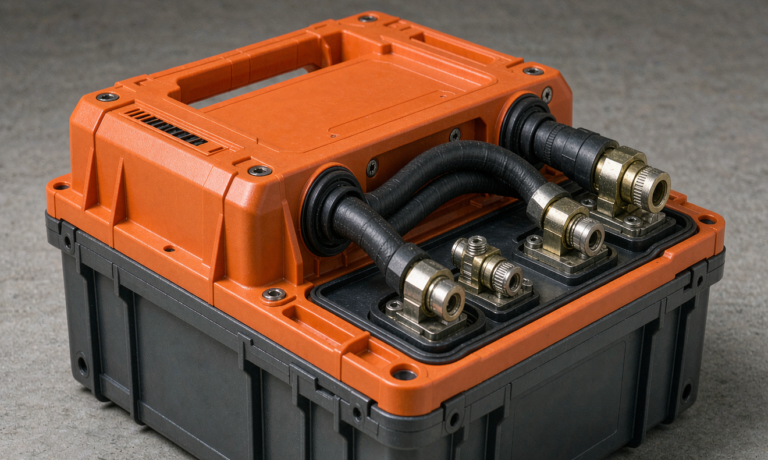
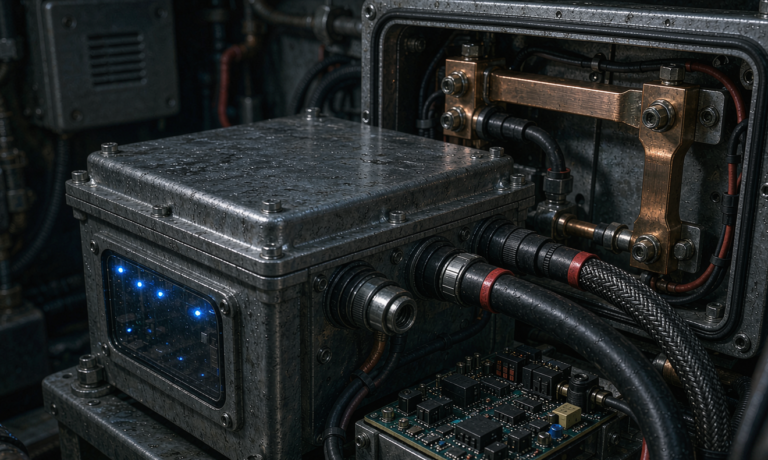
Ingress protection is non-negotiable: IP67 minimum, IP69K if the pack sits in the underbody spray zone where crews pressure-wash at 80°C every shift. Fit an ePTFE breather vent so thermal cycling does not pull moist air past the seals — condensation inside a 600 V pack is how a machine that was fine on Friday fails on Monday.
Road salt is the quiet killer in northern municipalities. Use 316 stainless hardware, IPC-CC-830 conformal coating on the BMS boards, and tinned or nickel-plated copper busbars. I have seen bare copper go green and lose 30% of its cross-section in four winters.
BMS, Telematics and Predictive Maintenance
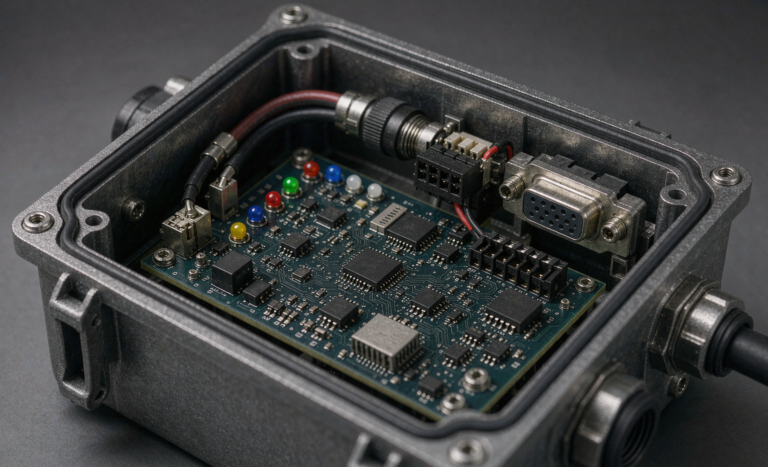
The BMS has two jobs: keep the pack safe, and tell the fleet manager when something is drifting before it strands a route. My baseline is 200 Hz cell voltage sampling, 1 kHz pack current, 10 Hz temperature, contactor open time under 5 ms on a hard fault, and dual-redundant analog front ends so no single chip failure can mask an overvoltage.
State-of-health from coulomb counting alone is not good enough. I combine it with 1 kHz AC impedance tracking, because a 30% impedance rise typically shows up 300 to 500 cycles before the capacity knee. That is the early warning that lets a depot plan a module swap over a weekend instead of losing a machine for two weeks in October.
Telemetry should go out over CAN J1939 to the vehicle and over 4G to the fleet platform, carrying state of charge, min/max cell temperature, cell delta, insulation resistance, cumulative amp-hours and charge sessions. A fleet manager does not want a dashboard; they want an exception report on Monday morning naming the two machines that need attention.
Charging, Depot Infrastructure and the Business Case
Overnight depot charging is right for almost every sweeper fleet. A 180 kWh pack recharged in a 6-hour window needs about 30 kW at the pack, so a 40 kW AC charger per bay covers it comfortably. LFP charge acceptance is good: 0.5C is fine daily, though I prefer a 0.3C regular profile because the cycle-life difference over ten years is real.
Opportunity charging is the lever when the duty will not fit the pack: a 100 kW DC session during a 25-minute break returns 35 to 40 kWh to a 150 kWh pack, extending a shift by two hours. Cap fast-charge events per week and keep the DC rate at or below 0.7C — sustained 1C costs cycle life faster than most models predict.
The fuel line is where the argument is won. A diesel sweeper burns 4 to 8 litres an hour, so nine hours is 40 to 70 litres, roughly $45 to $80 a day. The electric machine uses 200 to 230 kWh for the same shift, about $24 to $35 at commercial tariffs. Add eliminated engine servicing, DPF and aftertreatment maintenance and reduced brake wear, and payback on the incremental battery cost lands at three to five years.
Compliance, Transport and Procurement
Expect this list on a sweeper program: UN38.3 with test summary, shipped at or below 30% state of charge; IEC 62619 for industrial applications; IEC 62133-2 for cells and packs; ECE R100.02 or R100.03 for the vehicle installation; SAE J2464 or equivalent abuse testing; and ECE R10 or IEC 61000-6-2 for electromagnetic compatibility, which matters because sweepers radiate plenty of their own noise from blower drives. Municipal bids frequently add local-content provisions, a ten-year spare-parts commitment and depot technician training on top.
Commissioning: The Five Tests I Do Not Skip
Before a pack leaves our facility, and again before the machine enters service, I run the same five checks.
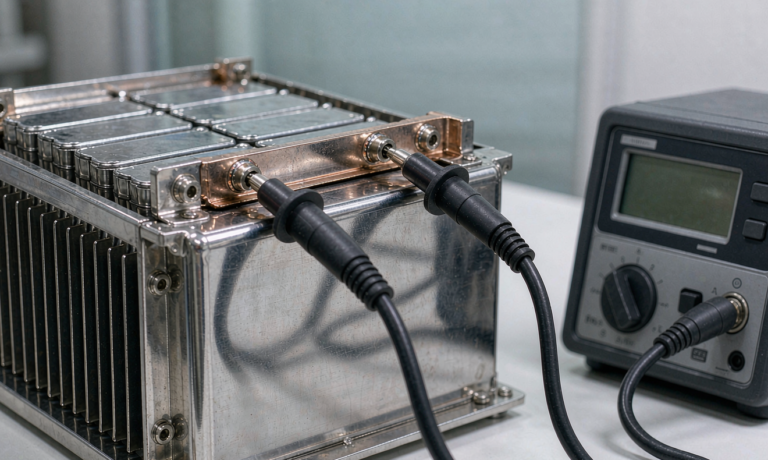
- Insulation resistance: 500 V megger, both poles to chassis. We ship above 100 MΩ and reject below 1 MΩ. The ISO 6469-3 floor is 500 Ω/V DC — only 300 kΩ on a 600 V pack. Meeting the standard is not the same as being safe.
- Cell balance after rest: full charge, two-hour rest, max delta under 30 mV. A pack that will not settle has a bad cell or a bad sense lead.
- Capacity verification: 0.2C discharge to cutoff must deliver at least 95% of nameplate.
- Thermal imaging at full load: 30 minutes of blower at maximum, then image every joint. Any termination more than 15 K hotter than its neighbours gets re-torqued and re-imaged.
- Charge interlock verification: prove on the bench that the BMS refuses to charge below 0°C and derates above the temperature limit. Simulate the sensor; do not trust the spec sheet.
Frequently Asked Questions
How many years does a lithium battery last in a street sweeper?
With LFP, active thermal management and a charge profile capped at 0.3 to 0.5C, expect 4,000 to 6,000 full equivalent cycles — 12 to 15 years on a 250-cycle-per-year machine before the pack reaches 80% capacity. The body will usually need refurbishment before the pack does, which is the outcome you want.
What size lithium battery pack does a mid-size sweeper need?
Work backwards from roughly 216 kWh at the terminals for a nine-hour shift with an 18 kW auxiliary load, then divide by 0.90 usable DoD, 0.95 efficiency and 0.80 end-of-life margin — about 316 kWh nameplate for full-shift autonomy with no opportunity charge. Most fleets compromise at 150 to 200 kWh plus one mid-shift fast charge.
Is LFP better than NMC for municipal sweeper fleets?
Almost always. You give up about 60% of gravimetric energy density, which a 4,000 kg machine does not care about, and gain roughly double the cycle life plus a thermal onset near 250°C instead of 110 to 140°C. Cycle life dominates total cost of ownership on a twelve-year asset.
Can a sweeper battery be charged in freezing weather?
Not without precautions. Charging below 0°C plates metallic lithium onto the anode and permanently reduces capacity. The pack needs a heater on shore power to bring cells above 5°C first, and the BMS must enforce a hard charge-current limit until that threshold is met. Budget 3 to 6% of daily energy for heating.
What ingress protection is required for a sweeper battery enclosure?
IP67 is the baseline; specify IP69K if the pack sits in the underbody spray zone that crews pressure-wash at 80°C every shift. Add an ePTFE breather vent to stop condensation being drawn in during thermal cycling, and use 316 stainless hardware with conformal-coated boards wherever winter road salt is used.
How much does electrifying a sweeper fleet actually save?
A diesel sweeper using 40 to 70 litres per shift costs roughly $45 to $80 a day in fuel; the electric equivalent uses 200 to 230 kWh, about $24 to $35 at commercial tariffs. Add eliminated engine servicing, DPF and aftertreatment maintenance and reduced brake wear, and payback on the incremental battery cost is typically three to five years.
What telemetry should a municipal fleet require from the BMS?
At minimum: state of charge, minimum and maximum cell temperature, cell voltage delta, insulation resistance, cumulative amp-hours and charge session history, over CAN J1939 to the vehicle and cellular to the fleet platform. Ask specifically for 1 kHz impedance-based state-of-health tracking, because impedance rise precedes capacity loss by 300 to 500 cycles.
Which standards apply to a street sweeper lithium battery?
UN38.3 for transport at or below 30% state of charge, IEC 62619 for the industrial application, IEC 62133-2 for cells and packs, ECE R100.02 or R100.03 for the vehicle installation, SAE J2464 for abuse testing, and ECE R10 or IEC 61000-6-2 for electromagnetic compatibility.
Further Reading
References