Home Energy Storage Thermal Envelope for Cold Basements
I have lost count of how many home energy storage systems I have walked into that were installed in exactly the same place: an unfinished basement, on a poured concrete wall, three meters from the service panel. Most of the time it is the right call. Concrete is non-combustible, the alternating current run is short, and the inverter tap is easy to land. What almost nobody budgets for is the thermal envelope. In a cold climate that basement sits between 8 and 14 degrees Celsius for five months of the year, the slab runs colder than the air, and the lithium battery inside the cabinet has a charging window that starts at 0 degrees Celsius. The gap between those two numbers is where warranty claims are born. This guide covers how to quantify the cold, what low temperature actually does inside the cell, how to size insulation and heater power without wrecking round-trip efficiency, and why an IP55 enclosure rating will not protect you from condensation.

Why the Basement Wins on Siting and Loses on Temperature
Engineers pick basements for home energy storage for three defensible reasons. First, the surfaces are non-combustible, which simplifies the fire separation conversation with the authority having jurisdiction and with NFPA 855. Second, a short alternating current run keeps voltage drop low, keeps the neutral and equipment grounding conductor path obvious, and keeps the NEC 705.12 connection at the panel simple. Third, the space is out of the weather and out of sight.
The thermal penalty is quieter but real. A below-grade space has almost no solar gain, it is coupled to soil that sits near the annual mean ground temperature, and the slab acts as a heat sink that never switches off. In a heating-dominated climate I routinely log basement air at 10 to 14 degrees Celsius when the outdoor temperature is minus 15, with the slab surface 2 to 4 kelvin colder than the air at floor level. The worst spot is the rim joist band at the top of the foundation wall, where I have measured 2 to 5 degrees Celsius on a design day.
Discharging in the cold is a performance problem
A lithium battery discharges reasonably well when cold. Capacity at 0 degrees Celsius is typically 85 to 90 percent of the 25 degrees rating for lithium iron phosphate, and 60 to 70 percent at minus 20. The bigger effect is internal resistance, which roughly doubles for every 10 to 15 kelvin drop: two to three times the room-temperature value at minus 10, four to six times at minus 20. That shows up as voltage sag, earlier low-voltage cutoff, and less usable energy on a winter evening. Annoying, but not cumulative.
Charging in the cold is a damage problem
Charging is the opposite case. When the anode is below roughly 0 to 5 degrees Celsius, the intercalation kinetics slow to the point that lithium ions plate as metallic lithium on the anode surface instead of inserting into the graphite or being taken up by the host structure. Some of that metal re-intercalates when the cell warms, but a fraction reacts with the electrolyte to form additional solid electrolyte interphase and permanently trapped dead lithium. Capacity fades, resistance grows, and in aggressive cases dendrites form and create an internal short path. This damage accumulates invisibly: a pack charged at 0.3C at minus 5 degrees Celsius thirty times will not throw a fault, it will simply retire two or three years early, and no state-of-health estimator will tell you which season caused it.
Sizing the Thermal Envelope With Real Numbers
For a cold basement, the thermal envelope is the air volume and surfaces separating the cells from the room. Treat it as any other thermal problem: steady-state loss is Q = U x A x dT, where U is the overall heat transfer coefficient in watts per square meter kelvin, A is exposed area, and dT is the interior-to-air difference.
The heat loss equation, applied
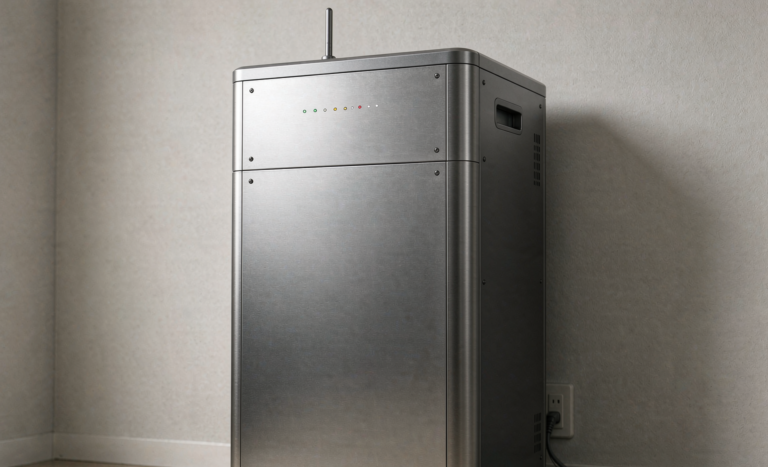
Take a typical wall-mounted cabinet, 900 millimeters wide, 1600 millimeters tall, 350 millimeters deep, with the back face against the wall. Exposed area is the front at 1.44 square meters, two sides at 1.12, and top plus bottom at 0.63, so about 3.2 square meters total. A bare painted steel enclosure with natural convection inside and outside has an effective U around 4 watts per square meter kelvin. Add 50 millimeters of rigid polyisocyanurate inside the shell and on the back plate and U drops to roughly 0.6.
Now set the design case honestly. It is not the average January afternoon, it is the coldest night of the year combined with the moment you most need to charge: an off-peak window at 2 a.m., or the first sunny morning after a storm. Say the basement is at 4 degrees Celsius and the pack must reach 15 to accept full-rate charge. That is an 11 kelvin delta. Bare enclosure: 4 x 3.2 x 11 = 141 watts, continuously. Insulated enclosure: 0.6 x 3.2 x 11 = 21 watts. Over a 150-day heating season with an average delta closer to 8 kelvin, the bare shell burns about 2.4 kilowatt-hours per day, roughly 360 per season. The insulated shell burns about 0.35 per day, roughly 55. Insulation is the difference between a parasitic load you can ignore and one that is a meaningful fraction of the system’s own conversion losses.
Size the heater for warm-up, not for steady state
Here is the mistake I see most often. An installer reads the 21 watt steady-state number, fits a 25 watt pad, then wonders why the pack never charges in February. Holding temperature is cheap; raising it is not. A 20 kilowatt-hour lithium iron phosphate pack has a mass of roughly 200 kilograms and a specific heat near 1000 joules per kilogram kelvin. Warming it from 4 to 15 degrees Celsius is 200 x 1000 x 11 = 2.2 megajoules, which is 0.61 kilowatt-hours. To do that in three hours you need about 204 watts of net heat into the cells plus envelope losses, so specify a 300 watt heater. With good insulation it then runs at roughly seven percent duty. Without insulation you need 204 plus 141 watts continuously, all winter.
The practical rule is the three-hour pre-heat. If your tariff charges the battery at 1 a.m., the thermal schedule has to start at 10 p.m. Most residential energy management apps do not expose this, so ask the manufacturer whether the pack supports a time-based pre-heat command or only a temperature-threshold trigger. The threshold-only version starts heating after the cell has already fallen below the inhibit point, and you lose the charge window.
Free heat you should count, and free heat you should not
Once the system is cycling, the pack makes its own heat. Charging 5 kilowatts at 92 percent efficiency dissipates 400 watts into the cells, and the inverter idle draw adds 30 to 60. In a well-insulated shell those losses exceed the 21 watt envelope loss, so the steady winter case takes care of itself. The dangerous case is the cold start: a system that sat idle through a holiday weekend at 3 degrees Celsius, then gets asked to accept a charge. Do not size the heater on the assumption that conversion losses will always be there.
Condensation, Dew Point and the Limits of IP Ratings
Cold is only half the story. In July that same basement sees 20 to 22 degrees Celsius air at 60 to 70 percent relative humidity, which puts the dew point at 13 to 16 degrees. The slab, the cold water riser and any uninsulated duct all sit below that, which is why they sweat. If the enclosure is thermally bridged to the slab, its surface can sit below the dew point and water will condense inside it.
Why IP55 will not save you
IEC 60529 ingress protection tests dust and water jets from outside. It says nothing about water forming inside a sealed box that happens to be the coldest surface in a humid room. I have opened IP65 enclosures with a film of moisture on the busbar insulation. The fixes are mechanical: break the thermal bridge to the concrete with a closed-cell foam pad, elevate the enclosure at least 150 millimeters above the slab, seal the back plate against vapor drive, and do not mount on an exterior foundation wall near the rim joist.
The weep hole you are afraid to drill
The counterintuitive fix is a drain. A sealed enclosure that breathes through its gasket as the temperature cycles pumps moist air in and out all year, and the water that condenses has nowhere to leave. A screened weep fitting at the lowest point, paired with a breathable vent plug that equalizes pressure while blocking liquid water, is standard practice in outdoor telecom cabinets for exactly this reason. Keep gasket compression even: I ask for 1.5 to 2.5 newton meters on the door fasteners, in a cross pattern, checked with a torque driver rather than by feel.
Commissioning a Cold-Climate Basement Install
Commissioning is where you find out whether the envelope works, and it should happen before the first cold snap. I run five measurements on every cold-climate basement job.
First, a cold soak. Leave the system idle for 24 hours at ambient, then confirm that the battery management system charge inhibit triggers at its stated setpoint, and note the hysteresis: many packs inhibit at 0 degrees Celsius and resume only at 3 to 5, which is deliberate and correct. Second, a warm-up rate test. Command a charge after the soak and log cell temperature rise per hour; if you are not seeing at least 3 to 4 kelvin per hour in a 4 degree room, the heater is undersized. Third, infrared thermography after the first full-rate charge, comparing terminations, busbars and the heater element against a baseline. Anything more than 10 kelvin above ambient at a termination is a torque problem, not a thermal problem. Fourth, a torque re-check: re-torque all direct current terminations at 24 hours and again at 30 days, because copper and aluminum creep under the first thermal cycles. Fifth, a 30-day data pull: minimum cell temperature, count of charge-inhibit events, heater run hours and heater kilowatt-hours.
Finally, set the winter configuration deliberately. Limit charge current to 0.1C below 5 degrees Celsius and 0.2C below 10. Raise the state-of-charge floor, because plating risk is worst at high state of charge combined with low temperature and high current. And schedule a monthly warm-afternoon full charge so passive balancing can still run: a pack that never reaches the top of charge in winter drifts out of balance by spring.
Codes, Standards and the Warranty Line
The listing stack is familiar: UL 9540 for the system, UL 9540A for thermal runaway propagation test data, UL 1973 for the battery subassembly, and UL 1741 Supplement SB for the grid-interactive inverter. IEC 62619 covers safety for secondary lithium cells in stationary applications and includes low-temperature conditioning tests; IEC 62133-2 covers the cells, and UN 38.3 governs transport. Installation sits under NFPA 855 and the adopting residential code, with NEC 110.26 working clearance still applying in a basement, the clause most often violated once a water heater and a workbench move into the same corner.
Two temperatures on the datasheet, one of them matters
Every honest spec sheet gives you two numbers: a minimum discharge temperature and a minimum charge temperature. They are not the same, and the charge number is the one that governs your design. Discharge might be rated to minus 20 degrees Celsius while charging is prohibited below 0. When I review a custom battery solution submittal for a cold region, the first thing I look for is whether those two lines are printed separately. If the sheet shows a single operating range, ask for the charge limit in writing.
The BMS log is the evidence
The practical warranty risk is documentation. A pack that accepted forty charge events below 0 degrees Celsius may still be at 88 percent capacity and working fine, but the event log shows the temperature at each charge and the claim is denied on that basis. Ask three questions in writing: what is the exact charge-inhibit setpoint and hysteresis, does the heater run from the pack or from household power, and does the warranty exclude damage from charging below the stated minimum. If the last answer is anything other than a clear sentence, assume the exclusion exists.
Frequently Asked Questions
Can I charge a home energy storage battery in an unheated basement?
Only if the cells themselves are above the manufacturer’s minimum charge temperature, usually 0 degrees Celsius for lithium iron phosphate. Air at 8 degrees Celsius does not mean the cells are at 8, and after a long idle period they will not be. Insulate the enclosure and fit a pre-heat schedule, or accept that winter charging will be blocked when the room drops below the inhibit point.
How cold is too cold for a lithium battery?
For discharge, most lithium iron phosphate packs are rated to minus 20 degrees Celsius with reduced capacity. For charge, the limit is far tighter: 0 degrees Celsius is the common cutoff, and below 5 degrees Celsius the safe charge current drops to roughly 0.1C. The asymmetry exists because cold charging plates metallic lithium on the anode and that damage does not reverse.
Do I need a heater for my basement battery?
If the space ever falls below the charge-inhibit temperature, yes. Size it for warm-up rate rather than steady-state loss: a 20 kilowatt-hour pack needs roughly 200 watts of net heat to rise 11 kelvin in three hours, so a 300 watt element in a well-insulated enclosure is typical.
Does cold weather void a home battery warranty?
Damage caused by charging below the stated minimum temperature is excluded by most residential warranties, even when the discharge rating is far lower. The pack logs cell temperature at each charge event, so a claim denied on that basis is hard to argue. Confirm the low-temperature clause and inhibit setpoint in writing.
Should I insulate behind the battery cabinet?
Yes, and it is the cheapest kilowatt-hour you will ever save. Fifty millimeters of rigid foam drops the effective heat transfer coefficient of a typical steel enclosure from about 4 to about 0.6 watts per square meter kelvin, cutting seasonal heater energy by roughly a factor of seven. Insulate the back plate as well, and break the thermal bridge to the slab.
Is a cold basement better than a hot garage for battery life?
For calendar aging, yes, but usability depends on what you need the battery to do. Cold reduces calendar degradation because Arrhenius kinetics slow down, yet it blocks charging and costs heater energy. Heat above roughly 40 degrees Celsius accelerates degradation far faster. A basement in the 8 to 20 degrees Celsius band is the better of the two, provided you manage the charging window.
Further Reading
References