Sodium-Ion Battery for Emergency Lighting and Exit Systems
As a senior lithium battery engineer at Horizon Power, I have spent the last decade specifying standby power for life-safety systems. Emergency lighting and illuminated exit signs are not glamorous, but they are the one battery application where a failure is measured in injuries. When a commercial building loses mains power, occupants need a clearly lit path out, and code requires that path to stay lit for at least 90 minutes. In this article I explain why a sodium-ion battery is becoming a practical, cost-stable choice for that job, and where it still gives way to other chemistries.
Why Emergency Lighting Demands a Different Battery Profile
Most batteries in a building are sized for energy or power. Emergency lighting is different. The load is small and steady: a few watts for an exit sign, perhaps twenty to forty watts for a remote area luminaire. What the code cares about is that the battery delivers those few watts reliably, for the full required duration, after sitting idle and partially charged for months at a time.
That duty cycle is brutal on conventional chemistries. Lead-acid sulfates. Nickel-cadmium suffers memory effect and a toxic end-of-life story. Lithium iron phosphate handles it well but carries a raw-material price that has swung sharply with cathode supply. A sodium-ion battery enters this niche with two advantages: abundance of sodium versus lithium, and a chemistry that tolerates partial state of charge without the same calendar aging penalties we see in some lithium cells.
Sodium-Ion Chemistry Basics That Matter for Standby Loads
A sodium-ion battery moves sodium ions between a hard carbon anode and a cathode built from layered oxides or Prussian blue analogues. For emergency lighting the relevant numbers are not peak energy density but the shape of the discharge curve and the self-discharge floor.
In our lab qualification at Horizon Power we see sodium-ion cells holding a usable terminal voltage down to about 2.0 volts per cell, with a gentle slope that makes state-of-charge estimation straightforward. The hard carbon anode gives a stable structure across thousands of shallow standby cycles, which is exactly the profile an exit sign demands: trickle float, rare deep discharge, long calendar life.
When I brief a facilities engineer, I describe the cell the same way I describe any custom battery solution we build: define the load, define the duration, define the ambient, then pick the chemistry. Sodium-ion is rarely the first choice for weight-sensitive packs, but for a wall-mounted light it is a strong fit.
Runtime, Power and the 90-Minute Rule
In the United States, UL 924 and NFPA 101 (the Life Safety Code) set the baseline: emergency lighting must operate for no less than 90 minutes on battery. The European equivalent, EN 50172 and IEC 62034, lands on the same duration and adds a discipline of automatic testing.
Sizing is simple arithmetic once you respect the derating. A typical LED exit sign draws three to five watts. A combined unit with two remote heads may draw fifteen to thirty watts. For a 90-minute hold at 20 watts you need about 30 watt-hours of usable capacity, and I add a 1.5x margin so the pack still meets code at end of life. A sodium-ion battery rated at 12.8 volts and 12 ampere-hours gives roughly 160 watt-hours, which covers a small cluster of fixtures with margin to spare.
The trap is not energy, it is the voltage floor. As the pack discharges, the inverter or driver must keep the LEDs at rated flux. I spec the cutoff at 2.2 volts per cell so the luminaire never dims below the 1.0 foot-candle floor the code expects along the egress path.
Temperature Behavior in Unconditioned Spaces
Exit signs and emergency lights live where buildings are least comfortable: stairwells, parking decks, unheated mechanical rooms. Cold is the enemy of most batteries.
This is where sodium-ion surprises people. Below freezing, a lithium iron phosphate cell loses a meaningful slice of usable capacity and its internal resistance climbs. A sodium-ion battery holds a larger fraction of its room-temperature capacity at 0 degrees Celsius and remains serviceable down to about minus 20 degrees Celsius, with less resistance rise than LFP over the same band. For a parking garage in a cold climate, that difference is the gap between a fixture that passes its annual discharge test and one that quietly fails.
I still recommend a thermally managed enclosure above minus 30 degrees Celsius, but the sodium-ion chemistry buys margin that a lithium battery pack of equal cost often cannot.
Self-Testing, Monitoring and Compliance Evidence
The hardest part of emergency lighting is not the install, it is the proof. IEC 62034 requires automatic test systems that exercise the battery monthly for a short interval and yearly for the full rated duration, then report a pass or fail. In the United States, NFPA 101 expects monthly functional tests of 30 seconds and an annual 90-minute test, with a written record.
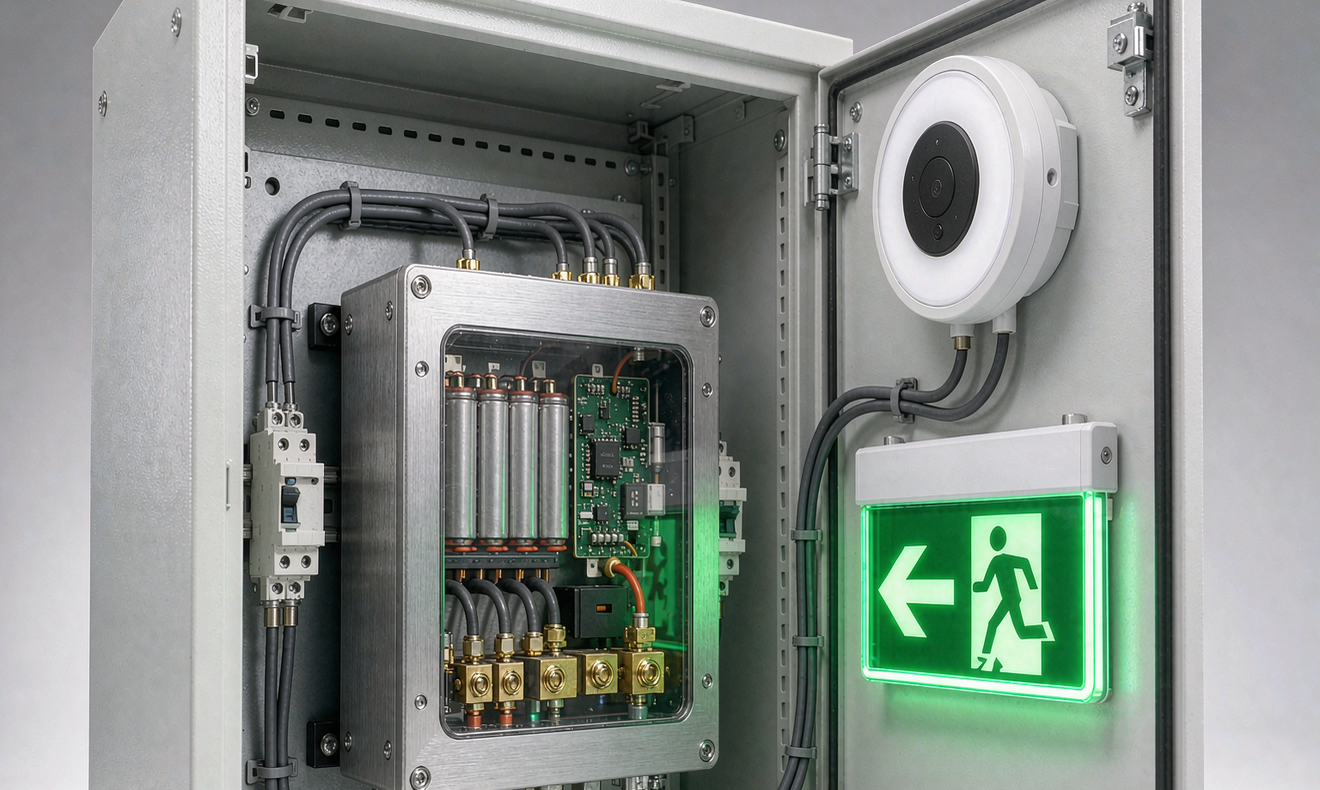
A sodium-ion battery pairs well with a small battery management circuit that logs internal resistance and capacity fade. In our Horizon Power builds we expose that data over a simple wired or wireless link so the building manager gets a compliance report instead of a ladder and a stopwatch. The chemistry’s flat discharge curve makes the pass/fail threshold easy to encode: if capacity at the 90-minute mark drops below 80 percent of nameplate, flag the unit.
Installation, Sizing and Safety
Wiring an emergency lighting battery is governed by NEC Article 700 for emergency systems and by the product safety standard IEC 62133 for the cells themselves. Every pack we ship also meets UN38.3 for transport, which matters because these units move through distribution before they reach a job site.
Practically, I tell installers to treat the battery as a sealed, vented-at-the-cell level module, mount it where ambient stays within the rated band, and keep the DC wiring on its own circuit so a contractor never accidentally loads the standby branch. A short circuit on a 12.8-volt sodium-ion pack will not arc like a lead-acid bank, but the current is still enough to weld a ring, so the same fusing discipline applies.
When Sodium-Ion Is the Right Call
Sodium-ion is not universal. For a single exit sign in a climate-controlled office, a lithium iron phosphate pack is cheaper per watt-hour today and perfectly adequate. For a large central battery that feeds dozens of fixtures, the longer calendar life and cold tolerance of sodium-ion start to pay back.
My rule of thumb: if the unit sits in an unconditioned space, serves more than a few fixtures, or must survive a decade of standby without a mid-life pack swap, a sodium-ion battery is the more defensible engineering choice. If it is a small, indoor, rarely-stressed sign, a lithium battery or even a modern nickel-metal-hydride unit will do the job for less.
Frequently Asked Questions
How long must emergency lighting batteries last during a power outage?
Most codes require a minimum of 90 minutes of illumination on battery power. In the United States that comes from UL 924 and NFPA 101, and in Europe from EN 50172 with IEC 62034. I always size the sodium-ion battery for 1.5x that duration so the unit still passes at end of battery life.
Is a sodium-ion battery safe inside an enclosed exit sign cabinet?
Yes. The cells are sealed and built to IEC 62133, and the pack is fused and managed. Sodium-ion has a high thermal stability margin, so an enclosed cabinet in a climate-controlled space is a safe, normal installation.
How does sodium-ion compare to nickel-cadmium for emergency lighting?
Nickel-cadmium is proven but suffers memory effect and carries a difficult toxic end-of-life path. A sodium-ion battery avoids both, offers better low-temperature capacity retention, and removes the cadmium disposal burden that many facilities now avoid.
What standards apply to emergency lighting batteries?
The core set is UL 924 and NFPA 101 in the United States, EN 50172 and IEC 62034 in Europe, with IEC 62133 for cell safety and UN38.3 for transport. Local amendents may add requirements, so I confirm the Authority Having Jurisdiction before a large rollout.
Can sodium-ion batteries be used outdoors for emergency lights?
They can, provided the enclosure keeps the pack within its rated ambient band. The chemistry holds capacity well down to about minus 20 degrees Celsius, which makes it a strong choice for cold-climate parking decks and exterior egress routes versus a standard lithium battery pack.
How often should emergency lighting batteries be tested?
Plan a short monthly functional test and a full 90-minute annual discharge test, exactly as NFPA 101 and IEC 62034 prescribe. With a sodium-ion battery and an auto-test management circuit, both tests run automatically and log a pass or fail record for the inspector.
Further Reading
References