Home Battery Fire Clearance and Ventilation Guide
As a senior lithium battery engineer, I get asked one question more often than any other when I commission a residential storage system: how much space does the battery need around it, and does it have to breathe? The short answer is that clearance and ventilation are not finishing touches you add at the end. They are part of the code-recognized safety envelope that lets a lithium pack fail safely instead of turning a utility room into a fire path. In this guide I walk through the real numbers I use in the field, the standards behind them, and the mistakes I see most often on home installs.
Why Fire Clearance Is the First Line of Defense
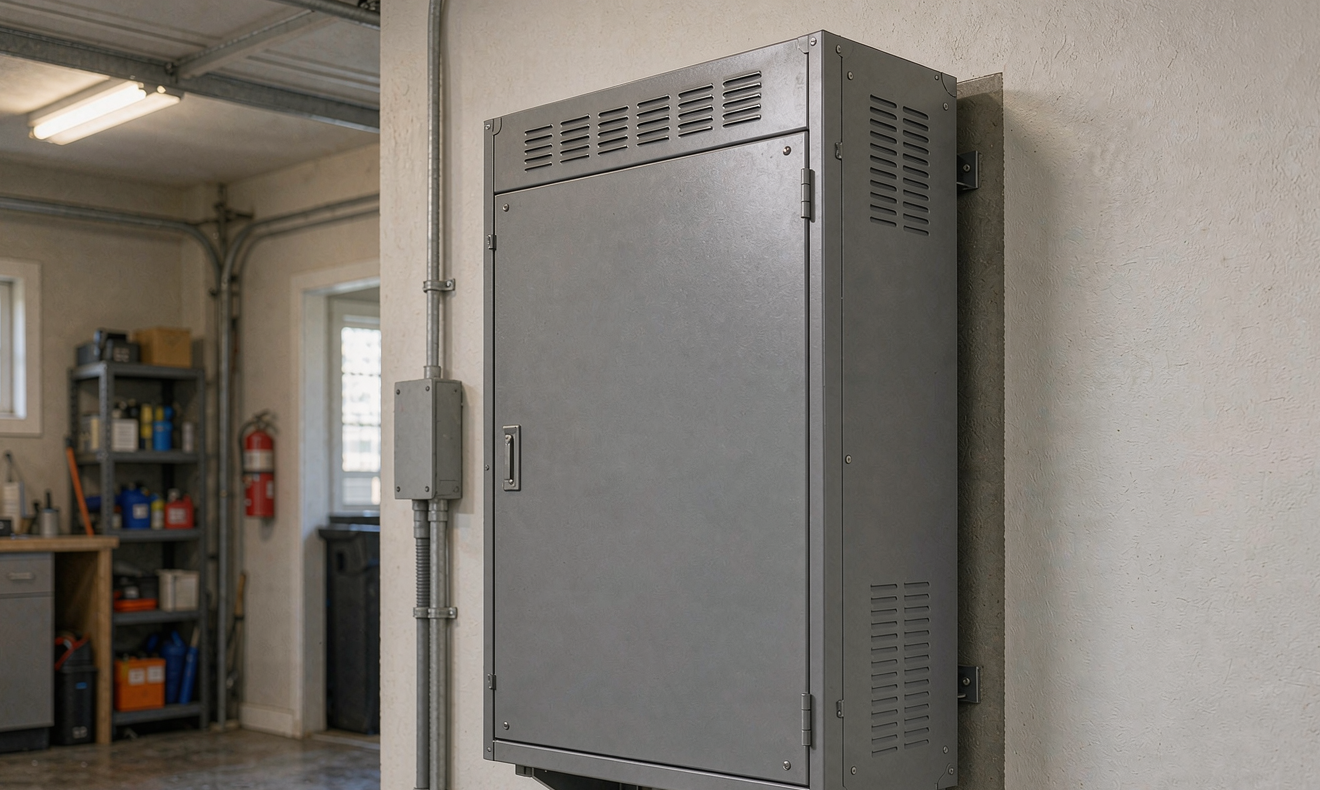
A lithium cell that goes into thermal runaway does not fail quietly. It vents gas, sheds heat, and can ignite nearby combustibles if they are close enough. A pack rated to IEC 62619 has passed internal cell-to-cell propagation testing, which tells you the design resists spreading the event inside the enclosure. What the standard does not do is protect the plywood behind the cabinet or the paint cans stored on the shelf above it. In my experience the biggest residential risk is rarely the battery itself. It is a battery mounted flush against a combustible wall or tucked into a cabinet full of flammable material. Clearance is the buffer that keeps a rare fault from becoming a house fire, and it is the single cheapest safety feature you will ever buy.
Clearance Distances I Actually Use
These are conservative field rules I apply before I trust a layout. The listing label and the local amendment always win, but this is my starting point:
- Keep at least 3 feet (0.9 meters) from permanent ignition sources such as a gas furnace burner, a water heater pilot, or an electrical panel with arc potential.
- Leave a minimum 1 inch (25 millimeters) air gap from combustible walls for a listed enclosure, though many authorities having jurisdiction want 3 inches (75 millimeters).
- Mount the unit at least 6 inches (150 millimeters) off the floor in damp or flood-prone spaces, using a floor stand rather than a direct wall bracket.
- Keep at least 18 inches (450 millimeters) of clear ceiling space above the enclosure so rising heat does not pool against the structure, and stay outside the spray pattern of any ceiling sprinkler.
- Never place the battery above, beside, or inside the same cabinet as fuels, solvents, or paper storage.
The point of these gaps is simple. They give heat somewhere to go and stop a single fault from reaching a second fuel load.
Ventilation Requirements for Off-Gas and Heat
Lithium cells can release hydrogen and other gases during overcharge, internal faults, or thermal stress. Hydrogen has a lower flammable limit of 4 percent by volume, so the code target is to keep the concentration below 1 percent, which is 25 percent of the lower flammable limit. Both NFPA 855 and the UL 9540A family push either natural ventilation with high and low openings or mechanical exhaust. I size mechanical ventilation at 1 cubic foot per minute per square foot (about 5 cubic meters per hour per square meter) of room floor area, with intake near the ceiling and exhaust near the floor. Hydrogen rises, but hot air also stratifies, so you want flow across the whole room. For passive systems I require at least two free openings, one high and one low, each not less than 1 square inch per 1,000 watt-hours of stored energy. On any system above about 10 kilowatt-hours I also add a hydrogen sensor that alarms at 1 percent and interlocks the exhaust fan, because dilution only works if the air is actually moving when gas appears.
What the Standards Actually Say
Homeowners hear a lot of brand names and very little specificity, so here is the short version of the documents that matter:
- UL 9540A is a test method, not an installation rule. It measures whether thermal runaway propagates between cells and how much heat and smoke a large module produces. A pass informs the clearance envelope your authority adopts.
- NFPA 855 is the installation standard for stationary energy storage systems. It defines ventilation, separation distances, and fire detection for indoor and outdoor units.
- IEC 62619 covers industrial secondary lithium cells and includes thermal runaway propagation and abuse testing that a credible home pack should reference.
- IEC 62133 and UN38.3 are cell-level safety and transport tests that matter when you ship, service, or replace modules.
Local building and fire codes can add smoke detection, suppression, or room construction rules on top of these, so always close the loop with your authority having jurisdiction before you drill the first hole.
Garage, Basement, or Utility Room
Where you put the battery changes the rules:
- Garage. Cool and convenient, but close to vehicles and fuels. Keep 3 feet from the car bay, mount high enough to avoid exhaust fume exposure, and confirm the space is vented. I also keep the unit away from the door sweep where vehicle exhaust can pool.
- Basement. Stable temperature, but often poor natural airflow. Plan mechanical exhaust rather than hoping a small window does the job, and watch for high humidity that accelerates terminal corrosion.
- Utility room. The most common choice, and the riskiest, because it usually shares space with the furnace and water heater. The 3 foot ignition-source rule is non-negotiable here.
I advise against closets that have no dedicated ventilation path. A battery in a sealed closet is a battery with no way to shed heat or dilute gas.
Detection, Suppression, and Emergency Response
Good clearance and ventilation reduce risk, but they do not remove the need for detection. I specify a heat or smoke detector in the same room as the battery, tied to the same panel as the rest of the house, because an event at 2 a.m. needs to wake someone. For larger installs I add a hydrogen sensor set to alarm at 1 percent and interlock the ventilation fan so the room starts exchanging air the moment gas appears. On suppression, the honest engineering answer is that a residential lithium event is hard to fight with water alone, so the design goal is containment and safe evacuation rather than heroics. Keep a multi-purpose extinguisher nearby, know the location of the disconnect, and make sure every household member knows to leave the building and call the fire department if the detector sounds. The enclosure, clearance, and ventilation are your first three lines of defense; detection and a plan are the fourth.
Signs Your Ventilation Is Wrong
You do not need a gas analyzer to spot a bad install. The symptoms show up early:
- Condensation or white corrosion on terminals and busbars.
- A persistent sulfuric, metallic, or rotten egg smell near the cabinet.
- Heat the battery management system cannot shed, shown by frequent derating in moderate weather.
- Nuisance smoke-detector trips in the same room.
The fix is usually straightforward. I have retrofitted more than one install with a 4 inch (100 millimeter) through-wall fan wired to a 40 degrees Celsius snap disc, plus a louvered high and low opening. That single change took rooms from stagnant to safely exchanging air.
Frequently Asked Questions
How much clearance do I need around a home battery?
As a baseline, keep 3 feet (0.9 meters) from ignition sources and at least 1 inch (25 millimeters) from combustible walls for a listed enclosure, with many authorities preferring 3 inches (75 millimeters). Always follow the unit’s listing label and local code, because those override any general rule.
Does a home battery need active ventilation or is passive enough?
It depends on the room and the stored energy. A small pack in a naturally vented space with high and low openings may be fine, but larger systems or sealed rooms need mechanical exhaust sized to the room area and the battery’s gas release rating.
Can I install a home battery in a closed closet?
Not safely. A closed closet has no path to dilute off-gas or shed heat, so the hydrogen concentration can climb toward the flammable limit. Use a vented utility room, garage wall, or basement with a real airflow path.
What hydrogen level is considered safe in a battery room?
The lower flammable limit for hydrogen is 4 percent by volume. Codes target keeping the level below 1 percent, which is 25 percent of the limit, through ventilation sized to the room and the stored energy.
Should the battery vent indoors or to the outside?
Ventilation should move air to a safe outdoor location, not recirculate it inside the living space. Exhaust near the floor and makeup air near the ceiling keeps the room within safe gas and temperature limits.
Conclusion
Clearance and ventilation are not optional cosmetic details. They are the documented safety envelope that lets a home battery do its job quietly for a decade and fail safely if it ever has to. Use the 3 foot ignition-source rule, give the enclosure real airflow, and let UL 9540A, NFPA 855, and IEC 62619 guide the details. Pair those with a detector and a simple household plan, and you have covered the four lines of defense an engineer would expect. If you are laying out a system and want a second set of engineering eyes on the clearance and airflow plan, our team at Horizon Power is happy to review it before you install.
Further Reading
References