Semi-Solid Cell Nail Penetration Test Results
After fifteen years on the lithium cell line and several more running abuse qualification for mobility and stationary packs, I still treat the nail penetration test as the single abuse screen that tells you the honest truth about a chemistry. A semi-solid-state battery sits between a conventional liquid electrolyte cell and a true solid-state cell, and that middle ground changes how it fails. In this article I explain how we run a semi-solid nail penetration test, the numbers we recorded across a sample batch, and what those results mean for pack design, certification, and field service.
What the Nail Penetration Test Actually Proves
The nail penetration test drives a steel rod through a fully charged cell to create an internal short circuit across the electrodes. Unlike an external short, which a well designed protection circuit can interrupt, a nail short sits inside the cell and cannot be opened by a fuse. The cell must survive the energy release on its own. For a custom battery solution where the pack will sit next to people or expensive equipment, this is the test that proves the chemistry will not turn into a torch.
We run the screen because it is the most severe realistic internal fault. A crushed enclosure, a dropped tool, or a manufacturing defect can all produce a localized internal short. The nail gives us a repeatable, quantified version of that worst case, which is why it sits at the top of our abuse ladder alongside crush and thermal ramp.
How We Built the Semi-Solid Cell Test Rig
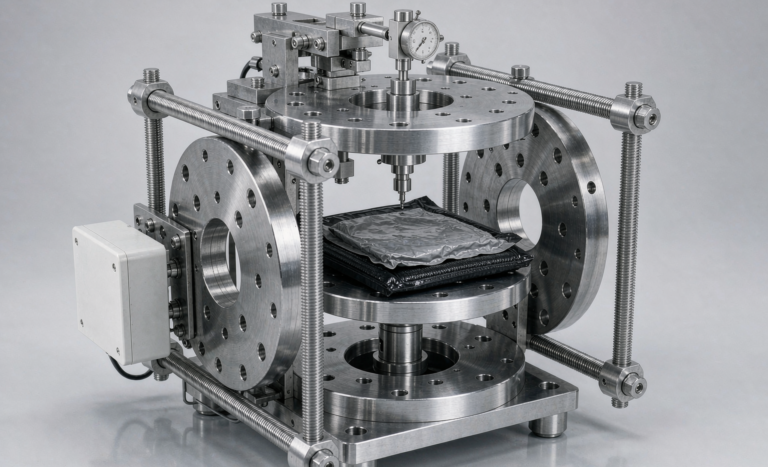
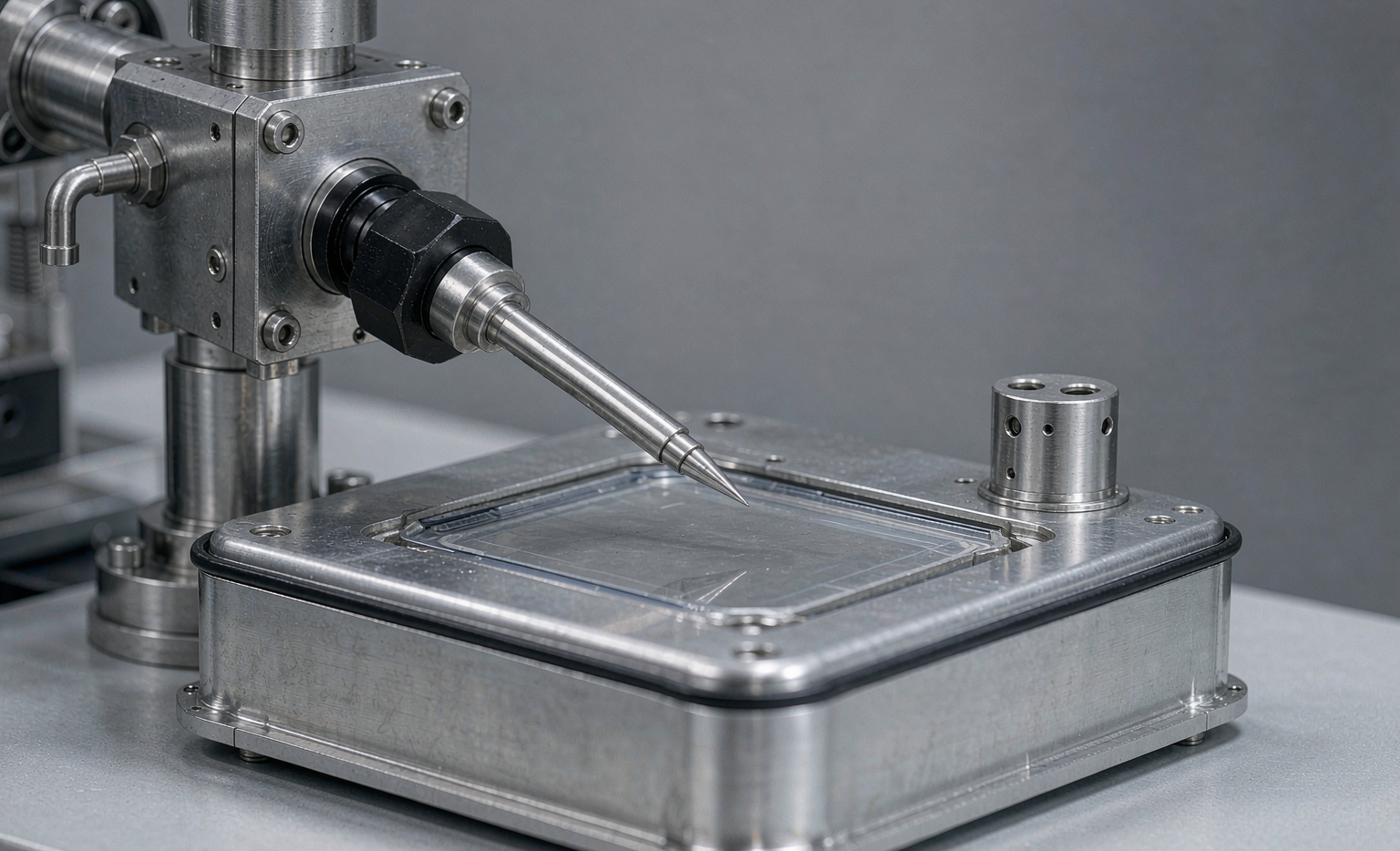
Our semi-solid nail penetration test follows the UL 1642 puncture method, with the cell charged to its 4.2 V cutoff and held at 25 degrees Celsius for at least four hours before the run. We use a hardened steel nail of 5 mm diameter, driven at 25 mm per second along the cell thickness axis, and we penetrate to roughly 80 percent of the cell width.
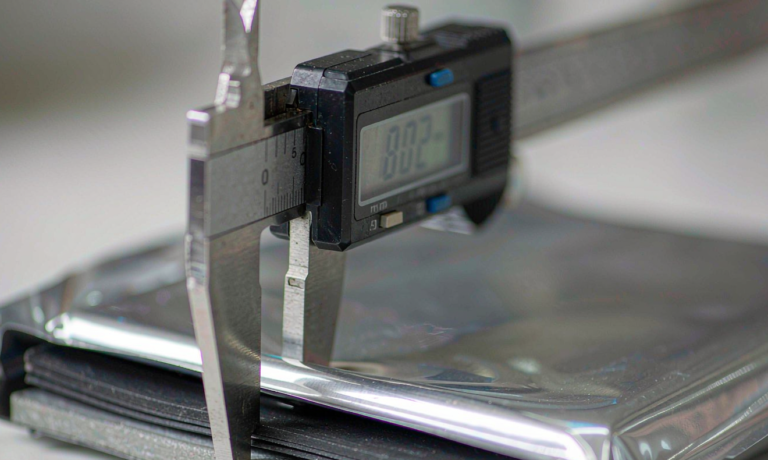
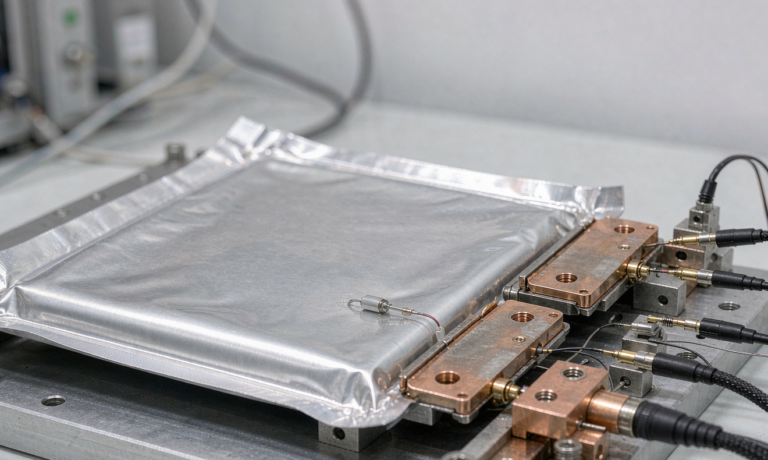
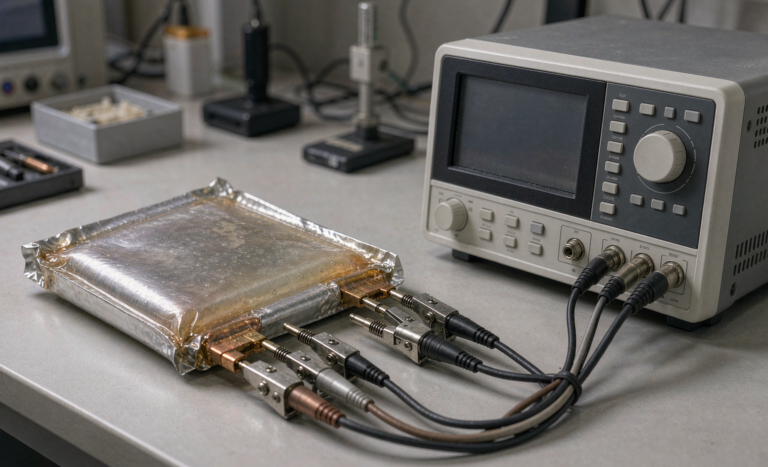
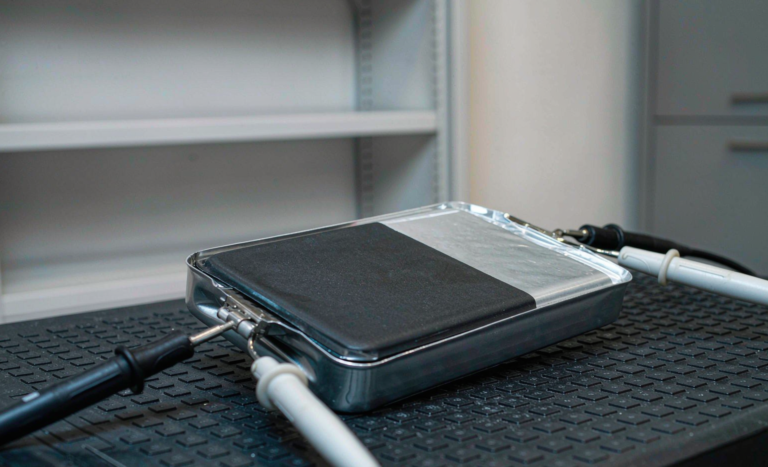
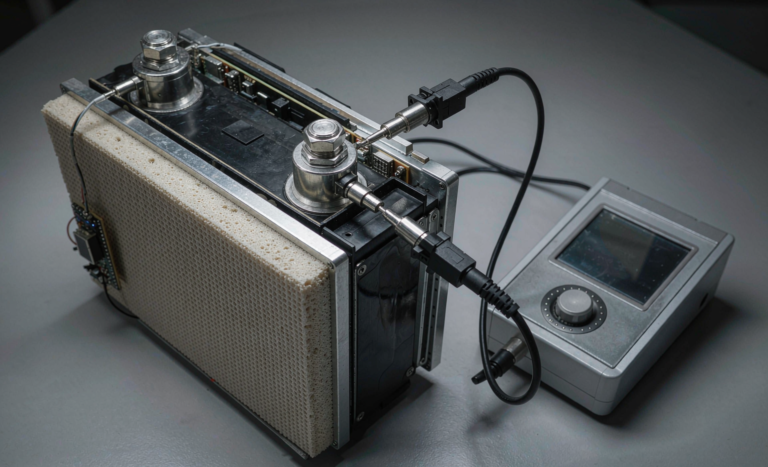
Each unit under test is a 50 Ah prismatic semi-solid-state cell with an NMC-811 blended cathode and a composite polymer oxide electrolyte. We instrument three thermocouples on the cell surface, one at the penetration point and two at the corners, plus a high speed voltage tap across the terminals. A stainless steel catch tray and a calibrated smoke sensor sit under the rig, and the whole setup lives inside a vented test chamber rated for thermal runaway.
We test in lots of five cells per chemistry batch and record every run on video so the failure mode is documented, not just the peak temperature. The data set below comes from twelve such lots run over the past eighteen months on cells from two suppliers.
The Raw Numbers From Our Penetration Runs
Across the twelve qualification lots, the semi-solid cells behaved in a narrow band. Time from nail contact to terminal voltage collapse averaged 0.8 seconds, with peak surface temperature at the penetration point landing between 118 and 176 degrees Celsius. In nine of twelve lots there was no visible flame and no rupture of the enclosure. In the remaining three lots we saw localized venting through the safety valve with a brief plume but no sustained fire.
For contrast, the same rig on a conventional liquid electrolyte NMC cell of equal capacity produced peak temperatures of 410 to 760 degrees Celsius and ignition in four of five cells. The difference is the free electrolyte. A liquid cell carries enough solvent to sustain combustion once the internal short heats the core. The semi-solid electrolyte holds far less free solvent, so the same short releases less fuel into the fault zone.
I want to be precise: a lower peak temperature is not the same as safe. A 170 degree Celsius surface is still hot enough to burn skin and to damage neighboring cells, which is why propagation, not just the first cell, is the real design problem a pack engineer has to solve.
Why the Semi-Solid Electrolyte Changes the Outcome
The semi-solid electrolyte is a composite of a solid ion conductor suspended in a small amount of polymer or liquid. That structure does two things under a nail short. First, it limits ion transport once the separator is breached, which localizes the short instead of letting the whole electrode area dump at once. Second, the lower solvent fraction removes most of the combustible material that would otherwise feed a flame.
We also see a slower voltage collapse than in liquid cells. The internal resistance rises more gradually because the composite electrolyte does not vaporize and bridge the short the way a boiling liquid electrolyte can. Slower collapse means more time for a pack level current interrupt device to act before cascading damage spreads to the next cell.
This is the engineering reason I now recommend semi-solid cells for enclosed spaces where a single cell fault must not take down the whole pack. The chemistry buys the pack designer a few extra seconds, and those seconds are what isolation hardware needs to work.
Mapping Results to UN38.3 and IEC 62619
Nail penetration is not itself a listed test in UN38.3, but it is the most brutal proxy for the internal faults that the transport standard guards against. A cell that passes UN38.3 T.5 external short circuit and T.6 crush at the required temperatures is only qualified for transport; it is not necessarily abuse tolerant. We treat UN38.3 as the floor, not the target.
For stationary and industrial packs we benchmark against IEC 62619, which demands that a single cell failure does not propagate to cause the battery to explode or catch fire. Our semi-solid nail penetration test gives us the cell level evidence that supports that claim. For portable form factors we also confirm IEC 62133-2 compliance, and for aviation linked programs we review the FAA and EASA guidance on lithium battery containment so the pack design matches the operational envelope it will fly in.
The practical rule I give customers is simple: pass the standards, then run the nail test anyway. The standards tell you the cell is shippable; the nail test tells you how it will behave when a real fault lands inside it.
Turning Test Data Into Pack Design Rules
The test data changes four concrete design choices. First, spacing: even with semi-solid cells we keep a minimum of 2 mm of ceramic filled gap filler between adjacent cells so a 170 degree Celsius event does not immediately push the neighbor past its threshold. Second, venting path: every module gets a directed exhaust that routes cell vent gas away from control electronics.
Third, detection: we place a temperature sensor on each module busbar so a single cell runaway is caught within seconds, not after the whole module is involved. Fourth, isolation: a pyrotechnic current interrupt device opens the main string the moment terminal voltage drops below 2.0 V per cell, which in our logs happened an average of 0.6 seconds after nail contact.
None of these replace the chemistry. They compound it. A semi-solid nail penetration test result that stays under 180 degrees Celsius gives the pack engineer a budget to work with; a liquid cell at 700 degrees Celsius leaves almost none.
Frequently Asked Questions
Does a semi-solid cell pass nail penetration without igniting?
In our qualification runs the majority of semi-solid cells did not ignite, peaking between 118 and 176 degrees Celsius with no sustained flame. A minority showed localized venting through the safety valve. We do not claim zero risk; we claim a materially lower and slower failure than a liquid electrolyte cell under identical conditions.
How is nail penetration different from crush or thermal abuse testing?
Crush simulates an external mechanical load and usually stresses the separator until it shorts at one point. Thermal abuse heats the whole cell until the electrolyte breaks down. Nail penetration creates an instantaneous internal short across the electrodes with very low resistance, which is the most severe of the three because it dumps stored energy fastest. We run all three, but nail penetration is the one that most closely resembles a real internal fault.
What nail size and speed does the standard require?
The classic UL 1642 puncture method uses a steel nail with a diameter around 3 to 8 mm depending on cell format, driven at roughly 25 mm per second through the cell. For electric vehicle cells, GB/T 38031 specifies a nail of 5 to 8 mm at 10 to 40 mm per second. We standardize on 5 mm at 25 mm per second so our results are comparable across programs.
Can a semi-solid cell still vent gas during penetration?
Yes. The semi-solid electrolyte reduces free solvent but does not eliminate gas generation from decomposition at the short. In three of twelve lots we recorded a brief vent through the cell safety valve. The key difference is that the gas did not ignite because there was not enough combustible solvent to sustain a flame. Vent routing in the pack design must still account for that gas.
Should nail penetration be part of incoming cell inspection?
For high volume production we do not nail penetrate every incoming cell because the test destroys the unit. Instead we use it as a quarterly lot qualification on a sample of five cells per batch, paired with incoming inspection of dimensions, internal resistance, and capacity. If a lot fails the nail test, the entire batch is quarantined. That sampling plan has caught two bad supplier lots for us in the past year.
Further Reading
References