Semi-Solid Cell Swelling and Thickness Growth Explained
When a customer asks me how long a semi-solid cell will last in their pack, the first number I look at is rarely capacity. It is thickness growth. Over months of cycling, every lithium cell gains a few microns, and semi-solid cells are no exception. As Karl Huang, Senior lithium battery Engineer at Horizon Power, I have torn down hundreds of pouch and prismatic cells after abuse testing, and the pattern is always the same: swelling tells you more about hidden degradation than the voltage curve ever will. This article explains what causes semi-solid cell swelling, how we measure it in the lab, what magnitudes are acceptable, and what you should specify before signing a supply agreement.
Why Semi-Solid Cells Swell
Semi-solid cell swelling is the irreversible or semi-reversible increase in cell thickness during charge, discharge, and calendar aging. In a semi-solid design the electrolyte is a viscous, ion-conductive composite rather than a free-flowing liquid, which changes the failure modes compared with conventional lithium-ion cells.
The first driver is lithium plating. When a cell is charged too fast at low temperature, metallic lithium deposits on the anode instead of intercalating. Plated lithium occupies roughly twice the volume of intercalated lithium, so even a small plating event adds measurable thickness. The second driver is solid electrolyte interphase (SEI) growth. Each cycle forms a few nanometers of new SEI on the anode, and over hundreds of cycles this layer can add several microns.
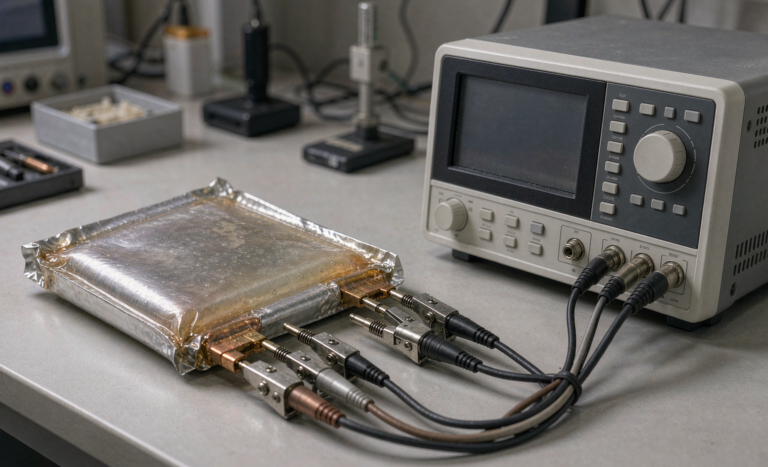
The third driver is gas generation. Semi-solid electrolytes still contain solvents and additives that can decompose at the electrode interface, producing carbon dioxide, methane, and trace ethane. In a sealed pouch the gas has nowhere to go, so the pouch balloons. The fourth driver is electrode densification. The semi-solid composite cathode and anode are compressible; under stack pressure they slowly consolidate, which paradoxically can reduce thickness while increasing internal stress on the separator.
How We Measure Thickness Growth
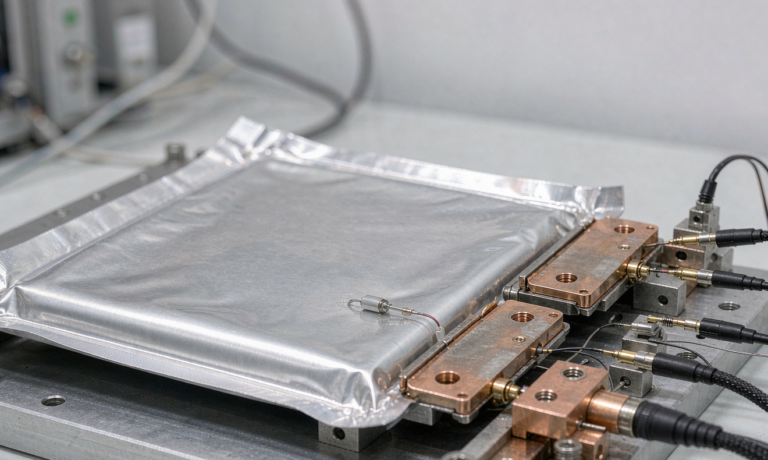
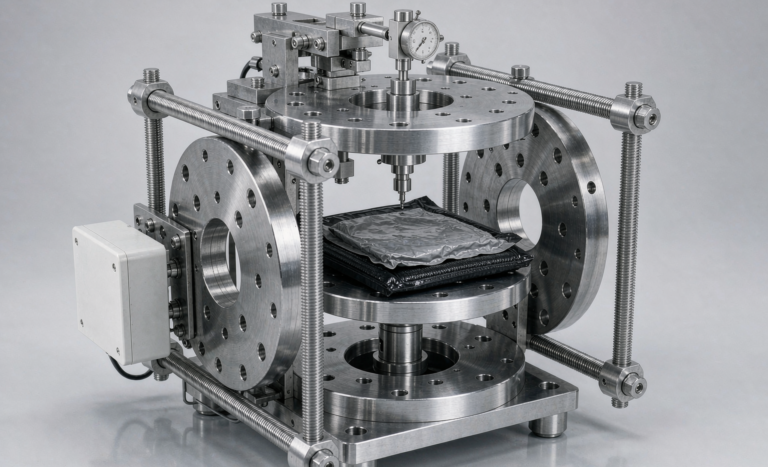
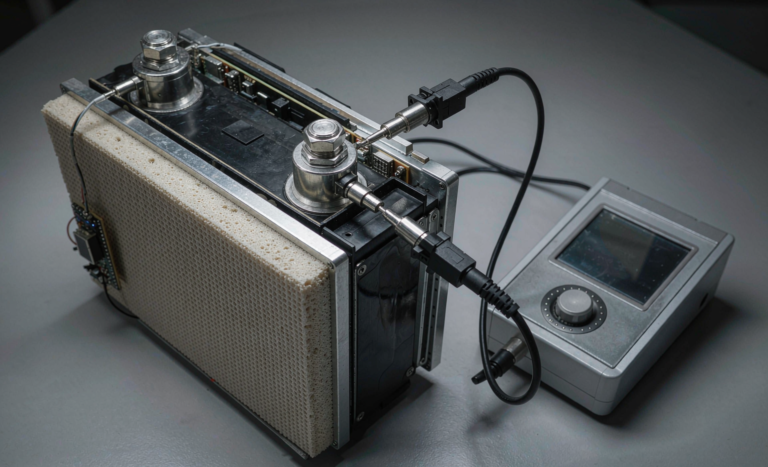
At Horizon Power we never rely on a single method. For formation and early life we use an in-line laser displacement sensor that tracks cell thickness continuously during the first ten cycles. It catches sudden jumps that a caliper would miss. For research we use a mechanical dilatometer, which applies a fixed external force and records the micrometer-level expansion of the electrode stack as a function of state of charge.
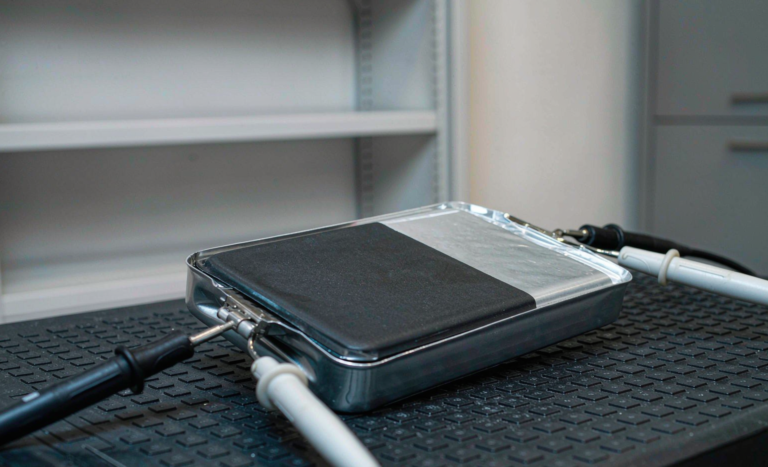
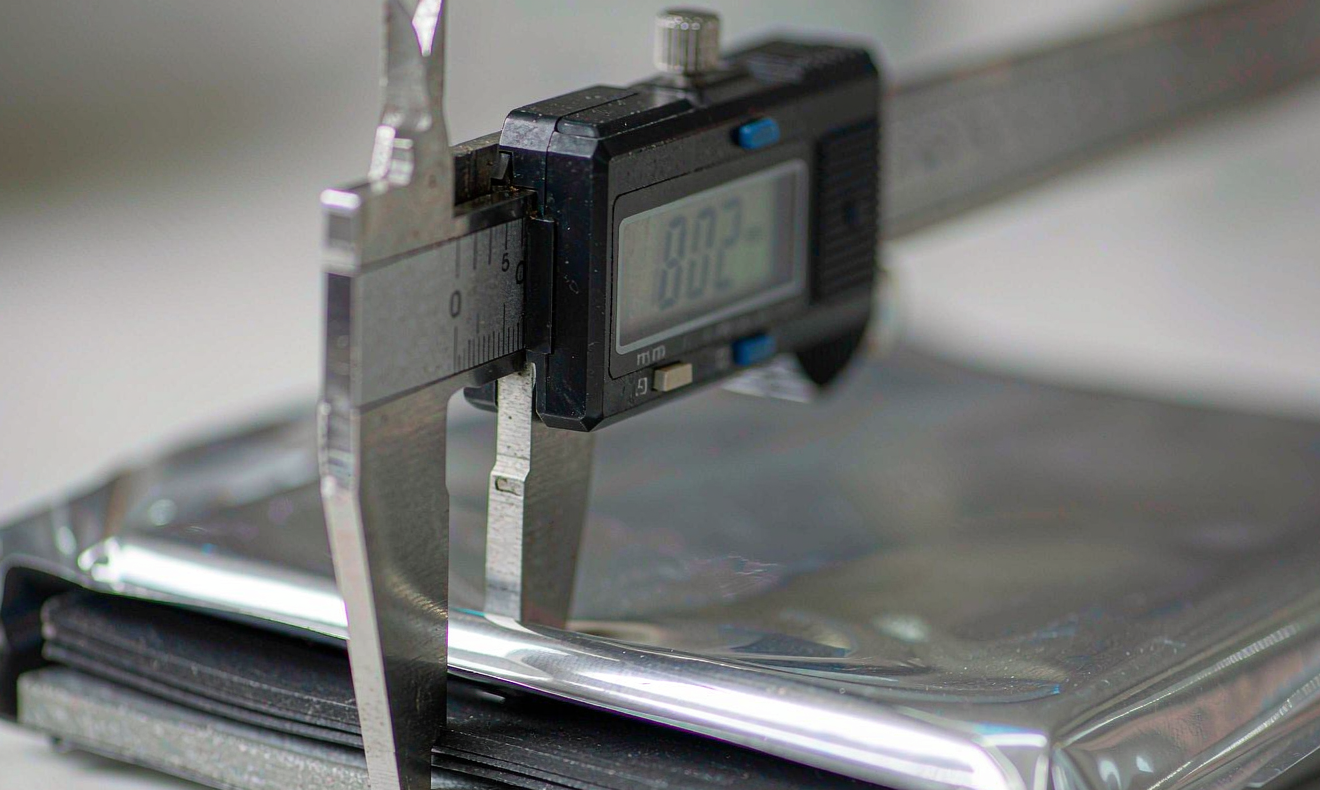
For post-mortem analysis we cut open retired cells and measure with a digital caliper at five points across the pouch, then average. The spread between points tells us whether swelling is uniform or localized, which points to plating versus gassing. We also use in-situ X-ray diffraction and neutron imaging on selected cells to watch the anode lattice expand, but those tools are too slow for production and stay in the lab.
The key engineering lesson is repeatability. A caliper reading is only useful if the cell was at the same state of charge, same temperature, and same rest time. We standardize on 50 percent state of charge, 25 degrees Celsius, and a 24 hour rest before every measurement.
Typical Magnitudes and Acceptance Limits
A well-built semi-solid pouch cell should show thickness growth below 3 percent after 500 full equivalent cycles under a controlled stack pressure of 0.3 to 0.7 MPa. Our internal acceptance limit for a new design is 5 percent growth at end of life, because beyond that the pouch seal and module enclosure start to see mechanical load they were not designed for.
Prismatic cells tolerate swelling better because the welded steel or aluminum case resists expansion, but they still accumulate internal stress that shows up as rising direct current internal resistance. Pouch cells are the opposite: they visibly balloon, which makes swelling easy to see but hard to contain without a pressure fixture. For module design we budget a thickness growth allowance of 100 to 200 microns per cell and leave clearance in the end plate so the stack can expand without cracking the housing.
Calendar aging matters too. A cell stored at 80 percent state of charge and 45 degrees Celsius for six months can gain as much thickness as one that cycled for a year at mild conditions. That is why we recommend storage at 30 to 50 percent state of charge for any semi-solid cell that will sit before deployment.
Impact on Cycle Life and Safety
Swelling is rarely the direct cause of failure, but it is an early warning system. As the stack thickens, the separator can lose even contact with the electrodes, creating hot spots where local current density rises. Those hot spots accelerate SEI growth, which causes more swelling, a slow positive feedback loop that ends in capacity fade.
From a compliance standpoint, uncontrolled swelling is a red flag during qualification. Transport safety tests such as UN38.3 and stationary system standards such as IEC 62619 and UL 1973 expect a cell to retain its mechanical integrity after thermal, vibration, and crush abuse. A cell that has already ballooned in normal use is far more likely to vent or short under those tests. We routinely screen outgoing lots by thickness, and any cell more than 2 percent over nominal at shipment is rejected.
Engineering Controls That Limit Swelling
The cheapest way to control semi-solid cell swelling is at the formation stage. A slow first formation with a strict voltage hold at 3.8 to 4.1 volts builds a dense, stable SEI and cuts long-term growth by a visible margin. We also tune the negative to positive electrode capacity ratio, the so-called N over P ratio, slightly negative-heavy so that lithium plating is avoided even during aggressive fast charge.
Stack pressure is the next lever. A constant external pressure of 0.2 to 1.0 MPa, applied through a foam or spring fixture in the module, keeps the electrodes in contact and suppresses gas pocket formation. Too much pressure, however, squeezes the semi-solid electrolyte out of the pores and raises resistance, so the value must be validated per cell format. Electrolyte formulation is the third lever: lower free solvent content and more stable additive packages reduce gas yield without hurting ionic conductivity.
What Buyers Should Specify
If you are sourcing semi-solid cells, do not accept a datasheet that lists only capacity and energy density. Ask for thickness growth per 500 cycles under a defined stack pressure, the test temperature, and the measurement method. A honest supplier will quote a number with a method; a vague one will only promise “low swelling” with no data.
Also confirm the end-of-life thickness allowance written into the warranty. We specify at Horizon Power that our semi-solid cells stay within 5 percent thickness growth through the rated cycle life, measured by our standard laser displacement protocol. For applications where space is tight, such as drone or portable equipment packs, tighten that to 3 percent and request the swelling curve rather than a single endpoint.
Frequently Asked Questions
How much thickness growth is normal for a semi-solid cell?
A healthy semi-solid pouch cell should stay under 3 percent thickness growth after 500 full equivalent cycles at 25 degrees Celsius under 0.3 to 0.7 MPa stack pressure. Above 5 percent at end of life we treat the design as out of specification.
Does semi-solid cell swelling mean the battery is failing?
Not by itself. Mild, uniform swelling is expected aging. Rapid or localized swelling, especially with rising internal resistance, signals lithium plating or gas generation and warns of impending capacity loss or safety risk.
Can semi-solid cell swelling be reversed?
Largely no. SEI growth and gas generation are irreversible chemical changes. A small elastic component can recover when stack pressure is released, but the net thickness after a full cycle stays higher than the starting value.
How do you measure cell swelling without disassembling the pack?
We use an in-line laser displacement sensor on individual cells during formation, and for field units we measure the module end-plate gap with a calibrated gauge. A shrinking gap over service life is a direct, non-destructive swelling indicator.
What stack pressure prevents semi-solid cell swelling?
A constant 0.2 to 1.0 MPa external pressure, delivered through a spring or foam fixture, keeps electrodes in contact and limits gas pockets. The exact value is validated per cell format because excess pressure raises internal resistance.
Conclusion
Semi-solid cell swelling is not a defect to fear but a signal to manage. By understanding the four root causes, measuring thickness with a repeatable protocol, and specifying clear growth limits in your purchase agreement, you turn an invisible failure mode into a controlled design parameter. At Horizon Power we build swelling budgets into every semi-solid cell we ship, so your pack keeps its shape and its performance for the full rated life.
Further Reading
References