Battery Solution Cold Chain Pharma Logistics
Every year, billions of dollars’ worth of vaccines, biologics, and specialty pharmaceuticals are moved across the globe, and most of that cargo lives or dies by a number on a data logger. As Karl Huang, Senior lithium battery Engineer at Horizon Power, I have spent the better part of a decade designing the power systems that sit behind those temperature curves. When a distributor asks me for a battery solution cold chain pharma logistics program can rely on, they are not really asking for cells and a casing. They are asking for a guarantee that a -70°C ultra-low freezer, an active 2–8°C tote, or a dry-ice-free shipper will hold its setpoint from a factory in Basel to a clinic in Manila, even if the flight is diverted and the truck breaks down.
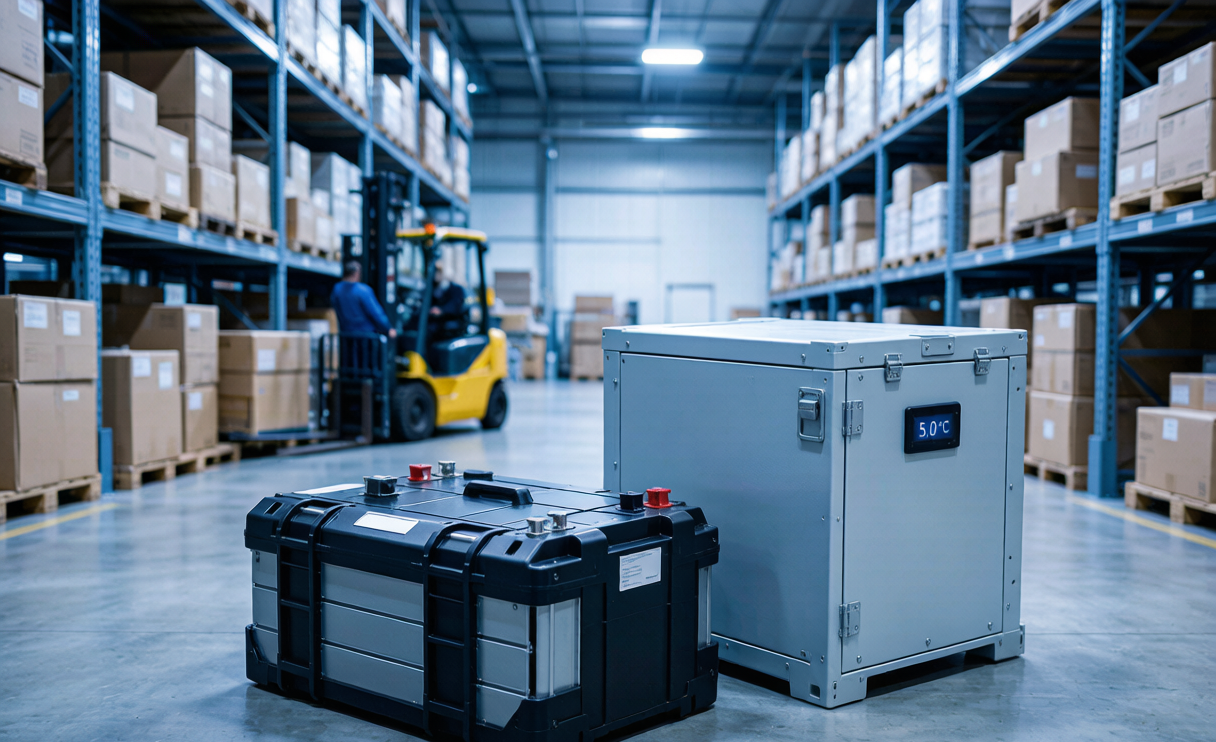
This article walks through how we engineer that guarantee: the low-temperature failure modes we design against, how a custom battery solution differs from an off-the-shelf pack, the thermal and state-of-charge strategy that keeps cargo inside spec, and the air-transport compliance that lets the whole thing actually board a plane.
Why Cold Chain Pharma Depends on a Dedicated Battery Solution
A passive cold chain box is only as good as the ice pack you charged it with. The moment you need active, sensor-controlled cooling — and most modern pharma logistics does — you are running a compressor, a fan, a controller, and often a small heater, all drawing from a finite energy budget. A generic power bank will not survive that duty cycle. The right battery solution is built around the load profile of the cooling system, not the other way around.
- Continuous draw, not pulses. A thermoelectric cooler pulls a steady few amps for hours. Cells must sustain that without voltage sag that trips the controller.
- Wide operating window. The pack may sit at -20°C in a cargo hold yet must deliver full current the instant the lid opens in a 35°C loading dock.
- Predictable end-of-discharge. In pharma, a brownout is a failure. The pack needs a clear, safe cutoff well before the cargo temperature drifts.
In my experience, the single biggest cause of cold chain excursions is not a bad battery chemistry — it is a battery selected for price instead of for the thermal profile of the actual route.
There is also a regulatory angle that non-specialists miss. A power system embedded in a qualified shipping container becomes part of a regulated medical device ecosystem. The battery’s behavior under fault conditions must be documented alongside the shipper’s qualification file, which is why we treat the electrical design and the thermal qualification as one integrated package rather than two separate purchases.
Core Engineering Challenges at Low Temperatures
Lithium cells hate the cold in two specific ways. First, internal resistance rises as electrolyte viscosity climbs, so available capacity drops. A cell that delivers 100% at 25°C may deliver only 70–80% at 0°C. Second, charging a lithium cell below 0°C without conditioning causes lithium plating, a permanent capacity loss and a genuine safety hazard. For pharma, where the pack is often recharged between legs of a journey, this matters.
That is why every pack we ship is validated against UN38.3 transportation testing and built to the construction and performance requirements of IEC 62133 for secondary lithium cells. Those standards are not paperwork — they are the checklist that forces us to prove the pack will not vent, short, or overheat under the shock, vibration, and thermal abuse it will meet in transit.
- Capacity retention curve. We characterize each cell family from -30°C to +60°C so the energy budget is real, not optimistic.
- Low-temp charge lockout. The BMS refuses to accept charge until cell temperature clears its threshold, then ramps current gently.
- Self-heating architecture. For ultra-low applications, we embed a controlled warm-up loop that draws a small amount of energy to keep the core above its safe floor.
Designing a Custom Battery Solution for Active Cooling
Off-the-shelf packs assume a generic load. A custom battery solution starts from the cooling system’s actual power signature. For a recent vaccine shipper program, the cooling load was 38 W average with 90 W peaks during pull-down. We matched that with a 14.4 V, 6.8 Ah lithium nickel-manganese-cobalt pack and a BMS tuned to the compressor’s inrush current, not a generic 10 A limit.
The custom route also lets us place the batteries where they help most: insulated from the cold chamber, wrapped in their own regulated micro-climate, and wired so a single cell fault isolates without killing the whole system. We model the thermal coupling between the pack and the cargo bay in finite-element software before a single prototype is built. The goal is simple — the battery should never be the reason the cargo left spec.
Thermal Management and State-of-Charge Strategy
Energy budgeting is where most programs win or lose. I tell clients to plan for the worst realistic leg plus a full day of contingency. If the measured active-cooling draw is 40 Wh per hour and the longest credible uninterrupted leg is 30 hours, the pack must deliver at least 1,200 Wh plus margin — we typically specify 1,500 Wh to cover door-open events, customs delays, and a diverted flight.
- State-of-charge floor. We set the controller to signal “recharge now” at 30% and hard-cut at 15%, never letting the cargo see the sag.
- Adaptive cooling. Smart firmware throttles the compressor when cargo is well inside band, banking energy for later legs.
- Dual-pack redundancy. For high-value biologics, two independent packs in passive failover add a second line of defense.
This is exactly the kind of engineered battery solution we build for regulated shippers, and it is the difference between a unit that “probably works” and one that passes an audit.
Compliance and Air Transport: FAA, EASA, and UN38.3
A cold chain pack is still a lithium battery, and airlines treat it that way. To move by air it must meet UN38.3, be packaged per the relevant IATA Dangerous Goods provisions, and carry the correct marking. In the United States, FAA guidance governs how lithium batteries are carried as cargo; in Europe, EASA sets the parallel rules for carriers operating under its authority. We prepare the test summaries, the State of Charge declaration (typically ≤30% for air transport of unsupported shipments), and the documentation that lets a ground handler clear the unit in minutes rather than hours.
For pharma, the extra wrinkle is that the battery is embedded in a qualified shipping system. We coordinate the battery test report with the shipper’s own qualification file so a regulator sees one coherent story, not two disconnected documents.
Real-World Deployment Lessons
The most useful lessons come from the field. On one亚太 distribution program, a客户的 active totes kept logging brief 9°C spikes at tropical transit hubs. The root cause was not the cells — it was the controller waking the compressor too late after a door-open event. We retuned the control loop, added a pre-cool reserve, and the excursions dropped to zero across the next 4,000 shipments. The takeaway: a custom battery solution is a system, and the software that talks to the cells is as important as the cells themselves.
Another lesson is about data. Every pack we ship now logs temperature and state-of-charge to a tamper-evident record. When a clinic questions a shipment, the battery’s own log closes the loop in seconds. That audit trail is increasingly a purchasing requirement, not a nice-to-have.
FAQ
What makes a battery solution suitable for cold chain pharma logistics?
It must be engineered around the cooling system’s real load profile, validated against UN38.3 and IEC 62133, rated for the full temperature range of the route, and paired with a BMS that manages low-temperature charge lockout and a safe state-of-charge cutoff. A generic consumer pack rarely meets any of those.
Can these battery packs be shipped by air with the pharmaceutical cargo?
Yes, when they are tested to UN38.3, packaged per IATA Dangerous Goods rules, and accompanied by the correct documentation. FAA and EASA rules govern air carriage in their regions, and we prepare the test summaries and State of Charge declarations so the unit clears handling quickly.
How do you keep a lithium battery working in sub-zero environments?
We characterize capacity at low temperature, add a low-temperature charge lockout to prevent lithium plating, and for ultra-low applications embed a controlled self-heating loop. The pack is insulated from the cold cargo chamber and kept in its own regulated micro-climate.
Why choose a custom battery solution over an off-the-shelf pack?
A custom pack is matched to the compressor’s inrush current, the route’s energy budget, and the shipper’s physical envelope. That matching eliminates the voltage sag, premature cutoffs, and thermal coupling problems that cause excursions in generic packs.
How much backup energy should a cold chain battery carry?
Plan for the longest credible uninterrupted leg plus a full day of contingency. For a 40 Wh/h load over 30 hours, specify roughly 1,500 Wh after accounting for door-open events and delays — never size to the ideal case.