Battery Solution for CCTV and Security Networks: An Engineer’s Field Guide to Reliable Backup Power
Over the last twelve years as a senior lithium battery engineer at Horizon Power, I have specified backup power for everything from single-store CCTV setups to city-wide surveillance grids. One thing never changes: a security network fails exactly when you need it most — during a grid outage, a storm, or a deliberate power cut. A properly engineered battery solution for CCTV and security networks is not a generic UPS bolted onto a cabinet. It is a deliberate system built around continuous load, cold-start surges, remote health telemetry, and the certifications that let you install it without a fight from the fire marshal.
Why Security Networks Need a Purpose-Built Battery Solution
A CCTV and security network is never truly idle. Even at 3 a.m., PoE cameras draw a steady trickle, the NVR keeps writing, and analytics processors keep scanning. Add infrared illuminators, heaters in cold climates, and PTZ motor surges, and you have a load profile that looks nothing like a laptop or a phone. A custom battery solution for surveillance has to absorb a continuous baseline plus sharp current spikes without voltage sag that reboots the recorder.
In my field experience, the biggest cause of “phantom” camera dropouts during outages is not capacity — it is a poorly matched battery that collapses under the PTZ’s inrush current. When we design a battery solution for a security network, we model the worst-case simultaneous event: all cameras switching to IR at dusk while the NVR runs a full backup. That spike, not the average draw, sets the discharge rating.
Chemistry Choice: Why Lithium Iron Phosphate (LFP) Wins for Surveillance
For stationary surveillance, lithium iron phosphate (LiFePO4) is the chemistry I recommend almost without exception. It runs at roughly 3.2 V per cell, stays thermally stable well past 60°C, and delivers 3,000–6,000 full cycles before it hits 80% state of health. A lead-acid bank you would have to replace every 2–3 years in a 24/7 duty cycle is simply more expensive over the life of the installation.
The safety case matters for security sites. LFP does not release oxygen the way nickel-cobalt cells do, which is why it passes abuse testing under IEC 62133-2 (portable packs) and IEC 62619 (industrial stationary packs) with far less drama. Every lithium battery cell we ship for security use is graded, formation-cycled, and traceable by batch. For a cabinet that may sit unattended for months, that consistency is what keeps the lights on.
Sizing the Battery: From Camera Count to Autonomy Hours
Sizing is arithmetic, not guesswork. Start with the real draw: a typical PoE camera pulls 4–15 W, an NVR another 20–40 W, and IR illuminators or cabin heaters can add 15–30 W during worst-case conditions. Multiply by your required autonomy, then divide by usable depth of discharge.
Here is a worked example I use in client briefs. A 16-camera site: 16 × 8 W = 128 W for cameras, plus 30 W for the NVR, plus 20 W for IR at night = roughly 178 W continuous. For 8 hours of autonomy at 90% depth of discharge, you need 178 W × 8 h = 1,424 Wh, divided by 0.9 = about 1,582 Wh. A 24 V 70 Ah lithium battery pack gives 1,680 Wh — comfortably above the target with margin for cable loss and aging. The BMS then enforces that 90% limit so you never strangle the cells.
Battery Management and Remote Health Monitoring
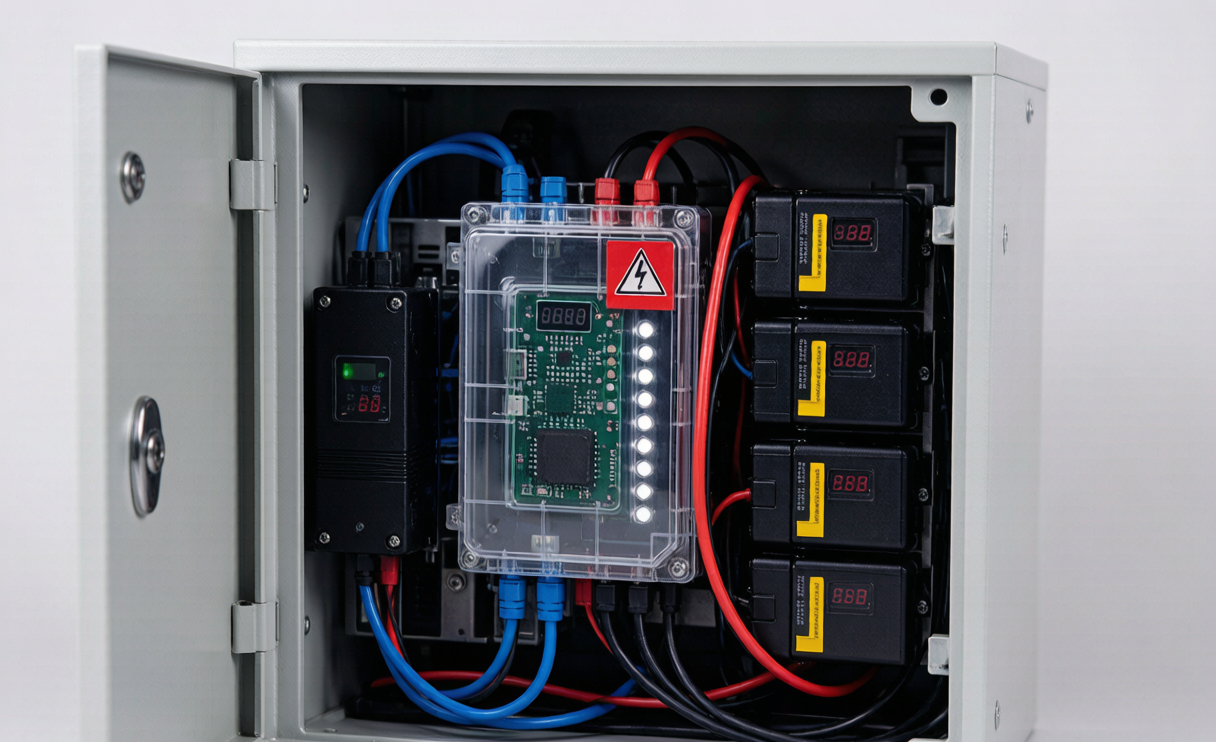
A surveillance battery you cannot see is a liability. The battery management system we build into every security pack handles cell balancing, over/under-voltage cut-off, temperature limiting, and short-circuit protection. More importantly for operators, it speaks the plant’s language: RS485/Modbus or CAN bus feeds state of charge (SoC) and state of health (SoH) straight into the video management system or network monitoring platform.
When a battery solution reports SoH dropping below 80% automatically, the maintenance team swaps the pack on a scheduled visit instead of discovering a dead site after the incident. That single telemetry link is what separates a real engineered system from a box of cells and hope.
Certifications and Compliance You Must Verify
Before any security battery goes on a wall, verify the paperwork. For transport and handling, UN38.3 covers the T.1–T.8 abuse series. For the cells themselves, IEC 62133-2 applies to portable packs and IEC 62619 to stationary industrial units. Stationary storage safety is governed by IEC 62477 and UL 9540; if the system includes an inverter, IEC 62109 and UL 1741 apply, and IEEE 1547 covers grid interconnection where relevant.
For the security system context, EN 50131 and IEC 60839 define the grades and requirements for intrusion and alarm systems — your power source should be specified to keep the graded equipment live through its declared fault period. We supply CE and FCC documentation as standard and can provide UL listings on request for North American tenders.
Installation, Thermal and Physical Considerations
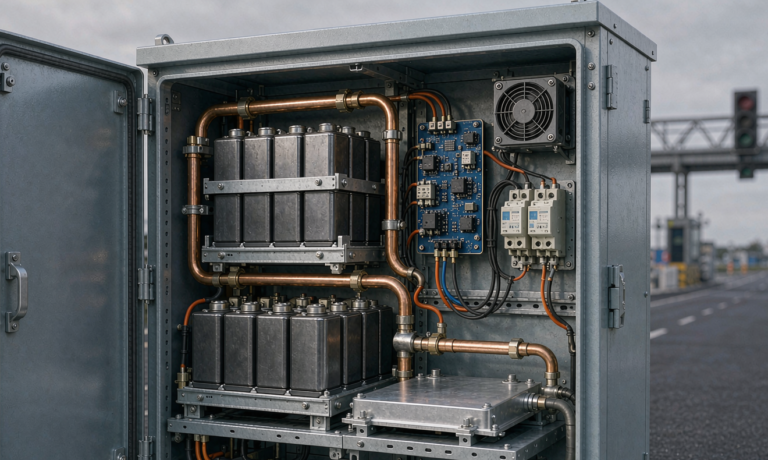
Most CCTV cabinets live outdoors or in unconditioned rooms. Specify an operating window of at least −20°C to 55°C, with self-regulating pad heaters for sub-zero sites so the lithium battery stays within charge temperature limits. Use an IP54+ enclosure, keep the pack off the cabin floor to avoid water ingress, and leave clearance for passive convection. Vibration from roadside poles is real — our custom battery solution builds use potted cells and damped mounts for exactly this reason.
FAQ
How long will a CCTV battery backup last during a power outage?
It depends on load and capacity, but the math is simple: total watts × hours ÷ usable Wh. A 1,680 Wh 24 V pack behind a 178 W load runs about 8–9 hours at 90% depth of discharge. Size for your worst realistic outage, not the average.
Can I use the same battery for both cameras and the NVR?
Yes, and you should. A single centralized lithium battery pack behind one BMS is cheaper, easier to monitor, and more reliable than separate supplies. Just make sure the pack’s continuous and peak current ratings cover the combined inrush of PTZ motors and IR arrays.
What certifications does a security battery need?
At minimum UN38.3 for transport, IEC 62133-2 or IEC 62619 for the cells, and IEC 62477 / UL 9540 for stationary safety. Add IEC 62109 / UL 1741 for any inverter, and reference EN 50131 / IEC 60839 for the security-system grade you must keep alive.
How do I monitor battery health remotely?
Specify a BMS with RS485/Modbus or CAN output and feed SoC/SoH into your VMS or NMS. A good battery solution pushes alerts on low SoC, cell imbalance, or temperature faults so the site is serviced before it fails.
At Horizon Power we treat every CCTV and security deployment as a critical-load application. If you are briefing a manufacturer, send us the camera count, autonomy target, and ambient range, and we will return a custom battery solution with the right chemistry, BMS, and certifications already lined up.